Search
A woman in a red, gold and green festival outfit dancing at an outdoor reggae concert at sunset, with stage lights and a crowd behind her

Reggae Festival Outfits for Women: All-Day Looks That Hold Up

A woman in a red, gold and green festival outfit dancing at an outdoor reggae concert at sunset, with stage lights and a crowd behind her

A reggae festival is a long day wearing a short outfit’s clothes. You arrive in the sun, you dance through the afternoon, the temperature drops after dark, it may rain, and the ground turns to mud under your feet — and the outfit that looked perfect in the mirror at home has to survive all of it. This guide is about building a festival outfit that holds up: a dress that breathes and moves, shoes that carry you across grass, layers that handle the evening chill, and a kit that fits in a small bag. The goal is simple. At midnight, when the last song ends, you should still feel like yourself — comfortable, dry enough, and ready to dance one more.

Start with the everyday version of the look. Our guide to Rasta Outfits for Women: Wearing Red, Gold and Green Well explains the colors and the proportions, and our guide to Rasta Colors explains what red, gold and green mean.

Key Takeaways

  • All-day means tested, not just pretty. An outfit that only works in a photograph is not a festival outfit. Test it walking, sitting, dancing, and carrying a bag.
  • Breathable fabric is the foundation. Cotton, rayon, and linen keep you cool in the sun and dry faster when the rain comes.
  • One layer handles the night. A light jacket or a denim layer, packed in the morning and worn after dark, is the difference between leaving early and staying for the last song.
  • Shoes decide the day. Flat, closed, broken-in shoes on grass beat new heels on every measure that matters.
  • The kit is small and fixed. Hat, sunscreen, water, a light jacket, and a small bag — packed the same way every time, so nothing is forgotten.
  • The colors still mean something. Red, gold and green are the colors of Ethiopia and the faith of Rastafari, and they belong at a reggae festival as much as anywhere.

Table of Contents

  1. The Problem: An Outfit That Quits by Noon
  2. What “All-Day” Actually Means
  3. The Foundation: Dress, Shoes, and Skin
  4. Layering: Day to Night Without a Second Outfit
  5. The Kit: What to Pack and How to Carry It
  6. Heat, Sun, and Rain: Dressing for the Weather
  7. Colors That Last: Red, Gold and Green in the Crowd
  8. Comfort Rules: The Small Choices That Save the Day
  9. Wear the Look: Three Dresses Built for the Whole Day
  10. Our View
  11. FAQ

The Problem: An Outfit That Quits by Noon

Every festival has the same casualties, and they are all wearing beautiful outfits that were never meant to last the day. The heels that were fine on the driveway and impossible on the grass. The white dress that met the mud by one o’clock. The strapless top that needed adjusting every three minutes. The jacket that was left in the car because it was warm at noon and missed by nine at night. None of these outfits were ugly. They were simply built for a photograph, not for a day — and a reggae festival is a day, twelve hours of sun and dancing and standing and walking, with weather that changes its mind and ground that changes under your feet.

The fix is to design for the day, not for the mirror. That means choosing the outfit by what it has to survive, in the order it has to survive it: the heat of the afternoon, the miles of walking, the evening chill, the rain that may or may not come, and the dancing that goes on through all of it. An outfit that holds up is not a boring outfit. It is a well-built one — a dress that breathes, shoes that carry you, a layer that waits in the bag, and colors that still mean something at midnight. This guide builds it, piece by piece, and it starts with the plainest question: what does all-day actually mean?

What “All-Day” Actually Means

All-day means three things, and they are not the same. It means duration: gates open in the late morning, the headliner plays after dark, and the walk back to the car takes an hour. It means activity: you will stand, walk, dance, sit on the grass, stand up again, and carry a bag through all of it. And it means weather: sun in the afternoon, a cool wind after sunset, and rain that arrives without asking. An outfit that only handles one of the three is an outfit that quits. The dress must breathe in the heat and still be warm enough with a layer at night. The shoes must grip the grass and survive the mud. The bag must hold the jacket, the water, and the sunscreen without weighing you down. Reggae itself is an all-day music — it grew, as UNESCO’s page on the reggae music of Jamaica records, out of the communities of Western Kingston and into festivals and concerts around the world — and the outfit should be built for the same long haul the music is.

Test the outfit the way the day will test it. Walk in it for twenty minutes, on grass if you can. Sit on the ground in it and stand up again. Dance in it for one song, in the shoes you will wear. Carry the bag you will carry, with the jacket and the water inside it. If anything pulls, slips, rubs, or needs holding up, fix it now — at home, with a mirror and a needle — because at the festival there will be no mirror, no needle, and no patience left. The best festival outfits are the ones that disappear: you stop thinking about them by the second song, and you do not think about them again until you are changing out of them at midnight, glad they held up.

The Foundation: Dress, Shoes, and Skin

Start with the dress, because everything else hangs off it. A lightweight dress in a breathable fabric — cotton, rayon, or a cotton blend — is the foundation of an all-day festival look. A skater dress in the green, gold and red stripes moves when you dance and dries quickly when it rains. A bodycon dress in a festival print holds its shape through the day. A mini dress in tie-dye is the coolest choice for the hottest afternoon, as long as it is long enough to sit on the grass in. Whichever you choose, the tests are the same: can you walk in it, sit in it, dance in it, and carry a bag in it without thinking about it? If the answer is yes to all four, the dress is the right one.

A woman in a lightweight red, gold and green festival dress and comfortable sandals standing on grass with a water bottle and a small crossbody bag
The foundation, worn the way the day will wear it: a light dress, sandals that grip the grass, water in hand, and a small bag across the body.

Shoes come next, and they matter more than the dress. On grass, heels sink; on mud, they stick; on a long walk, they punish. The right festival shoe is flat, closed or strapped, broken in before the day, and grippy enough for wet grass. Sandals with a proper sole work when the ground is dry. Trainers in a plain color work when it is not. Closed shoes protect your toes in the crowd, which is a kindness you will appreciate by the third hour. Whatever you choose, wear them in for a week first — a new shoe at a festival is a blister with a schedule. And your skin comes third: sunscreen on every exposed part before you leave, reapplied at midday, and a hat or a tam for the hours when the sun is straight overhead. Sunburn is the festival injury that lasts longest, and it is the easiest to prevent.

Layering: Day to Night Without a Second Outfit

The temperature at a festival can drop ten degrees between the afternoon and the headliner, and the outfit that was perfect at three in the afternoon can leave you shivering by nine. The answer is not a second outfit. It is one layer, chosen in the morning and carried all day. A light denim jacket is the classic: it goes over any dress, it takes the edge off the evening wind, and it looks right with the colors. A thin cardigan in gold or green does the same work more softly. A light rain jacket, if the forecast threatens, does it while keeping you dry. The layer should be light enough to tie around your waist or fold into the bag when the sun is high, and warm enough to matter when the sun is gone.
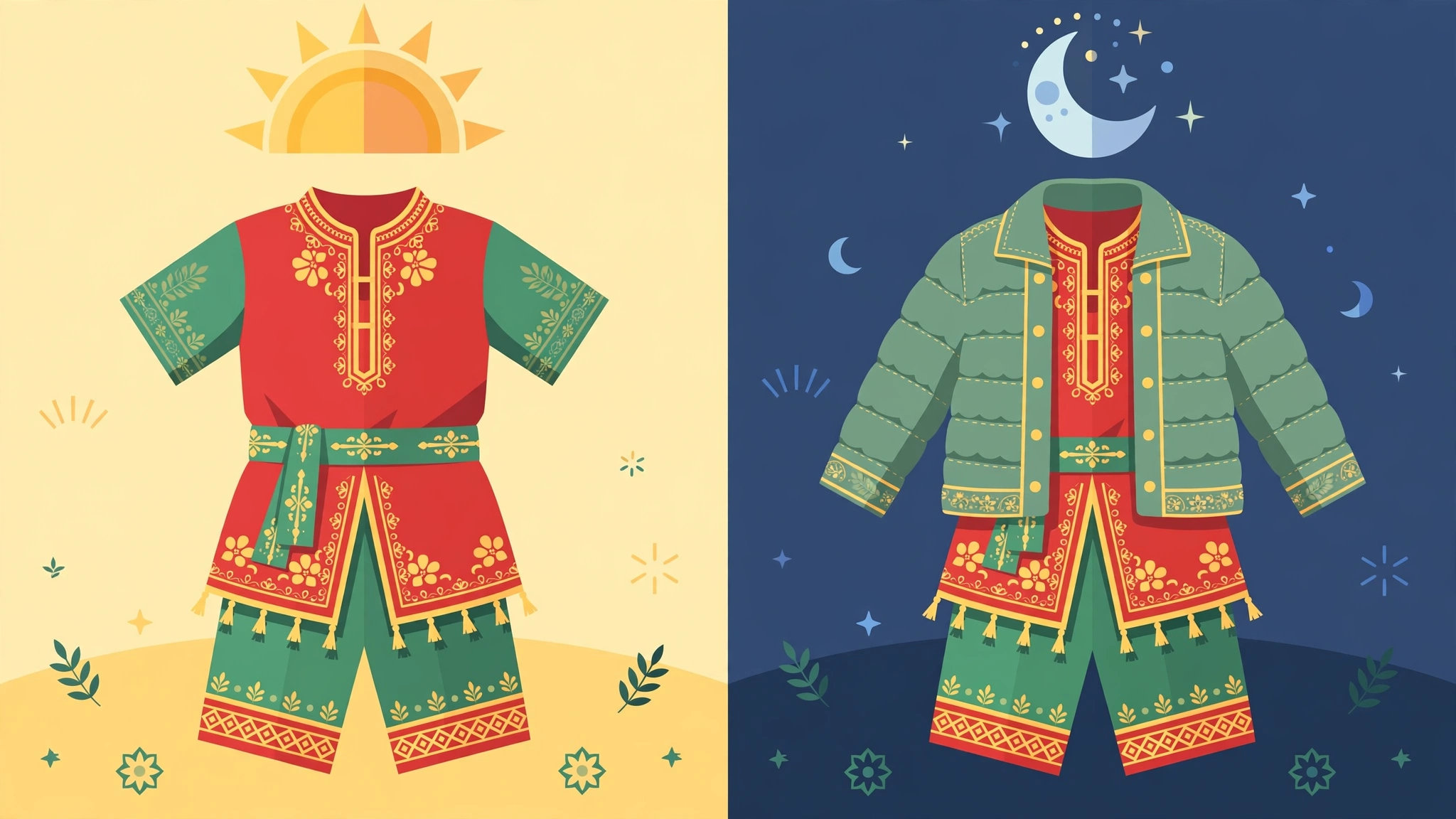
Two panels showing day-to-night festival layering: a dress under the sun, and the same dress with a green jacket under the moon
Day to night with one layer: the same dress under the sun, and the same dress with a jacket under the moon.

Layer in the right order. The dress is the base. The layer goes over it, never under it — a jacket under a dress bunches and pulls, while a jacket over a dress drapes and protects. The tam can stay on all day; it keeps the sun off at noon and the warmth in at night. And when the layer comes off in the heat, it should go somewhere it will not be lost: tied at the waist, folded into the bag, or worn over the shoulders. A jacket left on a fence is a jacket that belongs to someone else by morning. The rule for layering is the rule for the whole day: one layer, chosen in advance, carried with you, and worn when the air changes — not a wardrobe, but a plan.

The Kit: What to Pack and How to Carry It

Everything you need for a festival day fits in a small bag, and it fits the same way every time. The kit is fixed: a hat or tam for the sun, sunscreen, a water bottle, a light jacket, and a small crossbody bag to hold them all. Add a phone, a little cash, and a snack if you like — but the core five never change, and packing them the same way every time means nothing is forgotten. Lay the kit out on a blanket the night before, the way you would lay out the outfit, and check it against the list. The morning of the festival is the worst time to discover that the sunscreen is empty or the jacket is still in the wash.


Festival essentials laid out on a blanket: a straw hat, a plain sunscreen bottle, a blue water bottle, and a folded light jacket
The kit, laid out the night before: hat, sunscreen, water, and a light jacket — the four things that decide whether the day is comfortable.
A flat illustration of a red backpack with a hat, a water bottle, sunglasses, sandals, and a folded jacket arranged around it
One small backpack, everything around it: hat, bottle, sunglasses, sandals, and the jacket — packed the same way every time.

Carry the kit across your body, not in your hands. A small crossbody bag or a compact backpack keeps your hands free for dancing, for holding a drink, and for holding the people you came with. It also keeps the bag where you can feel it, which matters in a crowd. Pack the heaviest thing — the water — at the bottom and closest to your back, the jacket rolled on top, and the sunscreen and phone where you can reach them without unpacking. And leave room: the day will add things — a flyer, a friend’s jacket, a souvenir — and a bag that is full at noon is a bag that bursts by nine. Our guide to what to pack for a 420 festival covers the same kit in more detail, and our guide to the best music festivals in the US will help you choose the next day worth packing for.

Heat, Sun, and Rain: Dressing for the Weather

Festival weather is a rumor until it happens, so dress for all three forecasts at once. For heat, choose light colors and loose cuts: a light dress in a pale color reflects the sun, while a dark, tight dress absorbs it. Cotton and rayon breathe; synthetics trap sweat against the skin. For sun, the tam or hat is not optional, and neither is the sunscreen — apply it before you leave, reapply at midday, and do not forget the ears, the back of the neck, and the tops of the feet. For rain, a light jacket with a hood beats an umbrella in a crowd, and a dress that dries quickly beats a dress that holds water. If the ground turns to mud, closed shoes and a steady step beat clean shoes and a hurry.

Drink water before you feel thirsty, and keep drinking through the day. Dancing in the sun is exercise, and the body does not send a polite invitation before it runs dry. Eat something real at midday — not only snacks — and keep a little food in the bag for the evening, when the queues are long and the headliner is about to start. And know the signs that the day is asking too much: dizziness, a headache that will not quit, and skin that has stopped sweating in the heat. If any of those appear, find shade, drink water, and rest. The music will still be there in an hour. The day is long, and the outfit that holds up is the one worn by a person who is still standing at the end of it.

Colors That Last: Red, Gold and Green in the Crowd

At a reggae festival, the colors are not a costume — they are the crowd. Red, gold and green have been the colors of the movement since the flag of Ethiopia gave them to it, and they belong at the festival as much as anywhere. Our guide to Rasta Colors explains what each one stands for — red for the blood of the martyrs, gold for the wealth of the land, green for the life that grows on it — and our guide to Rasta Outfits for Women: Wearing Red, Gold and Green Well explains how to wear them in proportion: one color leading, one supporting, one as the accent. The festival is where that proportion proves itself, because the crowd is the test: an outfit that is all three colors at full strength, with nothing neutral to rest the eye, disappears into the noise. An outfit with one color leading and the others answering stands out — and it still reads as Rasta from the back of the field.

The colors also do practical work at a festival. They make you findable: in a crowd of thousands, a friend in a green and gold striped dress is a landmark. They photograph well in golden hour, when the low sun warms the red and the gold and turns the green deep. And they connect you to the music: reggae’s colors are the movement’s colors, and wearing them at a reggae festival is wearing the uniform of the occasion — not a uniform imposed on you, but one you chose. The history behind the colors runs deep: New World Encyclopedia’s Rastafari overview traces the faith and its symbols, and EBSCO’s Rastafari movement overview describes the beliefs that give them weight. Wear them with that knowledge, and they will never look like a trend.

Comfort Rules: The Small Choices That Save the Day

The difference between a good festival day and a miserable one is rarely the headline act. It is the small choices. Break the shoes in for a week — a new shoe at a festival is a blister with a schedule. Wear the outfit once at home, for a whole day, and fix whatever pulls or slips before the festival fixes it for you. Pack the bag the night before, and put the sunscreen where you can reach it without unpacking. Eat a real breakfast, because dancing on an empty stomach is a short road to a headache. Bring a little cash as well as a card, because the signal dies exactly when you need it. And make a meeting point with your friends before you go in — in a crowd with no signal, a meeting point is worth more than a phone.

Look after each other, too. If a friend is flagging, find shade and water together. If a stranger is struggling in the heat, offer the water before you offer the advice. A festival is a community for a day, and the same spirit that built the music — the voice of the marginalized, as UNESCO’s reggae listing puts it — is the spirit that looks after the people in the crowd. And when the day is done, change out of the outfit before the drive home: clean clothes, dry shoes, and a long drink of water. The outfit did its job. Let it rest, wash it cold and inside out, and it will be ready for the next festival — and so will you.

Wear the Look: Three Dresses Built for the Whole Day

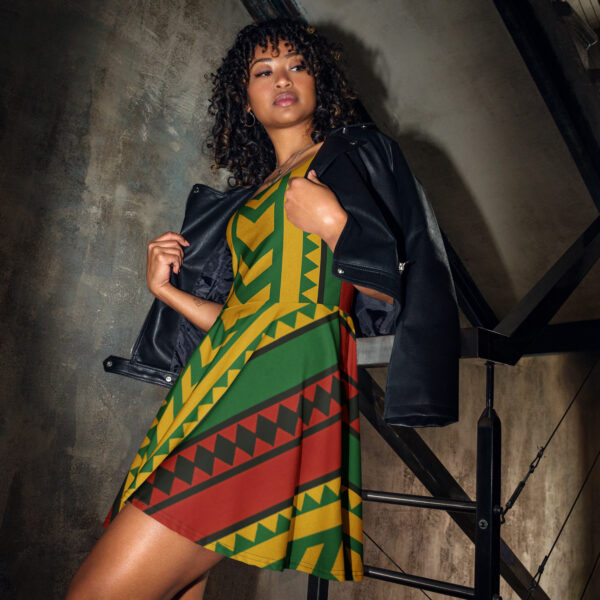
The three dresses below are the ones this guide is built around: a skater dress in green, gold and red stripes that moves the way a festival needs it to, a festival dress in the full red, gold and green leaf print, and a tie-dye mini for the hottest part of the afternoon. All three are from our own Fifth Degree™ shop, all three are breathable, and all three are priced for a day out — not for a photograph.
Our View

We make festival clothes for people who actually go to festivals — who dance in the sun, stand in the rain, and stay for the last song. That is why our dresses are cut to move, our fabrics are chosen to breathe, and our prices are set for a day out rather than a photograph. The best festival outfit is the one you forget you are wearing until someone asks where it came from. Build it for the whole day, wear the colors with the meaning first, and let the music do the rest.

FAQ

What should a woman wear to a reggae festival?

A lightweight, breathable dress in red, gold and green — a skater dress, a festival dress, or a mini dress — with flat, broken-in shoes, a tam or hat, and a light jacket for the evening. Add sunscreen, water, and a small crossbody bag. Our guide to what to wear to a reggae festival covers the same ground for the whole crowd.

What shoes are best for a reggae festival?

Flat, closed or strapped shoes with grip, broken in for a week before the day. Sandals with a proper sole work when the ground is dry; trainers work when it is wet. Heels sink into grass and stick in mud, and new shoes are a blister with a schedule.

What should I pack for an all-day festival?

The fixed kit: a hat or tam, sunscreen, a water bottle, a light jacket, and a small crossbody bag — plus your phone, a little cash, and a snack. Pack it the same way every time, the night before, so nothing is forgotten. Our guide to what to pack for a 420 festival covers the kit in more detail.

How do I stay cool at an outdoor festival?

Choose light colors and loose, breathable fabrics; wear a hat or tam; drink water before you feel thirsty; and rest in the shade when the sun is highest. Cotton and rayon breathe, synthetics trap heat. A light dress that moves air around you is worth more than any amount of shade.

What if it rains at the festival?

A light jacket with a hood beats an umbrella in a crowd, and a dress that dries quickly beats one that holds water. Closed shoes keep your feet safe in the mud, and a steady step beats a hurry. Keep the phone and cash in a sealed pocket or a small dry bag inside your crossbody.

Can I wear red, gold and green to any reggae festival?

Yes — the colors are the movement’s colors, and a reggae festival is where they belong. Wear them in proportion, with one color leading, and with the meaning behind them. Our guide to Rasta Colors explains what each color stands for.

Questions about what we make or why we make it?

We are a small shop with a big respect for the culture we serve. If you want help choosing a piece, or you want to talk about the meaning behind it, contact us and a real person will answer.

Sources

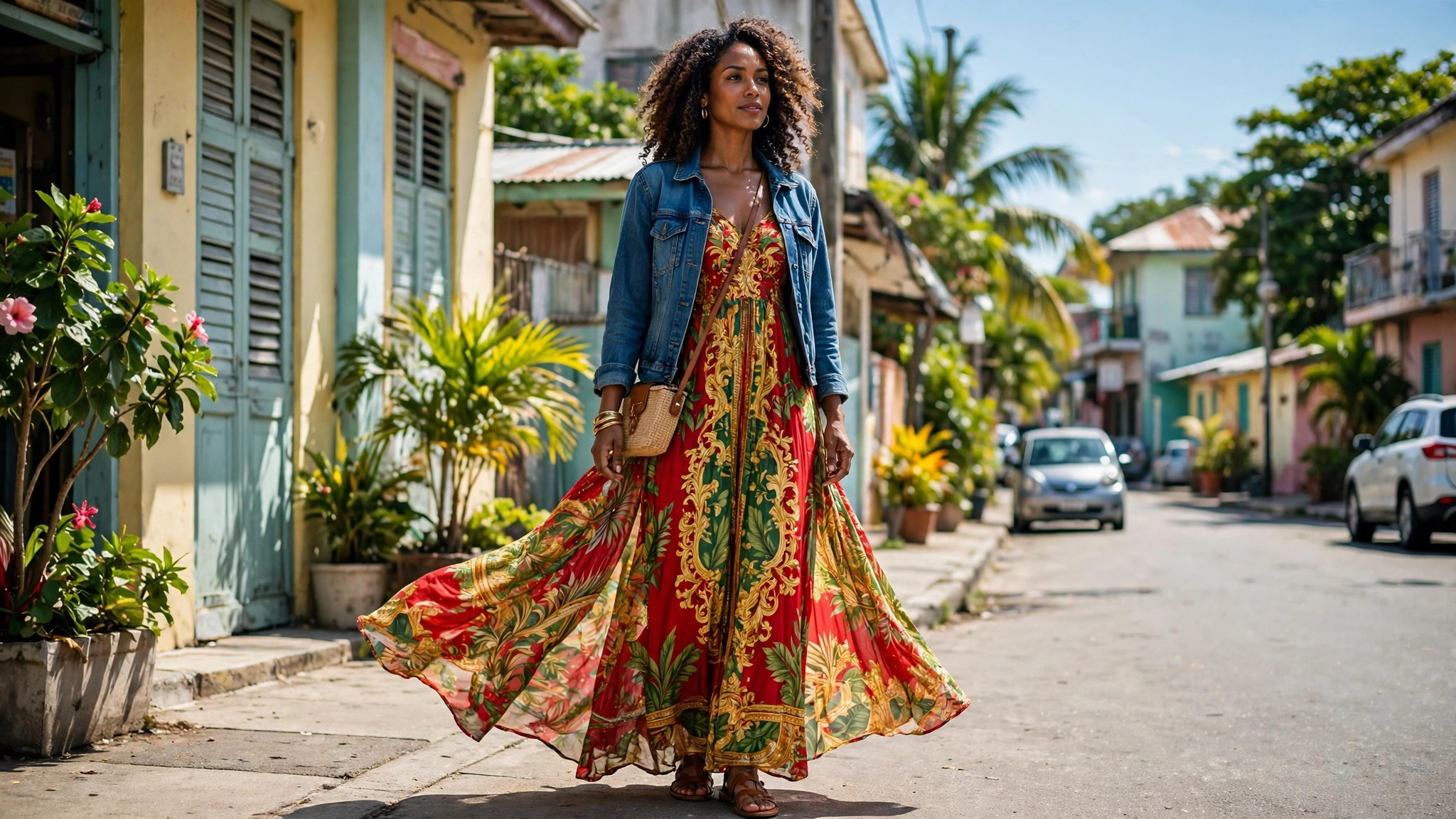
A woman in a flowing red, gold and green maxi dress with a denim jacket standing on a sunny Caribbean street

Rasta Outfits for Women: Wearing Red, Gold and Green Well

A woman in a flowing red, gold and green maxi dress with a denim jacket standing on a sunny Caribbean street

Red, gold and green are easy to love and surprisingly easy to get wrong. Worn with a plan, they look royal: the colors of Ethiopia, the colors of the Lion of Judah, the colors of a movement that has dressed with meaning for nearly a century. Worn without one, they can look like a costume, a flag wrapped around a body, or three loud colors arguing with each other. This guide is the plan. It explains what the colors mean, how much of each one to wear, which pieces do the work, and how to put together outfits that are comfortable, modest where they need to be, and unmistakably Rasta — for work, for worship, for the market, and for the evening.

Start with the meaning, then choose the clothes. Our guide to Rasta Colors explains the red, gold and green in full, and our guide to Dreadlocks in Rastafari: The Meaning and the Vow Behind Them explains the locks so many of these outfits are worn with.

Key Takeaways

  • One color leads, the others support. Let a single color dominate each outfit — usually green or red — and let gold act as the accent that warms it up.
  • The colors mean something. Red, gold and green carry the history of Ethiopia and the faith of Rastafari; wearing them well starts with knowing what they stand for.
  • Five pieces do the work. A dress, a skirt, a tee, leggings, and a tam can make a week’s worth of outfits without a single new idea.
  • Fit beats flash. Clothes that fit your body and your day will always look better than a louder outfit that fights you by noon.
  • Details finish the look. A striped tam, a beaded bracelet, and a plain canvas tote do more than any extra print.
  • Comfort is not optional. Breathable fabric, shoes you can walk in, and layers you can add or shed are what make an outfit wearable from morning to night.

Table of Contents

  1. The Problem: Colors With No Plan
  2. What Red, Gold and Green Actually Mean
  3. The Capsule: Five Pieces That Do the Work
  4. Proportions: How Much of Each Color
  5. Dressing for the Day: Work, Church, Market, Evening
  6. Fit and Fabric: Comfort That Lasts All Day
  7. The Details: Tam, Jewelry, Bag, Shoes
  8. What Not to Do: The Mistakes That Cheapen the Look
  9. Wear the Colors: Two Dresses That Do It Right
  10. Our View
  11. FAQ

The Problem: Colors With No Plan

Most outfits that fail in red, gold and green fail the same way. All three colors arrive at full strength, at the same time, in the same size, and the eye does not know where to rest. A red dress, a gold bag, a green tam, green shoes, and a red lip: each piece is fine on its own, and together they shout. The other common failure is the opposite — a timid outfit in which the colors appear only as a thin stripe on a black dress, so faint that the meaning disappears. Both mistakes come from the same place: treating the colors as decoration instead of as a language. The colors are not sprinkles. They are a sentence, and like any sentence they need a subject, a verb, and a full stop.

The fix is not to buy more clothes. It is to decide, before you dress, which color is leading today and what the outfit is for. A market morning needs different clothes from a church service, and a workday needs different clothes from an evening with friends. The women who wear these colors best are not the ones with the biggest wardrobes. They are the ones with a small set of pieces that fit, in fabrics that breathe, arranged so that one color speaks and the others answer. This guide gives you that arrangement — five pieces, a simple proportion, and a set of rules for the day that will carry you from the first coffee to the last song.

What Red, Gold and Green Actually Mean

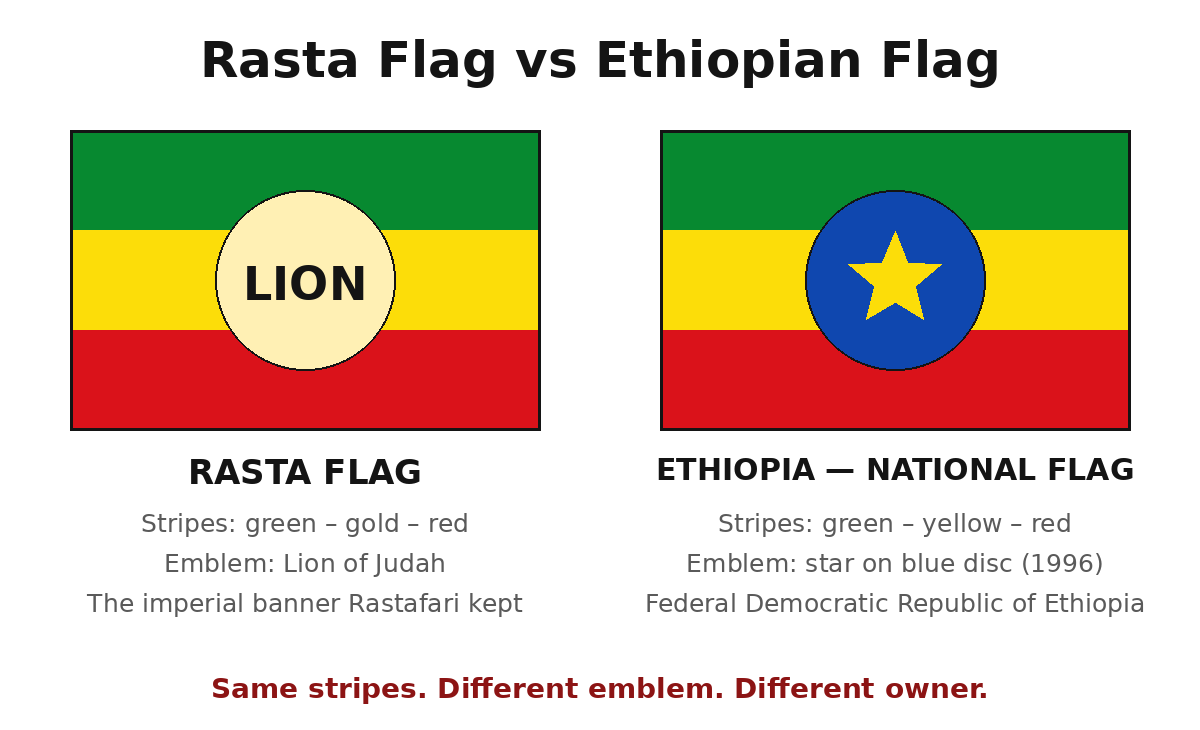
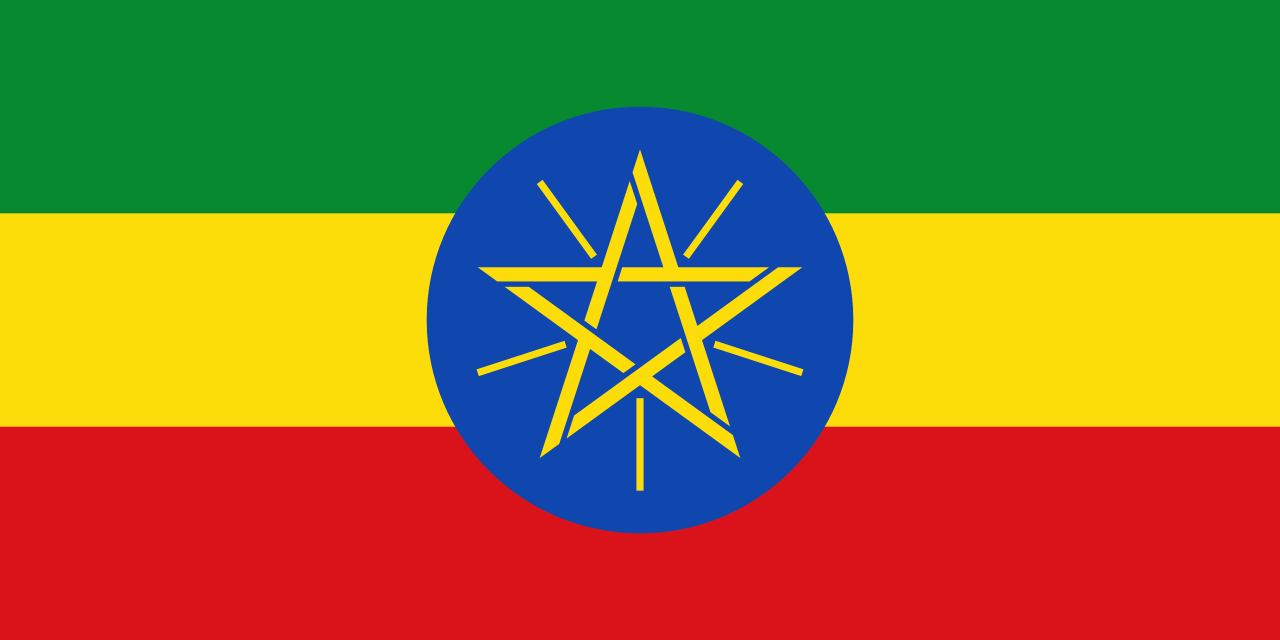
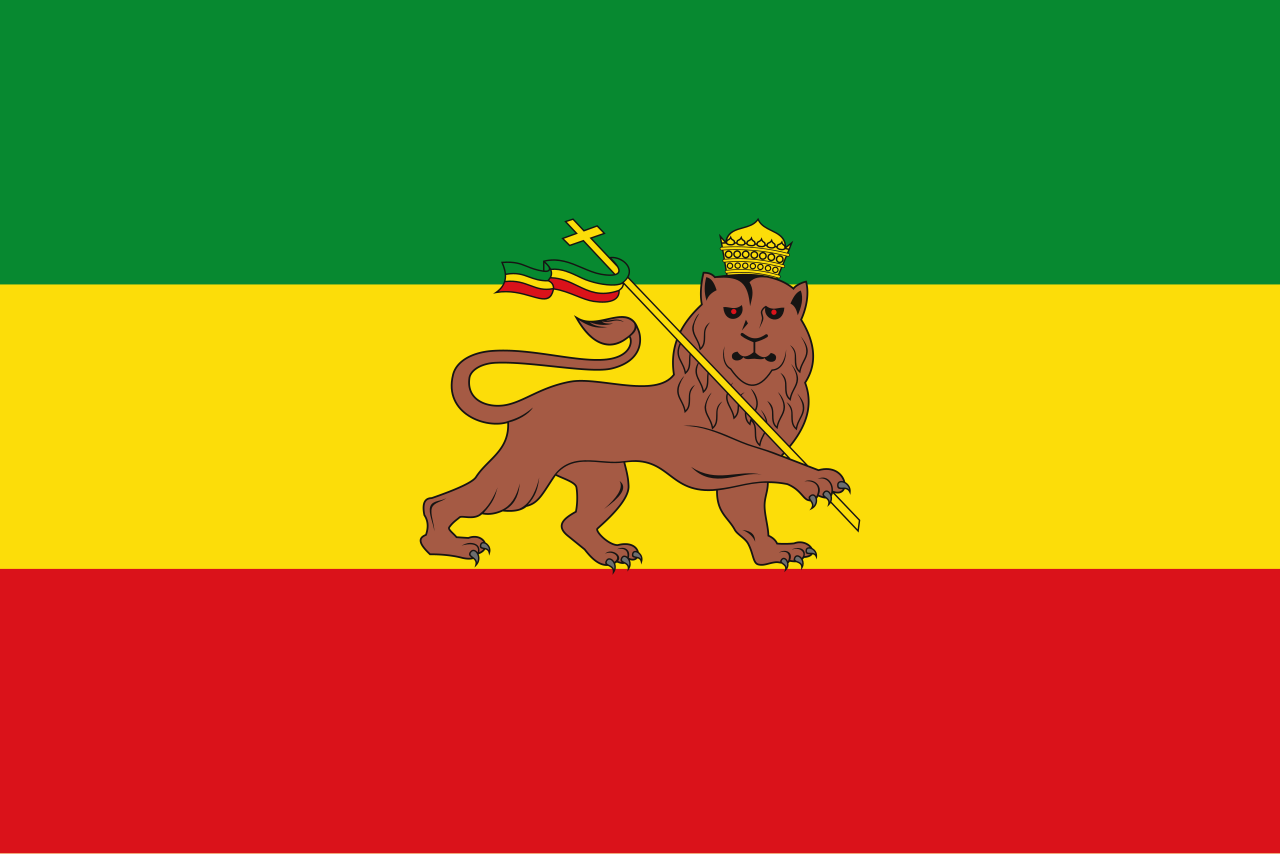
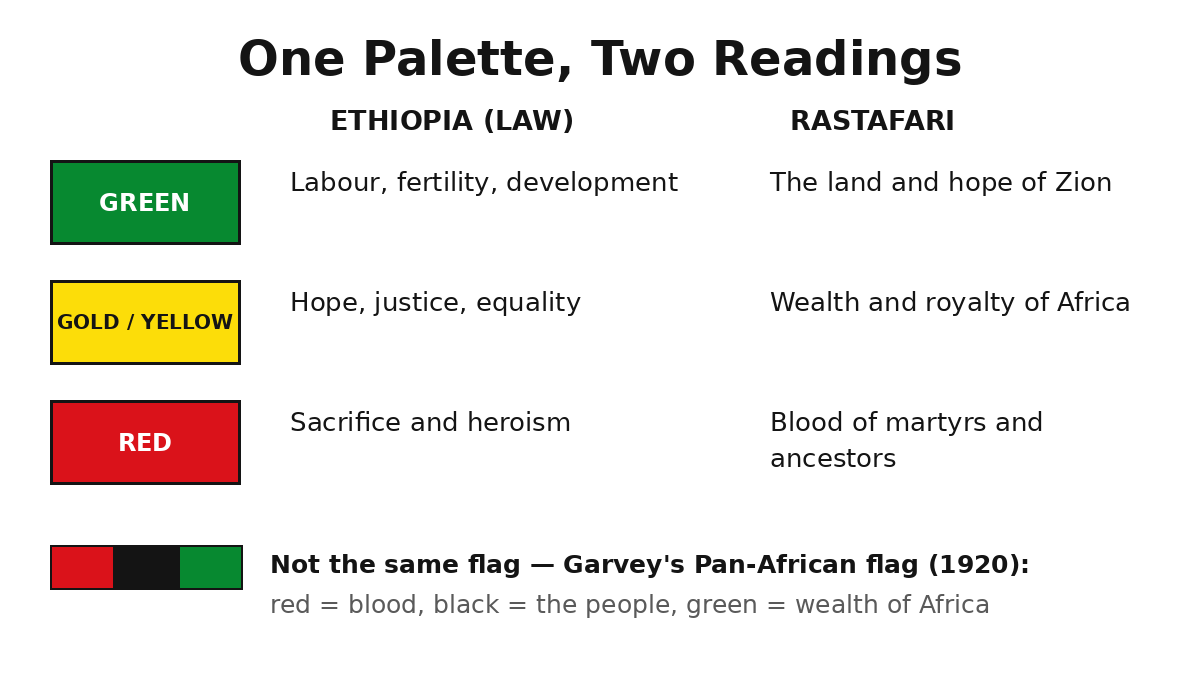
The colors come from the flag of Ethiopia, and they carry the history of the land Rastafari call Zion. Red stands for the blood of the martyrs and the struggle of the people. Gold stands for the wealth of the land and the richness of African heritage. Green stands for the land itself and the life that grows on it. Together they are a statement about who you are and where you come from — which is why they deserve more care than a random print. Our guide to Rasta Colors tells the full story of the colors, their order, and the difference between the Rasta colors and the Ethiopian flag, and our guide to Rasta Flag Colors vs Ethiopian Flag Colors: The Real Difference sorts out the confusion between the two.

The colors also carry the movement. New World Encyclopedia’s Rastafari overview explains how the faith, the history, and the symbols of Rastafari grew together, and EBSCO’s Rastafari movement overview describes the beliefs and practices that give the colors their weight. When you wear them, you are not only choosing a palette. You are joining a story that runs from the coronation of Haile Selassie I in 1930 — the event our guide to Coronation Day in Rastafari explains — through the music that carried the movement around the world. UNESCO’s page on the reggae music of Jamaica records how reggae, inscribed on the Representative List of the Intangible Cultural Heritage of Humanity in 2018, grew out of the same marginalized Kingston communities that gave the movement its voice. The colors, the King, and the music are one story, and your outfit is a sentence in it.

The Capsule: Five Pieces That Do the Work

A capsule is a small set of pieces that all work with each other, and for red, gold and green, five pieces are enough. Start with a dress in a solid color or a simple stripe — a maxi for cooler days, a skater dress for warmer ones. Add a skirt in a second color, cut to move: a pleated skirt in gold or a flowing skirt in green. Add a tee in the third color, plain and well-fitted, the piece that turns a skirt into an outfit and a dress into a layered look. Add leggings in black or in a deep green, the piece that makes every dress warmer, more modest, and more comfortable. And add a tam in the striped colors, the piece that ties the whole outfit together and covers the locks with pride. Five pieces, three colors, and a week of outfits without a single new idea — because the ideas are already in the pieces.

A flat lay of a capsule wardrobe: a red dress, a gold pleated skirt, a green tee, red leggings, and a green and gold knit tam
Five pieces, three colors: a dress, a skirt, a tee, leggings, and a tam — enough for a week of outfits.

Build the capsule in solid colors first. Prints are lovely, but a print commits you: a striped dress is already a whole statement, and it will fight with a striped tam. Solids, by contrast, are team players — a green dress takes a gold skirt, a red tee takes green leggings, and the tam can be the one striped piece in the outfit. Buy the best fabric you can afford in the pieces you will wear most: the dress and the leggings earn their money every week, while a cheap tee will lose its shape by the third wash. And buy for your real life, not your imagined one. If you walk to work, you need shoes and a hem that survive the walk. If you sit all day, you need a waist that does not dig in by noon. The capsule is not a fantasy. It is a toolkit, and it should fit the hands that use it.

Proportions: How Much of Each Color

The simplest rule for three strong colors is the one designers have used for a century: most of one, some of another, and a little of the third. In practice that means about sixty percent of your outfit in the leading color, about thirty percent in the supporting color, and about ten percent in the accent. A green dress with a gold skirt peeking beneath it and a red tam is sixty-thirty-ten. A red top with green leggings and a gold bracelet is sixty-thirty-ten. The numbers are not a law, they are a habit — and the habit keeps any one color from shouting over the other two. Gold is the natural accent: it is warm, it is bright, and a little of it goes a long way. Red is the natural leader: it holds attention, so it should hold the biggest piece. Green is the natural supporter: it is calm, it grounds the outfit, and it lets the other two shine.

Three horizontal color blocks in red, gold and green showing the proportion of each color to wear in an outfit
Most of one color, some of a second, and a little of the third — the proportion that keeps three strong colors from arguing.

Neutrals are your friends, not your enemies. Black leggings under a red dress do not dilute the meaning — they give the red somewhere to rest. A denim jacket over a green and gold dress does not hide the colors — it frames them, the way a frame holds a picture. White, cream, and brown work the same way: they are the quiet ground against which the three colors can speak. The mistake is to think every piece must be red, gold or green. An outfit that is entirely in the three colors is a flag, and a flag is not an outfit. Let the neutrals do the quiet work, and let the colors do the talking.

Dressing for the Day: Work, Church, Market, Evening

One outfit cannot do every job, but one capsule can. For work, lead with the calmest color: a green dress or a green skirt with a plain tee, leggings underneath, closed shoes, and the tam tied back neatly. The colors are present, the outfit is professional, and nothing about it fights the room. For church or gathering, lead with red: a red dress or a red top with a gold skirt, the tam worn with pride, and jewelry that catches the light. Red is the color of the blood and the struggle, and a gathering is where that meaning belongs. For the market, lead with comfort: a skater dress in the stripes, sandals you can walk in, a canvas tote for the shopping, and a hat or tam against the sun. The market is where the outfit is tested — by heat, by walking, by carrying — and the right outfit passes the test without a thought.

A woman in a green and gold striped skater dress standing at a colorful outdoor market stall
Market morning in a striped skater dress: comfortable, easy to move in, and unmistakably Rasta.

For the evening, add one layer and one light. A denim jacket over the day’s dress, or a light cardigan in gold over a green top, changes the outfit without changing it. Swap the sandals for a closed shoe, add a beaded bracelet, and let the tam sit a little higher. The evening outfit is the day outfit with the volume turned up one notch — not a new outfit, but the same outfit dressed for the dark. That is the whole secret of dressing for the day: you are not changing clothes four times. You are changing one or two pieces, and the capsule does the rest. Our guide to Rasta outfits for reggae lovers and our guide to reggae themed outfits for women show the same idea at a concert and a festival, where the day runs even longer and the layers matter even more.

Fit and Fabric: Comfort That Lasts All Day

An outfit that looks right at 8 in the morning and wrong by noon was never right. Fit is the difference. A dress should skim, not cling; a waist should sit where your waist is, not where the pattern thinks it is; a hem should move when you walk and settle when you stop. Try the sitting test before you buy: sit down in the dress, and if it rides up, pulls, or gaps, it is the wrong size or the wrong cut — no matter how beautiful it is on the hanger. Try the walking test too: walk the length of the shop, and if you are tugging at anything by the third step, you will be tugging at it all day. Clothes should be worn, not managed.

Fabric is the other half of comfort. In warm weather, cotton, rayon, and linen breathe; polyester traps heat and shows sweat. A dress with a little stretch moves with you and keeps its shape; a dress with no give at all will fight you at every step. For leggings, look for a thick, opaque fabric that does not go see-through when you bend — hold them up to the light before you buy. For tams, a soft knit that holds its shape without squeezing is worth more than a stiff one that looks perfect and feels like a band. And for the heat, remember the oldest rule of dressing in the tropics: loose beats tight, light beats dark on the skin, and a layer you can remove beats a layer you cannot. Our guide to how to style Rasta clothing goes deeper into fit and fabric, and our guide to traditional Rasta outfits that still look fly today shows how the older styles solved the same problems with the same fabrics.

The Details: Tam, Jewelry, Bag, Shoes

Details are where an outfit becomes yours. The tam comes first: a knitted crown in the striped colors that covers the locks, keeps the sun off, and carries the palette up to the top of the outfit. Wear it pulled down over the hair for work and errands, or pushed back for the evening — either way, it should fit without squeezing, and it should be the one striped piece if the dress is already striped. Jewelry comes second, and less is more: a beaded bracelet in red, gold and green, a simple wooden bead, or a thin gold chain. The colors are already loud; the jewelry should be the quiet note that lets them sing. A bag comes third: a plain canvas tote in natural cotton carries the shopping, the book, and the water bottle, and it does not compete with the outfit the way a printed or glittering bag would. And shoes come last, because they decide whether the day is a pleasure or a punishment.

A close-up of outfit details: a red gold and green striped knit tam, beaded bracelets, and a blank canvas tote
The details that finish the look: a striped tam, beaded bracelets, and a plain canvas tote that lets the colors speak.

For shoes, choose for the day you actually have. Sandals with a proper sole carry you through a market morning. Closed shoes with a low heel carry you through a workday. Trainers in a plain color carry you through a long day on your feet, and no one will fault you for them — comfort is part of the look, not a betrayal of it. What to avoid: heels so high you cannot walk the distance, shoes so new they have not been broken in, and anything that makes you think about your feet instead of your day. The best shoe is the one you forget you are wearing. Our guide to Rastafarian clothing styles with meaning shows how the same details — tam, beads, and bag — have been worn for decades, and our guide to what to wear to a reggae festival shows how they hold up when the day runs long and the ground is grass.

What Not to Do: The Mistakes That Cheapen the Look

Five mistakes cheapen a red, gold and green outfit faster than anything else. The first is the flag outfit: every piece in the three colors at full strength, with nothing neutral to rest the eye. The second is the costume: a Halloween version of Rasta dress — a fake beard, a plastic crown, a wig of locks — worn for a laugh. The colors deserve better, and so do the people who live them. The third is the clash: a busy print on top of a busy print, stripes fighting checks, so that the outfit looks like an argument. The fourth is the wrong size: a dress that pulls, a tam that squeezes, leggings that go see-through when you bend. And the fifth is the neglected finish: wrinkled fabric, scuffed shoes, and a bag that has seen better days. None of these is about money. All of them are about attention. Iron the dress. Polish the shoes. Choose one print. Let a neutral in. And never wear the colors as a joke — they are a promise, and promises are not punchlines.

The deeper mistake is to wear the colors without knowing them. The palette is not a trend that arrived with a festival season; it is the flag of Ethiopia and the emblem of a faith, and the people who wear it have paid for it with their comfort and sometimes with their freedom. Wearing the colors well means wearing them with that knowledge. Read the meaning — our guides to Rasta Colors and to the meaning behind the Lion of Judah are the place to start — and let the knowledge show in the care you take with the outfit. The women who wear these colors best are not the loudest in the room. They are the ones whose clothes fit, whose colors rest in proportion, and whose meaning is clear before they say a word.

Wear the Colors: Two Dresses That Do It Right

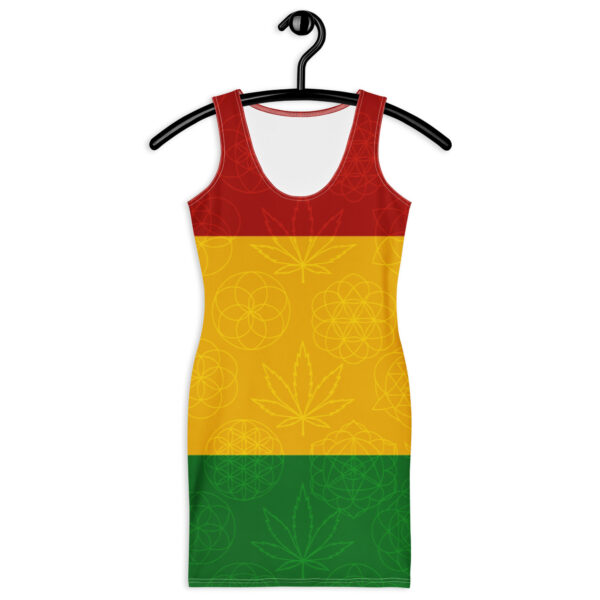
The two dresses below are the ones this guide keeps coming back to: a bodycon dress that carries the full palette in a sacred geometry print, and a skater dress in green, gold and red stripes that moves the way a market morning needs it to. Both are from our own Fifth Degree™ shop, both are in the colors, and both are built for the day — not just for the photograph.

Our View

We make these colors for the women who wear them every day, not only for the festival photograph. That is why our dresses are cut to move, our fabrics are chosen to breathe, and our prints carry the meaning plainly instead of shouting it. The best compliment our clothes ever get is the quiet one: a woman who puts one on in the morning and forgets about it until someone asks where it came from. Wear the colors with the meaning first and the mirror second, and they will never let you down.

FAQ

Can I wear all three Rasta colors in one outfit?

Yes — in proportion. Let one color lead (about sixty percent), a second support (about thirty percent), and the third act as an accent (about ten percent). Gold works best as the accent. An outfit that is all three colors at full strength, with nothing neutral to rest the eye, reads as a flag rather than an outfit.
What is the best dress style for wearing red, gold and green?

A skater dress in the stripes is the most forgiving and the easiest to wear: it fits at the waist, flares over the hips, and moves well in heat. A bodycon dress in the full palette works when the print does the talking and the accessories stay quiet. Both are in our shop, and both are built for a full day, not just a photograph.

Are Rasta colors appropriate for work?

Yes, when the outfit is built for work: lead with the calmest color, keep the fit professional, wear closed shoes, and let the colors appear in the dress or the tam rather than in every piece at once. The colors are a statement of identity, and identity belongs at work as much as anywhere else.

What should I wear under a Rasta dress?

Leggings in black or deep green, in a thick opaque fabric. They add warmth, modesty, and comfort, and they let a shorter dress work for a longer day. Hold any legging up to the light before you buy it — if you can see through it, it is not doing its job.

How do I keep red, gold and green clothes from fading?

Wash them in cold water, inside out, with a gentle detergent, and dry them out of direct sun. Red fades fastest, so it deserves the coldest water and the shortest time in the dryer. Treat the colors like the meaning they carry: with care, and they will stay bright.

Do I need a tam to wear a Rasta outfit?

No, but a tam completes the outfit: it covers the locks, carries the colors to the top of the look, and ties the pieces together. If you do not wear a tam, a simple headwrap or a hat in one of the colors does the same work. Our guide to Dreadlocks in Rastafari explains the locks the tam is so often worn with.

Questions about what we make or why we make it?

We are a small shop with a big respect for the culture we serve. If you want help choosing a piece, or you want to talk about the meaning behind it, contact us and a real person will answer.

Sources

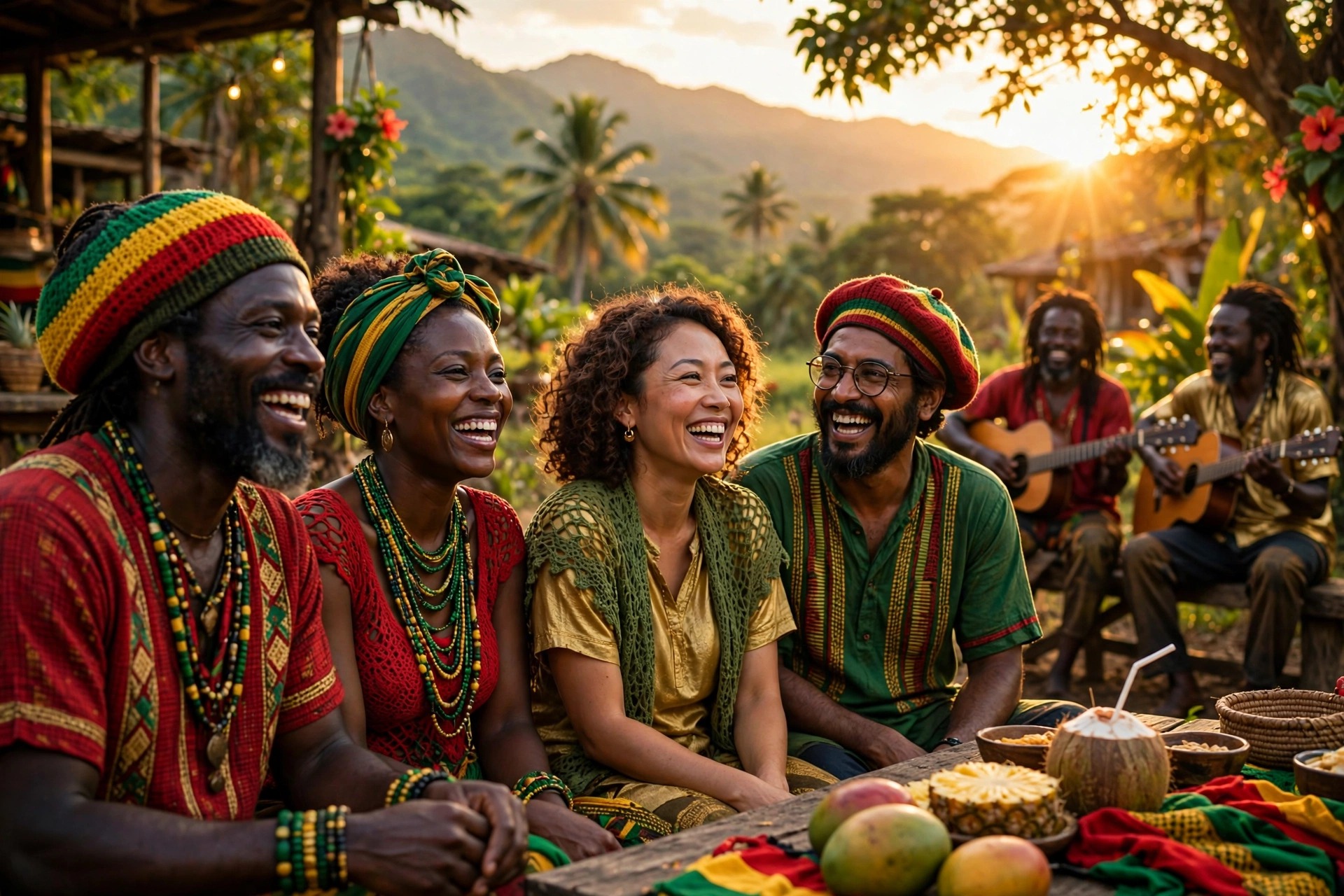
Joyful Rastafari gathering at sunset in Jamaica, with friends in red, gold, and green laughing together around a table of fruit while two musicians play guitars behind them

What Does “Irie” Mean? Rasta Words and Phrases, Explained

You hear it in a chorus, in a greeting at a market stall, in a friend signing off a message with warmth, and the word stops you, because it clearly means more than the dictionary shortcut of good or all right: irie is the feeling that everything is aligned, at peace, and held, and the phrases that travel with it, from Jah and Babylon to ital, Zion, and one love, form a whole way of seeing the world compressed into everyday speech. The problem for most listeners outside Jamaica is that reggae carried these words around the planet faster than it carried their meanings, so the vocabulary is famous while the thought behind it stays half heard. This guide solves that problem directly, starting with irie itself, then opening the full set of Rasta words and phrases around it, where each one comes from, and how to hear and use them with understanding rather than imitation.

Start here: Who Jah Bless No Man Curse — the sister phrases guide to Rastafari’s declaration of blessing and protection

Rasta Colors — our main guide to red, gold, and green and what each color stands for

Key Takeaways

  • Irie means good, all right, pleasing, and at peace, and in Rastafari use it also names a spiritual condition of harmony with Jah and creation.
  • Rasta speech, called Iyaric, Dread Talk, or Rasta Talk, deliberately rebuilds words so their sound matches their meaning, most famously in I-words such as ital, irie, and I and I.
  • Jah is God, Babylon is the oppressive system, and Zion is Africa, above all Ethiopia, as the promised home: together they map the whole Rasta story of exile and return.
  • Ital, dread, livity, seen, respect, and one love are not slang decorations; each one carries a practice, a value, or a relationship.
  • Reggae carried this vocabulary worldwide, which is why the words are familiar even where their meanings are not.

Table of Contents

What Irie Means: Good, All Right, and At Peace

Irie is the headline word, so start with its full range. At its simplest, irie means good, all right, cool, great, merry, or nice, and it works as an adjective, an adverb, and an interjection, which is why a single short word can do so much work in a conversation. A person can feel irie, a gathering can be irie, a meal, a song, and a whole afternoon can be irie. The most careful recent explainer of the word, DancehallMag on irie, reports that the Oxford English Dictionary files it as Jamaican English and records an older gloss that pushes the meaning higher still, toward powerful and pleasing, excellent, highest, the state of feeling great. That height matters, because irie was never only a casual thumbs up. Underneath approval sits peace, contentment, and harmony, the settled feeling that nothing in this moment needs fixing.

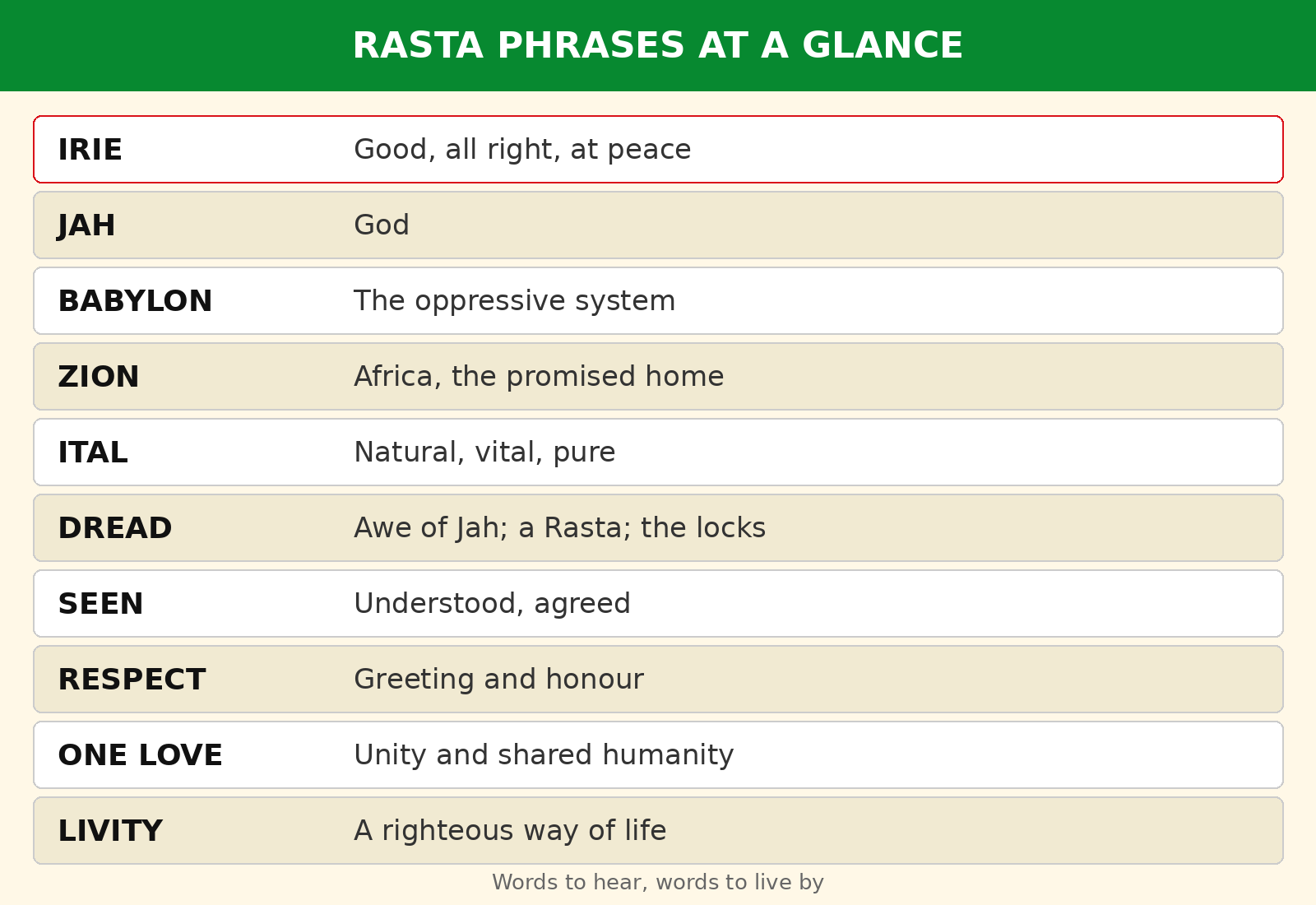
The phrases travel as a set, so learn them as a set. Irie rarely arrives alone in real speech. It sits inside a family of words that name God, the world as it is, the world as it should be, the food on the table, the hair on the head, and the bond between the people speaking. The table below gives the working glossary for this whole guide, covering irie alongside Jah, Babylon, Zion, ital, dread, seen, respect, one love, and livity, and every section that follows takes a group of these words and opens it properly, with its history and its weight, rather than leaving it as a one-line translation.

Word or Phrase What It Means How It Is Used
Irie Good, all right, pleasing, at peace Greeting, answer, approval, blessing
Jah God Prayer, praise, everyday reference to God
Babylon The oppressive, corrupt system Naming injustice, authority, and materialism
Zion Africa, above all Ethiopia, the promised home Hope, repatriation, redemption
Ital Natural, vital, pure, from vital with the I raised Food and living free of additives and artifice
Dread Awe of Jah; a Rastafari person; the locks themselves Reverence, identity, and address
Seen Understood, agreed, it is so Confirming that a point has landed
Respect Honour given and received Greeting, thanks, and farewell
One love Unity and shared humanity Blessing, sign-off, and call to unity
Livity A righteous, balanced way of life The whole practice of living the faith
Chart listing ten Rasta words and phrases with short meanings: irie, Jah, Babylon, Zion, ital, dread, seen, respect, one love, and livity
Ten words that carry a worldview: the core Rasta phrases at a glance.

Context decides which shade of irie you are hearing. Asked how you are, irie answers that you are well in body and in spirit, not merely unharmed. Said of a place, it praises the energy of the place, the feeling that the people, the music, and the moment agree with each other. Said as an exclamation, it blesses what has just happened. English separates feeling good, things going well, and being at peace into different phrases, while irie holds all three in one breath. Our sister guide to who Jah bless, no man curse shows the same compression in a longer phrase, where an entire theology of protection fits inside six words.

Where Irie Comes From: An Honest Answer

The honest answer about the origin of irie is that nobody knows for certain, and any guide that pretends otherwise is guessing. The Oxford English Dictionary, as reported by DancehallMag, calls the origin uncertain, and its earliest recorded evidence of the word in print comes from a Kingston newspaper in the middle of the roots reggae years, when Rasta language was pouring out of studios and sound systems into everyday Jamaican speech. Several theories circulate, and none is settled. One holds that irie is an alteration of an older word for hearty. Another sees it as a creation of Iyaric, blending the raised I with free or merry. A third links it to the English phrase all right, which would make irie a compressed blessing, the whole of all right gathered into a single joyful sound. What is beyond dispute is the use: Jamaicans made the word their own, reggae carried it, and its meaning in living speech is clear even where its origin is not.

Irie lives inside Jamaican Creole, and that language has its own dignity and its own scholarship. Jamaican Creole, called Patois or Patwa by its speakers, is not broken English but a full language with its own grammar, sound system, and literature. The reference entry on Jamaican Creole describes it as the English-based creole vernacular of Jamaica with the most extensive literature and the widest artistic use of any Caribbean English creole, spread worldwide by Jamaican music, dub poetry, and the Rastafari faith itself. The work of treating that language with institutional seriousness has a home: the Jamaican Language Unit at the University of the West Indies, Mona, was established to support speakers of Jamaican, widely referred to as Patwa, including a standard writing system for the language. You are not picking up slang in the dismissive sense, then. You are touching a language a university unit exists to document, teach, and defend.

The deepest layer of irie is spiritual, and it is the layer reggae listeners feel before they can name it. In Rastafari use, feeling irie means being in tune: right with Jah, right with other people, and right with creation, living inside livity rather than merely enjoying a good mood. That is why the true opposite of irie in Rasta thought is not sadness but Babylon, the oppressive order that pulls a life out of tune. A person can be poor, tired, and opposed and still be irie, because irie names alignment rather than comfort. Hold that distinction and the word becomes what it has always been for the people who shaped it: a small daily report on the state of the soul. The colors that carry the same report visually are set out in our guide to the rasta colors, where green, gold, and red do in cloth what irie does in speech.

Iyaric: The Language That Rebuilt English

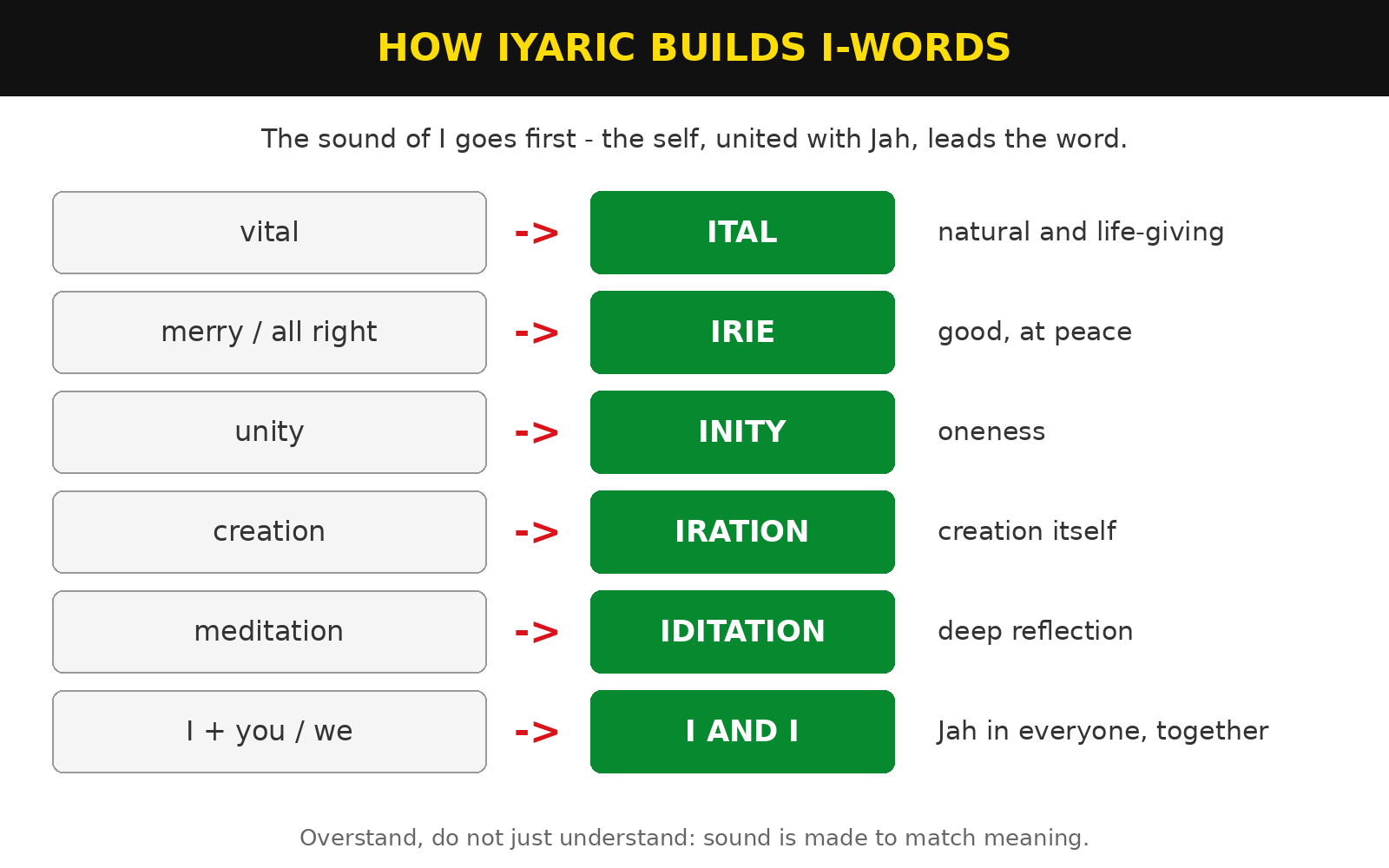
To understand any of these words properly, you have to understand Iyaric, the deliberate rebuilding of English from inside Rastafari. Iyaric, also called Dread Talk or Rasta Talk, grew as a conscious response to what Rastas experience as a negative colonial framework built into everyday English. Words were examined for the sounds they carry, and where a sound contradicted the meaning, the word was rebuilt. The greeting hello is avoided because it contains hell and low. Understand becomes overstand, because real understanding lifts a person up. Oppression becomes downpression, because the thing presses down. Encyclopaedia Britannica describes Iyaric, or Dread-talk, as the linguistic style of many Rastas, who substitute the sound of I for certain syllables, pointing at the most famous pattern of all: the I-words.

Diagram showing how Iyaric builds I-words, with vital becoming ital, unity becoming inity, creation becoming iration, meditation becoming iditation, and the pronoun form I and I
How I-words are built: the raised I goes first, and the word follows it.

The I-words are a system, not a game, and linguists have studied them as one. Benjamin Slade’s formal study of Rasta Talk morphology shows that forms such as ital, from vital, and irie, if from merry, belong to a larger pattern in which the initial syllable of a word is reshaped around the sound of I, a process he analyses as a special kind of blending rather than simple replacement. The same study catalogues the companion pattern of overstandings, including overstand for understand, downpress for oppress, and livicate for dedicate, where a part of a word whose connotation clashes with its meaning is replaced by its opposite until sound and sense agree. Behind the pattern stands a theology of the pronoun: I and I replaces me and you, and even we, because Jah dwells in every person and no speaker stands outside that unity. When irie is read inside this system, its opening I stops looking accidental. Whether or not the word was historically built this way, Rasta ears hear it this way, and hearing is part of meaning.

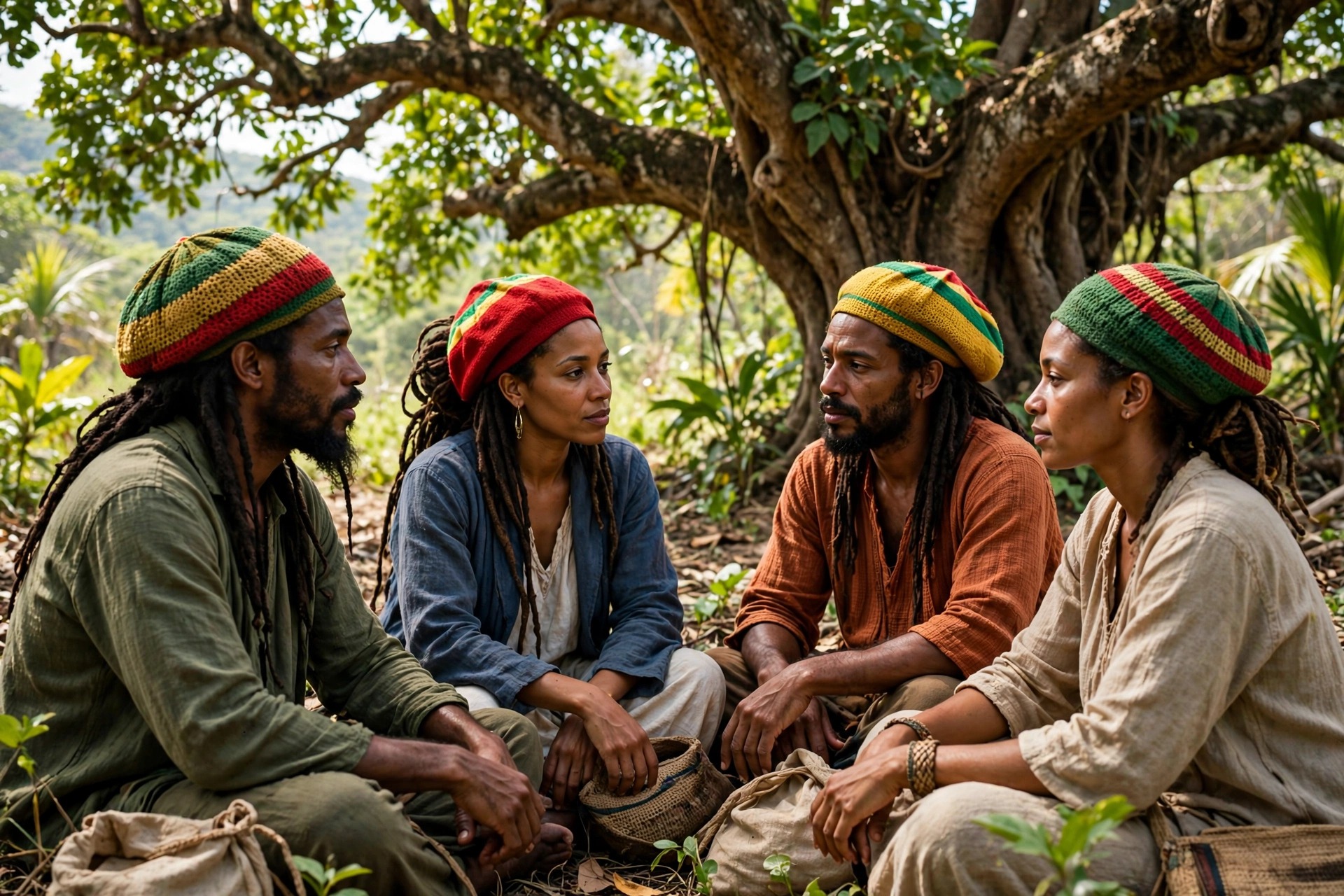
Four Rastafari friends with dreadlocks and green, gold, and red knit caps seated in a circle under a large tree in conversation
A reasoning: the setting where Rasta speech is sharpened, tested, and passed on.

This language travelled, literally, all the way back to Africa. The University of the West Indies lecture record on Ethiopia speaking Jamaican Creole describes the communities in the Shashamane valley, where Jamaican Rastafari repatriated to Ethiopia over decades, and where Jamaican Creole, particularly the Rastafari version of it, became a language of everyday communication alongside Tigrinya, Oromo, and Amharic. A language forged in Jamaica out of exile was carried home to Zion and became one of Ethiopia’s living tongues. The words in this guide are therefore not museum pieces, and the gatherings where the language is weighed and refined, the reasonings marked on holy days such as Groundation Day, remain its living classrooms.

Jah, Babylon, and Zion: The Map in Three Words

Jah, Babylon, and Zion are the three coordinates of the Rasta map, and every other phrase in this guide is located by them. Jah is God, the name drawn from the Hebrew of the Psalms. EBSCO’s Rastafari overview explains that Rastas believe God, whom they call Jah, is particularly identified with the Holy Spirit incarnate within every human being, which is exactly why the speech form I and I exists: if Jah dwells in each person, no encounter between people is merely human. Babylon is the opposite pole, the world of corruption and materialism, named for the empire that held God’s people captive in the Old Testament story. Britannica’s Rastafari entry sets the pair in their biblical frame, describing how Rastas overstand people of African descent in the Americas to be exiles in Babylon, tested by Jah through slavery, economic injustice, and racial downpression, and awaiting deliverance.

Zion is where the map points home. In that same Britannica account, Zion is the name for Ethiopia, drawn from the biblical tradition of Zion as the place of repatriation and redemption, and Ethiopia is described as the ultimate home of all Africans and the seat of Jah. The EBSCO overview tells the same story from the other side, describing how Rastas believe a new and perfect world of Zion will be created, with its capital in Ethiopia, through the separation of the righteous from Babylon. This is why the emperor at the centre of the faith matters to the vocabulary: many Rastas regard Haile Selassie I as the messiah, and the movement takes its very name from his pre-coronation name, Ras Tafari. Our collection of Haile Selassie quotes lets the emperor speak in his own words, our account of why Haile Selassie still reigns in Rasta culture follows his place in the faith, and our guide to the meaning behind the Lion of Judah in Rastafari culture explains the lion on his banner in full.

Heard together, the three words turn ordinary sentences into theology. When a lyric praises Jah, it names the God who dwells in the singer and the listener alike. When a lyric chants down Babylon, it indicts a system, the police at the gate, the price of food, the history of slavery and colony, in a single word with a Bible behind it. When a lyric longs for Zion, it voices the hope of return, to Africa, to Ethiopia, and to a world set right. This is also why the declaration that who Jah bless no man curse cannot be undone by human hostility lands with such force: the Jah in that sentence is this Jah, indwelling and sovereign. Learn these three words properly and half of every roots reggae catalogue opens at once.

Ital, Dread, and Livity: Words You Live, Not Just Say

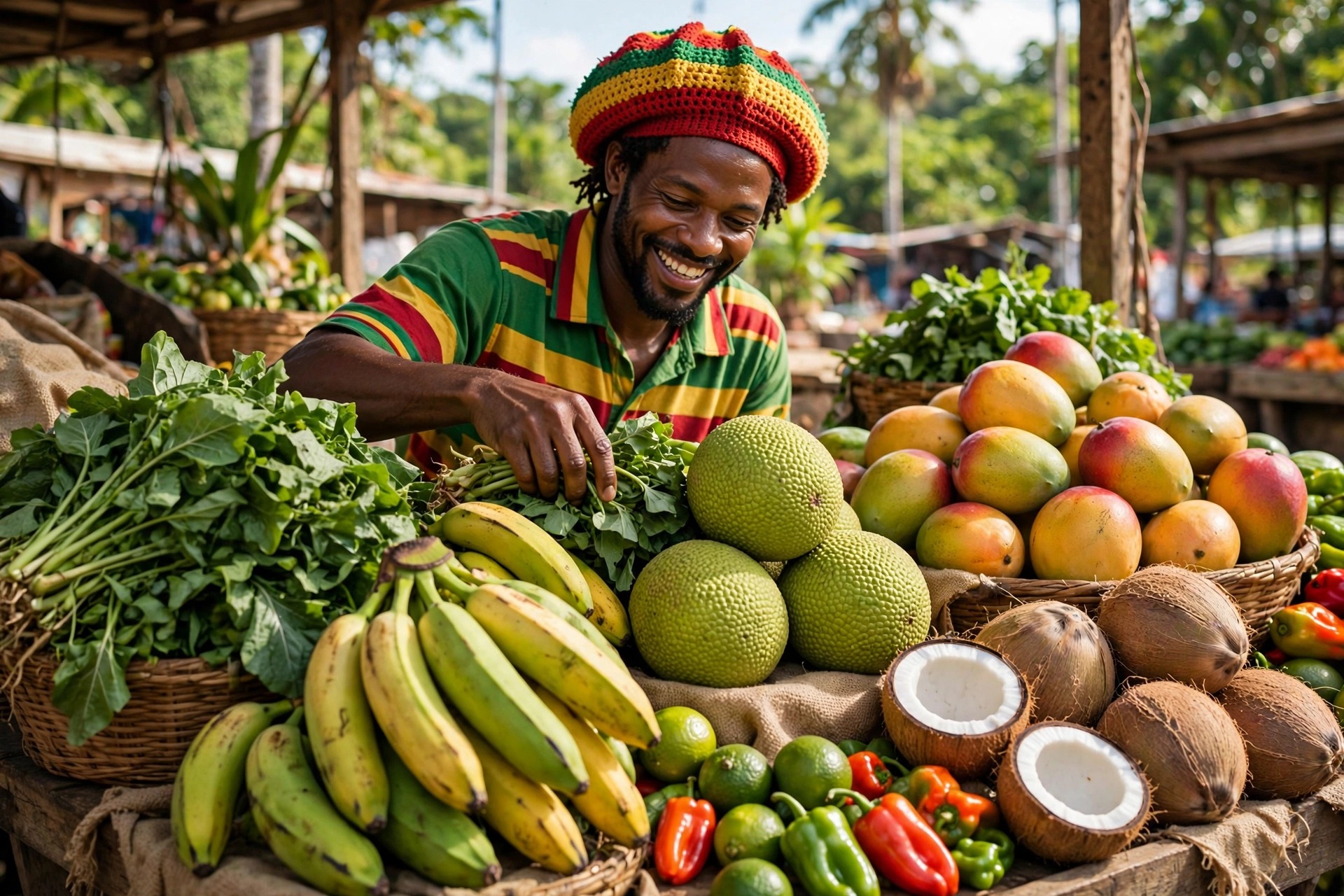
Ital, dread, and livity move the vocabulary off the tongue and into the kitchen, the mirror, and the whole conduct of a life. Ital, built from vital by raising the I, names food and living that are natural, pure, and life-giving: fresh food from the earth, free of additives and chemical interference, in most expressions vegetarian and in strict expressions vegan. Smithsonian Magazine on ital explains that ital, rhyming with and derived from vital, is employed throughout Rastafari speech to emphasize the oneness and unity of life, and that ital food promotes a healthy mind, body, spirit, and environment. National Geographic on ital eating reports the same principle from the farm itself, describing how Rastas eat a natural diet free from additives, chemicals, and most meat to stay spiritually connected to the earth, repeating the saying that sums the word up: ital is vital.

Smiling market vendor in a green, gold, and red striped shirt and knit cap arranging leafy greens beside plantains, breadfruit, mangoes, and halved coconuts
Ital begins at the stall: fresh, natural food, straight from the earth.

Dread is the word outsiders most often flatten, and it deserves its full weight back. In Rasta speech, dread names first a holy awe, the serious reverence due to Jah, and from there it names the person who lives in that awe and the locks that announce it. The dreadlocks are read through scripture, above all the Nazarite vow against the razor, and through the mane of the Lion of Judah, and they stand as a public refusal of Babylon’s grooming standards and vanity. The EBSCO history notes that dreadlocks became characteristic of Rastafari life in a reforming generation that took them up as a defiant rejection of a society that had rejected them, which is why dread carries pride rather than fear for those who wear it. Livity then gathers ital, dread, dress, speech, and conduct into one word: a balanced, righteous lifestyle, lived consciously every day rather than performed on a holy day. The University of the West Indies built a scholarly gathering around that word, as its record of the Rastafari Studies Conference shows, taking Rastafari livity and scholarship as its theme. Dress belongs inside livity too, which is why our guides to traditional rasta outfits that still look fly and how to dress like a Rastafarian woman treat clothing as expression rather than costume, and why the sequence in rasta colors in order is worth getting right.

Seen, Respect, and One Love: Words Between People

Seen, respect, and one love are the social words of the set, the ones that manage the space between one person and another. Seen is the smallest and the most efficient: it confirms that a point has been heard, understood, and accepted, and it carries a quiet claim about sight itself, that the listener has perceived the truth inside the words, not merely heard them. Respect works in both directions at once. Offered as a greeting or a farewell, it gives honour to the person addressed and states the speaker’s own standard in the same breath. Neither word is filler. In a speech community built on I and I, where every person carries Jah within, small words of acknowledgement are load-bearing, because they enact the equality the theology teaches.

One love is the phrase the whole world borrowed, and its history is older and more political than its greeting-card afterlife suggests. Dictionary.com on one love defines it as an expression of unity and inclusion, often used by Rastafarians, Jamaicans, and reggae musicians, and traces it to Marcus Garvey, who sometimes concluded his speeches with the phrase and whose movement’s motto of one God, one aim, one destiny Rastafari adapted into one love, one heart, one destiny. The Wailers recorded the song in the ska years and Bob Marley later re-released it, and where the phrase had centred Black solidarity for Garvey, Marley’s vision is generally read as a call to harmony among people of different races. Either way, the phrase in living use is a blessing with a programme inside it: unity is not a mood but a destiny, something to be built. It pairs naturally with irie itself: irie reports the inner state, one love directs it outward, and together they describe a person at peace with Jah and at peace with their neighbour.

Hearing the Phrases in Music, and Using Them Well

Reggae is the reason these words are in your ears at all, and the music’s own standing confirms that this vocabulary is heritage, not slang. UNESCO on reggae inscribed the reggae music of Jamaica on the Representative List of the Intangible Cultural Heritage of Humanity, describing a music that originated among marginalized groups in western Kingston and whose contribution to discourse on injustice, resistance, love, and humanity makes it at once cerebral, socio-political, sensual, and spiritual, a voice for all that still serves as social commentary, catharsis, and praise of God. Every one of those functions runs on the words in this guide: the praise on Jah, the resistance on Babylon, the love on irie and one love. When an institution of that standing treats the culture this seriously, the least a listener can do is learn its words properly.

Using the phrases well is mostly a matter of understanding plus restraint. Greet with irie where warmth is genuine and the setting is Jamaican or reggae-shaped. Answer seen when you have genuinely understood, not as punctuation. Offer respect and one love as the blessings they are, rather than as decoration on every sentence. Avoid forcing a borrowed accent, avoid stacking every phrase in this glossary into a single greeting, and avoid using Babylon, Zion, or Jah as jokes, because for the people who built this language those words carry scripture, history, and hope. If you want to go further, the door is reading rather than mimicry: follow the phrases into the posts linked throughout this guide, browse the shop to see how the words and colors live on clothing made for this culture, and let the vocabulary settle until the next lyric that puzzled you opens on its own.

Our View

Irie is a small word doing the work of a whole philosophy: it reports that a life is in tune, with Jah, with people, and with creation, and it refuses to separate feeling good from living right. That is why it has outlasted every fashion that carried it. Learn the word properly, learn the family it travels with, and you will never hear reggae, or greet a Jamaican friend, in quite the same way again. The language was built with care by people who believed words shape worlds. Treating it with care is how the rest of us honour that belief.

— The Editors, Rastafarian Clothing

Frequently Asked Questions

What does irie mean, in simple terms?

Irie means good, all right, pleasing, and at peace. It can describe how a person feels, how a place or gathering feels, or stand alone as a greeting, an answer, or an exclamation of approval. In Rastafari use it goes deeper, naming a spiritual condition of harmony with Jah, with other people, and with creation, which is why it means more than simply being in a good mood.

How do you pronounce irie, and how is it used in a sentence?

Irie is pronounced eye-ree, with the stress on the first syllable. Everyday uses include answering a greeting with a plain irie, saying everyting irie to report that everything is good, and describing a person, a song, a meal, or an evening as irie. It works as a greeting, a reply, and a judgement of quality, all in the same two syllables.

What is Iyaric, and how is it different from Jamaican Patois?

Jamaican Patois, or Jamaican Creole, is the everyday language of Jamaica, a full English-based creole language with West African influences. Iyaric, also called Dread Talk or Rasta Talk, is the deliberate Rastafari reshaping of that speech, built to make words carry righteous meanings: I-words such as ital, irie, and I and I, and rebuilt forms such as overstand for understand and downpression for oppression. Patois is the river; Iyaric is a channel the Rasta community dug through it on purpose.

What do Babylon and Zion mean in Rasta speech?

Babylon is the oppressive system: corrupt authority, materialism, and injustice, named for the empire that held God’s people captive in the Old Testament. Zion is its opposite, Africa and above all Ethiopia as the promised home. Together with Jah, the name for God, the two words map the Rasta story of exile in Babylon and return to Zion.

Is it respectful for visitors to say irie and one love?

Yes, when it is done warmly and sparingly. Irie and one love are welcoming words, and Jamaicans generally receive them gladly from visitors who use them as a genuine greeting and a genuine blessing. What gives offence is caricature: a forced accent, every phrase stacked into one sentence, or sacred words used as jokes. Understanding first, imitation last, is the respectful order.

Questions about the words, the culture, or an order?

Reach us through our contact page — we read everything and reply to everyone we can.

Sources

  • DancehallMag — Irie Meaning: irie as good, all right, cool, or great, its Oxford English Dictionary treatment as Jamaican English, its uncertain origin, and its spiritual sense in Rastafari and Iyaric.
  • Encyclopaedia Britannica — Rastafari: the movement begun in Jamaica in the 1930s, exiles in Babylon tested by Jah, Zion as Ethiopia, I-and-I, Iyaric or Dread-talk, livity, dreadlocks, and the ital diet.
  • Slade — Rasta Talk Morphology: formal analysis of I-words such as ital and irie as blending, and of overstandings such as overstand, downpress, and livicate in Rasta Talk.
  • Jamaican Language Unit: the University of the West Indies unit supporting speakers of Jamaican, widely referred to as Patwa, including a standard writing system for the language.
  • UWI — Ethiopia Speaks Jamaican Creole: Jamaican Creole, particularly the Rastafari version, as an everyday language of the repatriated communities in the Shashamane valley of Ethiopia.
  • UWI — Rastafari Studies Conference: the Mona conference on Rastafari livity and scholarship, marking the landmark Report on the Rastafari Movement in Kingston.
  • Encyclopedia.com — Jamaican Creole: Jamaican Creole as the English-based creole vernacular of Jamaica, spread worldwide by Jamaican music, dub poetry, and the Rastafarian religion.
  • UNESCO — Reggae Music of Jamaica: reggae inscribed on the Representative List of the Intangible Cultural Heritage of Humanity, originating among marginalized groups in western Kingston and acting as a voice for all.
  • Dictionary.com — One Love: one love as an expression of unity and inclusion, from Marcus Garvey’s speeches and motto through Rastafari adaptation to the Wailers and Bob Marley.
  • Smithsonian Magazine — Ital: ital, derived from vital, as natural food free from additives and chemicals that emphasizes the oneness and unity of life in Rastafari values.
  • National Geographic — Ital Eating: ital cooking as a natural diet free from additives, chemicals, and most meat, eaten to stay healthy and spiritually connected to the earth.
  • EBSCO — Rastafari Movement: Jah identified with the Holy Spirit incarnate in every person, I and I speech, Zion with its capital in Ethiopia, Babylon as corruption and materialism, and the history of dreadlocks.
Back view of a person with long dreadlocks and a red, gold and green knitted tam looking over golden Jamaican hills at sunset

Dreadlocks in Rastafari: The Meaning and the Vow Behind Them

Back view of a person with long dreadlocks and a red, gold and green knitted tam looking over golden Jamaican hills at sunset

Dreadlocks are the most recognizable sign of Rastafari, and also the most misunderstood. To some they look like a hairstyle. To Rastafari they are a vow made visible: hair left uncut as a sign of a promise to God, a mark of separation from Babylon, and a crown a person grows rather than buys. This guide explains what dreadlocks mean in Rastafari, where the practice comes from in the Bible, how it traveled to Jamaica, and how it is lived and kept today — so that you can understand the locks before you admire them, and respect them whether or not you ever wear them.

Keep reading the story of the King the locks honor. Our guide to Coronation Day in Rastafari: November 2 and Why It Matters explains the crowning of Haile Selassie I, and our guide to Rasta Colors explains the red, gold and green that so often go with the locks.

Key Takeaways

  • Dreadlocks are a vow, not a hairstyle. In Rastafari they point to the Nazirite vow of the Bible, in which the hair is left uncut as a sign of dedication to God.
  • The Bible is the root. Numbers 6 forbids the razor during the vow, and Samson’s story in Judges 13 ties uncut hair to strength and calling.
  • The locks came to Jamaica with a movement, not a fashion. They grew out of the early Rastafari community’s reading of Scripture, its reverence for Haile Selassie I, and its refusal of Babylon’s standards.
  • They mean identity, resistance, and covenant. The locks say who a person belongs to, what they refuse, and what they promised.
  • They take years and steady care. Locks mature in stages, and keeping them healthy is simple, regular work: washing, drying fully, palm-rolling new growth, and protecting them at night.
  • Respect is the first rule. Never touch another person’s locks without asking, and never treat them as a costume.

Table of Contents

  1. What Dreadlocks Actually Are
  2. The Nazirite Vow: The Biblical Root
  3. From the Bible to Jamaica: How the Vow Reached Rastafari
  4. Haile Selassie, the Lion of Judah, and the Crown
  5. What Dreadlocks Mean: Identity, Resistance, and Covenant
  6. How Dreadlocks Grow and How They Are Kept
  7. Dreadlocks, School, Work, and the Law
  8. Wearing Dreadlocks Well: Respect, Care, and Style
  9. Myths Worth Letting Go
  10. Wear the Vow: Haile Selassie Pieces
  11. Our View
  12. FAQ

What Dreadlocks Actually Are

A dreadlock is a section of hair that has been allowed to mat and lock together into a rope-like strand. Unlike a braid, which is woven and can be undone, or a twist, which is coiled and temporary, a lock forms when the hair’s own texture binds it into a permanent shape. The process takes months, and the result can last a lifetime. Locks can be thin or thick, short or floor-length, worn loose, tied back, or covered with a tam. The word itself carries the old sense of dread — not fear of the hair, but awe: the dread of the Lord, and the dreadful power of a person who has set themselves apart. New World Encyclopedia’s Rastafari overview places the locks among the movement’s most visible signs of identity, alongside the colors and the lion.

That visibility is the point, and it is also the problem. Because locks are so easy to see, they are the first thing strangers judge, and the first thing people copy without understanding. A lock is not a costume piece, and it is not a shortcut to looking like a Rasta. It is a slow-grown sign that says its wearer has made a decision about how to live. When you see locks worn with a red, gold and green tam, the colors and the hair are saying the same thing together: roots, royalty, and resistance. Our guide to what Rasta men wear shows how the locks fit into the wider picture of dress, from the tam on the head to the colors on the chest.

It helps to be clear about what locks are not. They are not dirty hair. Clean locks are washed regularly, and neglect is not a spiritual practice — it is neglect. They are not a single style, either: the locks of an elder who has worn them for forty years look nothing like the starter locs of someone six months in, and both are real. And they are not exclusive to Rastafari. Locked hair appears in many cultures and faiths, from the sadhus of India to the Maasai of East Africa. What makes the locks Rastafari is not the technique but the meaning the wearer gives them — the vow behind them. That is where the story starts, and it starts in the Bible.

The Nazirite Vow: The Biblical Root

The root of the Rastafari lock is the Nazirite vow, set out in Numbers 6. A Nazirite was a person who set themselves apart for God for a time, and the vow had three marks: no wine or strong drink, no contact with the dead, and no razor on the head. The verse is plain: during the entire period of the vow, no razor may be used on the head, and the person must let the hair grow long. The uncut hair was the visible sign of the promise — the part of the vow everyone could see, and the part the wearer could not hide. To cut it was to break the sign.

The same rule reaches back further, to the priests. Leviticus 21:5 tells priests not to shave their heads, and the reason is the same: the body of a person set apart for God is not to be treated like any other body. Hair, in this reading, is not decoration. It is a boundary. It marks the line between the holy and the common, between the person who has promised and the world that has not. When Rastafari leave the razor alone, they are standing in that same line.

The most famous Nazirite in the Bible is Samson, whose story is told in Judges 13. Before he was born, an angel told his mother that the boy would be a Nazirite from the womb, and that no razor was ever to touch his head. His strength was tied to his hair, and when his hair was cut, his strength left him. Rastafari read that story as more than a tale about a strong man. They read it as proof that the vow is real, that the hair carries the promise, and that cutting it has a cost. Not every Rasta is a lifelong Nazirite in the strict biblical sense — the vow in Numbers was often for a set time — but the principle is the same: the hair is left alone because God asked for it to be left alone.

That is why the first thing to understand about dreadlocks is that they are not about fashion at all. They are about obedience. A person who grows locks in Rastafari is saying, in the most public way possible, that they have heard a command and intend to keep it. The locks are the receipt for that promise. They grow a little every day, and every inch is a day the vow was kept.

From the Bible to Jamaica: How the Vow Reached Rastafari

Rastafari began in Jamaica in the 1930s, in a community that read the Bible as its own history. The coronation of Ras Tafari as Haile Selassie I, Emperor of Ethiopia, in 1930 was the spark: here was a Black king crowned in Africa, and the community read his crowning as the fulfillment of prophecy. The movement’s early teachers, Leonard Howell among them, preached that Black people were the true Israelites, that Ethiopia was Zion, and that the Bible — read from the standpoint of the oppressed — was a book about them. In that reading, the Nazirite vow was not ancient history. It was an instruction, and it was waiting to be obeyed. New World Encyclopedia’s Rastafari overview traces how the movement’s beliefs, including its reading of the Bible and its reverence for Haile Selassie I, came together in those early years.

The locks themselves became common among Rastafari in the 1940s and 1950s, carried by the movement’s most committed members — the brethren who lived apart, ate Ital, and refused the ways of Babylon. For them, growing locks was a rejection of the colonial order: the straightened hair, the European dress, and the respectability that the plantation and the church demanded. To let the hair lock was to refuse to be groomed into someone else’s image. It was also a practical break. A person who will not cut their hair cannot be made presentable on Babylon’s terms, and that was the point. The locks made the refusal visible every day, in every room, to every policeman and employer. Smithsonian Magazine’s One Love describes how the movement’s symbols, including the locks, carried that refusal into the wider world.

The cost was real. In Jamaica in the 1950s and 1960s, Rastas were harassed, beaten, and jailed, and their locks were sometimes cut off by force — a punishment that struck at the vow itself. The community answered by holding tighter to the practice, and by the 1970s the locks had become the movement’s unmistakable signature, carried around the world by reggae and by the image of Bob Marley. What began as a small community’s act of obedience had become a global sign. The vow had traveled from the desert of Numbers to the hills of Jamaica to the stages of the world — and the hair had carried it the whole way. Our guide to Coronation Day in Rastafari tells the story of the crowning that set the movement in motion, and the Library of Congress country study of Ethiopia gives the history of the land the movement calls Zion.

Haile Selassie, the Lion of Judah, and the Crown

No account of the locks is complete without the King they honor. Haile Selassie I was crowned Emperor of Ethiopia on November 2, 1930, and Rastafari received his crowning as the fulfillment of prophecy — the King of Kings and Lord of Lords, the Lion of the Tribe of Judah, come in the flesh. Britannica’s Haile Selassie I biography records his life from his birth as Ras Tafari Makonnen in 1892 to his long reign and his place in Ethiopian history, and the Library of Congress country study of Ethiopia sets his reign in the wider story of the country he ruled. Our guide to the meaning behind the Lion of Judah in Rastafari culture explains why the lion became the movement’s emblem, and our collection of Haile Selassie quotes gathers his own words on peace, unity, and the dignity of Africa.

The lion matters to the locks because the locks, like the lion, are a royal sign. The Lion of Judah is the emblem of the tribe from which the kings of Ethiopia claimed descent, and the locks are worn as the mane of that lion — a crown that grows from the head instead of sitting on it. That is why the locks and the image of the lion so often appear together, on flags, on album covers, and on the chest of a shirt: the hair says the wearer belongs to the Lion, and the Lion says the wearer is royalty. The Smithsonian Libraries record preserves materials from the coronation era, and the Crown Council of Ethiopia continues to publish statements on the imperial tradition the movement honors. To learn why the King still matters so deeply, read why Haile Selassie still reigns in Rasta culture, what Haile Selassie taught us about spiritual leadership, and why Haile Selassie is still the King of Reggae.

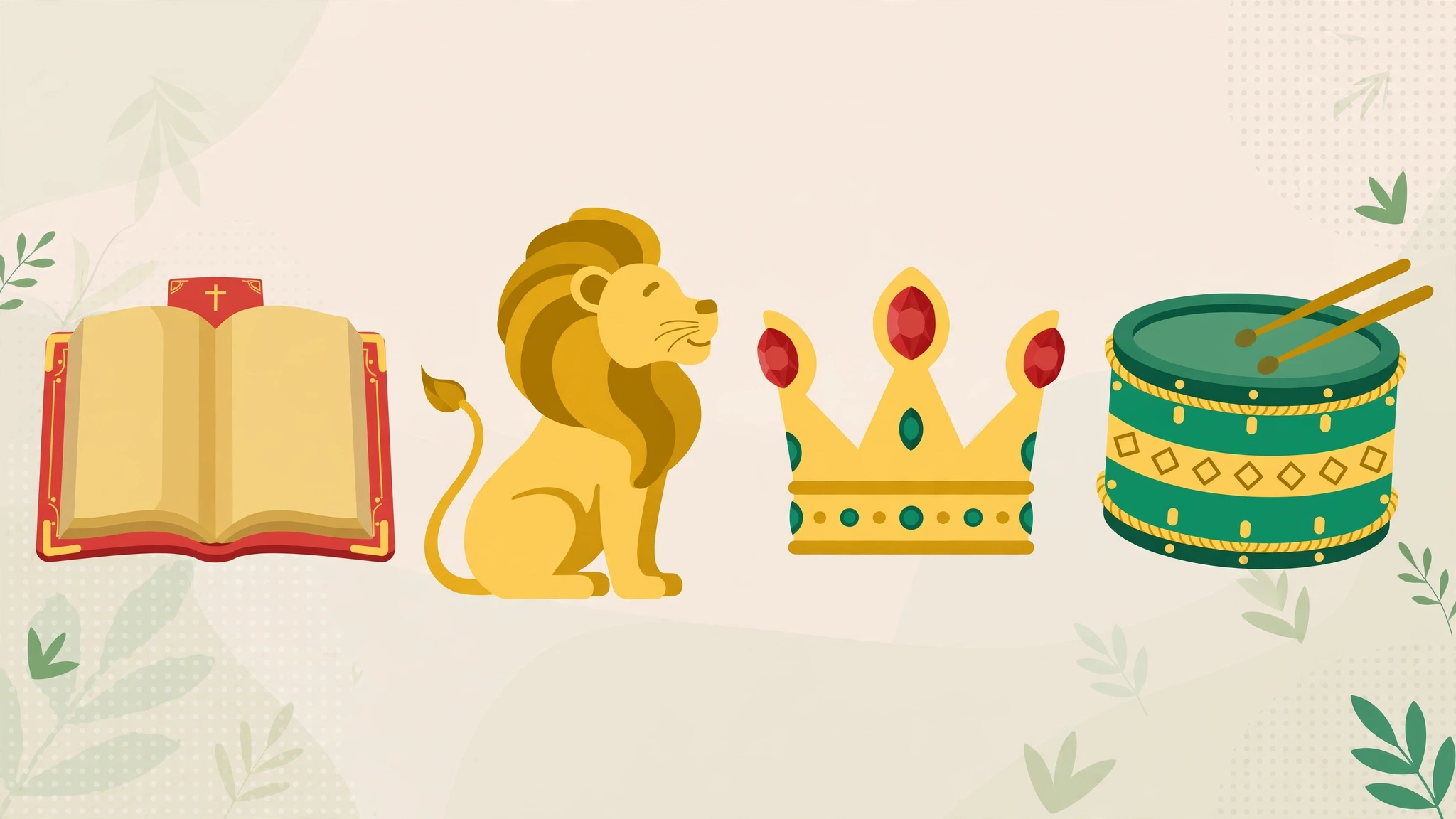
A flat illustration of an open Bible, a golden lion, a jeweled crown, and a green drum in a row on a cream background
The four symbols that stand behind the locks: the Bible that commands the vow, the Lion of Judah, the crown of Haile Selassie I, and the drum that carries the praise.

What Dreadlocks Mean: Identity, Resistance, and Covenant

Ask ten Rastas what their locks mean and you will get ten answers that rhyme. Identity comes first. The locks say who a person is before they say a word: a child of Africa, a member of the house of Israel, a follower of the King. In a world that spent centuries telling Black people their hair was a problem to be fixed, the locks answer that the hair was never the problem. The problem was the standard. Growing locks is a way of taking the standard back into your own hands — or rather, of taking your hands off your hair and letting it be what God made it to be. EBSCO’s Rastafari movement overview describes the movement’s beliefs and practices, including the place of the locks among them.

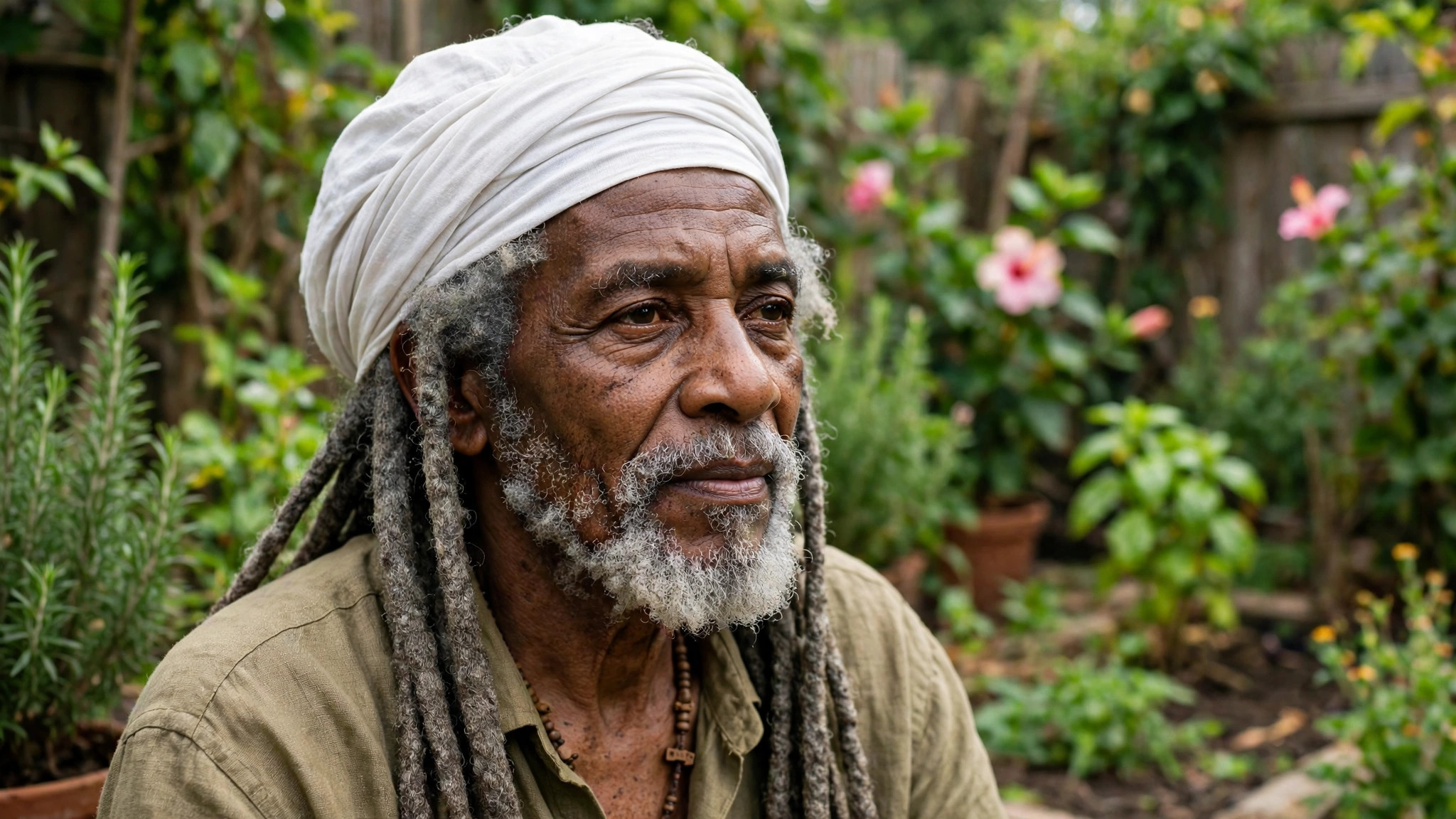
An elder with grey dreadlocks and a white headwrap standing in a garden of hibiscus flowers
An elder’s locks are a living record: decades of keeping a vow, worn in the open.

Resistance comes second, and it follows from the first. The locks refuse Babylon — the system of empire, exploitation, and empty respectability that Rastafari name as the enemy. A person in locks cannot pass as respectable in Babylon’s offices and courts, and that is precisely the point: the locks make the refusal permanent and public. They are a picket sign you wear to work, to school, and to the shop. And covenant comes third. The locks are a promise, and a promise is a relationship. Every morning the wearer wakes up with the vow on their head, and every day they choose to keep it. That daily choosing is what makes the locks more than a style: they are a discipline, renewed each morning without a word being spoken. For the wider story of how faith is worn, see our guide to Rastafarian clothing styles with meaning and our guide to Rasta outfits for reggae lovers, where the locks meet the colors and the music.

How Dreadlocks Grow and How They Are Kept

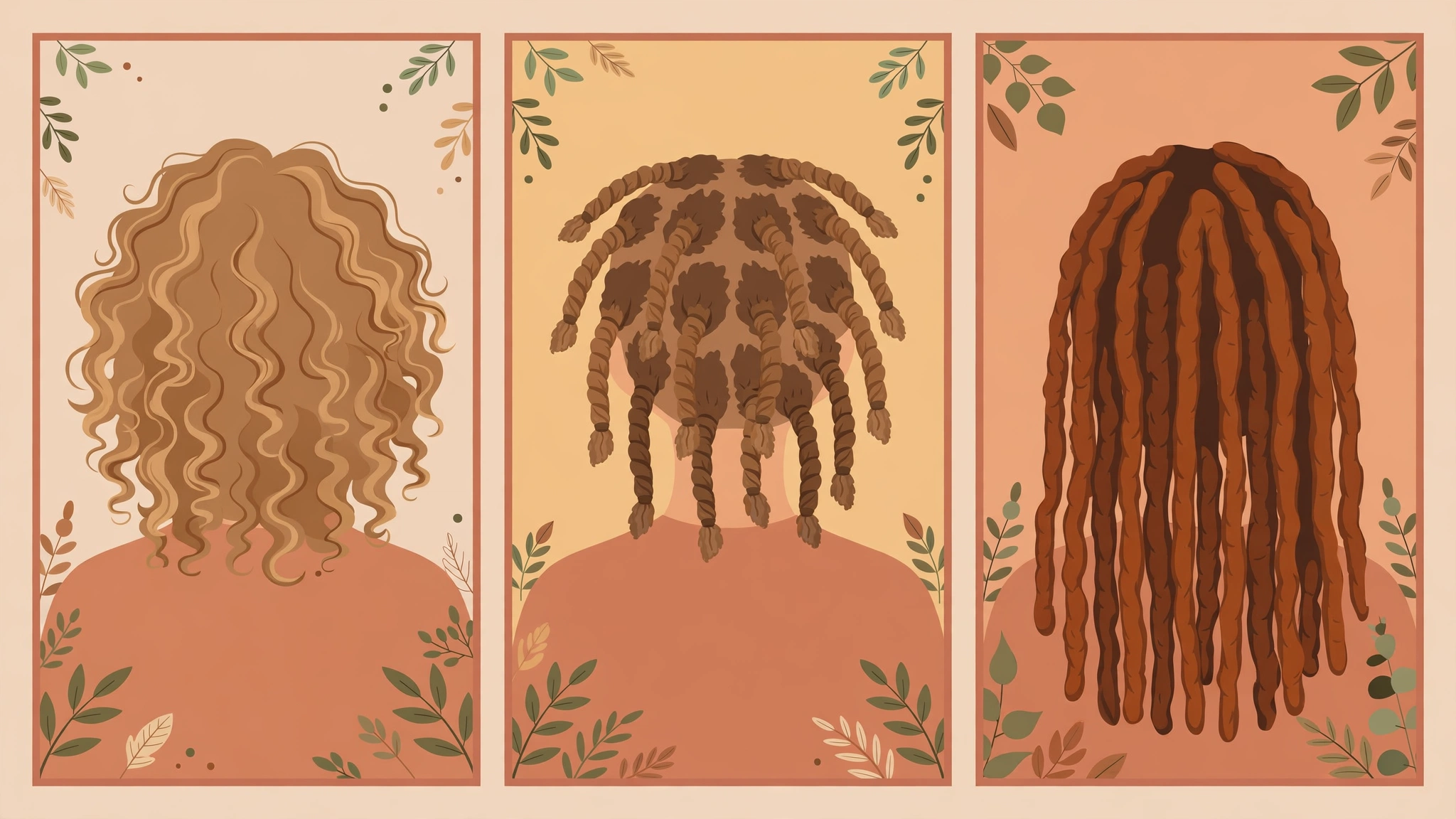
Locks do not appear overnight. They grow in stages, and each stage asks for something different. In the beginning there are starter locs — twists, coils, or two-strand twists that hold the hair in sections while it begins to mat. This is the awkward stage: the hair looks unfinished, it frizzes, it unravels in the wash, and the temptation to give up is strongest. Then comes budding, when the sections begin to swell and tangle at the roots and the locks start to hold their shape. After a year or two, the locks mature: they tighten, they hang, they gain weight and length, and they need less fussing and more simple care. Patience is the whole method. The hair knows what to do; the wearer’s job is mostly to stay out of its way and keep it clean.

Three panels showing hair at three stages: loose curls, budding locs, and mature long dreadlocks
From loose curls to budding locs to mature locks: the same head, three stages, and a lot of patience in between.

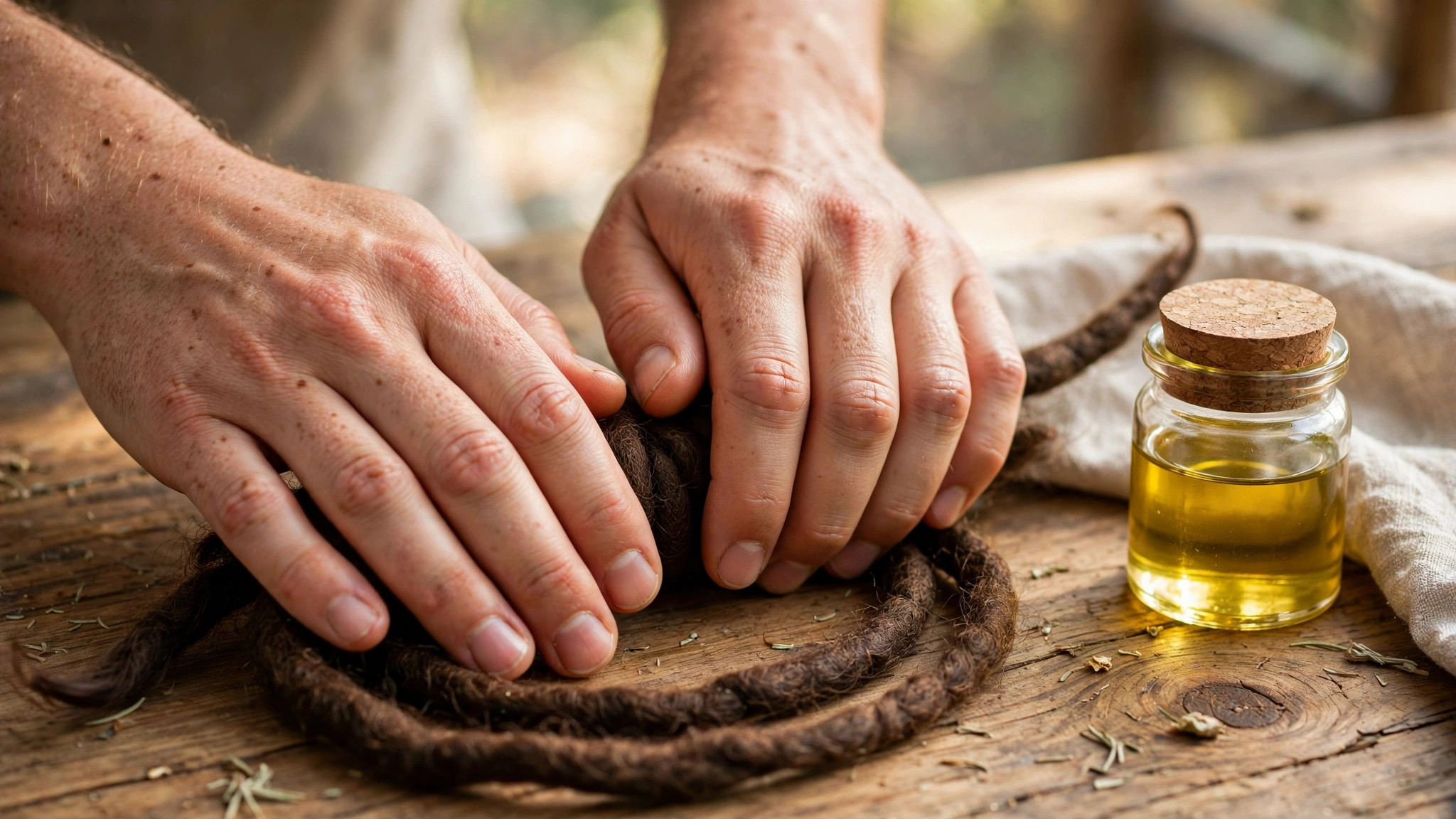
Keeping locks healthy is simple, regular work. Wash them — with a residue-free shampoo, so nothing builds up inside the lock. Dry them fully, because damp locks held against the scalp will smell and can grow mildew; a full day in the sun or a careful session with a dryer is not vanity, it is hygiene. Palm-roll the new growth, rolling each lock between the palms to help it tighten, and do it gently: hard pulling breaks hair and thins roots. Protect the locks at night with a silk or satin wrap or a durag, which keeps lint out and friction down. And keep the scalp in mind: a healthy scalp grows healthy locks, so oil it lightly, keep it clean, and leave it alone when it is not asking for help.

Hands palm-rolling a dreadlock on a wooden table beside a small glass bottle of golden oil
Palm-rolling keeps new growth tidy while the locs mature — gentle, regular, and unhurried.

What to avoid matters as much as what to do. Heavy waxes and thick butters promise to lock hair faster, but they build up inside the strands and are almost impossible to wash out; a little light oil goes further. Tight styles that pull at the roots can cause thinning and breakage, and the damage is slow to heal. Bleach and harsh color lift the hair’s strength along with its color, and on locked hair the damage is hard to cut away. And never let anyone cut your locks without your say-so — the vow is yours, and the scissors belong to no one else. If your locks ever need real repair, find a loctician who respects the vow and the hair in equal measure, and who will tell you the truth about what can and cannot be fixed.

Dreadlocks, School, Work, and the Law

For most of their history, dreadlocks have been treated by schools, employers, and police as a problem to be solved rather than a faith to be respected. Children have been sent home from school for their hair. Workers have been told to cut their locks or lose their jobs. Travelers have been searched, stopped, and singled out because of the hair on their heads. The pattern is old, and it is not an accident: when a hairstyle marks a person as a member of a movement that refuses the established order, the established order notices. Smithsonian Magazine’s One Love shows how the movement’s symbols have been read by the wider world, and how that reading has so often been a misreading.

The law has been catching up, slowly and unevenly. In the United States, a growing number of states have passed laws against hair discrimination in schools and workplaces — laws often grouped under the name of the CROWN Act — and courts in several countries have recognized that a person’s hair can be an expression of faith and identity, not a grooming failure. The protection is not the same everywhere, and it is not complete anywhere. If you wear locks and run into a rule about hair at school or work, ask for the policy in writing, ask how it is applied to other hairstyles, and ask what accommodation exists for religious practice. Keep a record of what is said. And if you are the person writing the policy, ask yourself whether the rule protects safety and hygiene, or whether it only protects a particular idea of what a respectable person looks like. The first is a rule. The second is a prejudice with a dress code.

For the rest of us, the rule is simpler: respect is not a legal argument, it is a habit. Do not touch a stranger’s locks. Do not ask a person with locks whether they wash their hair — you would not ask it of anyone else. Do not assume a person in locks smokes, or does not work, or holds any particular belief beyond the one their hair announces: that they have made a promise, and they intend to keep it. The law can punish the worst of the disrespect, but only manners can prevent most of it.

Wearing Dreadlocks Well: Respect, Care, and Style

Wearing locks well starts with the same rule as growing them: remember what they are for. The tam is the locks’ best friend — a knitted crown that keeps them out of the way, keeps the sun off, and carries the colors at the same time. A tam in red, gold and green says the same thing the locks say, and the two belong together; our guide to Rasta Colors explains what each color stands for and how to wear them without turning a sacred palette into a costume. Tie the locks back for work that needs a clear face and clear hands. Cover them in the kitchen, the workshop, and the places where loose hair is a hazard. Let them down when the day is done. The locks are not fragile, but they are not a tool either — treat them like a promise, not like a rope.

Style follows the vow, it does not lead it. A simple gold or wooden bead at the end of a lock, a wrap in the colors, a clean shirt in red, gold or green — these are enough, and they are more than enough. The mistake is to dress the locks up until the meaning disappears under the accessories. If you are not Rasta and you love the look, ask yourself what you are borrowing and why. There is a difference between appreciating a tradition and wearing it as a holiday. The first learns the vow before the hairstyle; the second takes the hairstyle and leaves the vow behind. If you want the look, learn the story first — this guide is a start — and if you want the locks themselves, grow them with the same patience and the same promise the elders grew theirs with.

Myths Worth Letting Go

Four myths about dreadlocks deserve to be retired. The first is that locks are dirty. Clean locks are washed, dried, and cared for like any other hair, and the cleanest locks belong to the people who wash them most. The second is that locks are only for Rastas. Locked hair appears in many faiths and cultures, and the technique belongs to no one — but the Rastafari meaning of the locks belongs to Rastafari, and it deserves to be named when it is borrowed. The third is that locks cannot be washed. They can, they must, and the people who tell you otherwise have never kept a set of locks. The fourth is that every Rasta has locks. Many do, and many do not: the movement has always included brethren and sistren who keep their hair short or covered, and their faith is no less for it. The locks are a sign of the vow, not a test of it, and no one should be judged by their hair — in either direction.

Wear the Vow: Haile Selassie Pieces

The locks honor a King, and the King’s image belongs on cloth as well as on the head. These pieces from our own Fifth Degree™ shop carry Haile Selassie I and the Lion of Judah — the tee and the hoodie from our own store, and the basketball jersey that has become a proven favorite. Wear them the way the locks are worn: with the meaning first and the style second.

Our View

We make clothes, not vows — and we know the difference. The locks belong to the people who grow them, and the best thing a clothing shop can do is honor the meaning without borrowing the holiness. That is why our Selassie pieces carry the Lion and the crown plainly, without irony and without costume: the King deserves to be worn the way the locks are worn, as a sign of something real. If you wear the locks, wear them with the vow. If you wear the colors, wear them with the story. And if you only admire the locks from a distance, admire them properly — as a promise kept in public, day after day, for years.

FAQ

Do all Rastafari have dreadlocks?

No. Many Rastafari wear locks, and the locks are the movement’s most visible sign, but the movement has always included brethren and sistren who keep their hair short or covered. The locks are a sign of the vow, not a test of faith, and no one should be judged by their hair in either direction.

Where do dreadlocks come from in the Bible?

From the Nazirite vow in Numbers 6, which forbids the razor while the vow is in force and requires the hair to grow long, and from the story of Samson in Judges 13, whose strength was tied to his uncut hair. The priestly rule in Leviticus 21:5 points the same way: the hair of a person set apart is not to be shaved.

How long does it take to grow dreadlocks?

Starter locs take a few months to hold their shape, the budding stage follows over the first year, and locks are generally mature after one to two years. After that they keep growing for as long as they are kept. Patience is the whole method — the hair knows what to do.

Do dreadlocks need to be washed?

Yes, regularly, with a residue-free shampoo, and they must be dried fully afterward. Clean locks are washed locks, and neglect is not a spiritual practice. Palm-rolling new growth and protecting the locks at night keep them healthy between washes.

Can I touch someone’s dreadlocks?

Only if they invite you to. The locks are personal, they are part of a vow, and they belong to the person wearing them. Admire them with your eyes and your words, not your hands.

Is it disrespectful for a non-Rasta to wear dreadlocks?

Locked hair exists in many cultures, so the style itself is not owned by one faith. What belongs to Rastafari is the meaning the locks carry in the movement — the vow, the King, and the refusal of Babylon. If you wear locks, learn that meaning first, honor it, and do not wear the look as a costume.

Questions about what we make or why we make it?

We are a small shop with a big respect for the culture we serve. If you want help choosing a piece, or you want to talk about the meaning behind it, contact us and a real person will answer.

Sources

Crowd in red, gold and green celebrating outside a stone Ethiopian Orthodox cathedral hung with green, gold and red banners, drummers in the foreground

Coronation Day in Rastafari: November 2 and Why It Matters

Crowd in red, gold and green celebrating outside a stone Ethiopian Orthodox cathedral hung with green, gold and red banners, drummers in the foreground

Every year on November 2, Rastafari across the world pause for the date that gave their faith its name. Coronation Day marks the morning in 1930 when Ras Tafari Makonnen was crowned Emperor of Ethiopia at St George’s Cathedral in Addis Ababa and took the throne name Haile Selassie I. For many readers the day is easy to confuse with Groundation Day in April, and easy to underestimate altogether, as if it were simply an anniversary on a calendar. It is neither. Groundation Day remembers a visit; Coronation Day remembers a crowning, and that crowning is the founding event of the movement itself. This guide separates the two days clearly, walks through what actually happened in Addis Ababa, explains why the titles proclaimed that morning mattered so much in Jamaica, and shows how the day is observed today, so that when November 2 comes around you know exactly what is being honoured and why it still carries such weight.

Keep reading the holy-days story

Start with Groundation Day: Haile Selassie’s Visit to Jamaica, the April holy day this one is most often confused with, and then explore Why Haile Selassie Still Reigns in Rasta Culture for the longer legacy.

Key Takeaways

  • Coronation Day falls on November 2 and marks the crowning of Ras Tafari Makonnen as Emperor Haile Selassie I of Ethiopia in 1930.
  • The ceremony took place at St George’s Cathedral in Addis Ababa, and Empress Menen Asfaw was crowned beside the Emperor on the same day.
  • The titles proclaimed that morning, including King of Kings and Conquering Lion of the Tribe of Judah, were read in Jamaica as the fulfilment of biblical prophecy.
  • The movement’s very name comes from the Emperor’s pre-coronation name and title: Ras Tafari.
  • Coronation Day is a different holy day from Groundation Day, which falls on April 21 and marks Selassie’s visit to Jamaica in 1966.
  • Today the day is observed with Nyabinghi drumming, chanting, psalm reading, reasoning and gatherings in red, gold and green.

Table of Contents

What Actually Happened on 2 November 1930

A regent became an emperor in a ceremony the whole world was invited to watch. To understand the morning, you first have to understand how long the man at its centre had already been governing. Born Tafari Makonnen in 1892, he had served as regent and heir apparent under Empress Zauditu from 1916, steadily centralising power, building a salaried civil service and representing the progressive wing of Ethiopian politics. As the Britannica biography records, he assumed the title of negus, meaning king, in 1928, and when Zauditu died in the spring of 1930 the path to the imperial throne was open. He did not rush the crowning. The formal coronation was held months later, on November 2, 1930, and the delay was deliberate statecraft rather than hesitation.

The seven-month gap between accession and coronation was part of the message. Ethiopia was, at that moment, the only independent African state in a continent carved up by European empires, and its survival was watched closely and not always kindly by the powers that surrounded it. A detailed EBSCO coronation account explains that the ceremony was postponed for seven months after Zauditu’s death precisely so that the largest possible number of foreign representatives could attend, and that meticulous preparations were made to impress the dignitaries and the hundreds of journalists who travelled to Addis Ababa. The pageantry told two audiences the same story in different languages. To Ethiopians, it announced that the old feudal order, in which great regional lords shared power and kept their own armies, had been replaced by a centralised state under one strong monarch. To the world, it announced that Ethiopia was a sovereign equal, an ancient Christian empire receiving the envoys of kings and presidents on its own ground.

The setting carried its own history before a single word of the liturgy was spoken. St George’s Cathedral was no neutral venue. The Crown Council account describes how, on the day before the coronation, the assembled guests gathered outside the cathedral to witness the unveiling of the equestrian statue of Emperor Menelik II, the hero of Adwa, whose victory had preserved Ethiopian independence a generation earlier. The cathedral itself was too small for the crowd of guests, so a vast tent was attached to its western side, doubling its size, with two canopied thrones set up inside. A week earlier the imperial regalia, the crowns of the Emperor and Empress, the sceptre and orb, the diamond rings, the sword and spears of state and the robes, had been carried in procession to the cathedral and placed in its Holy of Holies, where clergy prayed over them day and night. Forty-nine senior clergy recited the Psalms over the regalia in shifts, and on the final night the Emperor, the Empress, their children and the nobility joined the vigil at midnight.

Golden crown and ornate processional crosses resting on folded ceremonial cloth on a red velvet cushion inside a candlelit Ethiopian Orthodox cathedral, clergy in white robes behind

On the morning itself, the ancient rite unfolded step by step. The foreign guests arrived at seven and were seated interspersed with Ethiopian aristocrats, who could guide them on when to stand and when to sit. The Emperor and Empress entered in white cloaks embroidered with silver, took the coronation oath with a hand on a gold-bound Bible, and were then robed in red and gold. Item by item, abbots and bishops brought out the regalia: the robes of state, the diamond-studded sword, the sceptre placed in the Emperor’s right hand, the coronation ring, and the two golden spears. Then came the anointing. The Archbishop prayed over the holy oil and anointed the Emperor in the form of a cross on his forehead and chest, in the manner of the anointing of David and Solomon, before placing the imperial crown on his head. Empress Menen was then crowned in the same ceremony, in the same place, on the same day, which the Crown Council account notes was a first: empresses had traditionally been crowned by the Emperor at the palace, in a much smaller ceremony, on the third day.

The guest list explains why the news travelled so far, so fast. Britain sent Prince Henry, Duke of Gloucester, son of King George V. Italy sent the Prince of Udine, France sent one of its most senior marshals, and Japan, Egypt, the United States, Germany and a long list of other states sent senior representatives. A Pankhurst history of the period confirms the same roll call and adds a detail that mattered enormously for what followed: the celebrations attracted considerable international media coverage, for both the monarch and the country. Among those present was the novelist Evelyn Waugh, who wrote a journalistic account of the event. The coronation was filmed, photographed and reported on every continent. It was, in effect, the first Ethiopian coronation the whole world could see, and that visibility is the hinge on which the rest of this story turns. Within a year, that ceremonial authority had become written law: the Country Studies history records that in July 1931 the Emperor granted Ethiopia’s first written constitution, reserving succession to his own line and providing a legal basis for replacing traditional provincial rulers with loyal appointees. For the words the Emperor himself went on to speak across his reign, our collection of Haile Selassie quotes is the natural next read.

The Titles, and Why Jamaica Heard Prophecy in Them

Read the titles proclaimed that morning and you are reading the text Jamaica opened its Bibles to check. The new Emperor took the throne name Haile Selassie, meaning Power of the Trinity, his own baptismal name restored as a regnal name. Around it stood the full traditional style of the Ethiopian throne: King of Kings of Ethiopia, Lord of Lords, Elect of God, and Conquering Lion of the Tribe of Judah. RE Online’s Coronation Day entry lists the same titles and states plainly why the date endures: it is one of the holiest days of the Rastafari year, celebrating Selassie’s accession and cementing the role Ethiopia plays at the heart of the tradition. None of those titles was invented for the occasion. They were the inherited language of a dynasty that traced itself back, by tradition, to Solomon and the Queen of Sheba, and that inheritance is explored in depth in our guide to the Lion of Judah and what the symbol means.

In Jamaica, those inherited titles landed on ground that had been prepared for decades. Ethiopianism, the reading of the Bible through the lens of African dignity, had taught generations of Black Christians to watch Ethiopia closely. Psalm 68 speaks of princes coming out of Egypt and Ethiopia stretching out her hands to God. Revelation speaks of the Lion of the Tribe of Judah who has prevailed, and of a King of Kings and Lord of Lords. When newspaper reports and photographs of the Addis Ababa coronation reached Kingston, readers compared the reports with the verses they already knew by heart, and the correspondence seemed exact: a Black king, crowned in Africa’s one unconquered Christian empire, bearing in public the very titles their scriptures named. Our walk through Rastafarian scriptures sets out how those passages are read within the tradition, and the famous blessing explored in Who Jah Bless, No Man Curse shows the same habit of reading at work in everyday speech.

Marcus Garvey’s voice was the other half of the preparation. The Jamaican-born founder of the Universal Negro Improvement Association had spent the 1920s teaching Black pride, self-reliance and a return of attention to Africa, and a saying widely attributed to him urged his followers to look to Africa for the crowning of a Black king as a sign that deliverance was near. Historians are careful about the exact wording and dating of that saying, and honest writing should be careful too. What is not in dispute is the effect. When the crowning actually happened, in full view of the world’s press, Garvey’s audiences were ready to receive it as fulfilment. The Encyclopedia.com history of the movement describes how, following the 1930 crowning, street-corner preachers in Jamaica, among them Joseph Hibbert, Leonard Howell, Robert Hinds and Archibald Dunkley, began asserting that Selassie was a divine personage, and how for those Jamaicans he embodied Garvey’s vision of Black pride and repatriation while fulfilling the Bible’s prophecies of a messianic deliverer.

It is worth pausing on how the coronation was documented, because documentation is what carried it across an ocean. The Smithsonian Libraries hold the record of Addison Southard’s 1931 National Geographic account, published under a title that called Haile Selassie the successor to the world’s oldest continuously sovereign throne. That June 1931 coverage, with its photographs of a transformed Addis Ababa, its asphalted streets and electric lights and triumphal arches, is the kind of contemporary reporting through which the wider world, including the Caribbean, pictured the event. Time magazine put the Emperor on its cover at the start of November 1930. Film crews shot the processions. For a people in Jamaica who had been told in a hundred ways that Africa had no history worth honouring, here was Africa on the front pages, crowned, robed and receiving the bows of European princes. The medium was not incidental to the message. The message travelled because the medium did.

The Day That Named a Movement

Most faiths are named for a founder, a place or a book; this one is named for a man’s name before his crowning. Rastafari joins two words: Ras, the Ethiopian title of rank the future Emperor held, roughly prince or duke, and Tafari, his given name. The EBSCO Rastafari research overview spells the derivation out directly: the name is a compound of ras, meaning chief or head, and Tafari, the given name of Haile Selassie before he became Emperor. That etymology is the simplest proof of how central November 2 is. The movement does not merely commemorate the coronation as an important date in someone else’s history. It carries the coronation in its own name, every time the name is spoken. To say Rastafari is to say: the faith of Ras Tafari, the man crowned on that morning.

The preaching that followed turned a news event into a theology. In the years immediately after 1930, Leonard Howell and his fellow early preachers taught in Kingston’s streets and yards that the crowned Emperor was the returned Messiah, that Ethiopia was Zion, and that the system of colonial rule and racial humiliation under which Jamaicans lived, named Babylon in the movement’s language, would not have the final word. The New World Encyclopedia entry summarises the belief that unites the movement’s many mansions: that Ras Tafari Makonnen, crowned Haile Selassie I on November 2, 1930, is the living God incarnate, called Jah, who will lead the peoples of African origin into a promised land of full emancipation and divine justice, while noting honestly that some groups within the movement do not take that belief literally. Diversity of interpretation has been there from the start, and Coronation Day is one of the few observances that crosses all of it.

The Smithsonian’s landmark exhibition treated those origins with the seriousness they deserve. When the National Museum of Natural History mounted Discovering Rastafari, its curator explained that Ethiopianism, Garveyism and biblical literacy came together to form the basis of the belief in Selassie’s divinity that began to be preached in the early 1930s, and that the crowning in November 1930 received enormous media coverage and was interpreted by some in Jamaica as the second coming. The Smithsonian Magazine interview with the curator is valuable precisely because it refuses the lazy stereotype: this is a story about people reading their way, with the only book most of them owned, toward dignity. Coronation Day sits at the exact point where those three streams met. Remove the crowning, and Ethiopianism remains a hope, Garveyism remains a politics and the verses remain verses. With the crowning, all three became a faith.

There is a tension at the centre of the story, and a good account should not hide it. Haile Selassie himself was a devout member of the Ethiopian Orthodox Church throughout his life. He did not claim divinity, and on recorded occasions he directed his followers’ worship away from himself. The movement heard those words and, in the main, held its conviction anyway, reading his humility itself as a sign. Scholars of the movement have long noted this paradox without treating it as a punchline, and ordinary believers navigate it in different ways: some hold the full doctrine of his divinity, some honour him as a divinely appointed king and prophet-like figure, and some keep Coronation Day chiefly as a celebration of African sovereignty and Black dignity. The day is capacious enough for all of those observances, which is one reason it has outlasted every prediction that the movement would fade. Our longer reflection on why Haile Selassie still reigns in the culture takes that tension up in full.

Coronation Day Is Not Groundation Day

The confusion is understandable, and it is worth clearing up once and for all, because the two days honour opposite ends of the same story. Coronation Day, November 2, looks back to 1930, to Addis Ababa, to a crowning that happened before the movement existed and, in the movement’s own understanding, called it into being. Groundation Day, April 21, looks back to 1966, when the Emperor, by then an elderly statesman, came to Jamaica in person and stepped off an aircraft into a sea of believers at Kingston airport. One day is about a crown placed on a head in Ethiopia. The other is about that same man, thirty-six years later, standing on Jamaican soil in the rain while drummers played and crowds pressed in simply to see him. Our full account of Groundation Day tells the 1966 story properly; the short version is that the site’s own Groundation Day guide describes April 21 as one of the holiest days in the culture, second only to November 2, the anniversary of the coronation. Even in the ranking, the coronation comes first.

Keeping the two days distinct actually deepens both of them. If Coronation Day is the promise, Groundation Day is the meeting. In 1930 Jamaica heard about the Emperor through newspapers, photographs and film; almost nobody who believed had ever seen him, and faith had to travel on testimony alone. In 1966 testimony became presence. Elders who had preached for three decades about a king across the ocean stood in the same air as him, and the famous counsel associated with that visit, liberation before repatriation, redirected the movement’s energy toward building justice where its people actually lived. Rita Marley’s conversion after seeing the Emperor’s motorcade belongs to that day, not this one. Bob Marley’s whole career belongs downstream of both. When you celebrate November 2, you are honouring the root; when you celebrate April 21, you are honouring the encounter. A calendar that mixes them up loses the shape of the story, and the shape of the story is the teaching.

Chart listing five Rastafari holy days through the year: January 7 Ethiopian Christmas, April 21 Groundation Day, July 23 Selassie's birthday, September 11 Ethiopian New Year and November 2 Coronation Day highlighted

How Coronation Day Is Observed Today

There is no single headquarters issuing instructions for November 2, and that is by design. Rastafari is organised in mansions and houses, including the Nyabinghi Order, the Bobo Ashanti and the Twelve Tribes of Israel, and observance varies in detail from community to community and country to country. What unites the day across those differences is its register: where some holy days are reflective, Coronation Day is ceremonial. Drumming, chanting and psalm reading carry a deliberate note of majesty and praise, because the thing being remembered is a crowning. Gatherings may begin the night before with a vigil, echoing, consciously or not, the all-night prayer that preceded the original ceremony in Addis Ababa, and continue through the day with readings, reasonings and shared Ital food.

The Nyabinghi drums are the sound of the day. The bass, funde and repeater drums, played in the heartbeat rhythm that underpins the order’s worship, turn a gathering into a groundation in the older sense: a grounding, a collective settling into roots. Around the drums, elders and youth chant psalms and hymns, many of them addressed directly to the King whose crowning is being marked. Reasoning sessions, the movement’s characteristic form of communal discussion, take up the themes the day raises: sovereignty, dignity, the meaning of Zion and Babylon, and what liberation requires in the present rather than the past. For newcomers attending respectfully, the practical guidance is simple. Ask before joining a reasoning, dress modestly and in keeping with the occasion, expect the gathering to run on spiritual rather than clock time, and understand that you are a guest at someone’s act of worship, not an audience at a performance.

Circle of Rastafari drummers and singers outdoors at dusk, hands on tall wooden drums, wearing red, gold and green garments and headwraps

At home, observance can be quieter without being lesser. Many families mark the day with a morning reading, often from the Psalms or from Revelation, a shared meal prepared Ital style, music that honours the tradition, and time set aside to teach children the story properly: who Ras Tafari was, where Addis Ababa is, what happened at St George’s Cathedral and why people who had never met him wept at the news. That teaching function matters more with each passing generation. The coronation is now beyond living memory; nobody alive today stood in that cathedral tent. The day survives because it is taught, and every November 2 on which a child learns to separate it from Groundation Day, and to say what the titles mean, is a year the chain holds. Our guide to traditional Rasta outfits can help with dressing for a gathering in a way that honours rather than costumes the occasion.

Coronation Day in the Wider Holy-Days Calendar

November 2 does not stand alone; it anchors a year shaped by Ethiopian time. The Rastafari calendar braids together dates from Selassie’s life, dates from Ethiopian tradition and dates from the movement’s own history. Ethiopian Christmas falls on January 7, following the Ethiopian Orthodox calendar rather than the December date most of the world uses. Groundation Day follows on April 21. The Emperor’s birthday is kept on July 23, the day he was born near Harar in 1892, a date the Britannica record confirms. Emancipation Day on August 1 marks the abolition of slavery in the British Caribbean, and Ethiopian New Year, Enkutatash, opens the Ethiopian year on September 11. Marcus Garvey’s birthday on August 17 is also widely honoured. Read as a whole, the calendar tells the movement’s autobiography in dates: birth, crowning, visit, emancipation, renewal. Coronation Day is the hinge in the middle of it, the date without which none of the Selassie-centred dates would exist at all.

Fact chart for the coronation of 2 November 1930 listing the cathedral in Addis Ababa, Ras Tafari Makonnen crowned as Haile Selassie I, Empress Menen crowned the same day, the throne name meaning Power of the Trinity, the full royal titles, the seven months of preparation and the 1931 constitution that followed

Wearing the Day: Colours, Symbols and Respect

What people wear on November 2 is a language, and it helps to be able to read it. The dominant colours are green, gold and red, the colours of the Ethiopian flag of the imperial era, carried through the movement as a declaration of loyalty to Ethiopia and to the Emperor. Green speaks of the land and its fertility, gold of its wealth and royalty, and red of the blood of martyrs who suffered for the faith and the people. Our foundational guide to Rasta colours explains the full system, and the companion piece on the order of the colours settles the sequence questions that come up whenever flags and garments are made. On Coronation Day you will also see the Lion of Judah worked into garments, banners and jewellery, the imperial lion with its crown and banner, the single most recognisable emblem of the day.

The honest rule for dressing is the same as the rule for attending: honour, do not costume. Wearing the colours to a gathering you have been welcomed into, or to mark the day in your own community, is a gesture of respect that is generally received as one. Treating sacred symbols as fancy dress is not. If you are building a wardrobe that carries this heritage with understanding rather than as decoration, browse the Rastafarian Clothing shop with the story in mind: a Lion of Judah piece worn by someone who can say what the lion means, and when the King who bore that title was crowned, is a different garment from the same piece worn as a pattern. Coronation Day, at bottom, is an invitation to become the first kind of wearer. The knowledge is the difference, and the knowledge is freely given, which is rather the point of days like this one.

Our View

Coronation Day is the root date of Rastafari, and it deserves to be kept accurately. A regent was crowned in Addis Ababa on 2 November 1930, the world was invited to watch, and people in Jamaica who had been waiting on a promise recognised the titles when they heard them. Everything the movement became flows from that morning, including its name. Keep the day distinct from Groundation Day, teach it plainly, and honour it in the colours with the story attached. That is how a date stays alive for another century. — Rastafarian Clothing

Frequently Asked Questions

When is Coronation Day in Rastafari?

Coronation Day is observed every year on November 2. It marks the anniversary of the coronation of Ras Tafari Makonnen as Emperor Haile Selassie I of Ethiopia, which took place on 2 November 1930 at St George’s Cathedral in Addis Ababa.

What is the difference between Coronation Day and Groundation Day?

Coronation Day, on November 2, marks the crowning of Haile Selassie I in Ethiopia in 1930. Groundation Day, on April 21, marks his state visit to Jamaica in 1966, when he arrived in Kingston and met the Rastafari community in person. The first is a crowning in Addis Ababa; the second is a visit to Jamaica, thirty-six years later.

Why is November 2 so important to Rastafari?

Because the coronation is the movement’s founding event. The titles proclaimed that day, including King of Kings and Conquering Lion of the Tribe of Judah, were read in Jamaica as the fulfilment of biblical prophecy and of the hope associated with Marcus Garvey’s teaching. The movement’s name itself comes from Ras Tafari, the Emperor’s name and title before the crowning.

Who else was crowned on 2 November 1930?

Empress Menen Asfaw, the Emperor’s wife, was crowned in the same ceremony, in the same cathedral, on the same day. That was a departure from tradition: empresses had previously been crowned separately, at the palace, days after the Emperor’s coronation.

How is Coronation Day celebrated?

Observance varies by community, but commonly includes Nyabinghi drumming, chanting, psalm reading, reasoning sessions and communal gatherings, often with Ital food and the wearing of green, gold and red. Many families also mark the day at home with readings and by teaching the story of the coronation to their children.

Questions about Rastafari culture or our clothing?

Contact Rastafarian Clothing and we will be glad to help.

Sources

Imperial Ethiopian flag with the Lion of Judah beside the current Ethiopian flag with its blue disc and star, side by side

Rasta Flag Colors vs Ethiopian Flag Colors: The Real Difference

Two flags share the same three colors, the same horizontal stripes, and almost the same name in everyday conversation, yet they are not the same flag, they do not belong to the same owner, and they do not say the same thing. One is the living national flag of Ethiopia, a sovereign state whose emblem is a radiant star on a blue disc. The other is the banner most people call the Rasta flag, which is not a new design at all but the old imperial flag of Ethiopia, kept flying by the Rastafari movement long after Ethiopia itself set it aside. If you have ever looked at a green, gold and red flag and wondered whether the lion in the middle makes it Ethiopian, Rasta, or both, this guide settles the question piece by piece: stripe order, emblem, color meaning, history, and the third flag, Marcus Garvey’s red, black and green, that gets folded into the confusion.

Start with the colors themselves

Rasta Colors: The Complete Guide  |  Shop Rastafarian Clothing  |  Contact Us

Key Takeaways

  • The Rasta flag and the current Ethiopian flag share the green, yellow and red tricolour, in the same top-to-bottom order. The difference is the emblem in the center.
  • The Rasta flag carries the crowned Lion of Judah, the emblem of imperial Ethiopia. Ethiopia’s current national flag carries a yellow pentagram with rays on a light blue disc, adopted with the present design in 1996.
  • There is no single official Rasta flag issued by a government. What people call the Rasta flag is the imperial Ethiopian banner that Rastafari kept in use because of what Haile Selassie and the Lion mean within the faith.
  • Garvey’s Pan-African flag is a different flag again: red on top, black in the middle, green at the bottom, with no emblem and no gold stripe.
  • The colors carry overlapping but distinct meanings. In Ethiopia’s own law, green is for labour, fertility and development, yellow for hope, justice and equality, and red for sacrifice and heroism. In Rastafari use, gold is also read as the wealth of Africa and the lion adds kingship, strength and African sovereignty.

Table of Contents

Two Flags at a Glance

The fastest way to separate the two flags is to ignore the stripes and look at the middle. Both flags are built on the same green, yellow and red field, and that shared field is exactly why they are confused. The CIA World Factbook describes Ethiopia’s current flag as three equal horizontal bands of green, yellow and red with a yellow pentagram and rays on a light blue disc at the center, and no lion appears anywhere in that description. The flag most people call the Rasta flag keeps the same three bands but places the crowned Lion of Judah at the center instead, holding a staff topped with a cross. Same cloth, different center, different owner, different statement.

Feature Rasta Flag Ethiopian National Flag (Current)
Whose flag is it? A religious and cultural banner of the Rastafari movement; not issued by any state The official national flag of the Federal Democratic Republic of Ethiopia
Stripes, top to bottom Green, gold (yellow), red Green, yellow, red
Center emblem Crowned Lion of Judah holding a cross-topped staff Yellow pentagram with radiating rays on a light blue disc
Design origin The imperial Ethiopian flag, in use under the empire until 1974 and retained by Rastafari The tricolour tradition from 1897, with the blue disc and star emblem added in 1996
What the emblem declares Kingship, the Solomonic dynasty, and Haile Selassie as Conquering Lion of Judah Unity and equality of Ethiopia’s peoples, and a bright shared future
Blue in the design? No blue field or disc Yes, the emblem sits on a blue disc signifying peace
Legal status No legal standing as a national flag anywhere; flown freely as a faith and culture symbol Defined in Ethiopian law, including stripe order, proportions and emblem

Read the table from the center outward and the confusion mostly dissolves. The stripes tell you which family a flag belongs to, the green, gold and red family that Ethiopia created and the wider world borrowed. The emblem tells you which member of the family you are looking at: a lion means the imperial banner and, in modern use, Rastafari; a star on blue means the present-day Ethiopian state. A plain tricolour with nothing in the middle is the shared ancestor of both, and the version many Ethiopians still fly informally, as the Flags of the World entry on Ethiopia documents. Our full breakdown of the color family itself lives in our guide to rasta colors, which this comparison builds on rather than repeats.

Comparison diagram showing the Rasta flag and the current Ethiopian flag side by side with stripe order and emblem labels
The two flags side by side: identical stripes, different emblems, different owners.

Ethiopia’s National Flag Today: Stripes, Disc and Star

Ethiopia’s current flag is a legal object before it is a symbol, and its specification is written down in law. The country’s Flag and Emblem Proclamation states the construction plainly: green at the top, yellow in the middle and red at the bottom, the three colours bright and basic, structured horizontally in equal size, with the length of the flag twice its width. At the center sits the national emblem, a blue circle carrying a star formed by straight and equal yellow lines, with yellow rays radiating from the joints. That proclamation is the reason the modern Ethiopian flag can be described so precisely, and it is also the reason a flag with a lion in the middle, however beloved, is not the flag of Ethiopia today.

The emblem itself is younger than the stripes by almost a century. The Flags of the World record dates the current flag, emblem included, to 6 February 1996, and the Encyclopaedia Britannica account gives the same turning point, describing how the constitution for the Federal Democratic Republic added the central blue disc with its yellow outlined and rayed star. The emblem was adjusted again in 2009, when the disc took the darker blue seen today. So the honest answer on dating has two parts: the tricolour is a nineteenth-century creation, and the flag in its exact current form is a 1990s design laid over that older field.

Current national flag of Ethiopia with green, yellow and red horizontal stripes and a blue disc with a yellow star in the center
The current national flag of Ethiopia: green, yellow and red, with the blue disc and radiant star at the center.

The meanings attached to the modern flag are also a matter of record rather than folklore. The same Ethiopian proclamation assigns them directly: green for labour, fertility and development, yellow for hope, justice and equality, red for sacrifice and heroism in defence of freedom and equality, and the blue background of the emblem for peace. The star formed by equal lines signifies the unity of Ethiopia’s nations, nationalities and peoples, and its rays their bright prospect. General references land in the same place; WorldAtlas summarises the flag the same way. When the emblem is explained on our site, the companion piece is our explainer on the Ethiopian coat of arms, since the device on the flag and the national emblem are the same design doing two jobs.

One more fact explains why these colors travelled so far beyond Ethiopia’s borders. Ethiopia kept its independence through the colonial partition of Africa, and its flag became a template for liberation: the Factbook notes that the three main colors were adopted so often by other African countries on independence that they became known as the Pan-African colors. That borrowing is the deep reason green, gold and red now appear on flags, clothing and artwork with no direct connection to Ethiopia at all, a theme we return to in our look at reggae colors and how the palette moved through music culture.

The Rasta Flag: The Imperial Banner That Never Retired

The Rasta flag was never designed as a Rasta flag, and that single fact clears up most of the argument around it. It is the flag of imperial Ethiopia, the banner flown under the emperors, with the Conquering Lion of Judah at its center. When the empire fell in 1974 and Ethiopia moved through socialist emblems toward the present republican design, the lion flag lost its state. It did not lose its people. In Jamaica, a religious movement had spent four decades looking to Ethiopia as Zion and to its emperor as a living sign of African sovereignty, and that movement simply kept the flag. What the world now calls the Rasta flag is an act of preservation: a deposed empire’s banner, carried on by a faith that never accepted the deposition as the end of the story.

To see why the lion flag, of all flags, became sacred in Jamaica, start with what Rastafari is. Encyclopaedia Britannica describes Rastafari as a religious and political movement begun in Jamaica in the 1930s, combining Protestant Christianity, mysticism and a pan-African political consciousness, in which Ethiopia is the ultimate home of all Africans and many adherents regard Emperor Haile Selassie I, crowned in 1930, as the messiah. The Smithsonian Magazine account of the Smithsonian’s own Rastafari exhibition traces the movement to a longing for place and dignity among peoples of African descent, and to the November 1930 coronation that Jamaican preachers read as prophecy fulfilled. A movement built on that reading was never going to adopt the emblem of the republic that replaced him. It kept his flag instead.

Imperial Ethiopian flag with green, yellow and red horizontal stripes and the crowned Lion of Judah holding a cross-topped staff in the center
The imperial Ethiopian flag with the Lion of Judah, the banner Rastafari kept flying and the world now calls the Rasta flag.

The lion itself is far older than the movement that adopted it. The imperial arms showed a crowned lion holding a staff topped by a cross, with ribbons in the three national colours, and the Swiss National Museum explains the claim behind the image: the Ethiopian emperors styled themselves Conquering Lion of the Tribe of Judah, presenting Haile Selassie as a successor in the line of Solomon and the Queen of Sheba, and the crowned lion with its sceptre appeared on the Ethiopian flag of his era. Within Rastafari, that makes the lion a portrait as much as a symbol, a point we develop fully in our piece on the Lion of Judah in Rastafari culture. On the Rasta flag, the lion is not decoration. It is the reason the flag exists.

Because the Rasta flag has no issuing government, it has no single enforced specification, and honest variations exist. Some banners show the lion larger, some smaller, some render the middle stripe as a richer gold rather than flat yellow, and black joins the palette on clothing and artwork even though it is not a stripe of the flag itself. Britannica’s summary of Rastafari livity notes that adherents dress in red, green, gold and black, colours it glosses as the life force of blood, herbs, royalty and Africanness, which is why a four-colour palette surrounds a three-stripe flag. A university study of the colours in dress, Rasta Colors and African Roots from CUNY City Tech, traces exactly this spillover, showing how the Ethiopian colours and the Lion moved from flags into Rastafari textiles, garments and jewellery as everyday markers of identity. The flag is the source; the clothing is the flag, worn.

Stripe Order: Where Readers Get Tripped Up

On stripe order, the two flags agree, and the popular belief that they are arranged differently is the most durable myth in this comparison. Both run green on top, yellow or gold in the middle, and red at the bottom. If you are holding a green-gold-red flag with red at the top, you are not holding a different flag; you are holding one of these two flags the wrong way up, and the emblem is your check. On the Ethiopian flag the star sits centered on the stripes, and on the Rasta flag the lion stands on his feet, crown up, staff upright. An upside-down lion is the giveaway that the whole banner needs turning around.

The myth has a genuine historical root, which is why it refuses to die. The tricolour was not born in its present order. The Flags of the World history of imperial Ethiopia records that the rectangular flag adopted in October 1897 carried red at the top, and that the change to green on top came later, in the period after the Italian occupation ended in 1941. Britannica’s flag history tells the earlier part of the same story, noting that pennants of the three colours preceded the first official flag established by Emperor Menelik II in 1897, and that his first flag bore the initial of his name on the yellow stripe before the imperial lion arms took that central place for official use. So a red-top Ethiopian flag is not an invention. It is a photograph of the flag’s youth, and reproductions of the early design still circulate, where they quietly teach anyone who copies them an order the flag itself abandoned generations ago.

Flag historians also record a tradition that the tricolour flown with red uppermost signalled a country at war, which gave the reversed flag a meaning of its own rather than treating it as a simple mistake. For a modern reader, the practical rule is simpler than the history. Green on top is correct for both flags in any current context, on a wall, on a garment, or on a festival banner. Red on top is either an antique reproduction, a deliberate historical reference, or an error, and on anything made for Rastafari use today it is almost always the third of those. Getting the order right is part of wearing the colours with respect, a theme that runs through our guide to traditional rasta outfits as well.

What Green, Gold and Red Mean in Each Tradition

The colours are shared, but the two traditions load them with meaning in noticeably different proportions. Ethiopia’s official reading, set out in its flag proclamation, is civic in character. Green speaks of labour, fertility and development, the working land. Yellow speaks of hope, justice and equality, the terms on which the federation’s peoples live together. Red speaks of sacrifice and heroism, the price paid for freedom. It is the vocabulary of a state describing itself to itself: land, fairness, and the cost of keeping both. Nothing in the official reading is mystical, and the emblem’s blue disc adds the state’s favourite word of all, peace.

The Rastafari reading grows from the same soil but reaches further back and further out. Green is the land again, but now it is also the vegetation of Africa and Jamaica, the herb, and the hope of return to Zion. Gold, and Rasta usage insists on the word gold rather than yellow, is the wealth of Africa: its minerals, its riches, and the royalty of a people told for centuries that they had none. Red is blood, the blood of martyrs and of ancestors who died under slavery and oppression, remembered rather than merely honoured. The New World Encyclopedia entry on Rastafari shows how tightly these readings are bound to the movement’s core, describing a faith that takes Haile Selassie, whose pre-coronation name Ras Tafari gave the movement its own name, as Jah incarnate and the promised messiah, read through biblical prophecy and the emperor’s titles, among them Conquering Lion of Judah. Colours attached to a belief that strong become a creed.

Diagram comparing the meanings of green, gold and red in Rastafari and in Ethiopia's national symbolism, with Garvey's red, black and green shown separately
One palette, two readings: the civic meanings in Ethiopia’s law, and the faith meanings carried in Rastafari.

An older Ethiopian reading sits underneath both, and it explains why the colours felt sacred long before either the republic or Rastafari claimed them. Flag historians note that before the empire ended, the colours were also interpreted through the Ethiopian Orthodox Church: red for faith and power, yellow for the church, peace, natural wealth and love, and green for the land and hope, with a further association to the Holy Trinity. A colour set that a church, an empire, a republic and a religion have all found meaning in is a language, and fluency in it is most of what this site exists to teach, from the sayings collected in our Haile Selassie quotes to the blessing examined in Who Jah Bless, No Man Curse.

Lion vs Star: The Emblem Is the Whole Argument

Strip the emblems away and the two flags collapse into one; restore them and you can watch two different ideas of Ethiopia argue with each other in a single image. The lion argues for continuity with a sacred monarchy. It claims descent from Solomon and Sheba, it crowns its bearer King of Kings, and it roots the nation’s authority in a line of emperors stretching back through scripture. The star argues for a federation of equals. Its lines are straight and equal by law, its rays promise every nation, nationality and people the same bright future, and its blue field asks for peace rather than glory. Neither emblem is a logo in the modern sense. Each is a constitution, compressed into a picture small enough to sew onto cloth.

The lion’s side of the argument deserves its full weight, because outsiders routinely underestimate it. For Rastafari, Haile Selassie is not a mascot of the faith but its center, and the Smithsonian’s exhibition reporting describes adherents for whom his messages of liberation and unity remain paramount decades after his death. When a believer flies the lion flag, the claim being made is theological: the emperor the world deposed still reigns where it matters. Our coverage of the holy days that keep that calendar alive, beginning with Groundation Day, shows how the lion, the emperor and the colours are celebrated together rather than as separate symbols. To ask a Rasta to swap the lion for the star is not to ask for a design update. It is to ask for a different religion.

The star’s side deserves equal fairness, because the republic’s choice was deliberate and, on its own terms, generous. Ethiopia is home to many peoples and faiths, and an emblem drawn from one dynasty’s arms could not speak for all of them. The 1996 design reached for geometry instead of genealogy: a star anyone can stand under, on a disc the colour of peace. Ethiopians who fly the current flag are not flying a lesser version of the lion banner; they are flying a different settlement about what their country is, one in which the state belongs to its peoples collectively rather than to a throne. Two flags, one palette, and a plain tricolour flown by millions who decline to choose between them: that is the real shape of the comparison, and it is why the colours alone will never tell you which Ethiopia a given banner means.

The Third Flag in the Room: Garvey’s Red, Black and Green

Any honest comparison has to clear a third flag off the table, because a large share of what gets sold and searched as a Rasta flag is actually Marcus Garvey’s. The Pan-African flag, also called the Black Liberation flag or the UNIA flag, is a horizontal tricolour of red on top, black in the middle and green at the bottom. It has no gold stripe, no yellow stripe, and no emblem. It was formally adopted in August 1920 by the Universal Negro Improvement Association at its Madison Square Garden convention, a full decade before Haile Selassie’s coronation gave Rastafari its name. It belongs to Garvey’s movement first, and to the wider Pan-African world after it.

Its colours carry their own settled meanings, distinct from both Ethiopian readings. The Smithsonian Magazine account of the flag’s afterlife in American art records the standard gloss: red denotes the blood that was shed, black is for the people the flag represents, and green represents the abundant wealth of Africa. The UNIA’s own early catechism phrased it in the same spirit. Notice what is missing: there is no gold, because Garvey’s flag was designed for a people, not inherited from a state, and its black centre stripe, the people themselves, sits exactly where Ethiopia puts its gold.

Rastafari honours Garvey as a prophet, and the two flags fly side by side at gatherings so often that the public merges them into one blur of red, gold, green and black. The merger is understandable and, at a celebration, harmless. On a product listing, a tattoo, or a history exam, it is worth resisting. If the flag in front of you has a black middle stripe and no lion, you are looking at Garvey’s banner. If it has a gold middle stripe and a lion, you are looking at the imperial Ethiopian banner Rastafari kept. If it has a gold middle stripe and a star on blue, you are looking at the Ethiopia of today. Three flags, three owners, one shared conviction that African peoples deserved a banner of their own. The wider African roots of the palette are traced in our piece on ancient West African clothing and the colour traditions it carried.

Which Flag for What: Clothing, Festivals and Display

Knowing the difference changes what you wear, what you fly, and what you give, because each flag sends its message whether you intend it or not. Clothing printed with the lion speaks Rastafari. It is the design on the tams, tees and dresses documented in our guides to dressing like a Rastafarian woman and what rasta men wear, and it is read by everyone who knows the code as a statement of faith and identity, not a holiday souvenir. Wearing it well means wearing it accurately: green on top, lion upright and complete, crown and staff intact, because a cropped or upside-down lion reads to the people whose symbol it is the way a misspelled name reads to its owner.
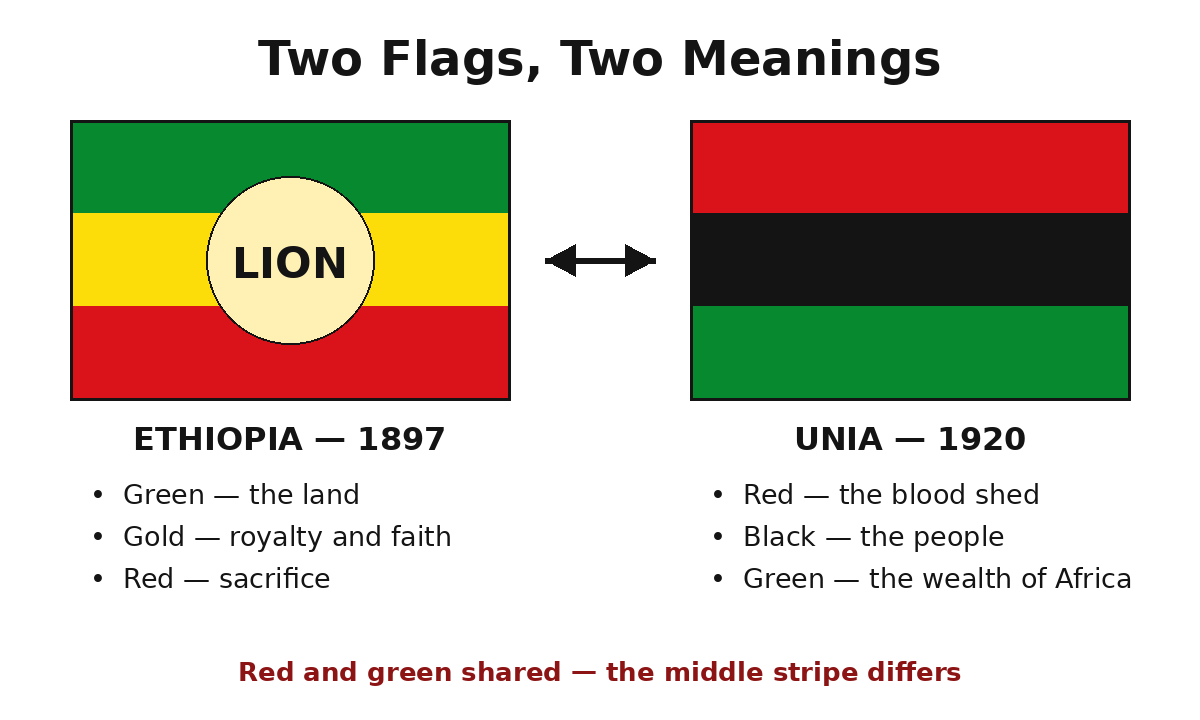

The current Ethiopian flag belongs, first, to Ethiopians, and its proper homes are the official and the celebratory: national days, cultural festivals, restaurants, churches and homes where it stands for the country as it is now. Flying it at a reggae festival as a generic Rasta banner is the one genuinely common misuse in this field, since it borrows a living state’s flag, emblem and all, to decorate a different tradition that already has a banner of its own. The reverse misuse matters too: presenting the lion flag as the current flag of Ethiopia, in a classroom, a shop listing or a news graphic, teaches an error about a real country, whose actual flag has carried the star for a generation. Respect runs in both directions, and it costs nothing but attention.

Garvey’s flag, finally, is the banner of Pan-African pride in the broadest sense, at home at Black history events, Juneteenth celebrations, and anywhere the message is the unity of the African diaspora rather than one faith or one nation. A well-made display can honour all three flags together, provided each is labelled for what it is. That labelling instinct, telling the lion from the star and the gold stripe from the black one, is the whole skill this article set out to teach. Once your eye learns to go straight to the center of the flag and the middle stripe, you will never confuse them again.

Our View

The two flags are not rivals, and treating them as versions of each other sells both short. Ethiopia’s star flag is a young emblem on an old and honourable field, chosen by a republic to speak for all its peoples at once. The lion flag is that same field carrying the emblem Ethiopia set aside, kept in the air by a faith for whom the emperor it honours never stopped mattering. Learn to read the center of the flag and you learn to read the difference between a nation describing itself and a people remembering a king, and there is room in the world, and on this site, for both stories to be told accurately.

— Rastafarian Clothing

Frequently Asked Questions

Is the Rasta flag the same as the Ethiopian flag?

No. The Rasta flag is the imperial Ethiopian flag with the Lion of Judah, retained by the Rastafari movement after the empire ended in 1974. Ethiopia’s current national flag keeps the same green, yellow and red stripes but carries a yellow star with rays on a blue disc, a design adopted in 1996. Same stripes, different emblem, different owner.

What are the Rasta flag colors in order?

From top to bottom: green, gold and red, with the crowned Lion of Judah at the center. The order matches the modern Ethiopian flag. A flag with red at the top is either an early historical design, since the original 1897 tricolour ran red first before the order later changed, or a modern flag hung upside down.

Why is there a lion on the Rasta flag?

The lion is the Conquering Lion of Judah, the emblem and title of Ethiopia’s emperors, including Haile Selassie I. Rastafari regards Selassie as central to the faith, so the movement kept his imperial banner, lion included, as its own. The lion stands for kingship, strength, pride and African sovereignty.

What does the star on the Ethiopian flag mean?

Under Ethiopia’s flag law, the star formed by straight and equal lines signifies the unity of the country’s nations, nationalities and peoples, its yellow rays signify their bright future, and the blue disc behind it signifies peace. The emblem was added to the tricolour in 1996 and its blue was darkened in a 2009 adjustment.

Is the red, black and green flag a Rasta flag?

Not originally. Red, black and green is the Pan-African or Black Liberation flag created under Marcus Garvey and adopted by the UNIA in 1920, before Rastafari existed. Rastas honour Garvey as a prophet and the two flags often appear together, which is why the designs are confused, but the Garvey flag has a black middle stripe and no gold and no lion.

Questions about the colours, the symbols, or an order?

Write to us through our contact page and we will point you to the right guide, garment or answer.

Sources

Recommended

Woman in a white garment with gold trim and gold jewellery beside a green, gold and red flag above terraced hills at sunset

What the Color Gold Means in Rastafari

Gold is the colour people notice first and understand last in Rastafari. A newcomer sees a bright yellow stripe on a flag, a gold chain, a gold-trimmed tam, and assumes it is simply decoration, or simply yellow by another name. That assumption misses almost everything the colour is doing. In Rastafari, gold carries royalty, stolen wealth that must one day be restored, divine light, hope for a just future, and a direct line back to Ethiopia, to its emperors, its church, and its ancient gold trade. This guide untangles gold from yellow, from the Ethiopian flag, and from the separate Garveyite colours, so that when you see gold worn, flown, or sung about, you can read what it is actually saying.

Start with the full picture

Read our complete guide to Rasta colors and their meanings for the whole family of colours, then browse the Rastafarian Clothing shop to see how those colours live in everyday dress.

Woman in a white garment with gold trim and gold jewellery beside a green, gold and red flag above terraced hills at sunset

Key Takeaways

  • Gold in Rastafari means royalty, African wealth, divine light, and hope. It is a claim about history, not a fashion accent.
  • Gold and yellow name the same stripe on the Ethiopian flag. Writers use both words, but Rastafari speech prefers gold because gold carries value and kingship that plain yellow does not.
  • The colour comes first from Ethiopia: its flag, its Solomonic emperors, its Orthodox church art, and its ancient gold coinage and trade.
  • Gold is not a Garveyite colour. Marcus Garvey’s UNIA flag is red, black, and green. Rastafari adds gold from Ethiopia, which is why Rasta dress so often shows four colours together.
  • Wearing gold well means wearing it with understanding: centred between green and red, paired respectfully with symbols such as the Lion of Judah, and never treated as a costume.

Table of Contents

Gold or Yellow? Settling the Name First

Gold is the deliberate word, and the choice of word is the first lesson. Flag manuals, vexillology charts, and many reference books describe the middle stripe of the Ethiopian flag as yellow. That description is accurate as a matter of dye and printing. It tells you what the cloth looks like. It does not tell you what the colour means to the people who revere it. When Rastafari speakers, singers, and artists name that stripe, they overwhelmingly call it gold, and the long Rastafari tradition summed up in the phrase ites, gold and green treats gold as wealth and spiritual richness, not as a paint sample. The distinction matters because yellow, in ordinary English, can sound pale, cautionary, or cheap. Gold never sounds cheap. Gold sounds weighty, enduring, and royal, and those are precisely the associations Rastafari wants to keep in view.

If you have read our overview of Rasta colors, you will have seen this naming question appear again and again, because it confuses readers who move between sources. One book says yellow, a song says gold, a flag shop sells a yellow stripe, and a Rasta elder corrects you to gold, and all four are talking about the same band of colour. The helpful way to hold the two words is this: yellow is the manufacturer’s word, gold is the meaning word. Printers need a reproducible shade, so they specify yellow. Believers need a word that carries history, so they say gold. Neither group is wrong, but only one word explains why the colour moves people. Throughout this post we use gold, following Rastafari usage, while noting where official descriptions use yellow so you can recognise the same fact in different dress.

The confusion deepens because Jamaica’s own flag also uses gold, in a very different design, and because Ghana and many later African flags adopted the same green, gold, and red family. A reader can easily assume all golds mean the same thing everywhere. They rhyme, but they are not identical. Ghanaian gold points most directly to mineral wealth in the ground, as the Ghana Information Services fact sheet puts it plainly when it glosses gold as the mineral wealth of the country. Ethiopian and Rastafari gold includes that mineral sense, but it adds older and more theological layers: Solomonic kingship, church gold leaf, and Aksumite coinage. Keeping those layers separate is the solution to the most common misunderstanding about this colour, and it is why a single-colour deep dive is worth doing at all, rather than repeating a one-line gloss.

Gold on the Ethiopian Flag

Every account of gold in Rastafari must begin with the Ethiopian flag, because that flag is the colour’s passport. The modern Ethiopian tricolour places green at the top, gold or yellow in the middle, and red at the bottom, an order we examine in detail in our guide to the Rasta colors order. The Britannica flag entry records that pennants in these three colours were displayed long before Emperor Menilek II established the first official flag, and that the present design adds a blue disc with a yellow star whose rays speak of unity and a bright future. In the official reading Britannica summarises, blue is for peace, yellow is for hope, justice, and equality, red is for sacrifice for freedom and equality, and green is for labour, development, and fertility. Notice what gold does in that reading: it is the hopeful, just centre. It sits between the land above and the sacrifice below, as if to say that hope and fairness are what the land and the sacrifice are for.

A second reference tradition gives the same centre a slightly warmer tone. The WorldAtlas flag guide describes the yellow band as symbolising justice and harmony, the green as hope and fertility of the land, and the red as strength and sacrifice in defence of the land, with the golden pentagram standing for unity and equality. Harmony is a valuable addition to the gloss. It reminds the reader that gold is not only about wealth held, but about peoples held together. Ethiopia is a country of many nationalities, languages, and faiths, and a central gold star that radiates equally in all directions makes a visual promise that no group stands closer to the light than another. Rastafari, a movement of a scattered people longing for unity, heard that promise clearly and carried it far beyond Ethiopia’s borders.

Ethiopia also traditionally linked its colours to the rainbow after the Flood, a sign of covenant and survival after catastrophe. That biblical framing matters for Rastafari, which reads history through Scripture and understands African peoples in the Americas as exiles being tested, awaiting deliverance and return to Zion, understood as Ethiopia. The account of the movement in Britannica on Rastafari makes that structure explicit: past, present, and future are read through Exodus and exile, and Ethiopia is held as the ultimate home and seat of Jah. Within that story, gold is the colour of the home’s glory. It is not nostalgia for decoration. It is the visible gleam of a place believed to be both real and promised, a kingdom that survived colonisation when almost no other African state did, and whose flag therefore became proof that African sovereignty was not a dream but a fact that had endured.

Diagram comparing the Ethiopian green, gold and red family with the UNIA red, black and green family

Wealth Taken, Wealth Remembered

Gold remembers wealth twice: wealth that Africa produced, and wealth that was taken from Africa. No source states the Rastafari reading more compactly than the museum record. The Smithsonian crocheted hat held by the Anacostia Community Museum is described with its colours decoded in a single sentence: red for the blood of martyrs in the Black liberation struggle, green for Ethiopia’s natural beauty, gold for Africa’s wealth, and black for African people. That short gloss, attached to an ordinary handmade hat, shows how completely the meaning had entered daily life. A person did not need a textbook to read the hat. The colours themselves taught the history lesson every time the hat was worn in the street.

A fuller academic treatment reaches the same conclusion with a sharper edge. The study of symbolism hosted by the University of Vermont explains that in Rastafarian art gold symbolises the wealth of Africa that was stolen by European invaders, while red stands for the blood of martyrs, green for the lush vegetation of Africa, and black for the Black African race. The word stolen is doing essential work there. Gold in this reading is not a celebration of riches comfortably possessed. It is an accusation and a claim. It says that Africa was rich, that its riches were looted through slavery, colonial extraction, and unequal trade, and that remembering the gold is a way of refusing to accept poverty as Africa’s natural condition. Wearing gold becomes a quiet act of historical correction.

The historical record underneath that claim is solid, and it reaches back far beyond the colonial period. The university course text at LibreTexts on Aksum notes that by the seventh century BCE gold and silver were already moving through the kingdom of Da’amat as trade goods, and that the later state of Aksum began minting its own gold and silver coins in the third century CE as proof of how important long-distance trade was to its economy. Pause on that fact. An African empire on the Red Sea trade routes was striking gold coinage, accepted by merchants who also dealt with Rome, Persia, and India, at a time when very few states anywhere could do so. Gold in Ethiopia is therefore not a metaphor borrowed from elsewhere. It is a literal part of the country’s economic history, dug, traded, minted, and buried with its wealthy dead in objects gilded in gold.

The biblical layer reinforces the historical one. The Biblical Archaeology Society recounts how the Queen of Sheba arrived in Jerusalem with camels carrying spices, gold, and precious stones, and gave Solomon 120 talents of gold, the largest gift of its kind in the account. Ethiopian tradition, preserved in the Kebra Nagast, names that queen Makeda and identifies her land as Ethiopia, making the gold-bearing queen an Ethiopian queen. Whether a reader approaches that story as history, as sacred tradition, or as national epic, its effect on the colour’s meaning is the same: gold flows from Africa toward the world’s most famous wise king, not the other way round. Africa appears in the story as giver and sovereign, not as supplicant. Rastafari preaching has returned to that reversal for generations, and our reflections on sayings such as who Jah bless, no man curse draw on the same conviction that dignity was given long before it was denied.

Read this way, gold jewellery, gold thread, and gold print in Rasta contexts carry a double charge that a purely decorative reading misses. They celebrate ingenuity and abundance, and they protest theft and impoverishment, at the same time. That doubleness explains the colour’s emotional range in music and speech, where gold can sound triumphant in one line and mournful in the next. It also explains why cheap, flimsy imitation gold can feel wrong to a thoughtful wearer even when the shade is correct. The meaning asks for substance. A colour that stands for real wealth, really taken, deserves to be rendered with some care, in materials and designs that honour rather than trivialise the claim.

Market stall with folded green, gold and red textiles beside gold jewellery and brass weights

Royalty, Solomon, and the Lion of Judah

Gold is the colour of the throne, and in Rastafari the throne is Solomonic. Ethiopian emperors claimed descent from Solomon and the Queen of Sheba through their son Menelik I, a lineage narrated in the Kebra Nagast and used for centuries to legitimate the dynasty. Gold crowns, gold crosses, and gold-trimmed robes were the ordinary visual language of that claim. When Rastafari adopted Ethiopian colours, it adopted that royal language too, and redirected it toward a people who had been told they were nobody’s royalty. To dress an ordinary person, a labourer, a musician, a mother, in the colour of emperors was a deliberate act of restoration. It said that kingship was not the property of a palace. It belonged, by heritage, to the people themselves.

At the centre of that royal language stands the Lion of Judah, the emblem we explore fully in our guide to the Lion of Judah. The museum record again gives a crisp anchor. The Kennedy Library lion statuette, a silver lion wearing a gold crown presented by Haile Selassie during his state visit, is catalogued with the note that the Lion of Judah is the national symbol of Ethiopia and that Conquering Lion of the Tribe of Judah was the title of every Ethiopian emperor. The detail that the crown, specifically, is gold while the lion is silver is instructive. Gold marks the crown because gold marks sovereignty itself. Wherever you see the lion rendered in Rasta art with a gold crown, a gold mane, or on a gold field, the same grammar is at work: gold identifies the royal element and lifts it above the rest of the design.

The emperor at the heart of the movement gives that grammar a human face. The biography in Britannica on Haile Selassie records that Tafari Makonnen served as regent, was crowned emperor on November 2, 1930, took the name Haile Selassie, meaning Might of the Trinity, modernised his country, led it through exile and return during the Italian invasion, and helped establish the Organization of African Unity. For Rastafari, as our account of why Haile Selassie still reigns explains, those historical facts are read together with biblical titles such as King of Kings and Conquering Lion of Judah, and the emperor is revered as messiah and returned Christ by many, though not all, adherents. Gold gathers around his image for the same reason it gathered around Solomon’s: in this tradition, the righteous king and the precious metal belong together, each testifying to the other’s worth. The collected Haile Selassie quotes most often shared in the community return repeatedly to unity, education, and perseverance, themes that keep the royal colour from collapsing into mere splendour. Gold, rightly read, obliges conduct.

Divine Light in Church and Art

Before gold was a flag colour, it was the colour of divine light on church walls. Ethiopian Orthodox art is among the oldest continuous Christian art traditions in the world, and its use of gold is precise. The study at The History Professor explains that in icon painting gold leaf was reserved for halos, for the garments of Christ and the Virgin Mary, and for the pages of open Gospels, signifying divine light and holiness, while red spoke of martyrdom, blue of heaven, and green of life and resurrection. Reserved is the key word. Gold was not spread everywhere for richness. It was placed only where heaven touched earth: around a holy head, on a sacred garment, on the words of Scripture themselves. Scarcity gave the colour its theology. To see gold was to see the exact point where the divine entered the picture.

That disciplined use travelled into Rastafari visual culture, even among artists who never entered an Ethiopian church. Rasta painters learned, often through reproductions, photographs, and church visits, to halo the emperor’s portrait in gold, to letter sacred words in gold, and to frame the lion in gold, while leaving ordinary elements in ordinary colours. The effect, when done well, is immediately legible to anyone formed by the older tradition, and quietly moving even to viewers who cannot name why. Gold tells the eye where to reverence. It is a highlighter for holiness. Misused, spread across every surface for maximum shine, it highlights nothing, and the picture goes flat and noisy. The church tradition therefore offers contemporary designers a practical rule as well as a spiritual one: use gold where it means most, and let restraint do the shining.

Hands holding an ornate gold Ethiopian processional cross with interlaced pattern above an open manuscript

Diagram listing four meanings of gold in Rastafari: royalty, wealth, divinity and hope

How Gold Differs from the Garvey Colours

Gold is where Rastafari and Garveyism meet, agree, and then part company, and confusing the two is the second great misunderstanding about this colour. Marcus Garvey’s Universal Negro Improvement Association adopted its flag at its New York convention in 1920, with horizontal bands of red, black, and green. The report by NPR Illinois, drawing on historian Robert Hill, explains that Garvey treated the absence of a Black flag as a mark of political powerlessness and the creation of one as proof that the race had come of age politically, with red for blood shed and shared, black for Black people, and green for growth and the fertility of Africa. It is a magnificent flag with a magnificent rationale, and Rastafari honours Garvey as a prophet. But its three colours contain no gold, and no yellow. Anyone who attributes gold to Garvey’s design has merged two different flags into one.

Rastafari’s gold comes from the other source: Ethiopia. Where Garvey’s flag centres black, for the people, the Ethiopian flag centres gold, for hope and royalty, and Rastafari, which centres Ethiopia as Zion and home, was never going to surrender that centre. The movement’s practical solution, visible on streets and stages for generations, was to wear both inheritances at once. That is why the four-colour set, red, gold, green, and black, is so common, and why summaries of livity in the Britannica Rastafari account list dressing in red, green, gold, and black together, glossed as blood, herbs, royalty, and Africanness. Four colours, two flags, one people with two homelands to honour: the African continent in general, figured by Garvey’s black, and Ethiopia in particular, figured by gold. Once you see the four-colour set as a merger rather than a muddle, a great deal of Rasta design suddenly becomes readable.

For the reader trying to keep the families straight, a simple test helps. If black is in the set and gold is not, you are looking at the Garveyite family. If gold is in the set and black is not, you are looking at the Ethiopian family. If both are present, you are almost certainly looking at Rastafari usage, or at later Pan-African design influenced by it. Our main guide to Rasta colors returns to this test with visual examples, and it is worth bookmarking if you buy, sell, teach, or write about these colours, because the two families are confused in print constantly, including by well-meaning shops and textbooks. Accuracy here is not pedantry. Each family honours a different history, and the people who fly them notice whether you know the difference.

Wearing Gold with Understanding

Wearing gold well is mostly a matter of proportion, placement, and respect. Proportion first. Because gold carries so much meaning, a little of it, well placed, says more than a flood of it. A gold medallion of the lion on a plain ground, a gold stripe at the centre of a tam, gold embroidery at the cuff or hem of a white garment, or a single gold accessory against green and red, all read as deliberate. Head-to-toe metallic gold reads as costume, and costume is the one thing a sacred colour should never become. The church rule applies to the wardrobe: reserve gold for the point of honour. In practice, that usually means one gold focal point per outfit, supported by green and red, with black grounding the whole when you want the fuller four-colour statement.

Placement second. As the flag teaches, gold sits naturally in the middle: between green above and red below on horizontal designs, at the centre of a chest emblem, at the heart in a pendant, or as the middle band of a wrist or head wrap. Our guides to traditional Rasta outfits show that central placement recurring across generations of dress, from formal white-and-gold ceremonial wear to everyday tams and scarves. For women, the companion guide to how to dress like a Rastafarian woman shows gold working through headwrap bands, jewellery, and trim that frame the face with light. For men, our survey of what Rasta men wear finds gold most often in the tam stripe, a chain and pendant, or a single embroidered emblem, each time as the outfit’s point of dignity rather than its loudest element.

Respect third, and it governs the first two. Gold in this tradition points to Ethiopia, to a living faith, and to a history of loss and endurance. That does not mean only adherents may wear it; Rasta colours have been welcomed worldwide as signs of solidarity, peace, and African pride, and the movement’s music carried them to every continent as an invitation. It does mean the thoughtful wearer learns the meanings before wearing the colours, avoids sacred emblems as jokes or novelties, and buys, where possible, from makers who understand and honour the tradition, including the long West and East African textile heritage traced in our history of ancient West African clothing, where gold thread and gold dust were prestige materials centuries before they were fashion. Knowledge does not make the colours heavier to wear. It makes them lighter, because the wearer no longer fears getting them wrong, and can enjoy them as what they are: a wearable history lesson in hope, royalty, and return.

Our View

Gold is the conscience of the Rasta colours. Green can be enjoyed as nature and red admired as courage without much thought, but gold refuses to be casual. It asks the wearer to remember a queen who arrived bearing treasure, an empire that minted its own coins, a church that saved its gold leaf for the face of the divine, and a people whose wealth was taken and whose dignity was not. We hold that gold should be taught, worn, and designed with that memory intact, centred on the garment as it is centred on the flag, and rendered with the care its history deserves. Get gold right, and the rest of the colours fall into place around it, because you have understood that these are not decorations at all. They are a history you can wear.

— The Rastafarian Clothing Team

Frequently Asked Questions

Is the middle Rasta colour gold or yellow?

It is the same stripe under two names. Official flag descriptions usually call it yellow, because they are specifying a reproducible shade. Rastafari usage calls it gold, because gold carries the meanings the colour holds: royalty, African wealth, divine light, and hope. When you are discussing meaning, gold is the better and more respectful word. When you are matching a printer’s specification, you may need the word yellow to get the right ink.

What does gold mean in Rastafari, in one sentence?

Gold means the royalty, wealth, divine light, and hopeful future of Africa and Ethiopia, including wealth that was stolen and will, in the movement’s hope, be restored. If you need it shorter still, remember the museum gloss attached to a handmade Rasta hat: gold is Africa’s wealth. Everything else in this post is an expansion of those three words.

Did Marcus Garvey choose the colour gold?

No. Garvey’s UNIA flag, adopted in 1920, is red, black, and green, with no gold band. Gold entered Rastafari dress from the Ethiopian flag, whose centre has always been gold or yellow. Rastafari honours Garvey as a prophet and often wears his black alongside Ethiopian gold, which is why the four colours red, gold, green, and black so often appear together, but the two flags and their colour sets have different origins and should not be merged.

Why is gold linked to the Lion of Judah?

Because gold marks sovereignty. The Lion of Judah was the title and emblem of Ethiopia’s emperors, who claimed Solomonic descent, and gold crowns, thrones, and regalia were the visual language of that sovereignty. A well-known museum example is a silver lion statuette wearing a gold crown, presented by Haile Selassie himself. In Rasta art the lion is therefore often crowned, maned, or set in gold, to identify it unmistakably as the royal element of the design.

Can anyone wear gold in Rasta colours, or is it only for Rastafari?

Anyone may wear these colours, and they are worn worldwide as signs of African pride, peace, and solidarity. The tradition asks only for understanding and respect: learn what gold and its companion colours mean, treat sacred emblems such as the Lion of Judah and the Ethiopian cross as emblems rather than novelties, and support makers who honour the tradition. Worn with that knowledge, gold is an invitation the movement’s music has extended to the whole world.

Questions about colours, symbols, or sizing?

We are glad to help you choose with understanding. Contact us and we will reply as soon as we can.

Sources

Recommended

Flag of Ethiopia in the correct order, with the green band on top, the yellow-gold band in the middle, and the red band at the bottom, and the blue national emblem disc at the centre

Red, Gold and Green: Where the Rasta Colors Actually Come From

Red, gold and green may be the most recognised colour combination in reggae culture, yet almost everything about where the colours actually come from gets tangled in the telling. They are often credited to a single flag, a single man or a single moment, when in truth they travelled: from Ethiopian church pennants and an imperial battlefield, through a Harlem convention hall that deliberately chose different colours of its own, and across the Atlantic in photographs, newspapers and song until they settled on Jamaica and became the everyday dress code of a faith. This is that journey, traced in order — where each colour set began, how the two sets differ, and how they ended up woven together in the clothes people wear today.

Key Takeaways

  • The Rasta colours descend from the Ethiopian tricolour: green, gold (yellow) and red pennants flown in Ethiopia long before a rectangular national flag existed.
  • Emperor Menelik II combined the pennants into a single tricolour in 1897, a year after Ethiopia’s victory at Adwa preserved its independence while most of Africa was colonised.
  • The imperial banner placed the Conquering Lion of Judah at its centre, tying the colours to Ethiopia’s Solomonic royal line.
  • Marcus Garvey’s UNIA adopted a different flag in 1920 — red, black and green — with black, not gold, in the middle. The two flags are cousins, not twins.
  • The 1930 coronation of Haile Selassie I carried Ethiopian imagery into Jamaican religious life, and reggae later carried the colours to the world.

Table of Contents

Ethiopia Before the Flag

Long before red, gold and green appeared on a knitted tam or a festival flag, the three colours were already flying in Ethiopia — not as a rectangular national flag, but as separate pennants carried in procession and war. Ethiopia’s own tradition, recorded in the rainbow tradition described by Encyclopaedia Britannica, identifies the green-yellow-red banner with the rainbow God set in the heavens after the Flood in the book of Genesis. That is a striking place for a flag to begin: not in a herald’s office or a design competition, but in scripture, in a country where church and crown had been intertwined for centuries and where coloured pennants were part of religious and military life well before any European-style flag code existed.

The detail matters because it corrects the most common misunderstanding about the Rasta colours. They were not invented for the Rastafari movement, and they were not invented in Jamaica. They were not even, at first, a flag in the modern sense. They were three colours with a settled place in Ethiopian public life, displayed as pennants before the first official flag was established. When later generations in Jamaica reached for a visual language of African dignity, they did not have to create one from nothing. Ethiopia had been speaking it for generations, in cloth, in church processions and on campaign.

Ethiopia could play that role for one simple reason: it had survived. While the map of Africa was being redrawn by European empires, Ethiopia remained an independent African state ruled by its own emperors, with its own ancient Christian church, its own written language and its own court rituals. For people of African descent in the Americas, whose histories had been deliberately severed, an unconquered African kingdom with a crowned king and a recognisable banner was more than a country. It was proof — visible, flag-shaped proof — that African sovereignty was real and had endured. The colours drew their power from that survival long before anyone outside Ethiopia wore them.

Adwa and the Tricolour of 1897

The pennants became a flag because of a war. In the 1890s Italy, established in neighbouring Eritrea, pressed a disputed treaty reading that would have made Ethiopia an Italian protectorate. Emperor Menelik II rejected the claim, mobilised an army drawn from across his empire, and met the Italian invasion in the northern highlands. The resulting Battle of Adwa, fought on March 1, 1896, ended in a decisive Ethiopian victory that Britannica describes as the first crushing defeat of a European power by African forces during the colonial era. The Treaty of Addis Ababa that followed recognised Ethiopia’s full sovereignty, and Menelik’s standing at home and abroad rose accordingly.

Timeline running from Ethiopian colour pennants and the Battle of Adwa through the 1897 tricolour, the 1920 UNIA flag and the 1930 coronation, ending with the colours established in Jamaica
From pennants to a national tricolour, and from Addis Ababa to Harlem and Kingston: the main stops on the colours’ journey.

A year after Adwa, the colours took their modern form. Britannica’s flag history records that pennants of the three colours had been displayed before Emperor Menelik II established the first official flag on October 6, 1897, bearing the first letter of his name in Amharic script on the yellow stripe. Other flag references date the combined rectangular tricolour to October 11, 1897; the small difference in the recorded day matters far less than the sequence, which is not in dispute — victory first, then a single rectangular banner joining what the pennants had carried separately. The order of the stripes also settled over time: red originally rode on top, and the arrangement later flipped to the green-over-gold-over-red order recognised today.

Because Ethiopia kept its flag while other African nations were still colonies, its colours became a template far beyond its borders. The CIA World Factbook notes that Ethiopia’s three main colours were so often adopted by other African countries on independence that they became known as the Pan-African colours. Ghana, Cameroon, Senegal, Mali and many others would eventually raise green, gold and red in some order, each time nodding, consciously or not, toward the one African state that had never had to ask permission to fly them. Every one of those later flags is part of this story’s family tree, and the Rastafari use of the colours sits on the same branch: an Ethiopian inheritance, adopted in admiration.

The Lion of Judah Banner

A plain tricolour, however, was only half of the imperial image. For official purposes the Ethiopian banner carried a device at its centre: the Conquering Lion of Judah, a crowned lion holding a staff topped by a cross, with ribbons in the three national colours. Britannica explains that the lion asserted a specific claim — that Menelik I, the legendary first emperor, had been the son of the Queen of Sheba and the biblical King Solomon — and with it the claim that Ethiopia’s emperors ruled in an unbroken Solomonic line. The first legal definition of the lion flag followed in November 1932, shortly after Haile Selassie’s coronation, and the banner remained in use until the empire fell in 1974, apart from the years of Italian occupation.

This is why the lion, and not just the stripes, saturates Rastafari imagery. The colours say Ethiopia; the lion says which Ethiopia — the Solomonic kingdom, the throne of David’s line transplanted to Africa. Our companion history of the Lion of Judah in Rastafari culture follows that symbol in full, and the related guide to the Ethiopian coat of arms shows how the imperial emblems fit together. For the origins of the colours themselves, the point to hold onto is the pairing: in imperial use, tricolour and lion were one statement, cloth and crown together, and it was that combined image — flag, lion, emperor — that the outside world received.

It was also the image attached to a person. When Ras Tafari Makonnen was crowned emperor on November 2, 1930, taking the throne name Haile Selassie I, he inherited the banner, the lion title and the Solomonic story in a single ceremony staged for maximum international attention, with foreign delegations and press in attendance. Britannica notes that he was afterwards regarded by the Rastafari movement as the messiah of the African race. The colours now had a living face, a coronation date and newspaper photographs that could cross an ocean — which is exactly what they did, though not before another flag entered the story from an entirely different direction.

Garvey and the Red, Black and Green

Marcus Garvey was born in St Ann’s Bay, Jamaica, in 1887, and on August 1, 1914, in Kingston, he founded the UNIA — the Universal Negro Improvement Association — dedicated to racial pride, economic self-sufficiency and an independent Black nation in Africa. The organisation found only a modest following in Jamaica, so Garvey carried it to Harlem in 1916, where it caught fire. The UCLA Marcus Garvey and UNIA Papers Project records that by 1920 the UNIA had hundreds of chapters worldwide, hosted elaborate international conventions and published the Negro World, a weekly so influential it was soon banned in many parts of Africa and the Caribbean. Garvey understood earlier than almost anyone that a scattered people needed shared symbols — a shipping line, an anthem, uniforms, titles — and above all, a flag.

Red, black and green horizontal tricolour flag adopted by the Universal Negro Improvement Association in 1920
The UNIA tricolour: red over black over green, adopted at Madison Square Garden in August 1920.

On August 13, 1920, during its month-long convention at Madison Square Garden in New York, the UNIA formally adopted its flag in Article 39 of the Declaration of Rights of the Negro Peoples of the World. The association’s own history records the meanings it assigned: red for the blood that unites all people of Black African ancestry and was shed for liberation; black for Black people themselves, a nation affirmed by the flag’s existence; and green for the abundant natural wealth of Africa. The flag was, in part, a direct rebuttal — created in response to a popular racist song of the era built on the taunt that every race had a flag except one. Garvey’s answer was to give his movement a banner and dare anyone to repeat the taunt.

Notice what Garvey did not do. He did not copy Ethiopia’s flag. His middle stripe is black, not gold, and the difference was deliberate: where Ethiopia’s banner spoke of a kingdom, Garvey’s spoke of a people — their blood, their skin, their land. As Smithsonian Magazine’s account of the National Museum of African American History and Culture explains, the Black Liberation Flag created in 1920 by Garvey and UNIA members was meant to mobilise and unite the whole African diaspora, and its colours proved so durable that artist David Hammons could rebuild the American flag itself in red, black and green seventy years later and be instantly understood. Two colour systems were now in circulation — Ethiopia’s green, gold and red, and Garvey’s red, black and green — both pointing at Africa, both carried by Black pride, and destined to be braided together in Jamaica.

Two Flags, One Persistent Confusion

Because the two flags share red and green and differ only in the middle stripe, they are constantly mistaken for each other, and the mistake flattens the history. Set them side by side and the distinction is clean. Ethiopia’s is a national flag: green over gold over red, born from pennants, formalised in 1897, centred for decades by the Lion of Judah and centred today by a blue disc and gold star, which the Factbook records was added in 1996. Garvey’s is a movement flag: red over black over green, adopted in 1920 by a diaspora organisation that held no territory and ruled no state, which was precisely its point — a nation without a country could still have colours.

Side-by-side comparison diagram of the Ethiopian green, gold and red tricolour with the Lion of Judah and the UNIA red, black and green flag, showing the shared colours and the different middle stripe
Same family, different flags: Ethiopia’s green, gold and red beside the UNIA’s red, black and green.

Rastafari dress draws on both, which is why the combination so often appears as four colours rather than three. Britannica’s survey of Rastafari livity describes adherents dressing in red, green, gold, and black, a four-colour palette that only makes sense once you see the two flags behind it: gold from Ethiopia’s imperial banner, black from Garvey’s liberation flag, red and green common to both. Neither flag cancelled the other out. In Jamaica they layered — the kingdom’s colours and the movement’s colours worn together, each correcting the other’s story. If you want the colour-by-colour symbolism of that combined palette, our earner guide to what the Rasta colors mean is the place to go; this history simply insists that the palette has two birth certificates, one Ethiopian and one Garveyite, and honesty about the colours starts with keeping both.

There is a practical payoff to getting this right. A tam in green, gold and red honours Ethiopia and its emperor. A design in red, black and green quotes Garvey and the liberation movement. A garment carrying all four colours — the most common Rastafari arrangement of all — is making the full statement: kingdom and people, Addis Ababa and Harlem, crown and diaspora. Wearers have always known the difference instinctively, even when outside commentators lumped every combination together as a generic reggae rainbow. The colours were never generic. Each stripe was argued over, adopted by vote or by decree, and carried at real cost by the people who first raised it.

The 1930 Coronation and Jamaica

The braid tightened on November 2, 1930. Ethiopia’s regent, Ras Tafari Makonnen, was crowned Emperor Haile Selassie I in Addis Ababa in a ceremony reported around the world. In Jamaica, the news landed in soil Garvey had already tilled. As Smithsonian Magazine’s history of the movement recounts, Garvey had frequently cited Psalm 68:31 — the prophecy that princes would come out of Egypt and Ethiopia would stretch out her hands to God — and had taught his followers to watch for a saviour crowned in Africa. When the coronation came, Jamaican preachers such as Leonard Howell read it as that prophecy fulfilled: the crowned king was African, his banner was the lion tricolour, and his precoronation name, Ras Tafari, gave the new faith its name.

What formed in Jamaica in the 1930s was therefore never just an Ethiopian fan club, and never just a Garveyite study circle. It was a new religious movement that fused the two inheritances: Garvey’s pan-African pride and organisational example, Ethiopia’s living king, flag and church, and the King James Bible read through the experience of slavery and colonial Jamaica. The colours fused with them. To wear green, gold and red in 1930s Kingston was to declare allegiance to an African king most Jamaicans would never see, in defiance of a colonial order that treated the wearers as outcasts. To add Garvey’s black was to declare the other half of the creed — that the people wearing the colours were themselves the nation the flags described.

None of this arrived from nowhere. The reading of Ethiopia as a promised land — sometimes called Ethiopianism — had circulated among enslaved and free Black Christians in the Americas for well over a century before Garvey, anchored in that same psalm and in the sheer fact of an African Christian kingdom still standing. Garvey gave the longing an organisation, a newspaper and a flag. The coronation gave it a date, a face and a photograph. Jamaica, where both currents ran strong and where colonial hardship gave them urgent local meaning, is simply where the two rivers met — and the colours show the confluence to this day.

The decades that followed tested that declaration hard. Early Rastafari were beaten, shaved, jailed and driven from place to place, and the movement’s own memory keeps those years close; our collection of Haile Selassie quotes gathers the words Jamaican believers carried through them. Italy’s invasion of Ethiopia in 1935 and the emperor’s exile and return bound Jamaican sympathies tighter still, because the flag under attack in Africa was now, in a real sense, their flag too. By the time Jamaica approached its own independence in 1962, the colours had completed the hardest part of their journey: they no longer needed Ethiopia’s permission or Garvey’s organisation to survive. They lived on Jamaican heads, shoulders and banners, as ordinary — and as charged — as clothing gets.

Kingston and the World

Street scene in downtown Kingston, Jamaica, with shoppers, traffic and storefronts along a busy commercial road
Kingston, Jamaica: the city where Ethiopian and Garveyite colours fused into a single everyday palette.

On April 21, 1966, the journey came full circle in a single afternoon. Haile Selassie arrived in Jamaica on a state visit, and the Jamaica Information Service records that 100,000 Rastafari descended on Palisadoes Airport in Kingston with drums and chalices to meet him — a crowd so vast the day is still kept as Groundation Day, which our guide to Groundation Day covers in depth. The emperor whose flag they had worn for three decades stood on Jamaican soil and treated the outcasts of Jamaican society with respect, and the Service notes the visit gave Rastafari a measure of respectability for the first time — and that the reggae music carrying the movement, colours and all, then became commercially viable and spread worldwide.

Reggae was the colours’ second ship, after Garvey’s newspapers and the coronation photographs. Britannica’s biography of Bob Marley describes how the Wailers’ Rastafari faith shaped their music and how, after signing to Island Records and releasing Catch a Fire, their reggae gained a global audience — an audience that met the music wearing its colours, on album sleeves, stage clothes and Marley’s own crocheted caps. The companion history of Jamaica’s impact on the spread of Rastafarian culture traces that export in full, and our look at reggae colors follows the palette onto stage and vinyl. Sayings travelled with the cloth, too — the blessing explored in Who Jah Bless, No Man Curse moved from scripture to lyric to everyday speech on the same route.

By the end of the twentieth century the circuit was complete. Colours that began as Ethiopian pennants could be bought on a market stall in London, worn at a festival in California or painted on a wall in Kingston, and at every stop someone could still tell you the whole chain: Adwa, Menelik, the lion, Garvey, the coronation, Kingston, Marley. Few design palettes in the world carry a documented itinerary like that. The colours did not drift into global culture by accident or by fashion. They were carried, deliberately, by an empire defending itself, a movement organising itself and a faith refusing to disappear — and each carrier left the palette slightly richer than they found it.

Wearing the History Today

All of which raises a fair question for anyone who wears the colours now: what, exactly, are you putting on? The honest answer is a layered statement, and the layers are the point. Green, gold and red alone salute Ethiopia — its land, its crown, its unconquered history. Red, black and green alone quote Garvey’s liberation flag. The full four-colour arrangement, the one knitted into tams, woven into belts and printed across traditional Rasta outfits that still hold their shape today, states the whole Jamaican synthesis at once. None of these is a costume. Each is a citation, whether the wearer spells it out or not.

How the citation gets worn has its own grammar, and it differs by wearer and occasion. Our styling guides walk through it piece by piece — how to dress like a Rastafarian woman and what Rasta men wear both start from the colours and build outward to fabric, fit and setting — while the deeper roots of the cloth itself reach back through the traditions surveyed in ancient West African clothing. The through-line across all of it is intention. In a culture where a middle stripe — gold or black — can change a flag’s entire meaning, choosing what to wear is a small act of history-keeping.

So wear the history accurately. Know that the gold is Ethiopia’s and the black is Garvey’s, that red ran on top of the first tricolour and green rides there now, that a lion once stood at the centre of the banner and a star stands there today. Know that the colours survived Adwa’s guns, Harlem’s printing presses, Kingston’s police raids and a century of being dismissed as mere decoration. Red, gold and green were never just a colour scheme. They are the visible residue of an argument — that African people had a past worth honouring and a future worth organising for — and the argument, stripe by stripe, is still being worn.

Our View

Most colour stories in fashion are marketing. This one is not. Red, gold and green earned their meaning the slow way — defended in battle, voted on in convention, preached in the street and sung to the world — and that is why they still stop people in a way a seasonal palette never will. Our view is simple: the colours deserve to be worn with their history attached. Gold for Ethiopia, black for Garvey’s people, red and green for the ground both flags share. Get the middle stripe right, and you have understood more real history than most textbooks manage.

— Rastafarian Clothing

Frequently Asked Questions

Did the Rasta colours come from Ethiopia or from Marcus Garvey?

From both, in sequence. Green, gold and red are Ethiopia’s colours, formalised as a tricolour in 1897. Marcus Garvey’s UNIA adopted its own flag — red, black and green — in 1920. Rastafari in Jamaica layered the two inheritances together, which is why the palette is so often worn as four colours: red, green, gold and black.

What is the difference between red, gold and green and red, black and green?

The middle stripe. Red, gold and green is the Ethiopian order, from the national tricolour that carried the Lion of Judah. Red, black and green is the UNIA liberation flag, where black stands for Black people themselves. They share red and green, point at the same continent, and mean different things.

When did Ethiopia adopt its tricolour?

The combined rectangular tricolour dates to 1897, under Emperor Menelik II, a year after the victory at Adwa. Britannica dates the first official flag to October 6, 1897; other flag references give October 11, 1897. The three colours had been flown as pennants long before either date.

Why is there a lion on so many Rasta flags?

The Conquering Lion of Judah stood at the centre of Ethiopia’s imperial banner and asserted the emperors’ claimed descent from Solomon and the Queen of Sheba. Because Rastafari honour Haile Selassie I, the last emperor to reign under that banner, the lion travelled with the colours into Jamaican religious art and dress.

Why do the colours appear in so many other African flags?

Because Ethiopia was the African state that stayed independent. The CIA World Factbook notes its three colours were adopted by so many countries on independence that they became known as the Pan-African colours — a deliberate nod to the one flag that had never been lowered to a colonial power.

Questions about the colours, the history or a piece in the shop?

We are glad to help you choose well and wear it accurately.

Contact Us

Sources

  1. Encyclopaedia Britannica, “Flag of Ethiopia” — Flag of Ethiopia
  2. CIA World Factbook, “Ethiopia” (Gov Archive) — CIA World Factbook: Ethiopia
  3. Encyclopaedia Britannica, “Battle of Adwa” — Battle of Adwa
  4. Encyclopaedia Britannica, “Haile Selassie I” — Haile Selassie I
  5. Encyclopaedia Britannica, “Marcus Garvey” — Marcus Garvey
  6. UCLA Marcus Garvey and UNIA Papers Project, “Marcus Garvey: An Overview” — Garvey Papers overview
  7. Universal Negro Improvement Association and African Communities League, “History of the Flag” — History of the Flag
  8. Smithsonian Magazine, “Smithsonian’s NMAAHC Acquires David Hammons’ ‘African American Flag'” — Smithsonian Magazine
  9. Encyclopaedia Britannica, “Rastafari” — Rastafari
  10. Smithsonian Magazine, “Rasta Revealed” — Rasta Revealed
  11. Jamaica Information Service, “Minister Grange Celebrates Rastafari Groundation Day” — Jamaica Information Service
  12. Encyclopaedia Britannica, “Bob Marley” — Bob Marley
Ethiopian flag waving against a twilight sky, green band on top, gold in the middle, red at the bottom, with the blue national emblem disc at the centre

Rasta Colors in Order: The Sequence and What Each Color Stands For

The Rasta colors in order are green, gold, and red — green at the top, gold in the middle, and red at the bottom. That is the sequence on the Ethiopian tricolour that Rastafari adopted as its own banner, and it is the sequence that matters when you read a flag, choose a garment, or check whether a design was put together with care. Yet it is one of the most commonly muddled facts in the whole subject: people list the colors in speech order, borrow the order from a different flag, or repeat a lyric as if it were a flag specification, and soon red is sitting on top and the meaning is lost. This guide settles the question directly — the order plainly, what each color stands for in its position, where the sequence comes from, the one famous historical exception, and how this banner differs from the flags it is confused with.

Start here: Rasta Colors — our main guide to the colors and their meanings

Shop Rastafarian Clothing — garments and pieces in green, gold, and red

Contact Us — questions about the colors, the culture, or an order

Key Takeaways

  • The Rasta colors in order, top to bottom, are green, gold, and red.
  • Green stands for the land, hope, and fertility; gold stands for royalty, wealth, peace, and justice; red stands for blood, sacrifice, and strength.
  • The sequence comes from the flag of Ethiopia, the African nation at the heart of Rastafari faith and identity.
  • The very first combined Ethiopian tricolour placed red on top; the order was later flipped to the green-first sequence used today.
  • Garvey’s Pan-African banner is a different flag — red, black, and green, with no gold — and black in Rasta dress carries its own separate meaning.

Table of Contents

The Order, Stated Plainly: Green, Gold, Red

Read the banner the way you would read a page: from the top down. The first color is green. The second, the band across the middle, is gold — the rich yellow-gold that flag descriptions usually record simply as yellow. The third, the band along the bottom, is red. Green, gold, red: that is the whole answer, and everything else here is the meaning, the history, and the proof behind those three words in that arrangement. The current national flag of Ethiopia, from which the Rasta banner descends, is described by World Atlas as three equal horizontal bands of green at the top, yellow in the middle, and red at the bottom, with a blue disc and gold star at the centre in its modern state form. When Rastafari use the plain tricolour, or the older imperial version with the Lion of Judah at its centre, the bands underneath stay in exactly the same order. The emblem changes with the era. The sequence does not.

Why does the order deserve a page of its own? Because a flag is not a bag of colors; it is a statement arranged in a deliberate sequence, and scrambling the sequence scrambles the statement. Green first declares what comes before everything else — the land and life itself. Gold in the middle is the treasure held at the centre of the story. Red last, at the foundation, is the price paid to hold the other two. For the fuller treatment of each color’s symbolism across Rasta life, our main guide to the rasta colors goes deeper, and our companion piece on reggae colors follows the same palette through the music that carried it around the world.

Flag of Ethiopia in the correct order, with the green band on top, the yellow-gold band in the middle, and the red band at the bottom, and the blue national emblem disc at the centre
The Ethiopian tricolour in its correct order: green, gold, red, top to bottom.

Green on Top: The Land, Hope, and Life

Green leads the sequence because the land comes first. In the Ethiopian reading, green is the earth itself — the fertile highlands and valleys of the homeland, the crops that feed the people, and the hope that life renews itself season after season. Britannica’s flag entry records the modern official reading, in which green is equated with labour, development, and fertility, and notes the older tradition identifying the flag with the rainbow set in the heavens after the Flood in Genesis — a sign of promise after judgement, and one reason the color of new growth sits at the head of the banner. Green is not decoration here: it is the ground of the whole message, placed where a reader meets it first — before royalty, before sacrifice, there is the living land and the people who work it.

Diagram of the Rasta color sequence as three horizontal bands in order, green first at the top, gold second in the middle, and red third at the bottom, with the meaning of each color written beside its band
The sequence at a glance: green, gold, red — and what each band stands for.

In Rastafari life, green extends that meaning: the herb, the ital garden, the hills of Jamaica and the fields of Africa held in a single thought — the natural world as Jah made it. Set at the head of the three bands, it becomes a signature, the opening word of a sentence the other two colors complete. Readers who want to follow the land thread further back will find background in our piece on ancient West African clothing, where cloth, color, and status were woven together long before any modern flag existed. And there is a practical point: because green is the first band, it is the color your eye should meet first in any striped design. A striped piece that opens with red at the top is showing you the historical arrangement covered later in this guide, or a mistake.

Gold in the Middle: Royalty, Wealth, and Peace

Gold holds the centre of the banner, and the centre is the place of honour. In the Rasta reading, gold is royalty — the crown, the throne, and the kingly line that Rastafari see running from Solomon through the Ethiopian emperors to Haile Selassie I. Encyclopaedia Britannica describes Rasta livity as including dress in the colors of red, green, gold, and black, symbolising the life force of blood, herbs, royalty, and Africanness — gold, in that mapping, is royalty itself. Gold is also the wealth of the homeland, the riches of Africa calmly reclaimed as African by right; and in the Ethiopian state reading, the same band — recorded as yellow in flag descriptions — carries hope, justice, and equality, with peace never far from it. Together, the middle band says this: at the centre of the story sits a crowned people, a rich homeland, and a just peace.

The position matters as much as the meaning. Gold is not first, because royalty is not the foundation; the land is. Gold is not last, because royalty is not the price; the blood is. It sits between the land that sustains the people and the sacrifice that defended them, exactly where a crown belongs — and it should read as a rich, warm gold, the color of a crown, not a caution sign. The emperor’s own words, in our collection of Haile Selassie quotes, carry the same order of values. And when you check any piece that claims the Rasta colors, find the gold and confirm it sits in the middle: a design that puts gold on top has promoted royalty above the land, and whatever it is selling, it is not this flag.

Red at the Bottom: Blood, Sacrifice, and Strength

Red closes the sequence at the bottom, and its position is the most eloquent of the three. Red is blood — the blood of the ancestors, the blood shed in slavery and in the defence of African freedom, and the life force running through the living community today. Set at the bottom of the banner, it works the way a foundation works: everything above it stands on it. The land is green and living because people bled to keep it; the crown is gold because people bled to defend it. In the Ethiopian state reading, red represents sacrifice for freedom and equality; in older imperial readings it carried power and faith as well.

That history is not abstract. The emperor whose reign gave Rastafari its name led his country’s resistance when Italy invaded, went into exile rather than surrender, and addressed the League of Nations in Geneva in an appeal that became one of the famous speeches of the century — Britannica’s biography recounts Haile Selassie I, crowned on 2 November 1930, exiled from 1936 to 1941, restored, and finally deposed in 1974, regarded by Rastas as the messiah of the African race. Red at the bottom holds that story of invasion, resistance, exile, and return in a single band. It is also why the familiar Rasta confidence in blessing and protection carries such weight in this culture; our page on who Jah bless, no man curse explores the saying and the assurance behind it. So wear red low and last — the bottom stripe, the band at the hem. The ancestors are the foundation, and foundations go at the bottom: that is the meaning of the flag, expressed in the only language a flag has, which is position.

Where the Sequence Comes From: Ethiopia’s Flag

The Rasta colors are Ethiopia’s colors, and the sequence is Ethiopia’s sequence. Green, yellow, and red pennants flew in Ethiopia for centuries before they were combined into a single rectangular flag, a combination traditionally dated to the reign of Emperor Menelik II, in the years after Ethiopia’s victory over Italy at the Battle of Adwa on 1 March 1896 — the victory that preserved Ethiopian independence while the rest of the continent was being carved into colonies, as FlagDB records. A free African empire, undefeated in the age of colonisation, flying green, gold, and red: that is the image that travelled. When Haile Selassie was crowned in 1930, the news reached Black communities from Harlem to Kingston within days, and Ethiopia — with Liberia one of only two African countries not under European colonisation at the time, as Smithsonian Folkways Magazine notes — became living proof that African sovereignty had survived. The movement that became Rastafari took the emperor’s name, his titles, and his flag’s colors as its own.

Traditional handwoven Ethiopian dress from Addis Ababa in white shemma cotton with woven coloured borders along the hem, sleeves, and neckline
Handwoven Ethiopian dressmaking, where woven border colors have carried meaning for generations.

Under Haile Selassie, the imperial flag carried the Lion of Judah at the centre of the three bands — the crowned lion holding a cross-topped staff, asserting the Solomonic line that Ethiopian tradition traces to Solomon and the Queen of Sheba. That lion version, flown until the empire fell in 1974, is the banner Rastafari kept long after Ethiopia moved on to other emblems. Our page on the meaning behind the Lion of Judah in Rastafari culture tells the lion’s story in full, and our guide to the Ethiopian coat of arms follows the emblem that replaced it — the blue disc and radiant gold star now set over the same three bands, in the same order. From Ethiopia the colors travelled twice: across Africa, where nation after nation adopted them on independence until they became known as the Pan-African colors, and across the Atlantic with reggae.

The Great Flip: When Red Sat on Top

Here is the honest complication, and the reason so many people get the order wrong with complete sincerity. The first combined Ethiopian tricolour did not put green on top. When Menelik II had the three pennants joined into one rectangular flag in 1897, the arrangement ran red at the top, yellow in the middle, and green at the bottom. Flags of the World records that the green-yellow-red flag appeared on 6 October 1897, that the colours were at first used as three separate strips with red at the top, and that at some point the order was changed — flipped, so green rose to the top and red settled to the bottom, where both have remained ever since. The same source records the older readings of the bands — red for power and faith, yellow for church, peace, natural wealth, and love, green for land and hope — alongside the later government reading of green for fertility, yellow for religious freedom, and red for the lives sacrificed in protecting national integrity.

Comparison diagram of three banners side by side: the Ethiopian tricolour in green, gold, and red order, the imperial Ethiopian flag with the Lion of Judah at its centre, and the red, black, and green Pan-African banner
Three banners, three arrangements: the modern tricolour, the imperial lion flag, and Garvey’s banner.

So if you meet someone who insists the colors run red, gold, and green from the top, they are not inventing it — they are remembering the 1897 arrangement, repeating the spoken list, or reading Garvey’s banner, which does begin with red. What they are not describing is the flag as it settled: the flag of Ethiopia today, and the flag whose image Rastafari carried into the world. That carrying had a defining moment in Jamaica — the emperor’s state visit of 21 April 1966, when vast crowds of Rastafari gathered at Palisadoes Airport to greet him, is still kept as Groundation Day, and the Jamaica Information Service records how that visit gave the movement a new measure of respect and helped carry its music, and its colors, to the world.

Not Garvey’s Flag: Where Black Fits In

The second great confusion is with a flag that shares two of the three colors and none of the order. In 1920 the Universal Negro Improvement Association of Marcus Garvey adopted a banner of red on top, black in the middle, and green at the bottom — the Pan-African or Black Liberation flag. The Smithsonian Institution describes how David Hammons later merged Garvey’s red, black, and green with the stars and stripes in his African-American Flag, held by the National Museum of African American History and Culture. But Garvey’s banner has no gold band, and its order runs red first. It is a great flag with its own meanings — red for the blood shed for liberation, black for the people, green for the land — and it is not the Rasta flag. Lay the two side by side and the difference is instant: gold in the middle and green on top means Ethiopia and Rastafari; black in the middle and red on top means Garvey and the UNIA.

Garvey’s place in the Rasta story is foundational even so. Jake Homiak, curator of the Discovering Rastafari! exhibition at the National Museum of Natural History, told Smithsonian Magazine how Ethiopianism and Garvey’s preaching in the idioms of Ethiopia — above all the biblical promise that Ethiopia shall stretch out her hands unto God — prepared Jamaica to hear of a Black king crowned in Africa in November 1930 as the fulfilment of prophecy. Garvey pointed toward Ethiopia; Ethiopia’s flag supplied the colors. That is why black still belongs in Rasta dress even though it is not a band of the tricolour: black stands for Africanness itself, the people whose land is green, whose crown is gold, and whose blood is red, and it frames the three colors the way a frame belongs to a painting without being one of its stripes. It was reggae that carried all of these colors worldwide — the music UNESCO inscribed on the Representative List of the Intangible Cultural Heritage of Humanity, born among marginalised communities in western Kingston and recognised as a voice for all on injustice, resistance, love, and humanity. One more confusion deserves a sentence: Jamaica’s national flag is a separate black, green, and gold emblem with no red and no three-band sequence — Jamaica gave the movement its birthplace, language, and music, but the flag came from Africa, and its order is Africa’s order.

Reading the Order on Clothing

Everything above becomes practical the moment you get dressed or go shopping. On clothing, the sequence reads the same way it reads on a flag: top to bottom. On a striped shirt, green sits highest on the chest and red lowest, toward the hem. On a tam, green leads and red finishes. On dresses and skirts, where designers run the bands down the body, the same rule applies. traditional rasta outfits that still look fly shows the palette across complete looks, our breakdown of how to dress like a Rastafarian woman and our answer to what do Rasta men wear apply it by wardrobe, and our notes on how to style rasta clothing pull the principles together.

This is not pedantry about stripes. Dress in Rastafari is part of livity, the principled, balanced way of life that scholars study as seriously as any other element of the movement; the University of the West Indies at Mona built its Rastafari Studies Conference around the theme of Rastafari livity and scholarship, marking fifty years since the university’s landmark Report on the Rastafari Movement in Kingston first treated the community’s way of life as worthy of respect. Wearing the colors in their order is a small act of accuracy inside that larger discipline, and it separates considered Rasta clothing from costume: a costume copies the colors, while a considered garment keeps the sequence. So run the check. Find the green — is it first? Find the gold — is it held in the middle, where the crown belongs? Find the red — is it last and lowest, the foundation? If the piece carries the Lion of Judah, the lion belongs at the centre, over the gold band, as he sat on the imperial flag.

A Simple Way to Check Any Flag or Outfit

Hold on to one short sentence and you will never get the order wrong again: the land first, the crown in the middle, the blood beneath. Land is green, and green goes on top. The crown is gold, and gold holds the centre. The blood is red, and red forms the foundation at the bottom. The sentence works because it is the flag’s own argument, in the flag’s own order — if you remember why each color sits where it sits, the order rebuilds itself every time.

Our View

Three colors, one order, and no shortcuts. Green for the land that feeds us, gold for the crown that dignifies us, red for the blood that bought us — in that sequence, the banner preaches before a word is spoken. The order is worth defending precisely because it is so easy to lose: one flipped stripe and a memorial becomes a decoration. Learn the sequence, wear the sequence, and pass it on correctly. That is how a flag stays a flag.

— The Editors, Rastafarian Clothing

Frequently Asked Questions

What is the correct order of the Rasta colors?

Top to bottom: green, gold, red. Green is the highest band, gold — recorded as yellow in flag descriptions — is the middle band, and red is the bottom band: the order of the Ethiopian tricolour that Rastafari adopted, and of the flag of Ethiopia today.

Why do so many people say red, gold, and green?

Because that is the order the colors are often listed in speech and song, and because the first combined Ethiopian tricolour of 1897 genuinely placed red at the top before the order was flipped to green first. A spoken list is not a flag order — and Garvey’s separate Pan-African banner, which really does run red first, adds to the mix-up.

Are the Rasta colors the same as the Ethiopian flag colors?

Yes. The Rasta tricolour is Ethiopia’s green, gold, and red, adopted because Ethiopia is the spiritual homeland at the centre of Rastafari faith. The differences are in the emblem, not the bands: the modern state flag adds a blue disc with a gold star, while the version Rastafari kept carries the Lion of Judah from the imperial flag.

Is black one of the Rasta colors?

Black belongs to the wider Rasta palette but is not a band of the tricolour. In Rasta dress it stands for Africanness — the people themselves — and frames and grounds the green, gold, and red. It is also the middle band of Garvey’s red, black, and green Pan-African flag, a different banner with a different order and no gold.

What do the Rasta colors mean, in order?

In order: green means the land, hope, fertility, and life; gold means royalty, the wealth of the homeland, peace, and justice; red means the blood of the ancestors, sacrifice for freedom, and strength. Remembered as a sentence — the land first, the crown in the middle, the blood beneath — the meanings and the order hold together.

Questions about the colors, the culture, or an order?

Reach us through our contact page — we read everything and reply to everyone we can.

Sources

Back to Top
Product has been added to your cart