
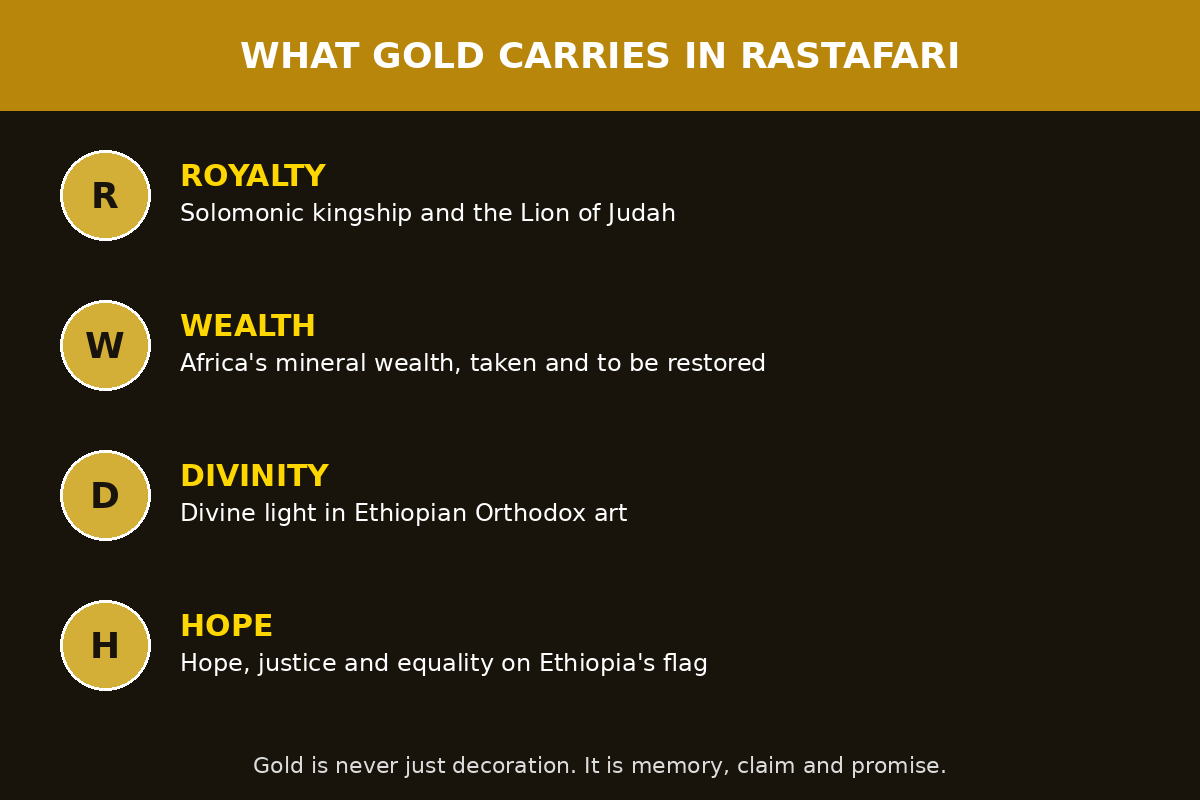
Gold is the colour people notice first and understand last in Rastafari. A newcomer sees a bright yellow stripe on a flag, a gold chain, a gold-trimmed tam, and assumes it is simply decoration, or simply yellow by another name. That assumption misses almost everything the colour is doing. In Rastafari, gold carries royalty, stolen wealth that must one day be restored, divine light, hope for a just future, and a direct line back to Ethiopia, to its emperors, its church, and its ancient gold trade. This guide untangles gold from yellow, from the Ethiopian flag, and from the separate Garveyite colours, so that when you see gold worn, flown, or sung about, you can read what it is actually saying.
Start with the full picture
Read our complete guide to Rasta colors and their meanings for the whole family of colours, then browse the Rastafarian Clothing shop to see how those colours live in everyday dress.
Key Takeaways
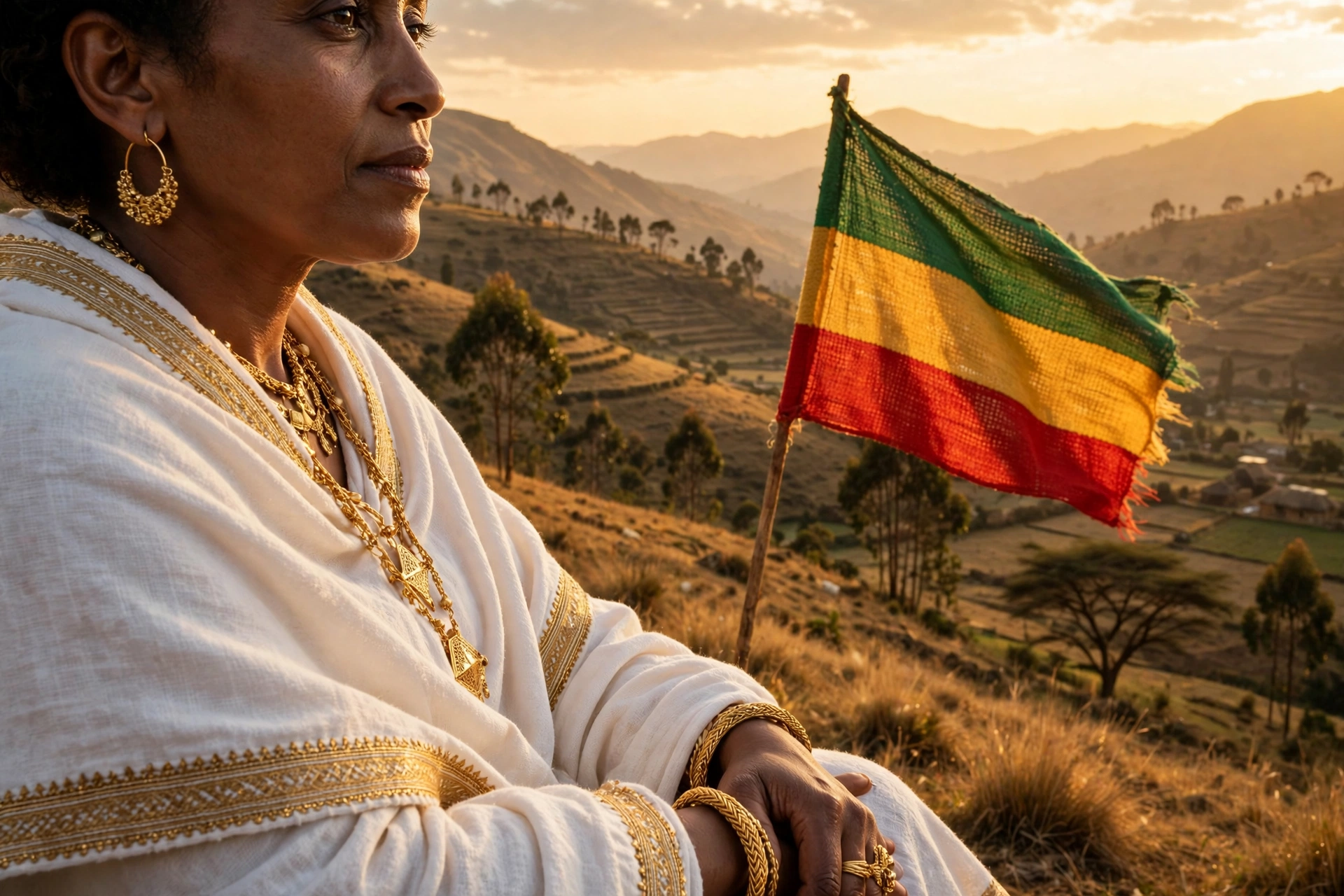
- Gold in Rastafari means royalty, African wealth, divine light, and hope. It is a claim about history, not a fashion accent.
- Gold and yellow name the same stripe on the Ethiopian flag. Writers use both words, but Rastafari speech prefers gold because gold carries value and kingship that plain yellow does not.
- The colour comes first from Ethiopia: its flag, its Solomonic emperors, its Orthodox church art, and its ancient gold coinage and trade.
- Gold is not a Garveyite colour. Marcus Garvey’s UNIA flag is red, black, and green. Rastafari adds gold from Ethiopia, which is why Rasta dress so often shows four colours together.
- Wearing gold well means wearing it with understanding: centred between green and red, paired respectfully with symbols such as the Lion of Judah, and never treated as a costume.
Table of Contents
- Gold or Yellow? Settling the Name First
- Gold on the Ethiopian Flag
- Wealth Taken, Wealth Remembered
- Royalty, Solomon, and the Lion of Judah
- Divine Light in Church and Art
- How Gold Differs from the Garvey Colours
- Wearing Gold with Understanding
- Our View
- Frequently Asked Questions
Gold or Yellow? Settling the Name First
Gold is the deliberate word, and the choice of word is the first lesson. Flag manuals, vexillology charts, and many reference books describe the middle stripe of the Ethiopian flag as yellow. That description is accurate as a matter of dye and printing. It tells you what the cloth looks like. It does not tell you what the colour means to the people who revere it. When Rastafari speakers, singers, and artists name that stripe, they overwhelmingly call it gold, and the long Rastafari tradition summed up in the phrase ites, gold and green treats gold as wealth and spiritual richness, not as a paint sample. The distinction matters because yellow, in ordinary English, can sound pale, cautionary, or cheap. Gold never sounds cheap. Gold sounds weighty, enduring, and royal, and those are precisely the associations Rastafari wants to keep in view.
If you have read our overview of Rasta colors, you will have seen this naming question appear again and again, because it confuses readers who move between sources. One book says yellow, a song says gold, a flag shop sells a yellow stripe, and a Rasta elder corrects you to gold, and all four are talking about the same band of colour. The helpful way to hold the two words is this: yellow is the manufacturer’s word, gold is the meaning word. Printers need a reproducible shade, so they specify yellow. Believers need a word that carries history, so they say gold. Neither group is wrong, but only one word explains why the colour moves people. Throughout this post we use gold, following Rastafari usage, while noting where official descriptions use yellow so you can recognise the same fact in different dress.
The confusion deepens because Jamaica’s own flag also uses gold, in a very different design, and because Ghana and many later African flags adopted the same green, gold, and red family. A reader can easily assume all golds mean the same thing everywhere. They rhyme, but they are not identical. Ghanaian gold points most directly to mineral wealth in the ground, as the Ghana Information Services fact sheet puts it plainly when it glosses gold as the mineral wealth of the country. Ethiopian and Rastafari gold includes that mineral sense, but it adds older and more theological layers: Solomonic kingship, church gold leaf, and Aksumite coinage. Keeping those layers separate is the solution to the most common misunderstanding about this colour, and it is why a single-colour deep dive is worth doing at all, rather than repeating a one-line gloss.
Gold on the Ethiopian Flag
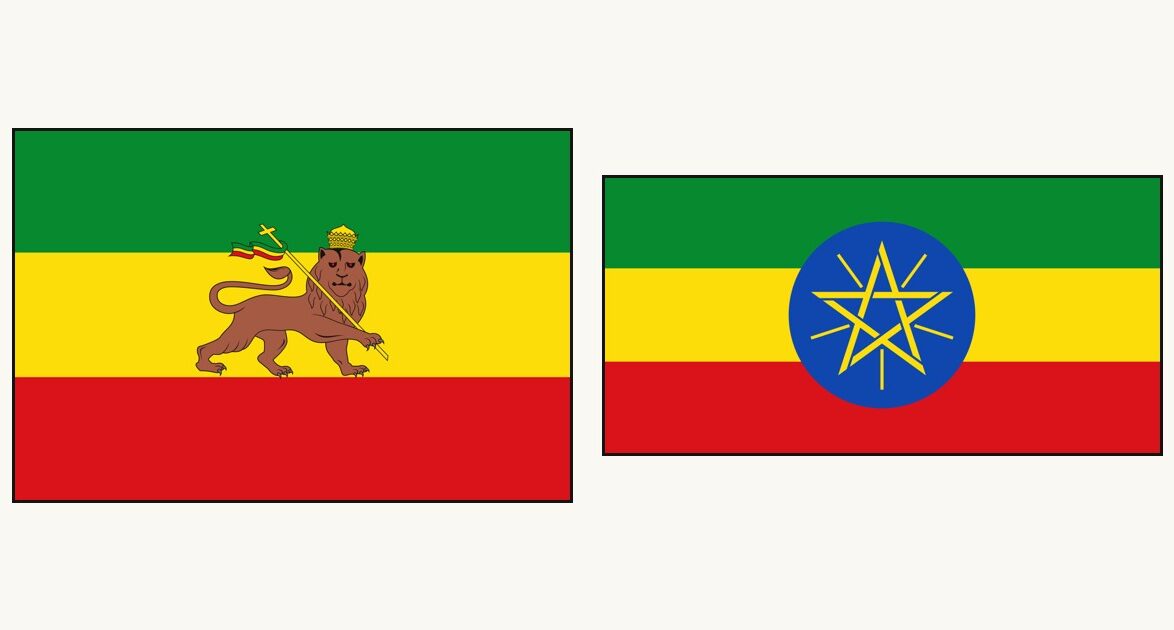
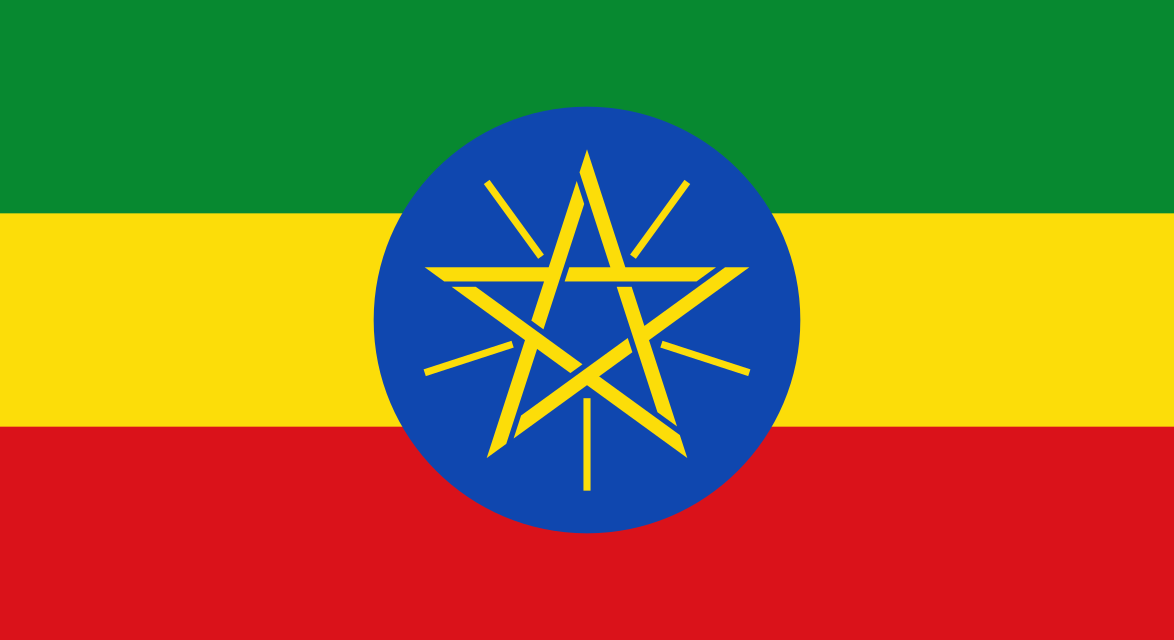
Every account of gold in Rastafari must begin with the Ethiopian flag, because that flag is the colour’s passport. The modern Ethiopian tricolour places green at the top, gold or yellow in the middle, and red at the bottom, an order we examine in detail in our guide to the Rasta colors order. The Britannica flag entry records that pennants in these three colours were displayed long before Emperor Menilek II established the first official flag, and that the present design adds a blue disc with a yellow star whose rays speak of unity and a bright future. In the official reading Britannica summarises, blue is for peace, yellow is for hope, justice, and equality, red is for sacrifice for freedom and equality, and green is for labour, development, and fertility. Notice what gold does in that reading: it is the hopeful, just centre. It sits between the land above and the sacrifice below, as if to say that hope and fairness are what the land and the sacrifice are for.
A second reference tradition gives the same centre a slightly warmer tone. The WorldAtlas flag guide describes the yellow band as symbolising justice and harmony, the green as hope and fertility of the land, and the red as strength and sacrifice in defence of the land, with the golden pentagram standing for unity and equality. Harmony is a valuable addition to the gloss. It reminds the reader that gold is not only about wealth held, but about peoples held together. Ethiopia is a country of many nationalities, languages, and faiths, and a central gold star that radiates equally in all directions makes a visual promise that no group stands closer to the light than another. Rastafari, a movement of a scattered people longing for unity, heard that promise clearly and carried it far beyond Ethiopia’s borders.
Ethiopia also traditionally linked its colours to the rainbow after the Flood, a sign of covenant and survival after catastrophe. That biblical framing matters for Rastafari, which reads history through Scripture and understands African peoples in the Americas as exiles being tested, awaiting deliverance and return to Zion, understood as Ethiopia. The account of the movement in Britannica on Rastafari makes that structure explicit: past, present, and future are read through Exodus and exile, and Ethiopia is held as the ultimate home and seat of Jah. Within that story, gold is the colour of the home’s glory. It is not nostalgia for decoration. It is the visible gleam of a place believed to be both real and promised, a kingdom that survived colonisation when almost no other African state did, and whose flag therefore became proof that African sovereignty was not a dream but a fact that had endured.
Wealth Taken, Wealth Remembered
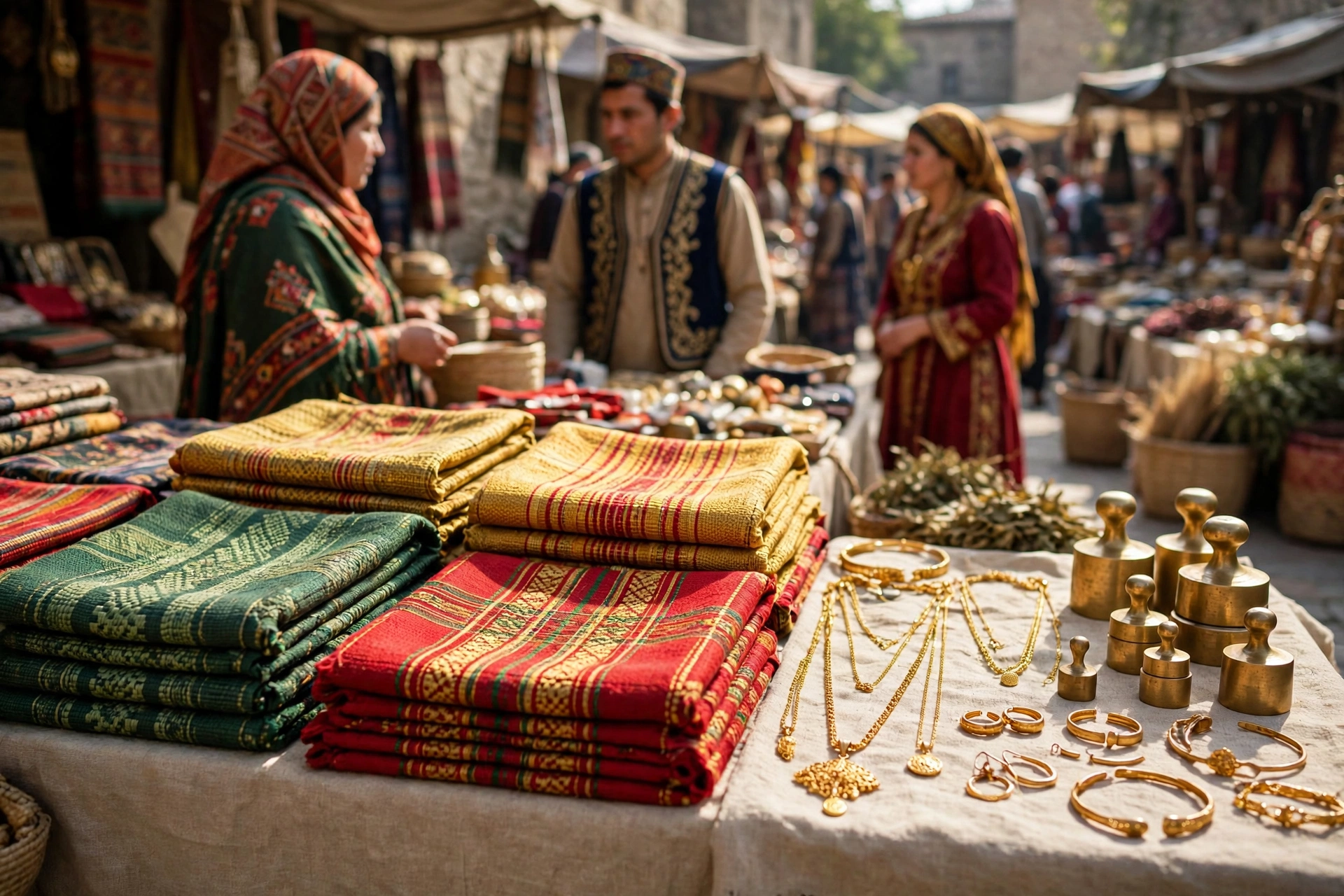
Gold remembers wealth twice: wealth that Africa produced, and wealth that was taken from Africa. No source states the Rastafari reading more compactly than the museum record. The Smithsonian crocheted hat held by the Anacostia Community Museum is described with its colours decoded in a single sentence: red for the blood of martyrs in the Black liberation struggle, green for Ethiopia’s natural beauty, gold for Africa’s wealth, and black for African people. That short gloss, attached to an ordinary handmade hat, shows how completely the meaning had entered daily life. A person did not need a textbook to read the hat. The colours themselves taught the history lesson every time the hat was worn in the street.
A fuller academic treatment reaches the same conclusion with a sharper edge. The study of symbolism hosted by the University of Vermont explains that in Rastafarian art gold symbolises the wealth of Africa that was stolen by European invaders, while red stands for the blood of martyrs, green for the lush vegetation of Africa, and black for the Black African race. The word stolen is doing essential work there. Gold in this reading is not a celebration of riches comfortably possessed. It is an accusation and a claim. It says that Africa was rich, that its riches were looted through slavery, colonial extraction, and unequal trade, and that remembering the gold is a way of refusing to accept poverty as Africa’s natural condition. Wearing gold becomes a quiet act of historical correction.
The historical record underneath that claim is solid, and it reaches back far beyond the colonial period. The university course text at LibreTexts on Aksum notes that by the seventh century BCE gold and silver were already moving through the kingdom of Da’amat as trade goods, and that the later state of Aksum began minting its own gold and silver coins in the third century CE as proof of how important long-distance trade was to its economy. Pause on that fact. An African empire on the Red Sea trade routes was striking gold coinage, accepted by merchants who also dealt with Rome, Persia, and India, at a time when very few states anywhere could do so. Gold in Ethiopia is therefore not a metaphor borrowed from elsewhere. It is a literal part of the country’s economic history, dug, traded, minted, and buried with its wealthy dead in objects gilded in gold.
The biblical layer reinforces the historical one. The Biblical Archaeology Society recounts how the Queen of Sheba arrived in Jerusalem with camels carrying spices, gold, and precious stones, and gave Solomon 120 talents of gold, the largest gift of its kind in the account. Ethiopian tradition, preserved in the Kebra Nagast, names that queen Makeda and identifies her land as Ethiopia, making the gold-bearing queen an Ethiopian queen. Whether a reader approaches that story as history, as sacred tradition, or as national epic, its effect on the colour’s meaning is the same: gold flows from Africa toward the world’s most famous wise king, not the other way round. Africa appears in the story as giver and sovereign, not as supplicant. Rastafari preaching has returned to that reversal for generations, and our reflections on sayings such as who Jah bless, no man curse draw on the same conviction that dignity was given long before it was denied.
Read this way, gold jewellery, gold thread, and gold print in Rasta contexts carry a double charge that a purely decorative reading misses. They celebrate ingenuity and abundance, and they protest theft and impoverishment, at the same time. That doubleness explains the colour’s emotional range in music and speech, where gold can sound triumphant in one line and mournful in the next. It also explains why cheap, flimsy imitation gold can feel wrong to a thoughtful wearer even when the shade is correct. The meaning asks for substance. A colour that stands for real wealth, really taken, deserves to be rendered with some care, in materials and designs that honour rather than trivialise the claim.
Royalty, Solomon, and the Lion of Judah
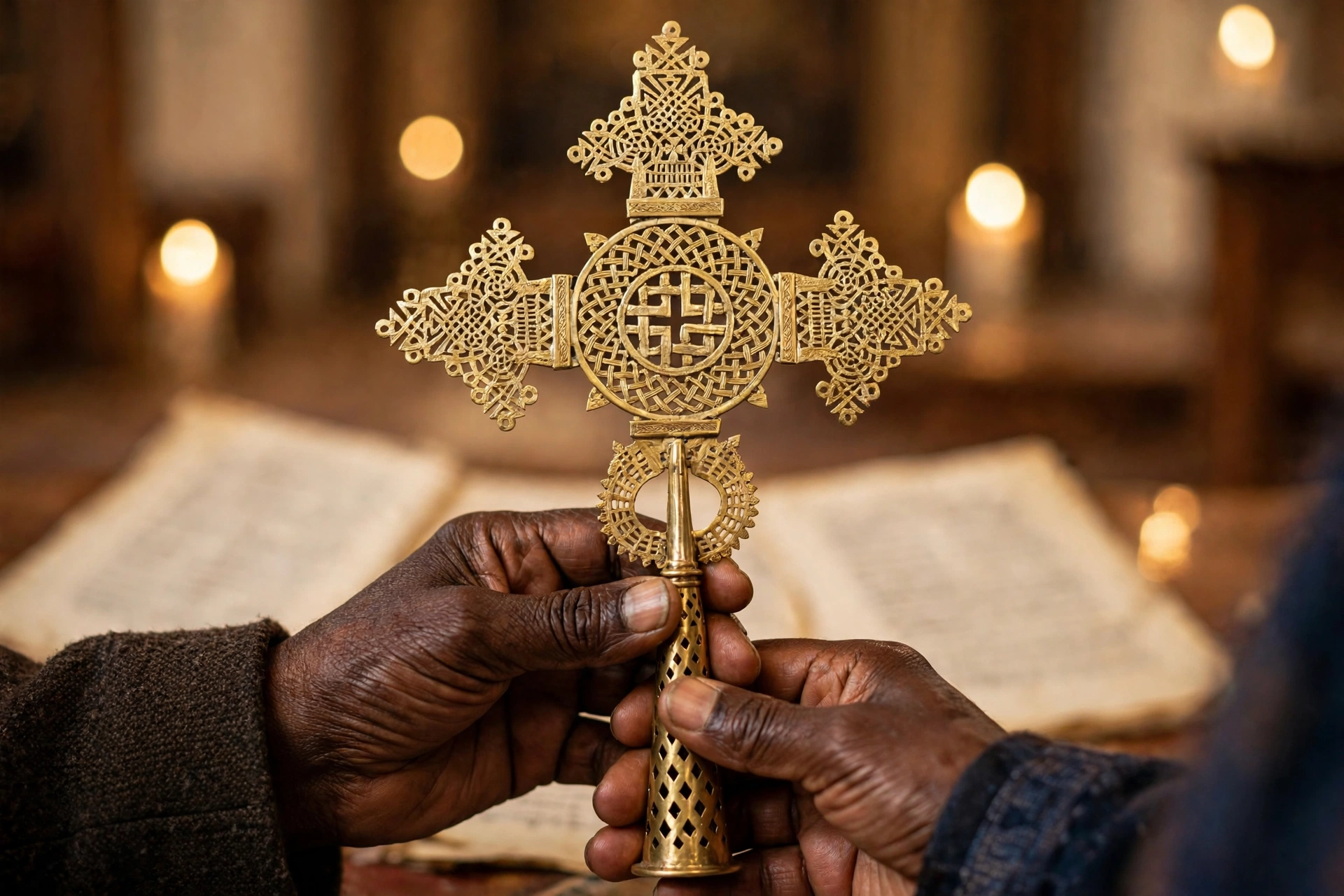
Gold is the colour of the throne, and in Rastafari the throne is Solomonic. Ethiopian emperors claimed descent from Solomon and the Queen of Sheba through their son Menelik I, a lineage narrated in the Kebra Nagast and used for centuries to legitimate the dynasty. Gold crowns, gold crosses, and gold-trimmed robes were the ordinary visual language of that claim. When Rastafari adopted Ethiopian colours, it adopted that royal language too, and redirected it toward a people who had been told they were nobody’s royalty. To dress an ordinary person, a labourer, a musician, a mother, in the colour of emperors was a deliberate act of restoration. It said that kingship was not the property of a palace. It belonged, by heritage, to the people themselves.
At the centre of that royal language stands the Lion of Judah, the emblem we explore fully in our guide to the Lion of Judah. The museum record again gives a crisp anchor. The Kennedy Library lion statuette, a silver lion wearing a gold crown presented by Haile Selassie during his state visit, is catalogued with the note that the Lion of Judah is the national symbol of Ethiopia and that Conquering Lion of the Tribe of Judah was the title of every Ethiopian emperor. The detail that the crown, specifically, is gold while the lion is silver is instructive. Gold marks the crown because gold marks sovereignty itself. Wherever you see the lion rendered in Rasta art with a gold crown, a gold mane, or on a gold field, the same grammar is at work: gold identifies the royal element and lifts it above the rest of the design.
The emperor at the heart of the movement gives that grammar a human face. The biography in Britannica on Haile Selassie records that Tafari Makonnen served as regent, was crowned emperor on November 2, 1930, took the name Haile Selassie, meaning Might of the Trinity, modernised his country, led it through exile and return during the Italian invasion, and helped establish the Organization of African Unity. For Rastafari, as our account of why Haile Selassie still reigns explains, those historical facts are read together with biblical titles such as King of Kings and Conquering Lion of Judah, and the emperor is revered as messiah and returned Christ by many, though not all, adherents. Gold gathers around his image for the same reason it gathered around Solomon’s: in this tradition, the righteous king and the precious metal belong together, each testifying to the other’s worth. The collected Haile Selassie quotes most often shared in the community return repeatedly to unity, education, and perseverance, themes that keep the royal colour from collapsing into mere splendour. Gold, rightly read, obliges conduct.
Divine Light in Church and Art
Before gold was a flag colour, it was the colour of divine light on church walls. Ethiopian Orthodox art is among the oldest continuous Christian art traditions in the world, and its use of gold is precise. The study at The History Professor explains that in icon painting gold leaf was reserved for halos, for the garments of Christ and the Virgin Mary, and for the pages of open Gospels, signifying divine light and holiness, while red spoke of martyrdom, blue of heaven, and green of life and resurrection. Reserved is the key word. Gold was not spread everywhere for richness. It was placed only where heaven touched earth: around a holy head, on a sacred garment, on the words of Scripture themselves. Scarcity gave the colour its theology. To see gold was to see the exact point where the divine entered the picture.
That disciplined use travelled into Rastafari visual culture, even among artists who never entered an Ethiopian church. Rasta painters learned, often through reproductions, photographs, and church visits, to halo the emperor’s portrait in gold, to letter sacred words in gold, and to frame the lion in gold, while leaving ordinary elements in ordinary colours. The effect, when done well, is immediately legible to anyone formed by the older tradition, and quietly moving even to viewers who cannot name why. Gold tells the eye where to reverence. It is a highlighter for holiness. Misused, spread across every surface for maximum shine, it highlights nothing, and the picture goes flat and noisy. The church tradition therefore offers contemporary designers a practical rule as well as a spiritual one: use gold where it means most, and let restraint do the shining.
How Gold Differs from the Garvey Colours
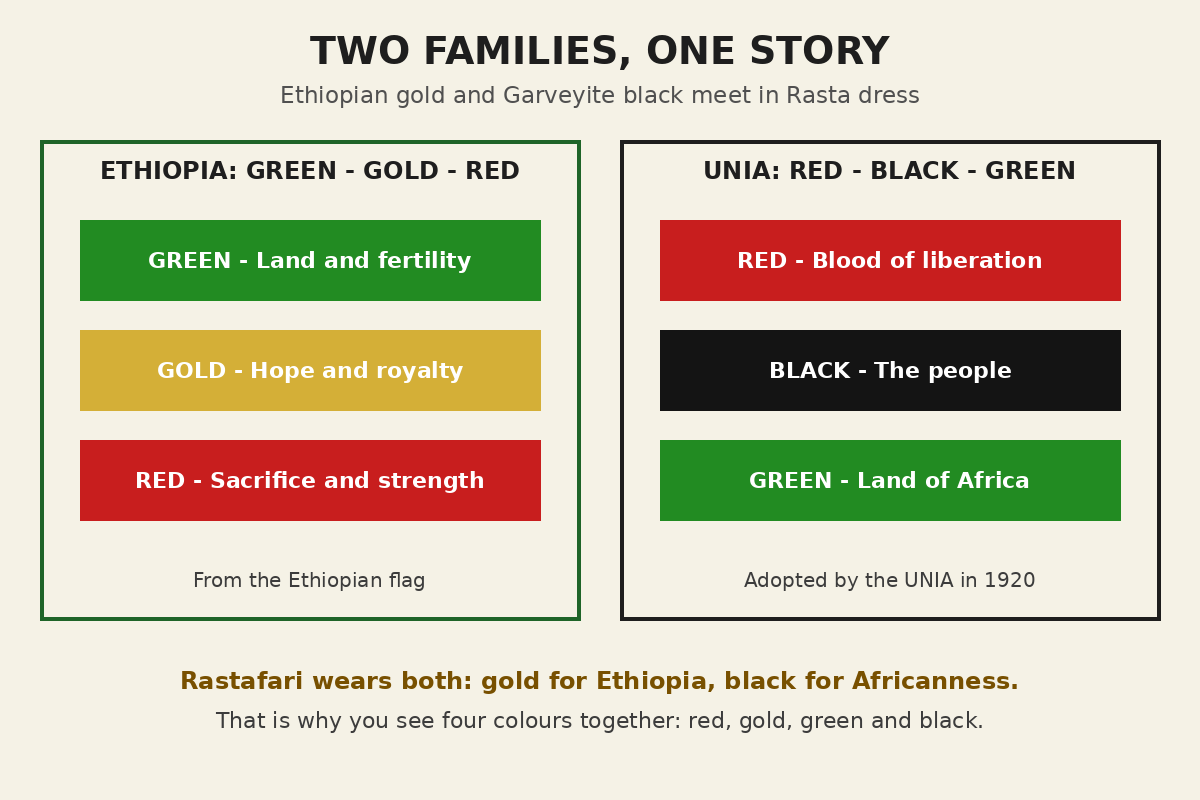
Gold is where Rastafari and Garveyism meet, agree, and then part company, and confusing the two is the second great misunderstanding about this colour. Marcus Garvey’s Universal Negro Improvement Association adopted its flag at its New York convention in 1920, with horizontal bands of red, black, and green. The report by NPR Illinois, drawing on historian Robert Hill, explains that Garvey treated the absence of a Black flag as a mark of political powerlessness and the creation of one as proof that the race had come of age politically, with red for blood shed and shared, black for Black people, and green for growth and the fertility of Africa. It is a magnificent flag with a magnificent rationale, and Rastafari honours Garvey as a prophet. But its three colours contain no gold, and no yellow. Anyone who attributes gold to Garvey’s design has merged two different flags into one.
Rastafari’s gold comes from the other source: Ethiopia. Where Garvey’s flag centres black, for the people, the Ethiopian flag centres gold, for hope and royalty, and Rastafari, which centres Ethiopia as Zion and home, was never going to surrender that centre. The movement’s practical solution, visible on streets and stages for generations, was to wear both inheritances at once. That is why the four-colour set, red, gold, green, and black, is so common, and why summaries of livity in the Britannica Rastafari account list dressing in red, green, gold, and black together, glossed as blood, herbs, royalty, and Africanness. Four colours, two flags, one people with two homelands to honour: the African continent in general, figured by Garvey’s black, and Ethiopia in particular, figured by gold. Once you see the four-colour set as a merger rather than a muddle, a great deal of Rasta design suddenly becomes readable.
For the reader trying to keep the families straight, a simple test helps. If black is in the set and gold is not, you are looking at the Garveyite family. If gold is in the set and black is not, you are looking at the Ethiopian family. If both are present, you are almost certainly looking at Rastafari usage, or at later Pan-African design influenced by it. Our main guide to Rasta colors returns to this test with visual examples, and it is worth bookmarking if you buy, sell, teach, or write about these colours, because the two families are confused in print constantly, including by well-meaning shops and textbooks. Accuracy here is not pedantry. Each family honours a different history, and the people who fly them notice whether you know the difference.
Wearing Gold with Understanding
Wearing gold well is mostly a matter of proportion, placement, and respect. Proportion first. Because gold carries so much meaning, a little of it, well placed, says more than a flood of it. A gold medallion of the lion on a plain ground, a gold stripe at the centre of a tam, gold embroidery at the cuff or hem of a white garment, or a single gold accessory against green and red, all read as deliberate. Head-to-toe metallic gold reads as costume, and costume is the one thing a sacred colour should never become. The church rule applies to the wardrobe: reserve gold for the point of honour. In practice, that usually means one gold focal point per outfit, supported by green and red, with black grounding the whole when you want the fuller four-colour statement.
Placement second. As the flag teaches, gold sits naturally in the middle: between green above and red below on horizontal designs, at the centre of a chest emblem, at the heart in a pendant, or as the middle band of a wrist or head wrap. Our guides to traditional Rasta outfits show that central placement recurring across generations of dress, from formal white-and-gold ceremonial wear to everyday tams and scarves. For women, the companion guide to how to dress like a Rastafarian woman shows gold working through headwrap bands, jewellery, and trim that frame the face with light. For men, our survey of what Rasta men wear finds gold most often in the tam stripe, a chain and pendant, or a single embroidered emblem, each time as the outfit’s point of dignity rather than its loudest element.
Respect third, and it governs the first two. Gold in this tradition points to Ethiopia, to a living faith, and to a history of loss and endurance. That does not mean only adherents may wear it; Rasta colours have been welcomed worldwide as signs of solidarity, peace, and African pride, and the movement’s music carried them to every continent as an invitation. It does mean the thoughtful wearer learns the meanings before wearing the colours, avoids sacred emblems as jokes or novelties, and buys, where possible, from makers who understand and honour the tradition, including the long West and East African textile heritage traced in our history of ancient West African clothing, where gold thread and gold dust were prestige materials centuries before they were fashion. Knowledge does not make the colours heavier to wear. It makes them lighter, because the wearer no longer fears getting them wrong, and can enjoy them as what they are: a wearable history lesson in hope, royalty, and return.
Our View
Gold is the conscience of the Rasta colours. Green can be enjoyed as nature and red admired as courage without much thought, but gold refuses to be casual. It asks the wearer to remember a queen who arrived bearing treasure, an empire that minted its own coins, a church that saved its gold leaf for the face of the divine, and a people whose wealth was taken and whose dignity was not. We hold that gold should be taught, worn, and designed with that memory intact, centred on the garment as it is centred on the flag, and rendered with the care its history deserves. Get gold right, and the rest of the colours fall into place around it, because you have understood that these are not decorations at all. They are a history you can wear.
— The Rastafarian Clothing Team
Frequently Asked Questions
Is the middle Rasta colour gold or yellow?
It is the same stripe under two names. Official flag descriptions usually call it yellow, because they are specifying a reproducible shade. Rastafari usage calls it gold, because gold carries the meanings the colour holds: royalty, African wealth, divine light, and hope. When you are discussing meaning, gold is the better and more respectful word. When you are matching a printer’s specification, you may need the word yellow to get the right ink.
What does gold mean in Rastafari, in one sentence?
Gold means the royalty, wealth, divine light, and hopeful future of Africa and Ethiopia, including wealth that was stolen and will, in the movement’s hope, be restored. If you need it shorter still, remember the museum gloss attached to a handmade Rasta hat: gold is Africa’s wealth. Everything else in this post is an expansion of those three words.
Did Marcus Garvey choose the colour gold?
No. Garvey’s UNIA flag, adopted in 1920, is red, black, and green, with no gold band. Gold entered Rastafari dress from the Ethiopian flag, whose centre has always been gold or yellow. Rastafari honours Garvey as a prophet and often wears his black alongside Ethiopian gold, which is why the four colours red, gold, green, and black so often appear together, but the two flags and their colour sets have different origins and should not be merged.
Why is gold linked to the Lion of Judah?
Because gold marks sovereignty. The Lion of Judah was the title and emblem of Ethiopia’s emperors, who claimed Solomonic descent, and gold crowns, thrones, and regalia were the visual language of that sovereignty. A well-known museum example is a silver lion statuette wearing a gold crown, presented by Haile Selassie himself. In Rasta art the lion is therefore often crowned, maned, or set in gold, to identify it unmistakably as the royal element of the design.
Can anyone wear gold in Rasta colours, or is it only for Rastafari?
Anyone may wear these colours, and they are worn worldwide as signs of African pride, peace, and solidarity. The tradition asks only for understanding and respect: learn what gold and its companion colours mean, treat sacred emblems such as the Lion of Judah and the Ethiopian cross as emblems rather than novelties, and support makers who honour the tradition. Worn with that knowledge, gold is an invitation the movement’s music has extended to the whole world.
Questions about colours, symbols, or sizing?
We are glad to help you choose with understanding. Contact us and we will reply as soon as we can.
Sources
- Britannica on Rastafari — Encyclopaedia Britannica. Movement history, Zion and Ethiopia, and livity colours.
- Britannica on Haile Selassie — Encyclopaedia Britannica. Coronation, reign, exile, and African unity.
- Britannica flag entry — Encyclopaedia Britannica. Ethiopian flag history and official colour meanings.
- Smithsonian crocheted hat — Smithsonian Institution. Gold glossed as Africa’s wealth.
- Kennedy Library lion statuette — John F. Kennedy Presidential Library. Gold-crowned Lion of Judah as imperial title.
- University of Vermont — Rastafarian symbolism in the visual arts. Gold as wealth stolen by invaders.
- The History Professor — Ethiopian Orthodox art and manuscripts. Gold leaf as divine light.
- NPR Illinois — Remembering the red, black and green. Garvey flag history and meanings.
- WorldAtlas flag guide — Flags of Ethiopia. Yellow as justice and harmony, golden pentagram.
- Biblical Archaeology Society — Who is the Queen of Sheba? Her gold gift and the Kebra Nagast tradition.
- LibreTexts on Aksum — Aksum and Ethiopia. Early gold trade and Aksumite gold coinage.
- Ghana Information Services — Facts About Ghana. Gold as mineral wealth on Ghana’s flag.
Recommended
- Rasta Colors: Meaning, Order and How to Wear Them
- Red, Gold and Green: The Story of the Rasta Flag Colors
- The Meaning Behind the Lion of Judah in Rastafari Culture



Leave a comment
Your email address will not be published. Required fields are marked *