
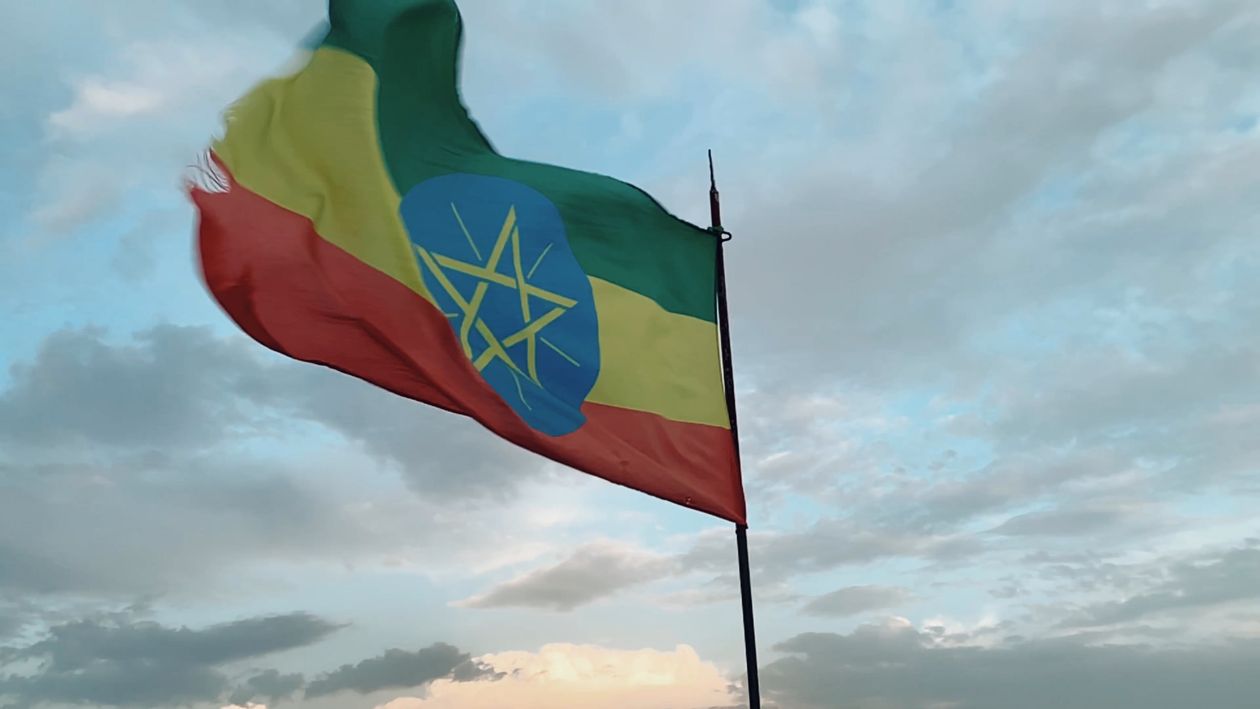
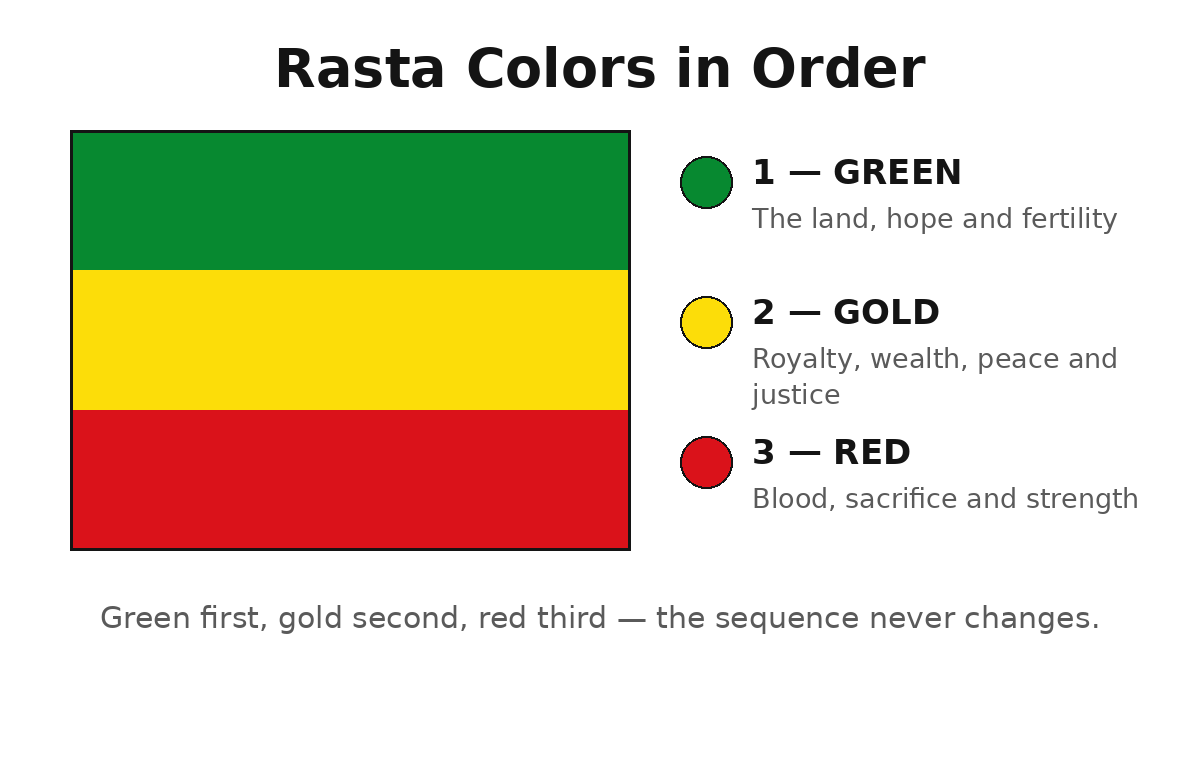
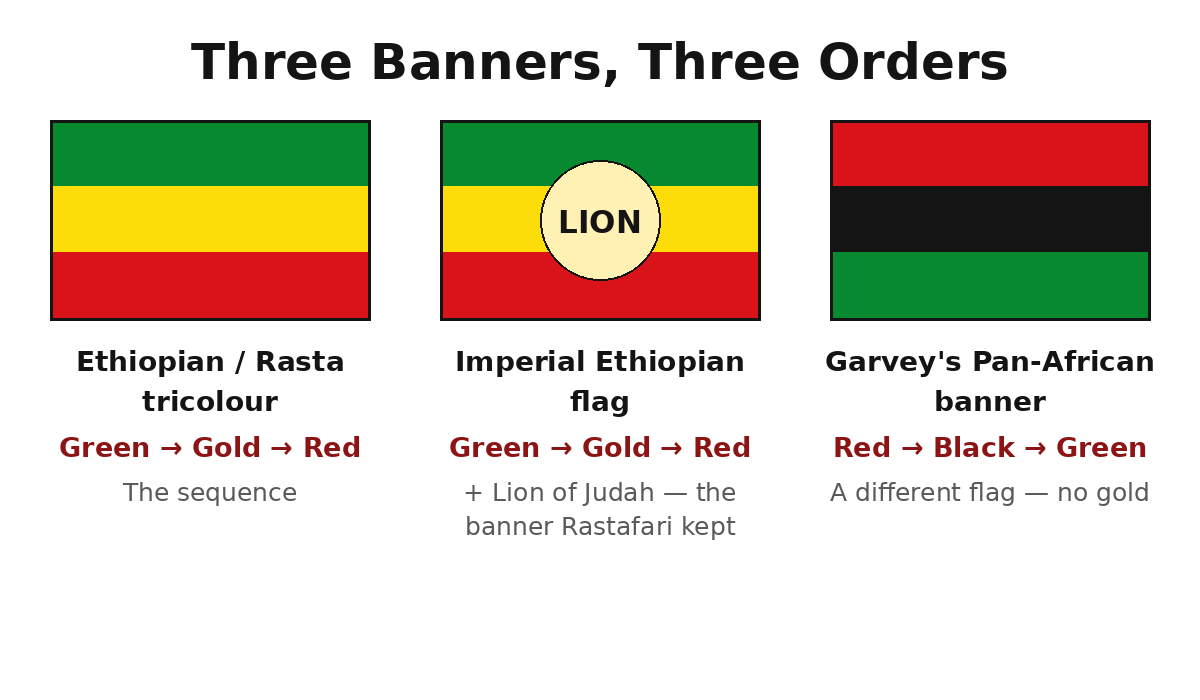
The Rasta colors in order are green, gold, and red — green at the top, gold in the middle, and red at the bottom. That is the sequence on the Ethiopian tricolour that Rastafari adopted as its own banner, and it is the sequence that matters when you read a flag, choose a garment, or check whether a design was put together with care. Yet it is one of the most commonly muddled facts in the whole subject: people list the colors in speech order, borrow the order from a different flag, or repeat a lyric as if it were a flag specification, and soon red is sitting on top and the meaning is lost. This guide settles the question directly — the order plainly, what each color stands for in its position, where the sequence comes from, the one famous historical exception, and how this banner differs from the flags it is confused with.
Start here: Rasta Colors — our main guide to the colors and their meanings
Shop Rastafarian Clothing — garments and pieces in green, gold, and red
Contact Us — questions about the colors, the culture, or an order
Key Takeaways
- The Rasta colors in order, top to bottom, are green, gold, and red.
- Green stands for the land, hope, and fertility; gold stands for royalty, wealth, peace, and justice; red stands for blood, sacrifice, and strength.
- The sequence comes from the flag of Ethiopia, the African nation at the heart of Rastafari faith and identity.
- The very first combined Ethiopian tricolour placed red on top; the order was later flipped to the green-first sequence used today.
- Garvey’s Pan-African banner is a different flag — red, black, and green, with no gold — and black in Rasta dress carries its own separate meaning.
Table of Contents
- The Order, Stated Plainly: Green, Gold, Red
- Green on Top: The Land, Hope, and Life
- Gold in the Middle: Royalty, Wealth, and Peace
- Red at the Bottom: Blood, Sacrifice, and Strength
- Where the Sequence Comes From: Ethiopia’s Flag
- The Great Flip: When Red Sat on Top
- Not Garvey’s Flag: Where Black Fits In
- Reading the Order on Clothing
- A Simple Way to Check Any Flag or Outfit
- Our View
- Frequently Asked Questions
- Sources
- Recommended
The Order, Stated Plainly: Green, Gold, Red
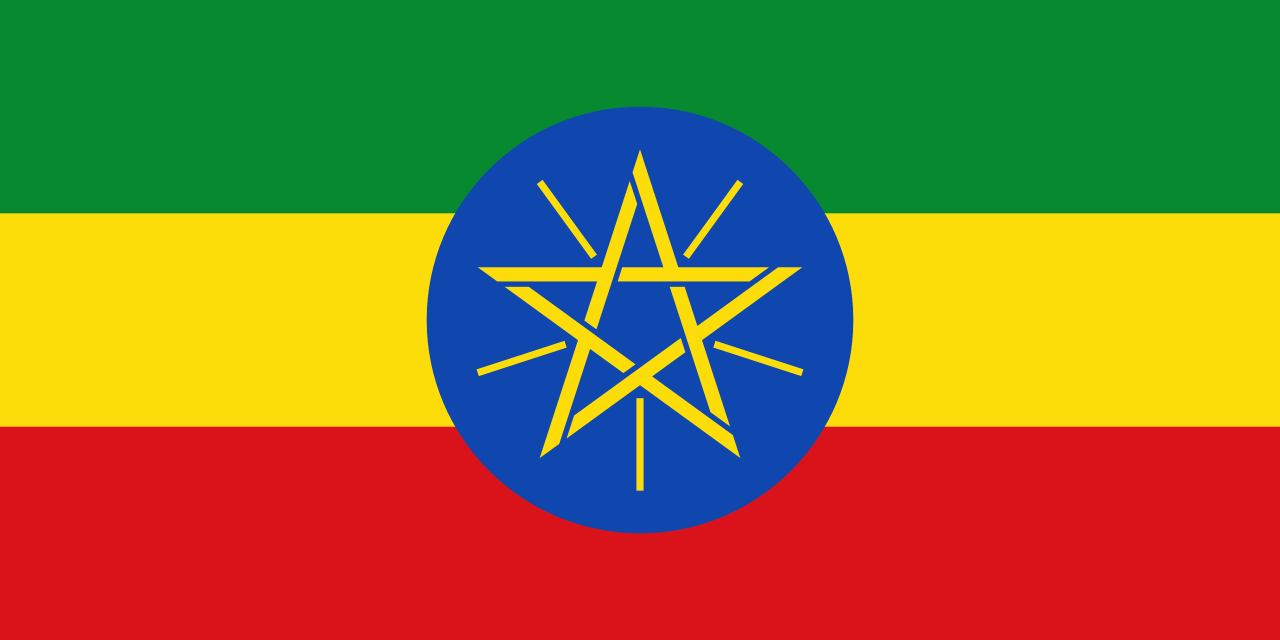
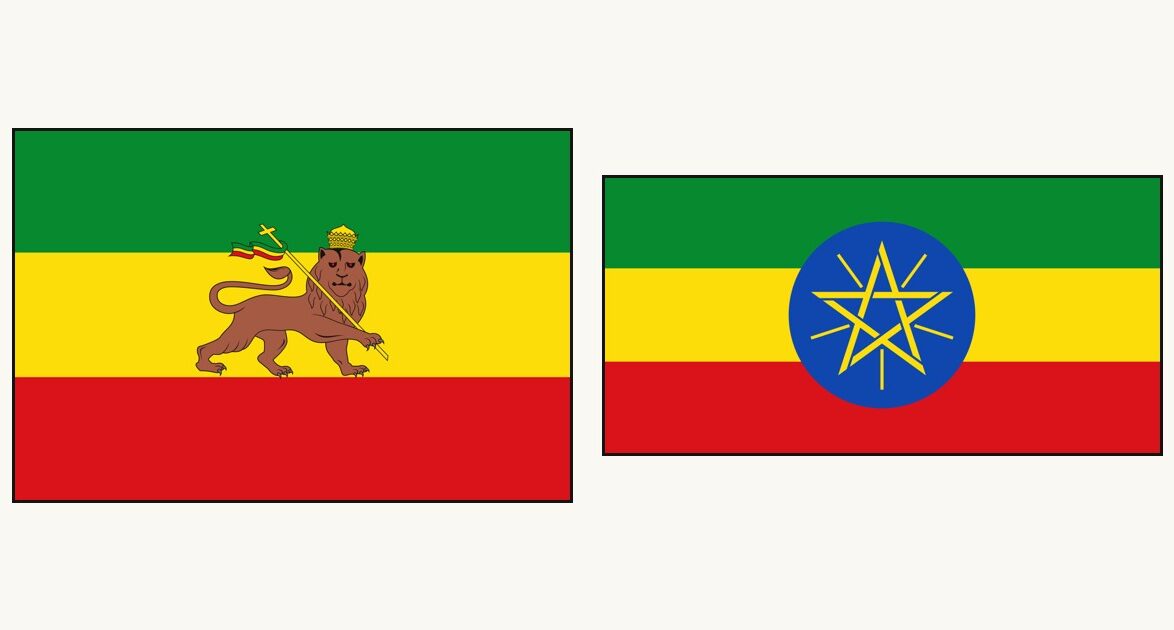
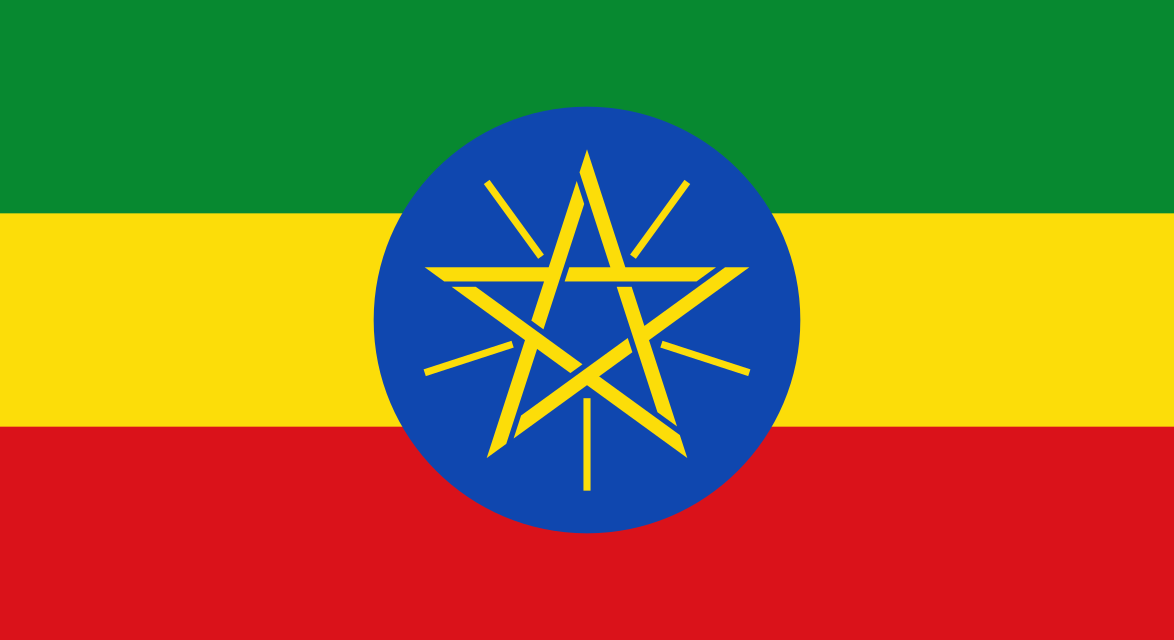
Read the banner the way you would read a page: from the top down. The first color is green. The second, the band across the middle, is gold — the rich yellow-gold that flag descriptions usually record simply as yellow. The third, the band along the bottom, is red. Green, gold, red: that is the whole answer, and everything else here is the meaning, the history, and the proof behind those three words in that arrangement. The current national flag of Ethiopia, from which the Rasta banner descends, is described by World Atlas as three equal horizontal bands of green at the top, yellow in the middle, and red at the bottom, with a blue disc and gold star at the centre in its modern state form. When Rastafari use the plain tricolour, or the older imperial version with the Lion of Judah at its centre, the bands underneath stay in exactly the same order. The emblem changes with the era. The sequence does not.
Why does the order deserve a page of its own? Because a flag is not a bag of colors; it is a statement arranged in a deliberate sequence, and scrambling the sequence scrambles the statement. Green first declares what comes before everything else — the land and life itself. Gold in the middle is the treasure held at the centre of the story. Red last, at the foundation, is the price paid to hold the other two. For the fuller treatment of each color’s symbolism across Rasta life, our main guide to the rasta colors goes deeper, and our companion piece on reggae colors follows the same palette through the music that carried it around the world.
Green on Top: The Land, Hope, and Life
Green leads the sequence because the land comes first. In the Ethiopian reading, green is the earth itself — the fertile highlands and valleys of the homeland, the crops that feed the people, and the hope that life renews itself season after season. Britannica’s flag entry records the modern official reading, in which green is equated with labour, development, and fertility, and notes the older tradition identifying the flag with the rainbow set in the heavens after the Flood in Genesis — a sign of promise after judgement, and one reason the color of new growth sits at the head of the banner. Green is not decoration here: it is the ground of the whole message, placed where a reader meets it first — before royalty, before sacrifice, there is the living land and the people who work it.
In Rastafari life, green extends that meaning: the herb, the ital garden, the hills of Jamaica and the fields of Africa held in a single thought — the natural world as Jah made it. Set at the head of the three bands, it becomes a signature, the opening word of a sentence the other two colors complete. Readers who want to follow the land thread further back will find background in our piece on ancient West African clothing, where cloth, color, and status were woven together long before any modern flag existed. And there is a practical point: because green is the first band, it is the color your eye should meet first in any striped design. A striped piece that opens with red at the top is showing you the historical arrangement covered later in this guide, or a mistake.
Gold in the Middle: Royalty, Wealth, and Peace
Gold holds the centre of the banner, and the centre is the place of honour. In the Rasta reading, gold is royalty — the crown, the throne, and the kingly line that Rastafari see running from Solomon through the Ethiopian emperors to Haile Selassie I. Encyclopaedia Britannica describes Rasta livity as including dress in the colors of red, green, gold, and black, symbolising the life force of blood, herbs, royalty, and Africanness — gold, in that mapping, is royalty itself. Gold is also the wealth of the homeland, the riches of Africa calmly reclaimed as African by right; and in the Ethiopian state reading, the same band — recorded as yellow in flag descriptions — carries hope, justice, and equality, with peace never far from it. Together, the middle band says this: at the centre of the story sits a crowned people, a rich homeland, and a just peace.
The position matters as much as the meaning. Gold is not first, because royalty is not the foundation; the land is. Gold is not last, because royalty is not the price; the blood is. It sits between the land that sustains the people and the sacrifice that defended them, exactly where a crown belongs — and it should read as a rich, warm gold, the color of a crown, not a caution sign. The emperor’s own words, in our collection of Haile Selassie quotes, carry the same order of values. And when you check any piece that claims the Rasta colors, find the gold and confirm it sits in the middle: a design that puts gold on top has promoted royalty above the land, and whatever it is selling, it is not this flag.
Red at the Bottom: Blood, Sacrifice, and Strength
Red closes the sequence at the bottom, and its position is the most eloquent of the three. Red is blood — the blood of the ancestors, the blood shed in slavery and in the defence of African freedom, and the life force running through the living community today. Set at the bottom of the banner, it works the way a foundation works: everything above it stands on it. The land is green and living because people bled to keep it; the crown is gold because people bled to defend it. In the Ethiopian state reading, red represents sacrifice for freedom and equality; in older imperial readings it carried power and faith as well.
That history is not abstract. The emperor whose reign gave Rastafari its name led his country’s resistance when Italy invaded, went into exile rather than surrender, and addressed the League of Nations in Geneva in an appeal that became one of the famous speeches of the century — Britannica’s biography recounts Haile Selassie I, crowned on 2 November 1930, exiled from 1936 to 1941, restored, and finally deposed in 1974, regarded by Rastas as the messiah of the African race. Red at the bottom holds that story of invasion, resistance, exile, and return in a single band. It is also why the familiar Rasta confidence in blessing and protection carries such weight in this culture; our page on who Jah bless, no man curse explores the saying and the assurance behind it. So wear red low and last — the bottom stripe, the band at the hem. The ancestors are the foundation, and foundations go at the bottom: that is the meaning of the flag, expressed in the only language a flag has, which is position.
Where the Sequence Comes From: Ethiopia’s Flag
The Rasta colors are Ethiopia’s colors, and the sequence is Ethiopia’s sequence. Green, yellow, and red pennants flew in Ethiopia for centuries before they were combined into a single rectangular flag, a combination traditionally dated to the reign of Emperor Menelik II, in the years after Ethiopia’s victory over Italy at the Battle of Adwa on 1 March 1896 — the victory that preserved Ethiopian independence while the rest of the continent was being carved into colonies, as FlagDB records. A free African empire, undefeated in the age of colonisation, flying green, gold, and red: that is the image that travelled. When Haile Selassie was crowned in 1930, the news reached Black communities from Harlem to Kingston within days, and Ethiopia — with Liberia one of only two African countries not under European colonisation at the time, as Smithsonian Folkways Magazine notes — became living proof that African sovereignty had survived. The movement that became Rastafari took the emperor’s name, his titles, and his flag’s colors as its own.
Under Haile Selassie, the imperial flag carried the Lion of Judah at the centre of the three bands — the crowned lion holding a cross-topped staff, asserting the Solomonic line that Ethiopian tradition traces to Solomon and the Queen of Sheba. That lion version, flown until the empire fell in 1974, is the banner Rastafari kept long after Ethiopia moved on to other emblems. Our page on the meaning behind the Lion of Judah in Rastafari culture tells the lion’s story in full, and our guide to the Ethiopian coat of arms follows the emblem that replaced it — the blue disc and radiant gold star now set over the same three bands, in the same order. From Ethiopia the colors travelled twice: across Africa, where nation after nation adopted them on independence until they became known as the Pan-African colors, and across the Atlantic with reggae.
The Great Flip: When Red Sat on Top
Here is the honest complication, and the reason so many people get the order wrong with complete sincerity. The first combined Ethiopian tricolour did not put green on top. When Menelik II had the three pennants joined into one rectangular flag in 1897, the arrangement ran red at the top, yellow in the middle, and green at the bottom. Flags of the World records that the green-yellow-red flag appeared on 6 October 1897, that the colours were at first used as three separate strips with red at the top, and that at some point the order was changed — flipped, so green rose to the top and red settled to the bottom, where both have remained ever since. The same source records the older readings of the bands — red for power and faith, yellow for church, peace, natural wealth, and love, green for land and hope — alongside the later government reading of green for fertility, yellow for religious freedom, and red for the lives sacrificed in protecting national integrity.
So if you meet someone who insists the colors run red, gold, and green from the top, they are not inventing it — they are remembering the 1897 arrangement, repeating the spoken list, or reading Garvey’s banner, which does begin with red. What they are not describing is the flag as it settled: the flag of Ethiopia today, and the flag whose image Rastafari carried into the world. That carrying had a defining moment in Jamaica — the emperor’s state visit of 21 April 1966, when vast crowds of Rastafari gathered at Palisadoes Airport to greet him, is still kept as Groundation Day, and the Jamaica Information Service records how that visit gave the movement a new measure of respect and helped carry its music, and its colors, to the world.
Not Garvey’s Flag: Where Black Fits In
The second great confusion is with a flag that shares two of the three colors and none of the order. In 1920 the Universal Negro Improvement Association of Marcus Garvey adopted a banner of red on top, black in the middle, and green at the bottom — the Pan-African or Black Liberation flag. The Smithsonian Institution describes how David Hammons later merged Garvey’s red, black, and green with the stars and stripes in his African-American Flag, held by the National Museum of African American History and Culture. But Garvey’s banner has no gold band, and its order runs red first. It is a great flag with its own meanings — red for the blood shed for liberation, black for the people, green for the land — and it is not the Rasta flag. Lay the two side by side and the difference is instant: gold in the middle and green on top means Ethiopia and Rastafari; black in the middle and red on top means Garvey and the UNIA.
Garvey’s place in the Rasta story is foundational even so. Jake Homiak, curator of the Discovering Rastafari! exhibition at the National Museum of Natural History, told Smithsonian Magazine how Ethiopianism and Garvey’s preaching in the idioms of Ethiopia — above all the biblical promise that Ethiopia shall stretch out her hands unto God — prepared Jamaica to hear of a Black king crowned in Africa in November 1930 as the fulfilment of prophecy. Garvey pointed toward Ethiopia; Ethiopia’s flag supplied the colors. That is why black still belongs in Rasta dress even though it is not a band of the tricolour: black stands for Africanness itself, the people whose land is green, whose crown is gold, and whose blood is red, and it frames the three colors the way a frame belongs to a painting without being one of its stripes. It was reggae that carried all of these colors worldwide — the music UNESCO inscribed on the Representative List of the Intangible Cultural Heritage of Humanity, born among marginalised communities in western Kingston and recognised as a voice for all on injustice, resistance, love, and humanity. One more confusion deserves a sentence: Jamaica’s national flag is a separate black, green, and gold emblem with no red and no three-band sequence — Jamaica gave the movement its birthplace, language, and music, but the flag came from Africa, and its order is Africa’s order.
Reading the Order on Clothing
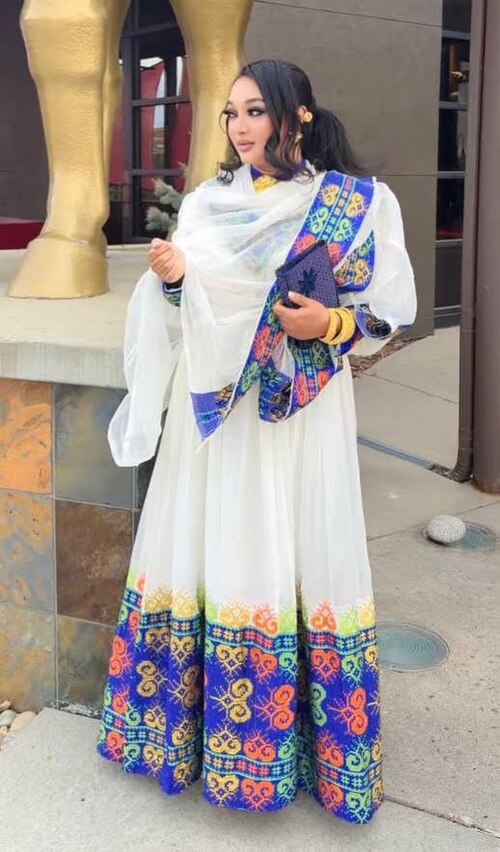
Everything above becomes practical the moment you get dressed or go shopping. On clothing, the sequence reads the same way it reads on a flag: top to bottom. On a striped shirt, green sits highest on the chest and red lowest, toward the hem. On a tam, green leads and red finishes. On dresses and skirts, where designers run the bands down the body, the same rule applies. traditional rasta outfits that still look fly shows the palette across complete looks, our breakdown of how to dress like a Rastafarian woman and our answer to what do Rasta men wear apply it by wardrobe, and our notes on how to style rasta clothing pull the principles together.
This is not pedantry about stripes. Dress in Rastafari is part of livity, the principled, balanced way of life that scholars study as seriously as any other element of the movement; the University of the West Indies at Mona built its Rastafari Studies Conference around the theme of Rastafari livity and scholarship, marking fifty years since the university’s landmark Report on the Rastafari Movement in Kingston first treated the community’s way of life as worthy of respect. Wearing the colors in their order is a small act of accuracy inside that larger discipline, and it separates considered Rasta clothing from costume: a costume copies the colors, while a considered garment keeps the sequence. So run the check. Find the green — is it first? Find the gold — is it held in the middle, where the crown belongs? Find the red — is it last and lowest, the foundation? If the piece carries the Lion of Judah, the lion belongs at the centre, over the gold band, as he sat on the imperial flag.
A Simple Way to Check Any Flag or Outfit
Hold on to one short sentence and you will never get the order wrong again: the land first, the crown in the middle, the blood beneath. Land is green, and green goes on top. The crown is gold, and gold holds the centre. The blood is red, and red forms the foundation at the bottom. The sentence works because it is the flag’s own argument, in the flag’s own order — if you remember why each color sits where it sits, the order rebuilds itself every time.
Our View
Three colors, one order, and no shortcuts. Green for the land that feeds us, gold for the crown that dignifies us, red for the blood that bought us — in that sequence, the banner preaches before a word is spoken. The order is worth defending precisely because it is so easy to lose: one flipped stripe and a memorial becomes a decoration. Learn the sequence, wear the sequence, and pass it on correctly. That is how a flag stays a flag.
— The Editors, Rastafarian Clothing
Frequently Asked Questions
What is the correct order of the Rasta colors?
Top to bottom: green, gold, red. Green is the highest band, gold — recorded as yellow in flag descriptions — is the middle band, and red is the bottom band: the order of the Ethiopian tricolour that Rastafari adopted, and of the flag of Ethiopia today.
Why do so many people say red, gold, and green?
Because that is the order the colors are often listed in speech and song, and because the first combined Ethiopian tricolour of 1897 genuinely placed red at the top before the order was flipped to green first. A spoken list is not a flag order — and Garvey’s separate Pan-African banner, which really does run red first, adds to the mix-up.
Are the Rasta colors the same as the Ethiopian flag colors?
Yes. The Rasta tricolour is Ethiopia’s green, gold, and red, adopted because Ethiopia is the spiritual homeland at the centre of Rastafari faith. The differences are in the emblem, not the bands: the modern state flag adds a blue disc with a gold star, while the version Rastafari kept carries the Lion of Judah from the imperial flag.
Is black one of the Rasta colors?
Black belongs to the wider Rasta palette but is not a band of the tricolour. In Rasta dress it stands for Africanness — the people themselves — and frames and grounds the green, gold, and red. It is also the middle band of Garvey’s red, black, and green Pan-African flag, a different banner with a different order and no gold.
What do the Rasta colors mean, in order?
In order: green means the land, hope, fertility, and life; gold means royalty, the wealth of the homeland, peace, and justice; red means the blood of the ancestors, sacrifice for freedom, and strength. Remembered as a sentence — the land first, the crown in the middle, the blood beneath — the meanings and the order hold together.
Questions about the colors, the culture, or an order?
Reach us through our contact page — we read everything and reply to everyone we can.
Sources
- Encyclopaedia Britannica — Rastafari: the movement’s history, beliefs, and livity, including dress in red, green, gold, and black and what those colors symbolise.
- Encyclopaedia Britannica — Haile Selassie I: the emperor’s reign from 1930 to 1974, his 1930 coronation, exile, resistance to invasion, and place in Rastafari faith.
- Encyclopaedia Britannica — Flag of Ethiopia: the green-yellow-red flag, its 1897 establishment under Menilek II, the Lion of Judah arms, and the official meanings of the colors.
- Smithsonian Magazine — One Love: Discovering Rastafari!: curator Jake Homiak on Ethiopianism, Garvey, and the origins of Rastafari.
- Smithsonian Folkways Magazine — Rasta Sounds: how reggae and Rastafari connect Ethiopia to the Americas, and Ethiopia’s uncolonised status at the time of the 1930 coronation.
- Jamaica Information Service — Groundation Day: the 1966 visit of Haile Selassie to Jamaica and its significance for the Rastafari community.
- UNESCO — Reggae Music of Jamaica: reggae’s inscription on the Representative List of the Intangible Cultural Heritage of Humanity and its role as a voice for all.
- Flags of the World — Ethiopia: the flag’s legal order, the original red-first arrangement of 1897, the change of order, and historical readings of the colors.
- University of the West Indies — Rastafari Studies Conference: the Mona conference on Rastafari livity and scholarship and the landmark Report on the Rastafari Movement.
- World Atlas — Flag of Ethiopia: the current flag’s bands in order, the meanings of green, yellow, and red, and the flag’s history.
- Smithsonian Institution — African-American Flag: David Hammons’ flag and the red, black, and green colors of Marcus Garvey’s pan-African flag.
- FlagDB — The Flag of Ethiopia: the tricolour’s history from Menelik II and the Battle of Adwa to its adoption across Africa and its place in Rastafari culture.
Recommended
- Rasta Colors — Red Gold and Green Meaning and How to Wear Them
- The Meaning Behind the Lion of Judah in Rastafari Culture — Complete Guide
- Traditional Rasta Outfits That Still Look Fly Today


Leave a comment
Your email address will not be published. Required fields are marked *