Search
Rastafarian man wearing a green shirt and a red gold green striped cap on a beach in Jamaica

Rasta Clothing: What It Is and What the Colors Mean

Rasta clothing is clothing that carries the colors, symbols, and spirit of Rastafari into everyday life. It is recognized at once by its red, gold, green, and black palette, its lion imagery, and its relaxed, confident fit. This guide explains what rasta clothing is, where the colors come from, what each color means, how the main garments work together, and how to wear the look with respect, comfort, and personal style.

Looking for rasta clothing made to be worn, not just looked at?

Fifth Degree makes rasta-inspired clothing in the colors and symbols described in this guide.

Shop Fifth Degree

Key Takeaways

  • Learn what red, gold, green, and black stand for before you wear them.
  • Start with one strong color piece, then build the outfit around it.
  • Wear lion, flag, and crown imagery with respect for the faith behind it.
  • Choose breathable cotton and comfortable cuts for daily wear.
  • Check fit, fabric, and print quality before you buy.

Table of Contents

What Is Rasta Clothing?

Rasta clothing is a style of dress rooted in the Rastafari movement, a faith and way of life that grew in Jamaica and spread around the world through music, migration, and shared culture. It is not a uniform, and there is no single outfit that every person who follows Rastafari wears. Instead, it is a family of garments, colors, and symbols that people combine in their own way, often with a strong sense of identity, pride, and belonging.

To understand the clothing, it helps to understand the movement behind it. Rastafari is a religious and cultural movement that looks to Ethiopia and to the figure of Haile Selassie, and that places a high value on dignity, self-reliance, community, and a connection with the natural world. Those values show up in the clothes in practical ways. Natural fibers, comfortable cuts, and colors drawn from a shared heritage are favored over stiff formal wear.

Music is one of the main reasons the style traveled so far. Reggae carried Rastafari ideas, language, and imagery to listeners in many countries, and the artists who made that music wore the colors on stage, on album covers, and in public life. When people heard the music, they also saw the clothes, and the two became linked in the public mind. That link is still strong.

At its simplest, rasta clothing is everyday clothing in the Rastafari color palette, often decorated with symbols that matter to the wearer. The most common symbols are the Lion of Judah, the Ethiopian flag, and the colors themselves in stripes or blocks. The Lion of Judah appears on tees, jerseys, jackets, and patches, and it is understood as a symbol of strength, kingship, and the connection between Rastafari and Ethiopia. Our guide to Rasta Colors gives a short introduction to the palette.

Style What it looks like Best for How bold it reads
Everyday color One color piece, such as a striped tee, with plain neutrals Daily wear Subtle
Full color Red, gold, and green across top, bottom, and headwear Festivals and gatherings Bold
Symbol-led Lion, flag, or crown print as the center of the outfit Making a statement Medium to bold
Sport and street Basketball jerseys, joggers, and hoodies in rasta colors Sport and casual days Medium
Traditional Long dresses, wraps, and modest cuts with color accents Community and family occasions Quiet and grounded

The table above shows that there is no single correct level of boldness. A quiet, everyday version and a full festival version are both rasta clothing, and the right choice depends on the occasion, the weather, and the wearer. That flexibility is part of the appeal. A person can wear the colors every day without shouting, and can turn the volume up when the moment calls for it.

Rastafarian man wearing a green red gold and yellow crochet cap
A crocheted cap in green, red, gold, and yellow is one of the most recognizable pieces of rasta clothing.

Where the Colors Come From

The colors of rasta clothing come from the Ethiopian flag and from the wider Pan-African color tradition, and their story is tied to the history of Ethiopia, Jamaica, and the African diaspora. Green, gold, and red are the colors of the Ethiopian flag, and they were taken up by Rastafari as a sign of connection with Ethiopia, which holds a central place in the movement as a spiritual homeland and as a symbol of African independence. Black was added as a color of the people themselves.

The flag of Ethiopia has green, gold, and red in horizontal bands. When Rastafari began in Jamaica, Ethiopia was already a powerful symbol. It was an African nation that had kept its independence, and its emperor, Haile Selassie, was seen by early Rastafari as a figure of great spiritual importance. That reverence is rooted in Ethiopia’s own ancient faith, centered on the Ethiopian Orthodox Tewahedo Church, to which Haile Selassie himself belonged. Wearing the colors of Ethiopia was a way to show that connection in public, without words. The life of Haile Selassie is central to that story.

The colors also sit within a broader tradition. Pan-African colours are used by many movements, flags, and organizations that express African unity and pride, and red, black, and green in particular have a long history in that tradition. Marcus Garvey, whose ideas influenced Rastafari and many other movements, promoted red, black, and green as colors of the African people. The work of Marcus Garvey is worth reading for anyone who wants to understand the background of the palette.

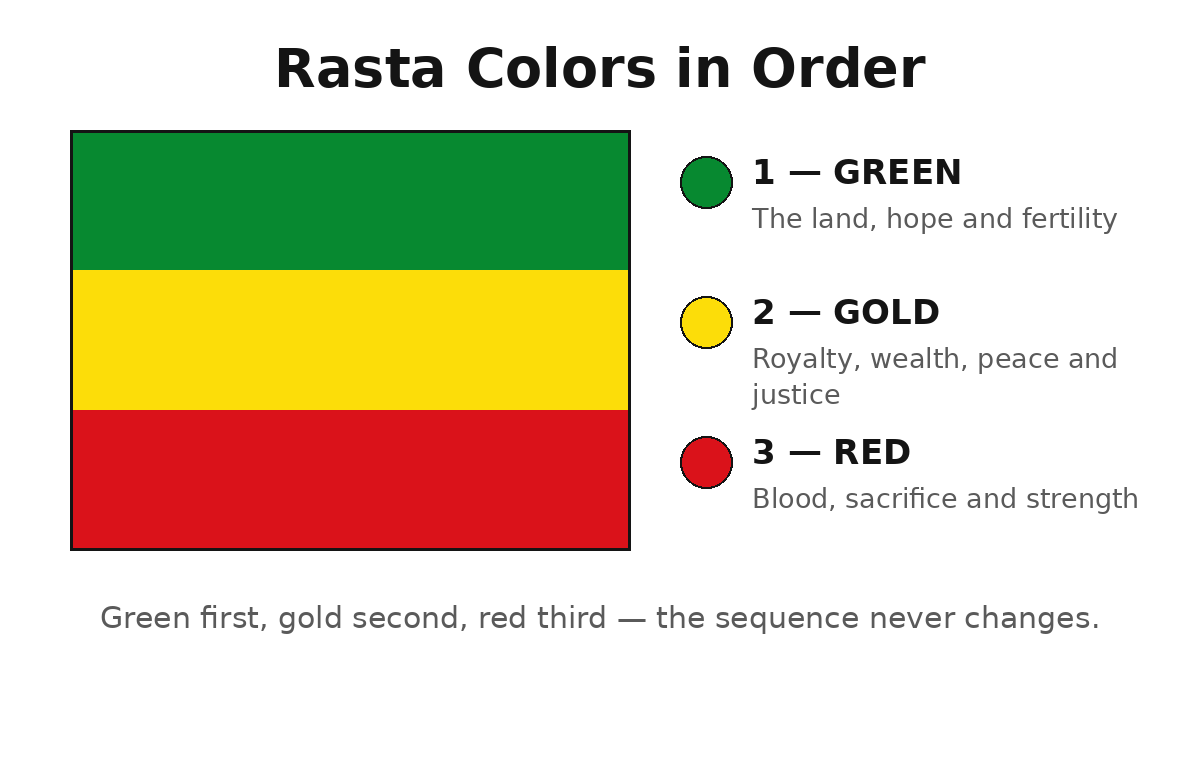
Over time, the colors moved from flags and banners into clothing. Early wearers used simple striped shirts, knitted caps, and sashes, often made at home or bought from local makers. As reggae spread, the colors appeared on stage clothes, on posters, and on record sleeves, and makers began to print them on tees, hoodies, and dresses for a wider audience. The colors are a living tradition, not a fixed code. Our guide to Rasta Colors in Order explains the sequence and what each position can mean. Our comparison of rasta flag colors vs Ethiopian flag colors sets out the difference between the Ethiopian flag and the rasta flag in full.

What Each Color Means

Each color in rasta clothing carries a meaning, and the meanings are often explained together, as a single story told in four parts. Green is the color of the land of Ethiopia and of Africa, and it stands for growth, life, and the natural world. It is the color of the hills, the fields, and the vegetation that sustains people, and it is also a reminder of a homeland that many wearers have not lived in but still feel connected to. When green appears in clothing, it often grounds the outfit.

Gold, sometimes called yellow, is the color of the wealth of the land and of the richness of African heritage. It stands for sunshine, for harvest, and for the value of the people and the culture. In clothing, gold is often the brightest of the four colors, and it is used to lift an outfit and to draw the eye. A gold stripe, a gold cap, or a gold print can change a plain black tee into a rasta piece. Our piece on what gold means in Rastafari goes into that meaning in more depth.

Rasta color meanings chart: green for land and growth, gold for wealth and heritage, red for sacrifice and struggle, black for the people
The four rasta colors and what each one means.

Red is the color of the blood of those who fought and suffered, and it stands for sacrifice, struggle, and the cost of freedom. It is the most intense of the colors, and it is often used with care. A full red outfit can be powerful, and a red stripe or a red cap can be enough to make the meaning clear without overwhelming the rest of the clothes. People who wear red in this tradition are often aware of that weight, and they wear it as a mark of respect for those who came before.

Black is the color of the people, and it stands for the African people and for the strength and dignity of the diaspora. In clothing, black is also a practical color. It is a base that lets the other colors stand out, and it suits many occasions, from daily wear to formal gatherings. A black tee with a red, gold, and green print is one of the most common rasta garments. Taken together, the four colors tell a story about land, wealth, struggle, and people.

Rastafarian man in Barbados wearing a red gold green and black crochet cap
In Barbados and across the Caribbean, a crocheted cap in the four rasta colors is a familiar and practical piece of dress.

The Main Pieces of a Rasta Wardrobe

A rasta wardrobe is built from familiar garments, and the main pieces are easy to find and easy to wear. T-shirts are the starting point for most people. A cotton tee in black, white, or green, with a lion print, a flag stripe, or a simple wordmark, is a versatile piece that can be worn alone or layered under a hoodie or jacket. The best tees are made from soft, breathable cotton, with a print that is clear and well placed, and with a fit that is comfortable without being shapeless.

The main pieces of a rasta wardrobe: tam, t-shirt, dress, jersey, hoodie and scarf in green, gold, red and black
The main pieces of a rasta wardrobe, from the tam to the scarf.

Hoodies and sweatshirts are the next layer. They are worn in cooler weather, on travel days, and at evening gatherings, and they are often the piece that carries the boldest color. A hoodie in green with a gold lion, or a black hoodie with a red, gold, and green stripe across the chest, can be the center of an outfit, and it pairs well with jeans, joggers, or a skirt. When choosing a hoodie, look for a soft interior, a sturdy drawstring, and a print that does not crack after a few washes.

Basketball jerseys have become a signature piece in modern rasta clothing, and they show how the style can take a sport garment and make it its own. A jersey in black with red, gold, and green trim, or in green with a lion emblem, is worn on the court, at festivals, and on the street, and it is often paired with shorts, joggers, or jeans. Our guides to rasta jerseys and to Fifth Degree rasta jerseys explain the cut, the fit, and the way the colors are used on these pieces. One jersey that shows the idea well is the Ethiopia Haile Selassie I Basketball Jersey, the Rasta Lion of Zion design from Fifth Degree, at 65 dollars on Etsy, which puts the lion, the Ethiopian colors, and the name of Haile Selassie on a black basketball jersey that can be worn as a statement piece or as part of a fuller outfit.

Dresses, skirts, and leggings are central to the women’s side of the style. The women’s wardrobe includes long dresses in earth tones with color accents, striped dresses for festivals, leggings in rasta colors for comfort and movement, and skirts that pair with a plain tee or a fitted top. The same principles apply. One strong color piece, a comfortable fit, and a print that means something will always work better than a busy outfit with no clear center. Our piece on Rastafarian clothing styles for women who dress with meaning shows how those choices are made. Our guide to what Rasta men wear covers the men’s side in detail, and men’s and women’s pieces differ mainly in cut.

How to Wear Rasta Clothing Well

Wearing rasta clothing well starts with the occasion. A festival, a concert, or a community gathering is a place for bold color, for a full outfit, and for a statement piece. A day at work, a family visit, or a trip to the shops is a place for a quieter version, with one color piece and a neutral base. The same wardrobe can serve both occasions, and the difference is in how the pieces are combined. A striped tee that is bold at a festival can be toned down with dark jeans and a plain jacket.

Fit is the next consideration. Rasta clothing is meant to be comfortable, and that means a fit that allows movement without looking sloppy. A tee should sit on the shoulders, a hoodie should allow the arms to move, and a pair of joggers should be comfortable at the waist and the ankle. Sizes vary between makers, so it is worth checking the size guide, reading the measurements, and, when possible, trying the garment on before buying. A garment that fits well will look better, feel better, and last longer.

Color balance is a practical skill, and it can be learned. The simplest rule is to choose one main color, one supporting color, and one accent, and to let the rest of the outfit be neutral. A green hoodie, black joggers, and a gold cap is an example. A black tee with a red, gold, and green print, blue jeans, and plain shoes is another. White is a useful neutral, because it brightens the palette and it works in warm weather. Brown and tan are useful too, because they connect with the earth tones in the tradition.

Layering helps in cooler weather and in changing conditions. A tee under a hoodie, a hoodie under a jacket, or a scarf over a dress can add warmth and depth, and it can also add a second color without changing the whole outfit. Footwear matters too, and it is often overlooked. Comfortable shoes, sandals, or boots that suit the occasion will complete an outfit, and they should be chosen with the same care as the top. Our guide to how to style rasta clothing gives more examples, and our festival guide on what to wear to a reggae festival shows how the same principles work when the occasion is loud, warm, and crowded.

Respect, Context, and Common Mistakes

Rasta clothing is worn in a cultural and religious context, and respect for that context is part of wearing it well. The most important habit is to learn before you wear. Learn what the colors mean, learn who Haile Selassie was, learn what the Lion of Judah stands for, and learn how the movement sees itself. That learning does not need to be academic, and it does not need to take a long time. Reading a clear guide, listening to reggae with attention to the words, and talking with people who wear the style can all help. Jamaica, where the movement grew, is a good place to start that learning.

One common mistake is to treat the colors as a costume. A costume is worn for a party, for a joke, or for a single night, and it is taken off without thought. Rasta clothing is not a costume, and wearing it as one can feel disrespectful to people for whom the colors are a matter of faith and identity. That does not mean that only Rastafari can wear the colors. It means that anyone who wears them should do so with care, with knowledge, and with a willingness to be corrected.

Another mistake is to mix sacred symbols with careless or offensive designs. A lion print on a well-made tee is one thing. A lion print combined with a design that mocks the faith, or that uses the colors to sell something that has nothing to do with the culture, is another. When buying, look at the whole design, not only the colors. A maker who explains the design, who names the symbols, and who shows care in the way the garment is made is more likely to be making clothing that respects the tradition. Our Rasta Store guide and our Rasta Apparel guide both discuss how to tell the difference.

Choosing Quality Rasta Clothing

Quality in rasta clothing starts with fabric. Cotton is the most common choice, and it is valued for its breathability, its softness, and its ability to hold color. A good cotton tee will feel soft, will not be too thin, and will keep its shape after washing. A cheap cotton tee will often be thin, will lose its shape, and will fade quickly. Blends with a small amount of synthetic fiber can add stretch and durability, and they are common in leggings, joggers, and dresses. The key is to read the fabric description, to feel the garment when possible, and to avoid pieces that feel rough or stiff.

Print quality is the next test. A good print is clear, well placed, and made with ink that stays on the fabric. A poor print is blurry, off-center, or made with ink that cracks and peels. When shopping online, look for close-up photos of the print, read the description of the printing method, and check the reviews for comments about washing and wear. A maker who shows the print clearly and who explains how it is made is more likely to be selling a garment that will last.

Fit and construction matter as much as fabric and print. Check the seams, the hems, and the collar. A well-made garment will have straight seams, a collar that lies flat, and hems that do not curl. Size guides are also a sign of care. Where the clothing is made, and who makes it, is worth considering too. Small makers, independent shops, and makers who explain their process often produce clothing with more care than large, anonymous sellers. The Rasta Gear guide and the Rasta Shop of Your Dreams guide both discuss how to judge a shop. Dreadlocks themselves are a central part of Rastafari identity for many wearers, and headwear that respects them is part of the clothing tradition.

Care is the last part of quality. Rasta clothing, like any colored clothing, should be washed in cold water, turned inside out, and dried away from strong sun when possible. That care will keep the red from fading, the gold from dulling, and the green from losing its depth. A garment that is cared for will last longer, and it will also look better for longer. That is a practical point, and it is also a point about respect. Clothing that is made with care and worn with care will show that care.

Our View — Brian Ka

Rasta clothing works best when it is worn as a choice, not as a trend. Learn the colors, choose one good piece, wear it often, and let the rest of the wardrobe grow from there. The colors have lasted because they mean something, and the people who wear them with knowledge are the people who keep that meaning alive.

Frequently Asked Questions

What is rasta clothing?

Rasta clothing is clothing in the colors and symbols of Rastafari, including red, gold, green, and black, lion and flag imagery, and garments such as tees, hoodies, jerseys, dresses, and crocheted tams. It is everyday clothing with a cultural and spiritual meaning, and it is worn by Rastafari, by reggae fans, and by people who admire the culture.

What do the rasta colors mean?

Green stands for the land and for life, gold stands for the wealth and richness of African heritage, red stands for the blood and sacrifice of those who struggled for freedom, and black stands for the African people. Together, the colors tell a story about land, value, struggle, and identity, and they are drawn from the Ethiopian flag and the wider Pan-African tradition.

Can anyone wear rasta clothing?

Anyone can wear rasta clothing, and many people do, but it should be worn with knowledge and respect. Learn what the colors and symbols mean, choose garments that are well made, and avoid wearing the style as a costume or a joke. Wearing the colors with care is the best way to show respect for the faith and culture behind them.

What is the difference between rasta colors and the Ethiopian flag?

The Ethiopian flag is the national flag of Ethiopia, with green, gold, and red bands. Rasta colors draw on the same palette and add black and symbols such as the Lion of Judah, and they are used as a sign of connection with Ethiopia and with African heritage. The two are closely related, and they are not the same thing, and both deserve care in the way they are used.

How should I start wearing rasta clothing?

Start with one strong piece, such as a striped tee, a lion-print jersey, or a cap in the colors, and pair it with neutral jeans, joggers, or a skirt. Check the fit and the fabric, wear the piece often, and add new pieces only when they work with what you already own. That simple start will give you a wardrobe that is comfortable, balanced, and true to the meaning of the colors.

Questions about rasta clothing, sizing, or an order?

Reach out to Fifth Degree and we will help you find the right piece.

Contact Fifth Degree

Sources

Recommended

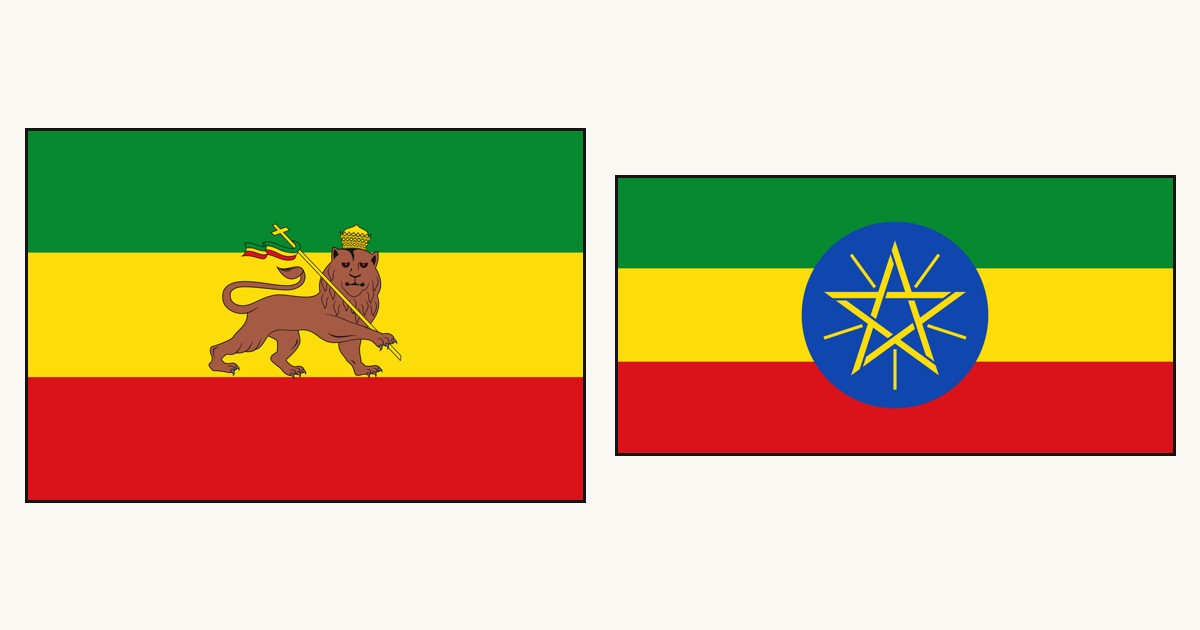
Imperial Ethiopian flag with the Lion of Judah beside the current Ethiopian flag with its blue disc and star, side by side

Rasta Flag Colors vs Ethiopian Flag Colors: The Real Difference

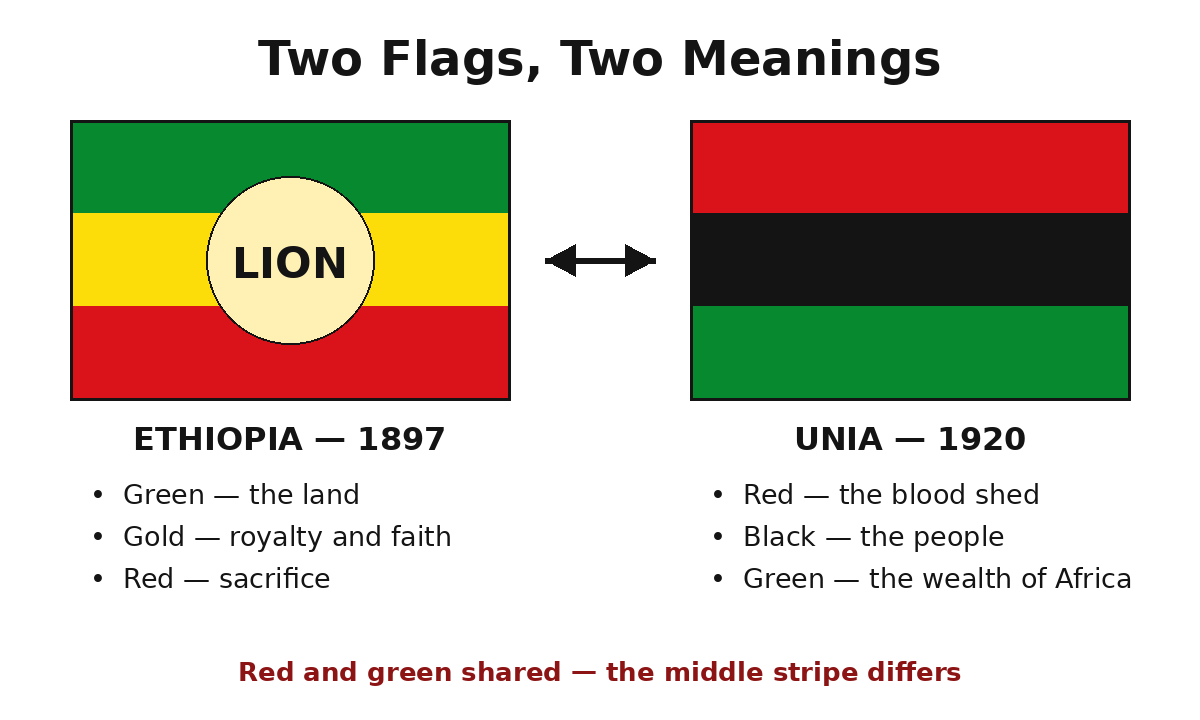
Two flags share the same three colors, the same horizontal stripes, and almost the same name in everyday conversation, yet they are not the same flag, they do not belong to the same owner, and they do not say the same thing. One is the living national flag of Ethiopia, a sovereign state whose emblem is a radiant star on a blue disc. The other is the banner most people call the Rasta flag, which is not a new design at all but the old imperial flag of Ethiopia, kept flying by the Rastafari movement long after Ethiopia itself set it aside. If you have ever looked at a green, gold and red flag and wondered whether the lion in the middle makes it Ethiopian, Rasta, or both, this guide settles the question piece by piece: stripe order, emblem, color meaning, history, and the third flag, Marcus Garvey’s red, black and green, that gets folded into the confusion.

Start with the colors themselves

Rasta Colors: The Complete Guide  |  Shop Rastafarian Clothing  |  Contact Us

Key Takeaways

  • The Rasta flag and the current Ethiopian flag share the green, yellow and red tricolour, in the same top-to-bottom order. The difference is the emblem in the center.
  • The Rasta flag carries the crowned Lion of Judah, the emblem of imperial Ethiopia. Ethiopia’s current national flag carries a yellow pentagram with rays on a light blue disc, adopted with the present design in 1996.
  • There is no single official Rasta flag issued by a government. What people call the Rasta flag is the imperial Ethiopian banner that Rastafari kept in use because of what Haile Selassie and the Lion mean within the faith.
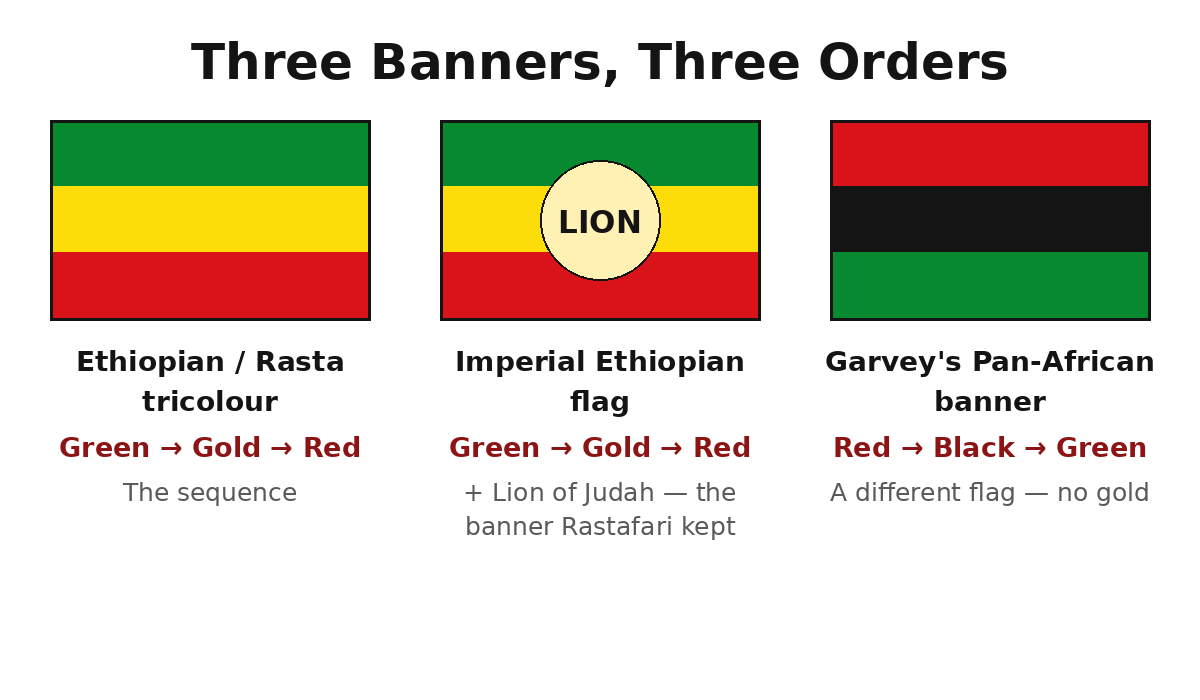
  • Garvey’s Pan-African flag is a different flag again: red on top, black in the middle, green at the bottom, with no emblem and no gold stripe.
  • The colors carry overlapping but distinct meanings. In Ethiopia’s own law, green is for labour, fertility and development, yellow for hope, justice and equality, and red for sacrifice and heroism. In Rastafari use, gold is also read as the wealth of Africa and the lion adds kingship, strength and African sovereignty.

Table of Contents

Two Flags at a Glance

The fastest way to separate the two flags is to ignore the stripes and look at the middle. Both flags are built on the same green, yellow and red field, and that shared field is exactly why they are confused. The CIA World Factbook describes Ethiopia’s current flag as three equal horizontal bands of green, yellow and red with a yellow pentagram and rays on a light blue disc at the center, and no lion appears anywhere in that description. The flag most people call the Rasta flag keeps the same three bands but places the crowned Lion of Judah at the center instead, holding a staff topped with a cross. Same cloth, different center, different owner, different statement.

Feature Rasta Flag Ethiopian National Flag (Current)
Whose flag is it? A religious and cultural banner of the Rastafari movement; not issued by any state The official national flag of the Federal Democratic Republic of Ethiopia
Stripes, top to bottom Green, gold (yellow), red Green, yellow, red
Center emblem Crowned Lion of Judah holding a cross-topped staff Yellow pentagram with radiating rays on a light blue disc
Design origin The imperial Ethiopian flag, in use under the empire until 1974 and retained by Rastafari The tricolour tradition from 1897, with the blue disc and star emblem added in 1996
What the emblem declares Kingship, the Solomonic dynasty, and Haile Selassie as Conquering Lion of Judah Unity and equality of Ethiopia’s peoples, and a bright shared future
Blue in the design? No blue field or disc Yes, the emblem sits on a blue disc signifying peace
Legal status No legal standing as a national flag anywhere; flown freely as a faith and culture symbol Defined in Ethiopian law, including stripe order, proportions and emblem

Read the table from the center outward and the confusion mostly dissolves. The stripes tell you which family a flag belongs to, the green, gold and red family that Ethiopia created and the wider world borrowed. The emblem tells you which member of the family you are looking at: a lion means the imperial banner and, in modern use, Rastafari; a star on blue means the present-day Ethiopian state. A plain tricolour with nothing in the middle is the shared ancestor of both, and the version many Ethiopians still fly informally, as the Flags of the World entry on Ethiopia documents. Our full breakdown of the color family itself lives in our guide to rasta colors, which this comparison builds on rather than repeats.

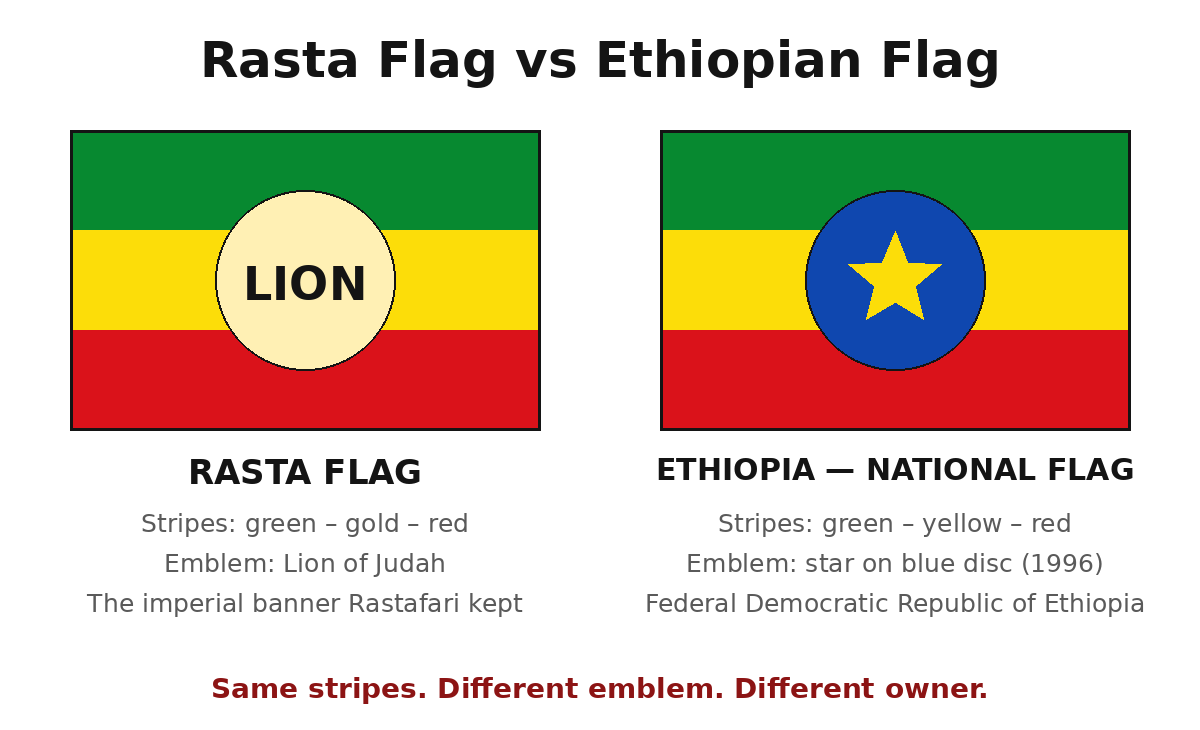
Comparison diagram showing the Rasta flag and the current Ethiopian flag side by side with stripe order and emblem labels
The two flags side by side: identical stripes, different emblems, different owners.

Ethiopia’s National Flag Today: Stripes, Disc and Star

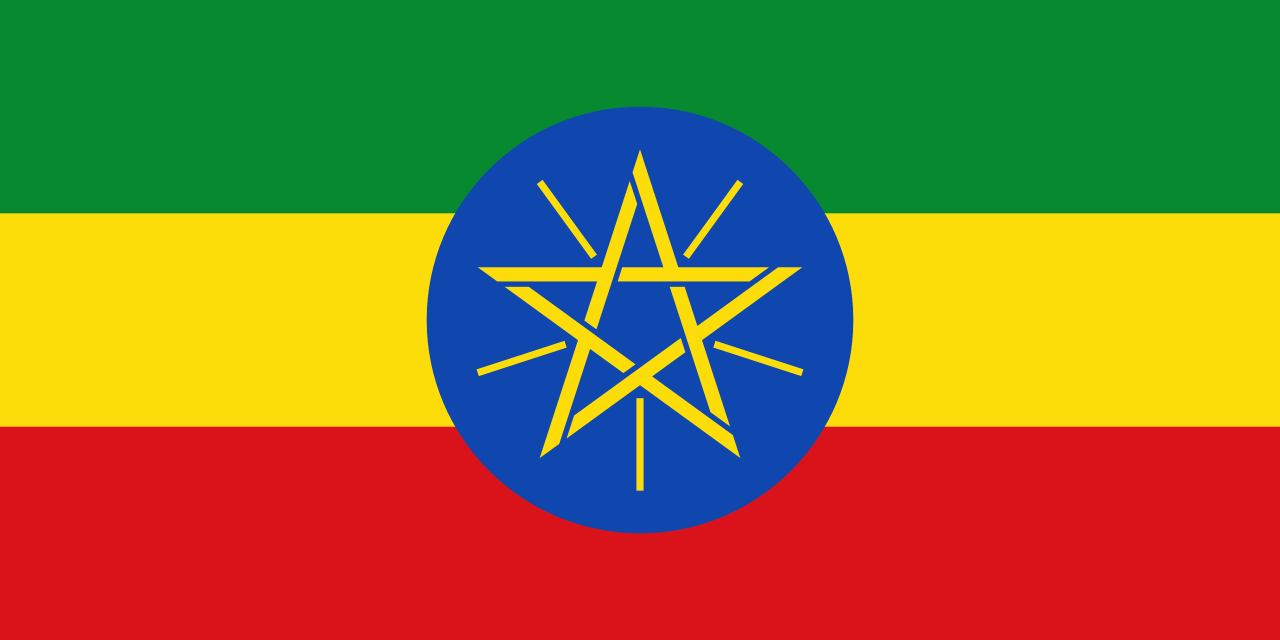
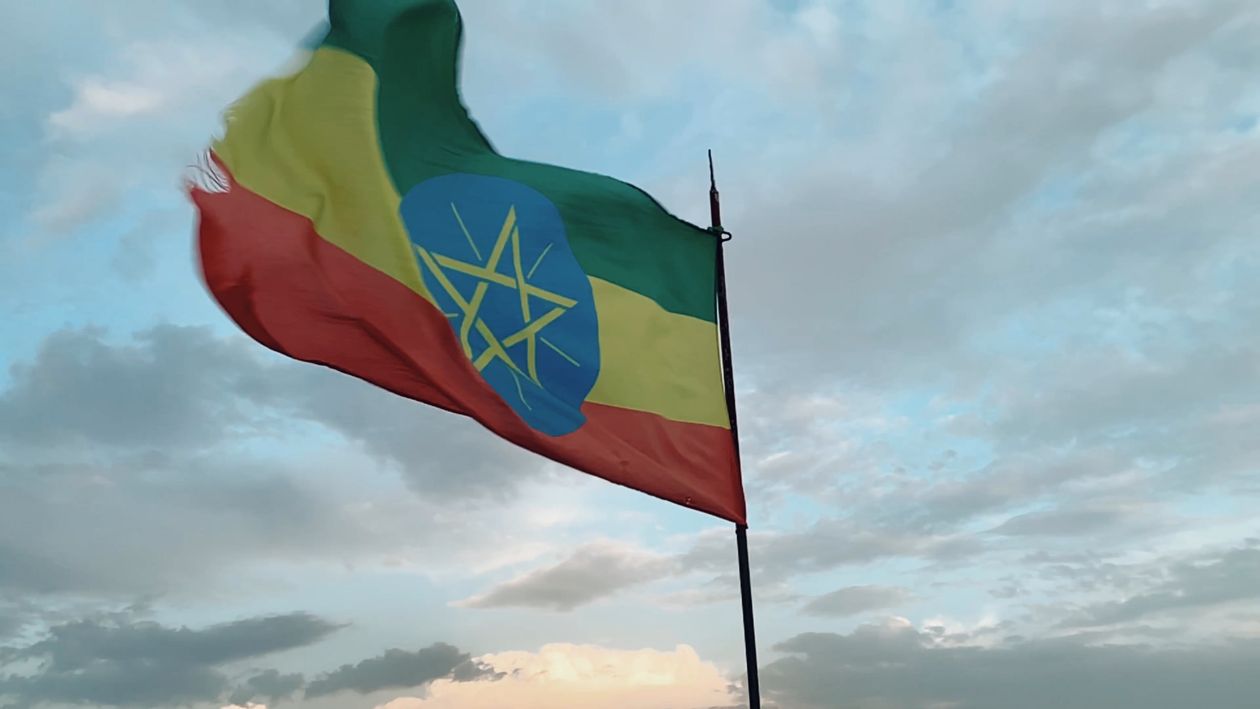
Ethiopia’s current flag is a legal object before it is a symbol, and its specification is written down in law. The country’s Flag and Emblem Proclamation states the construction plainly: green at the top, yellow in the middle and red at the bottom, the three colours bright and basic, structured horizontally in equal size, with the length of the flag twice its width. At the center sits the national emblem, a blue circle carrying a star formed by straight and equal yellow lines, with yellow rays radiating from the joints. That proclamation is the reason the modern Ethiopian flag can be described so precisely, and it is also the reason a flag with a lion in the middle, however beloved, is not the flag of Ethiopia today.

The emblem itself is younger than the stripes by almost a century. The Flags of the World record dates the current flag, emblem included, to 6 February 1996, and the Encyclopaedia Britannica account gives the same turning point, describing how the constitution for the Federal Democratic Republic added the central blue disc with its yellow outlined and rayed star. The emblem was adjusted again in 2009, when the disc took the darker blue seen today. So the honest answer on dating has two parts: the tricolour is a nineteenth-century creation, and the flag in its exact current form is a 1990s design laid over that older field.

Current national flag of Ethiopia with green, yellow and red horizontal stripes and a blue disc with a yellow star in the center
The current national flag of Ethiopia: green, yellow and red, with the blue disc and radiant star at the center.

The meanings attached to the modern flag are also a matter of record rather than folklore. The same Ethiopian proclamation assigns them directly: green for labour, fertility and development, yellow for hope, justice and equality, red for sacrifice and heroism in defence of freedom and equality, and the blue background of the emblem for peace. The star formed by equal lines signifies the unity of Ethiopia’s nations, nationalities and peoples, and its rays their bright prospect. General references land in the same place; WorldAtlas summarises the flag the same way. When the emblem is explained on our site, the companion piece is our explainer on the Ethiopian coat of arms, since the device on the flag and the national emblem are the same design doing two jobs.

One more fact explains why these colors travelled so far beyond Ethiopia’s borders. Ethiopia kept its independence through the colonial partition of Africa, and its flag became a template for liberation: the Factbook notes that the three main colors were adopted so often by other African countries on independence that they became known as the Pan-African colors. That borrowing is the deep reason green, gold and red now appear on flags, clothing and artwork with no direct connection to Ethiopia at all, a theme we return to in our look at reggae colors and how the palette moved through music culture.

The Rasta Flag: The Imperial Banner That Never Retired

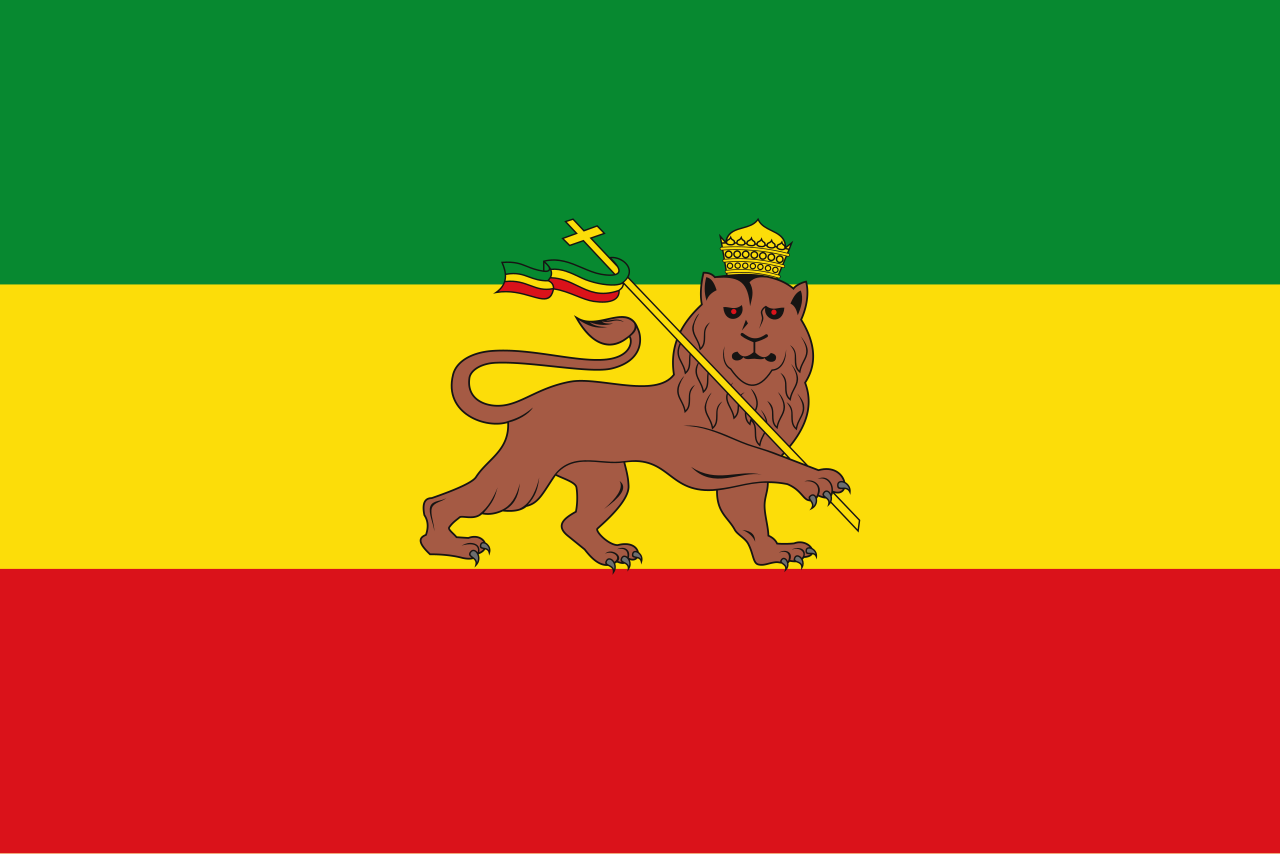
The Rasta flag was never designed as a Rasta flag, and that single fact clears up most of the argument around it. It is the flag of imperial Ethiopia, the banner flown under the emperors, with the Conquering Lion of Judah at its center. When the empire fell in 1974 and Ethiopia moved through socialist emblems toward the present republican design, the lion flag lost its state. It did not lose its people. In Jamaica, a religious movement had spent four decades looking to Ethiopia as Zion and to its emperor as a living sign of African sovereignty, and that movement simply kept the flag. What the world now calls the Rasta flag is an act of preservation: a deposed empire’s banner, carried on by a faith that never accepted the deposition as the end of the story.

To see why the lion flag, of all flags, became sacred in Jamaica, start with what Rastafari is. Encyclopaedia Britannica describes Rastafari as a religious and political movement begun in Jamaica in the 1930s, combining Protestant Christianity, mysticism and a pan-African political consciousness, in which Ethiopia is the ultimate home of all Africans and many adherents regard Emperor Haile Selassie I, crowned in 1930, as the messiah. The Smithsonian Magazine account of the Smithsonian’s own Rastafari exhibition traces the movement to a longing for place and dignity among peoples of African descent, and to the November 1930 coronation that Jamaican preachers read as prophecy fulfilled. A movement built on that reading was never going to adopt the emblem of the republic that replaced him. It kept his flag instead.

Imperial Ethiopian flag with green, yellow and red horizontal stripes and the crowned Lion of Judah holding a cross-topped staff in the center
The imperial Ethiopian flag with the Lion of Judah, the banner Rastafari kept flying and the world now calls the Rasta flag.

The lion itself is far older than the movement that adopted it. The imperial arms showed a crowned lion holding a staff topped by a cross, with ribbons in the three national colours, and the Swiss National Museum explains the claim behind the image: the Ethiopian emperors styled themselves Conquering Lion of the Tribe of Judah, presenting Haile Selassie as a successor in the line of Solomon and the Queen of Sheba, and the crowned lion with its sceptre appeared on the Ethiopian flag of his era. Within Rastafari, that makes the lion a portrait as much as a symbol, a point we develop fully in our piece on the Lion of Judah in Rastafari culture. On the Rasta flag, the lion is not decoration. It is the reason the flag exists.

Because the Rasta flag has no issuing government, it has no single enforced specification, and honest variations exist. Some banners show the lion larger, some smaller, some render the middle stripe as a richer gold rather than flat yellow, and black joins the palette on clothing and artwork even though it is not a stripe of the flag itself. Britannica’s summary of Rastafari livity notes that adherents dress in red, green, gold and black, colours it glosses as the life force of blood, herbs, royalty and Africanness, which is why a four-colour palette surrounds a three-stripe flag. A university study of the colours in dress, Rasta Colors and African Roots from CUNY City Tech, traces exactly this spillover, showing how the Ethiopian colours and the Lion moved from flags into Rastafari textiles, garments and jewellery as everyday markers of identity. The flag is the source; the clothing is the flag, worn.

Stripe Order: Where Readers Get Tripped Up

On stripe order, the two flags agree, and the popular belief that they are arranged differently is the most durable myth in this comparison. Both run green on top, yellow or gold in the middle, and red at the bottom. If you are holding a green-gold-red flag with red at the top, you are not holding a different flag; you are holding one of these two flags the wrong way up, and the emblem is your check. On the Ethiopian flag the star sits centered on the stripes, and on the Rasta flag the lion stands on his feet, crown up, staff upright. An upside-down lion is the giveaway that the whole banner needs turning around.

The myth has a genuine historical root, which is why it refuses to die. The tricolour was not born in its present order. The Flags of the World history of imperial Ethiopia records that the rectangular flag adopted in October 1897 carried red at the top, and that the change to green on top came later, in the period after the Italian occupation ended in 1941. Britannica’s flag history tells the earlier part of the same story, noting that pennants of the three colours preceded the first official flag established by Emperor Menelik II in 1897, and that his first flag bore the initial of his name on the yellow stripe before the imperial lion arms took that central place for official use. So a red-top Ethiopian flag is not an invention. It is a photograph of the flag’s youth, and reproductions of the early design still circulate, where they quietly teach anyone who copies them an order the flag itself abandoned generations ago.

Flag historians also record a tradition that the tricolour flown with red uppermost signalled a country at war, which gave the reversed flag a meaning of its own rather than treating it as a simple mistake. For a modern reader, the practical rule is simpler than the history. Green on top is correct for both flags in any current context, on a wall, on a garment, or on a festival banner. Red on top is either an antique reproduction, a deliberate historical reference, or an error, and on anything made for Rastafari use today it is almost always the third of those. Getting the order right is part of wearing the colours with respect, a theme that runs through our guide to traditional rasta outfits as well.

What Green, Gold and Red Mean in Each Tradition

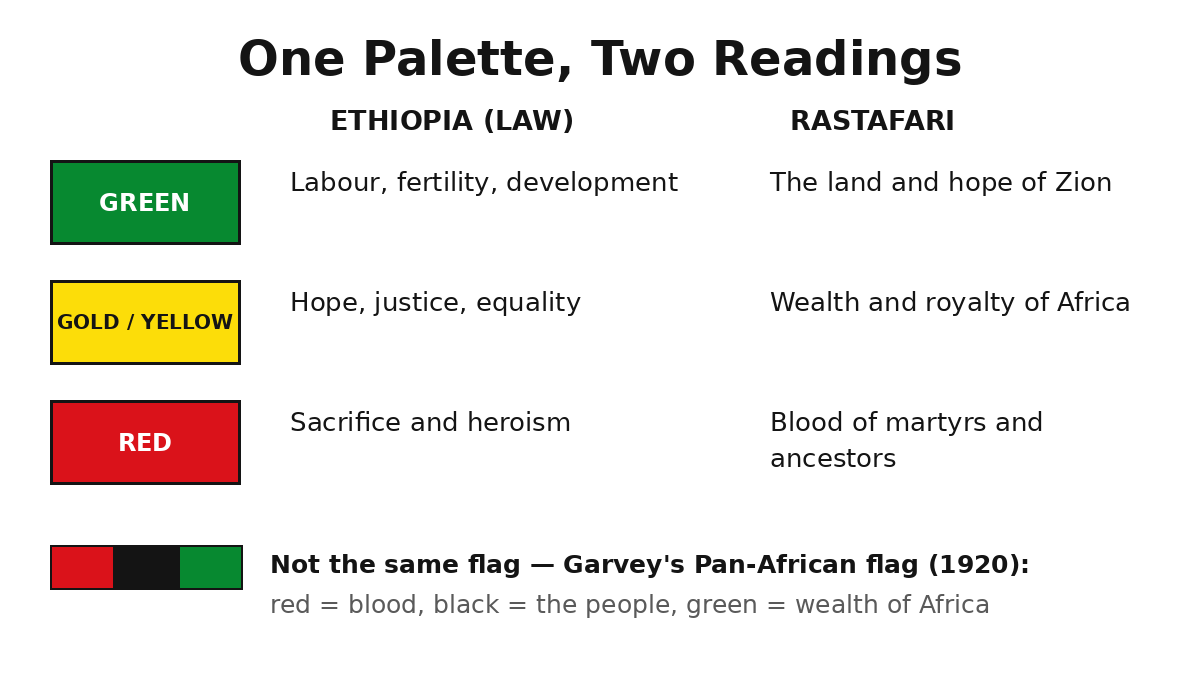
The colours are shared, but the two traditions load them with meaning in noticeably different proportions. Ethiopia’s official reading, set out in its flag proclamation, is civic in character. Green speaks of labour, fertility and development, the working land. Yellow speaks of hope, justice and equality, the terms on which the federation’s peoples live together. Red speaks of sacrifice and heroism, the price paid for freedom. It is the vocabulary of a state describing itself to itself: land, fairness, and the cost of keeping both. Nothing in the official reading is mystical, and the emblem’s blue disc adds the state’s favourite word of all, peace.

The Rastafari reading grows from the same soil but reaches further back and further out. Green is the land again, but now it is also the vegetation of Africa and Jamaica, the herb, and the hope of return to Zion. Gold, and Rasta usage insists on the word gold rather than yellow, is the wealth of Africa: its minerals, its riches, and the royalty of a people told for centuries that they had none. Red is blood, the blood of martyrs and of ancestors who died under slavery and oppression, remembered rather than merely honoured. The New World Encyclopedia entry on Rastafari shows how tightly these readings are bound to the movement’s core, describing a faith that takes Haile Selassie, whose pre-coronation name Ras Tafari gave the movement its own name, as Jah incarnate and the promised messiah, read through biblical prophecy and the emperor’s titles, among them Conquering Lion of Judah. Colours attached to a belief that strong become a creed.

Diagram comparing the meanings of green, gold and red in Rastafari and in Ethiopia's national symbolism, with Garvey's red, black and green shown separately
One palette, two readings: the civic meanings in Ethiopia’s law, and the faith meanings carried in Rastafari.

An older Ethiopian reading sits underneath both, and it explains why the colours felt sacred long before either the republic or Rastafari claimed them. Flag historians note that before the empire ended, the colours were also interpreted through the Ethiopian Orthodox Church: red for faith and power, yellow for the church, peace, natural wealth and love, and green for the land and hope, with a further association to the Holy Trinity. A colour set that a church, an empire, a republic and a religion have all found meaning in is a language, and fluency in it is most of what this site exists to teach, from the sayings collected in our Haile Selassie quotes to the blessing examined in Who Jah Bless, No Man Curse.

Lion vs Star: The Emblem Is the Whole Argument

Strip the emblems away and the two flags collapse into one; restore them and you can watch two different ideas of Ethiopia argue with each other in a single image. The lion argues for continuity with a sacred monarchy. It claims descent from Solomon and Sheba, it crowns its bearer King of Kings, and it roots the nation’s authority in a line of emperors stretching back through scripture. The star argues for a federation of equals. Its lines are straight and equal by law, its rays promise every nation, nationality and people the same bright future, and its blue field asks for peace rather than glory. Neither emblem is a logo in the modern sense. Each is a constitution, compressed into a picture small enough to sew onto cloth.

The lion’s side of the argument deserves its full weight, because outsiders routinely underestimate it. For Rastafari, Haile Selassie is not a mascot of the faith but its center, and the Smithsonian’s exhibition reporting describes adherents for whom his messages of liberation and unity remain paramount decades after his death. When a believer flies the lion flag, the claim being made is theological: the emperor the world deposed still reigns where it matters. Our coverage of the holy days that keep that calendar alive, beginning with Groundation Day, shows how the lion, the emperor and the colours are celebrated together rather than as separate symbols. To ask a Rasta to swap the lion for the star is not to ask for a design update. It is to ask for a different religion.

The star’s side deserves equal fairness, because the republic’s choice was deliberate and, on its own terms, generous. Ethiopia is home to many peoples and faiths, and an emblem drawn from one dynasty’s arms could not speak for all of them. The 1996 design reached for geometry instead of genealogy: a star anyone can stand under, on a disc the colour of peace. Ethiopians who fly the current flag are not flying a lesser version of the lion banner; they are flying a different settlement about what their country is, one in which the state belongs to its peoples collectively rather than to a throne. Two flags, one palette, and a plain tricolour flown by millions who decline to choose between them: that is the real shape of the comparison, and it is why the colours alone will never tell you which Ethiopia a given banner means.

The Third Flag in the Room: Garvey’s Red, Black and Green

Any honest comparison has to clear a third flag off the table, because a large share of what gets sold and searched as a Rasta flag is actually Marcus Garvey’s. The Pan-African flag, also called the Black Liberation flag or the UNIA flag, is a horizontal tricolour of red on top, black in the middle and green at the bottom. It has no gold stripe, no yellow stripe, and no emblem. It was formally adopted in August 1920 by the Universal Negro Improvement Association at its Madison Square Garden convention, a full decade before Haile Selassie’s coronation gave Rastafari its name. It belongs to Garvey’s movement first, and to the wider Pan-African world after it.

Its colours carry their own settled meanings, distinct from both Ethiopian readings. The Smithsonian Magazine account of the flag’s afterlife in American art records the standard gloss: red denotes the blood that was shed, black is for the people the flag represents, and green represents the abundant wealth of Africa. The UNIA’s own early catechism phrased it in the same spirit. Notice what is missing: there is no gold, because Garvey’s flag was designed for a people, not inherited from a state, and its black centre stripe, the people themselves, sits exactly where Ethiopia puts its gold.

Rastafari honours Garvey as a prophet, and the two flags fly side by side at gatherings so often that the public merges them into one blur of red, gold, green and black. The merger is understandable and, at a celebration, harmless. On a product listing, a tattoo, or a history exam, it is worth resisting. If the flag in front of you has a black middle stripe and no lion, you are looking at Garvey’s banner. If it has a gold middle stripe and a lion, you are looking at the imperial Ethiopian banner Rastafari kept. If it has a gold middle stripe and a star on blue, you are looking at the Ethiopia of today. Three flags, three owners, one shared conviction that African peoples deserved a banner of their own. The wider African roots of the palette are traced in our piece on ancient West African clothing and the colour traditions it carried.

Which Flag for What: Clothing, Festivals and Display

Knowing the difference changes what you wear, what you fly, and what you give, because each flag sends its message whether you intend it or not. Clothing printed with the lion speaks Rastafari. It is the design on the tams, tees and dresses documented in our guides to dressing like a Rastafarian woman and what rasta men wear, and it is read by everyone who knows the code as a statement of faith and identity, not a holiday souvenir. Wearing it well means wearing it accurately: green on top, lion upright and complete, crown and staff intact, because a cropped or upside-down lion reads to the people whose symbol it is the way a misspelled name reads to its owner.

The current Ethiopian flag belongs, first, to Ethiopians, and its proper homes are the official and the celebratory: national days, cultural festivals, restaurants, churches and homes where it stands for the country as it is now. Flying it at a reggae festival as a generic Rasta banner is the one genuinely common misuse in this field, since it borrows a living state’s flag, emblem and all, to decorate a different tradition that already has a banner of its own. The reverse misuse matters too: presenting the lion flag as the current flag of Ethiopia, in a classroom, a shop listing or a news graphic, teaches an error about a real country, whose actual flag has carried the star for a generation. Respect runs in both directions, and it costs nothing but attention.

Garvey’s flag, finally, is the banner of Pan-African pride in the broadest sense, at home at Black history events, Juneteenth celebrations, and anywhere the message is the unity of the African diaspora rather than one faith or one nation. A well-made display can honour all three flags together, provided each is labelled for what it is. That labelling instinct, telling the lion from the star and the gold stripe from the black one, is the whole skill this article set out to teach. Once your eye learns to go straight to the center of the flag and the middle stripe, you will never confuse them again.

Our View

The two flags are not rivals, and treating them as versions of each other sells both short. Ethiopia’s star flag is a young emblem on an old and honourable field, chosen by a republic to speak for all its peoples at once. The lion flag is that same field carrying the emblem Ethiopia set aside, kept in the air by a faith for whom the emperor it honours never stopped mattering. Learn to read the center of the flag and you learn to read the difference between a nation describing itself and a people remembering a king, and there is room in the world, and on this site, for both stories to be told accurately.

— Rastafarian Clothing

Frequently Asked Questions

Is the Rasta flag the same as the Ethiopian flag?

No. The Rasta flag is the imperial Ethiopian flag with the Lion of Judah, retained by the Rastafari movement after the empire ended in 1974. Ethiopia’s current national flag keeps the same green, yellow and red stripes but carries a yellow star with rays on a blue disc, a design adopted in 1996. Same stripes, different emblem, different owner.

What are the Rasta flag colors in order?

From top to bottom: green, gold and red, with the crowned Lion of Judah at the center. The order matches the modern Ethiopian flag. A flag with red at the top is either an early historical design, since the original 1897 tricolour ran red first before the order later changed, or a modern flag hung upside down.

Why is there a lion on the Rasta flag?

The lion is the Conquering Lion of Judah, the emblem and title of Ethiopia’s emperors, including Haile Selassie I. Rastafari regards Selassie as central to the faith, so the movement kept his imperial banner, lion included, as its own. The lion stands for kingship, strength, pride and African sovereignty.

What does the star on the Ethiopian flag mean?

Under Ethiopia’s flag law, the star formed by straight and equal lines signifies the unity of the country’s nations, nationalities and peoples, its yellow rays signify their bright future, and the blue disc behind it signifies peace. The emblem was added to the tricolour in 1996 and its blue was darkened in a 2009 adjustment.

Is the red, black and green flag a Rasta flag?

Not originally. Red, black and green is the Pan-African or Black Liberation flag created under Marcus Garvey and adopted by the UNIA in 1920, before Rastafari existed. Rastas honour Garvey as a prophet and the two flags often appear together, which is why the designs are confused, but the Garvey flag has a black middle stripe and no gold and no lion.

Questions about the colours, the symbols, or an order?

Write to us through our contact page and we will point you to the right guide, garment or answer.

Sources

Recommended

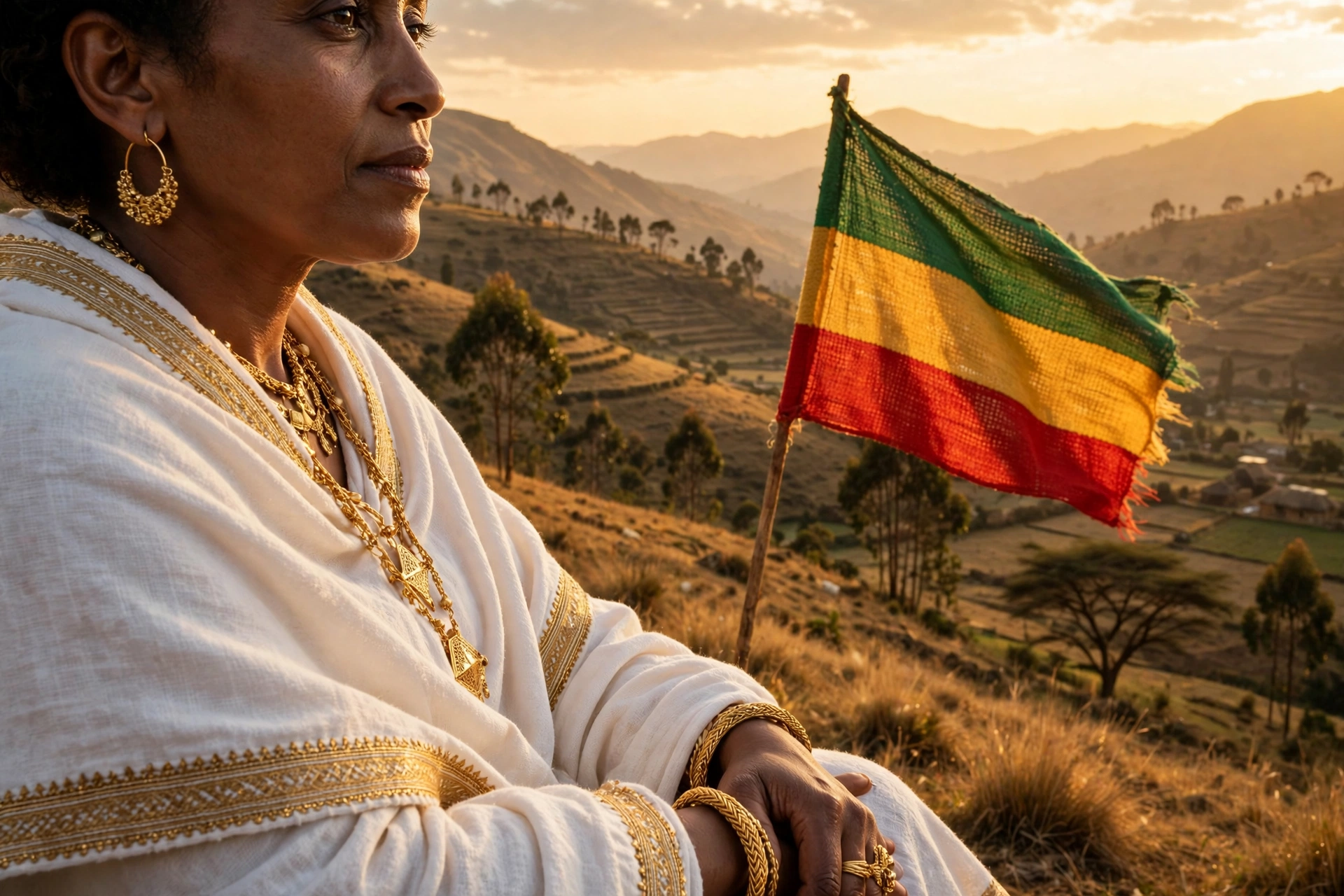
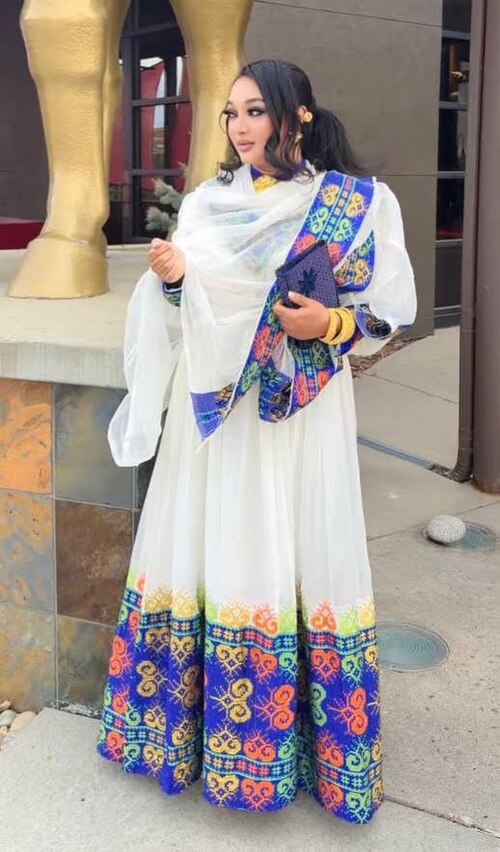
Woman in a white garment with gold trim and gold jewellery beside a green, gold and red flag above terraced hills at sunset

What the Color Gold Means in Rastafari

Gold is the colour people notice first and understand last in Rastafari. A newcomer sees a bright yellow stripe on a flag, a gold chain, a gold-trimmed tam, and assumes it is simply decoration, or simply yellow by another name. That assumption misses almost everything the colour is doing. In Rastafari, gold carries royalty, stolen wealth that must one day be restored, divine light, hope for a just future, and a direct line back to Ethiopia, to its emperors, its church, and its ancient gold trade. This guide untangles gold from yellow, from the Ethiopian flag, and from the separate Garveyite colours, so that when you see gold worn, flown, or sung about, you can read what it is actually saying.

Start with the full picture

Read our complete guide to Rasta colors and their meanings for the whole family of colours, then browse the Rastafarian Clothing shop to see how those colours live in everyday dress.

Woman in a white garment with gold trim and gold jewellery beside a green, gold and red flag above terraced hills at sunset

Key Takeaways

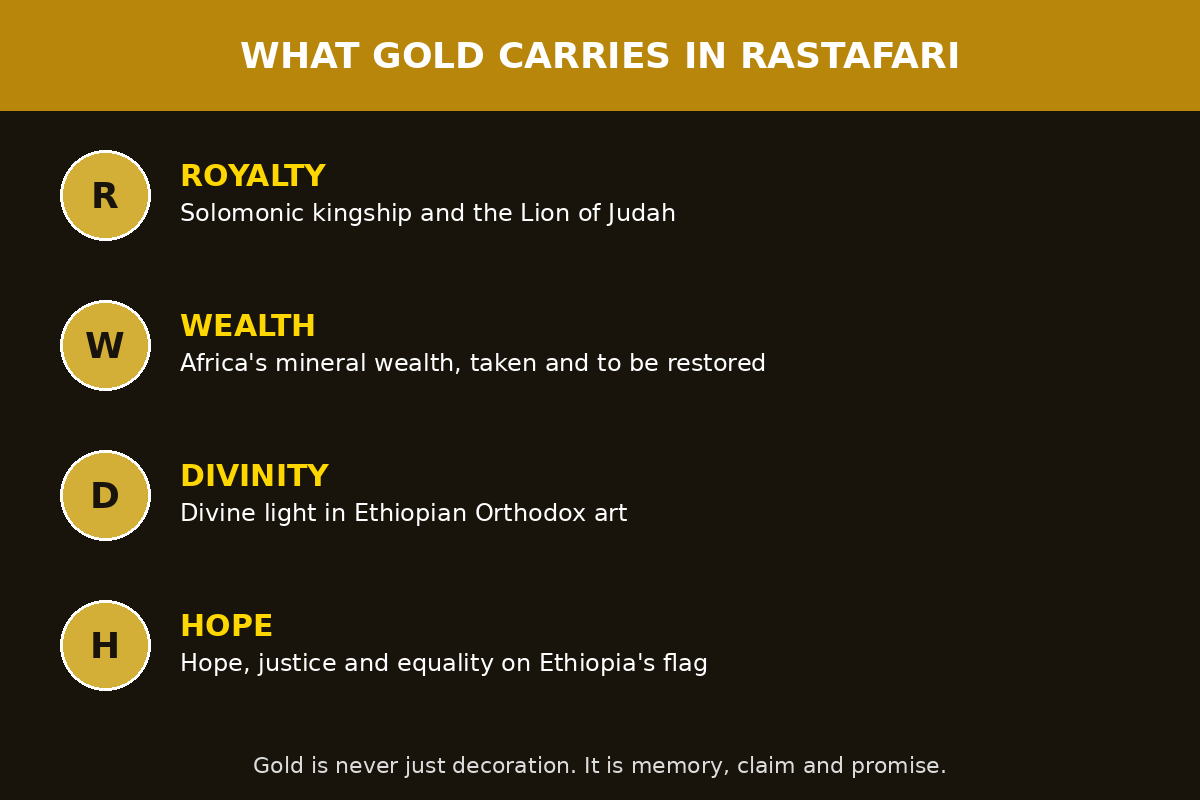
  • Gold in Rastafari means royalty, African wealth, divine light, and hope. It is a claim about history, not a fashion accent.
  • Gold and yellow name the same stripe on the Ethiopian flag. Writers use both words, but Rastafari speech prefers gold because gold carries value and kingship that plain yellow does not.
  • The colour comes first from Ethiopia: its flag, its Solomonic emperors, its Orthodox church art, and its ancient gold coinage and trade.
  • Gold is not a Garveyite colour. Marcus Garvey’s UNIA flag is red, black, and green. Rastafari adds gold from Ethiopia, which is why Rasta dress so often shows four colours together.
  • Wearing gold well means wearing it with understanding: centred between green and red, paired respectfully with symbols such as the Lion of Judah, and never treated as a costume.

Table of Contents

Gold or Yellow? Settling the Name First

Gold is the deliberate word, and the choice of word is the first lesson. Flag manuals, vexillology charts, and many reference books describe the middle stripe of the Ethiopian flag as yellow. That description is accurate as a matter of dye and printing. It tells you what the cloth looks like. It does not tell you what the colour means to the people who revere it. When Rastafari speakers, singers, and artists name that stripe, they overwhelmingly call it gold, and the long Rastafari tradition summed up in the phrase ites, gold and green treats gold as wealth and spiritual richness, not as a paint sample. The distinction matters because yellow, in ordinary English, can sound pale, cautionary, or cheap. Gold never sounds cheap. Gold sounds weighty, enduring, and royal, and those are precisely the associations Rastafari wants to keep in view.

If you have read our overview of Rasta colors, you will have seen this naming question appear again and again, because it confuses readers who move between sources. One book says yellow, a song says gold, a flag shop sells a yellow stripe, and a Rasta elder corrects you to gold, and all four are talking about the same band of colour. The helpful way to hold the two words is this: yellow is the manufacturer’s word, gold is the meaning word. Printers need a reproducible shade, so they specify yellow. Believers need a word that carries history, so they say gold. Neither group is wrong, but only one word explains why the colour moves people. Throughout this post we use gold, following Rastafari usage, while noting where official descriptions use yellow so you can recognise the same fact in different dress.

The confusion deepens because Jamaica’s own flag also uses gold, in a very different design, and because Ghana and many later African flags adopted the same green, gold, and red family. A reader can easily assume all golds mean the same thing everywhere. They rhyme, but they are not identical. Ghanaian gold points most directly to mineral wealth in the ground, as the Ghana Information Services fact sheet puts it plainly when it glosses gold as the mineral wealth of the country. Ethiopian and Rastafari gold includes that mineral sense, but it adds older and more theological layers: Solomonic kingship, church gold leaf, and Aksumite coinage. Keeping those layers separate is the solution to the most common misunderstanding about this colour, and it is why a single-colour deep dive is worth doing at all, rather than repeating a one-line gloss.

Gold on the Ethiopian Flag

Every account of gold in Rastafari must begin with the Ethiopian flag, because that flag is the colour’s passport. The modern Ethiopian tricolour places green at the top, gold or yellow in the middle, and red at the bottom, an order we examine in detail in our guide to the Rasta colors order. The Britannica flag entry records that pennants in these three colours were displayed long before Emperor Menilek II established the first official flag, and that the present design adds a blue disc with a yellow star whose rays speak of unity and a bright future. In the official reading Britannica summarises, blue is for peace, yellow is for hope, justice, and equality, red is for sacrifice for freedom and equality, and green is for labour, development, and fertility. Notice what gold does in that reading: it is the hopeful, just centre. It sits between the land above and the sacrifice below, as if to say that hope and fairness are what the land and the sacrifice are for.

A second reference tradition gives the same centre a slightly warmer tone. The WorldAtlas flag guide describes the yellow band as symbolising justice and harmony, the green as hope and fertility of the land, and the red as strength and sacrifice in defence of the land, with the golden pentagram standing for unity and equality. Harmony is a valuable addition to the gloss. It reminds the reader that gold is not only about wealth held, but about peoples held together. Ethiopia is a country of many nationalities, languages, and faiths, and a central gold star that radiates equally in all directions makes a visual promise that no group stands closer to the light than another. Rastafari, a movement of a scattered people longing for unity, heard that promise clearly and carried it far beyond Ethiopia’s borders.

Ethiopia also traditionally linked its colours to the rainbow after the Flood, a sign of covenant and survival after catastrophe. That biblical framing matters for Rastafari, which reads history through Scripture and understands African peoples in the Americas as exiles being tested, awaiting deliverance and return to Zion, understood as Ethiopia. The account of the movement in Britannica on Rastafari makes that structure explicit: past, present, and future are read through Exodus and exile, and Ethiopia is held as the ultimate home and seat of Jah. Within that story, gold is the colour of the home’s glory. It is not nostalgia for decoration. It is the visible gleam of a place believed to be both real and promised, a kingdom that survived colonisation when almost no other African state did, and whose flag therefore became proof that African sovereignty was not a dream but a fact that had endured.

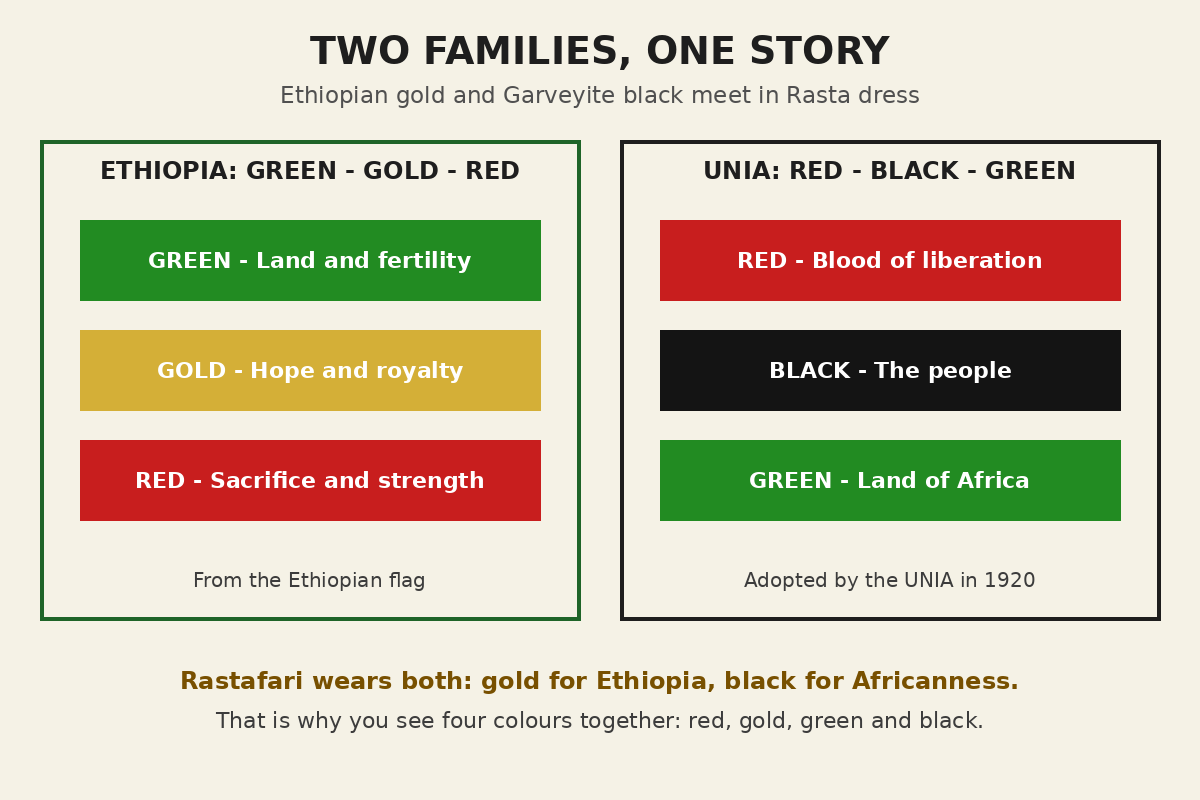
Diagram comparing the Ethiopian green, gold and red family with the UNIA red, black and green family

Wealth Taken, Wealth Remembered

Gold remembers wealth twice: wealth that Africa produced, and wealth that was taken from Africa. No source states the Rastafari reading more compactly than the museum record. The Smithsonian crocheted hat held by the Anacostia Community Museum is described with its colours decoded in a single sentence: red for the blood of martyrs in the Black liberation struggle, green for Ethiopia’s natural beauty, gold for Africa’s wealth, and black for African people. That short gloss, attached to an ordinary handmade hat, shows how completely the meaning had entered daily life. A person did not need a textbook to read the hat. The colours themselves taught the history lesson every time the hat was worn in the street.

A fuller academic treatment reaches the same conclusion with a sharper edge. The study of symbolism hosted by the University of Vermont explains that in Rastafarian art gold symbolises the wealth of Africa that was stolen by European invaders, while red stands for the blood of martyrs, green for the lush vegetation of Africa, and black for the Black African race. The word stolen is doing essential work there. Gold in this reading is not a celebration of riches comfortably possessed. It is an accusation and a claim. It says that Africa was rich, that its riches were looted through slavery, colonial extraction, and unequal trade, and that remembering the gold is a way of refusing to accept poverty as Africa’s natural condition. Wearing gold becomes a quiet act of historical correction.

The historical record underneath that claim is solid, and it reaches back far beyond the colonial period. The university course text at LibreTexts on Aksum notes that by the seventh century BCE gold and silver were already moving through the kingdom of Da’amat as trade goods, and that the later state of Aksum began minting its own gold and silver coins in the third century CE as proof of how important long-distance trade was to its economy. Pause on that fact. An African empire on the Red Sea trade routes was striking gold coinage, accepted by merchants who also dealt with Rome, Persia, and India, at a time when very few states anywhere could do so. Gold in Ethiopia is therefore not a metaphor borrowed from elsewhere. It is a literal part of the country’s economic history, dug, traded, minted, and buried with its wealthy dead in objects gilded in gold.

The biblical layer reinforces the historical one. The Biblical Archaeology Society recounts how the Queen of Sheba arrived in Jerusalem with camels carrying spices, gold, and precious stones, and gave Solomon 120 talents of gold, the largest gift of its kind in the account. Ethiopian tradition, preserved in the Kebra Nagast, names that queen Makeda and identifies her land as Ethiopia, making the gold-bearing queen an Ethiopian queen. Whether a reader approaches that story as history, as sacred tradition, or as national epic, its effect on the colour’s meaning is the same: gold flows from Africa toward the world’s most famous wise king, not the other way round. Africa appears in the story as giver and sovereign, not as supplicant. Rastafari preaching has returned to that reversal for generations, and our reflections on sayings such as who Jah bless, no man curse draw on the same conviction that dignity was given long before it was denied.

Read this way, gold jewellery, gold thread, and gold print in Rasta contexts carry a double charge that a purely decorative reading misses. They celebrate ingenuity and abundance, and they protest theft and impoverishment, at the same time. That doubleness explains the colour’s emotional range in music and speech, where gold can sound triumphant in one line and mournful in the next. It also explains why cheap, flimsy imitation gold can feel wrong to a thoughtful wearer even when the shade is correct. The meaning asks for substance. A colour that stands for real wealth, really taken, deserves to be rendered with some care, in materials and designs that honour rather than trivialise the claim.

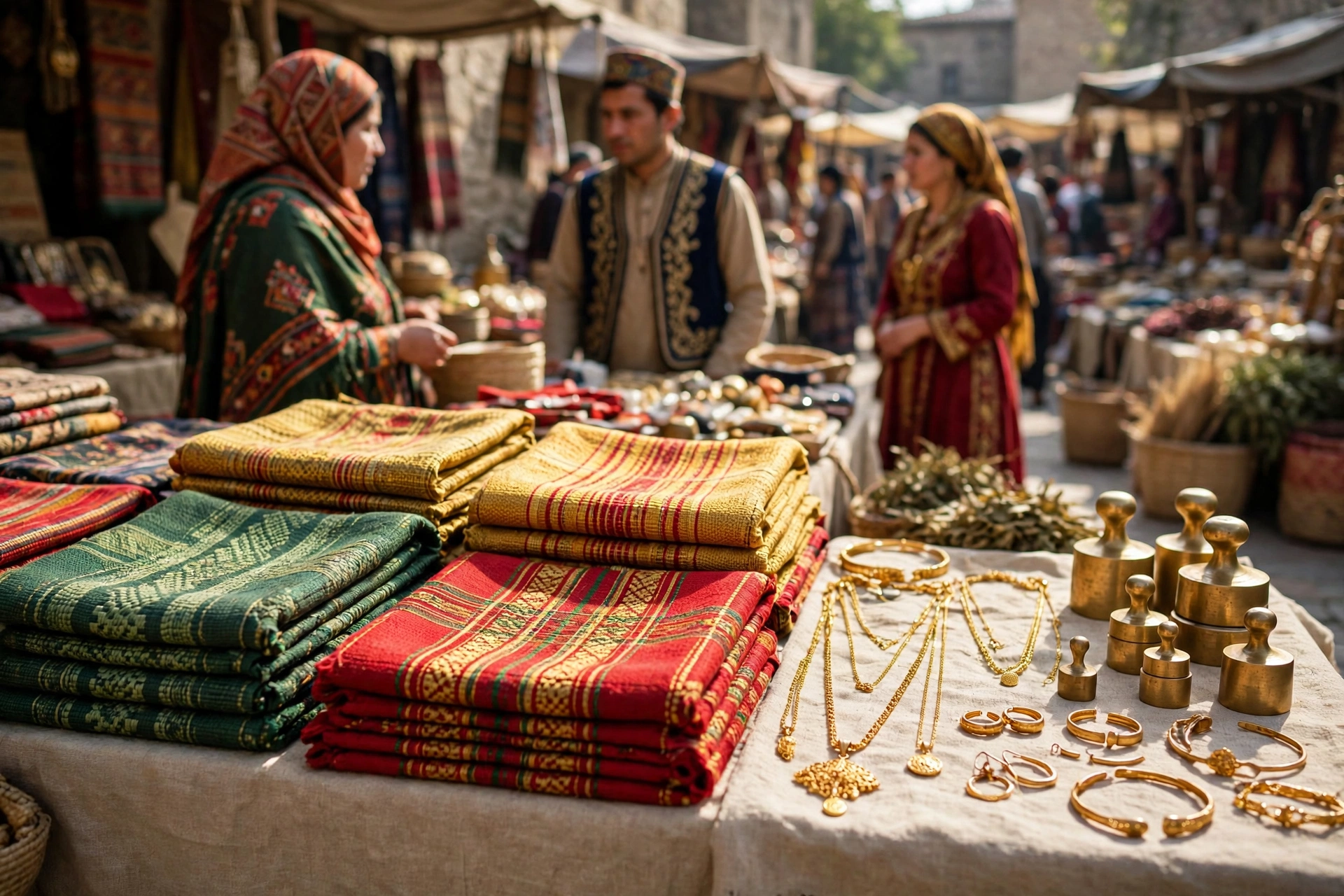
Market stall with folded green, gold and red textiles beside gold jewellery and brass weights

Royalty, Solomon, and the Lion of Judah

Gold is the colour of the throne, and in Rastafari the throne is Solomonic. Ethiopian emperors claimed descent from Solomon and the Queen of Sheba through their son Menelik I, a lineage narrated in the Kebra Nagast and used for centuries to legitimate the dynasty. Gold crowns, gold crosses, and gold-trimmed robes were the ordinary visual language of that claim. When Rastafari adopted Ethiopian colours, it adopted that royal language too, and redirected it toward a people who had been told they were nobody’s royalty. To dress an ordinary person, a labourer, a musician, a mother, in the colour of emperors was a deliberate act of restoration. It said that kingship was not the property of a palace. It belonged, by heritage, to the people themselves.

At the centre of that royal language stands the Lion of Judah, the emblem we explore fully in our guide to the Lion of Judah. The museum record again gives a crisp anchor. The Kennedy Library lion statuette, a silver lion wearing a gold crown presented by Haile Selassie during his state visit, is catalogued with the note that the Lion of Judah is the national symbol of Ethiopia and that Conquering Lion of the Tribe of Judah was the title of every Ethiopian emperor. The detail that the crown, specifically, is gold while the lion is silver is instructive. Gold marks the crown because gold marks sovereignty itself. Wherever you see the lion rendered in Rasta art with a gold crown, a gold mane, or on a gold field, the same grammar is at work: gold identifies the royal element and lifts it above the rest of the design.

The emperor at the heart of the movement gives that grammar a human face. The biography in Britannica on Haile Selassie records that Tafari Makonnen served as regent, was crowned emperor on November 2, 1930, took the name Haile Selassie, meaning Might of the Trinity, modernised his country, led it through exile and return during the Italian invasion, and helped establish the Organization of African Unity. For Rastafari, as our account of why Haile Selassie still reigns explains, those historical facts are read together with biblical titles such as King of Kings and Conquering Lion of Judah, and the emperor is revered as messiah and returned Christ by many, though not all, adherents. Gold gathers around his image for the same reason it gathered around Solomon’s: in this tradition, the righteous king and the precious metal belong together, each testifying to the other’s worth. The collected Haile Selassie quotes most often shared in the community return repeatedly to unity, education, and perseverance, themes that keep the royal colour from collapsing into mere splendour. Gold, rightly read, obliges conduct.

Divine Light in Church and Art

Before gold was a flag colour, it was the colour of divine light on church walls. Ethiopian Orthodox art is among the oldest continuous Christian art traditions in the world, and its use of gold is precise. The study at The History Professor explains that in icon painting gold leaf was reserved for halos, for the garments of Christ and the Virgin Mary, and for the pages of open Gospels, signifying divine light and holiness, while red spoke of martyrdom, blue of heaven, and green of life and resurrection. Reserved is the key word. Gold was not spread everywhere for richness. It was placed only where heaven touched earth: around a holy head, on a sacred garment, on the words of Scripture themselves. Scarcity gave the colour its theology. To see gold was to see the exact point where the divine entered the picture.

That disciplined use travelled into Rastafari visual culture, even among artists who never entered an Ethiopian church. Rasta painters learned, often through reproductions, photographs, and church visits, to halo the emperor’s portrait in gold, to letter sacred words in gold, and to frame the lion in gold, while leaving ordinary elements in ordinary colours. The effect, when done well, is immediately legible to anyone formed by the older tradition, and quietly moving even to viewers who cannot name why. Gold tells the eye where to reverence. It is a highlighter for holiness. Misused, spread across every surface for maximum shine, it highlights nothing, and the picture goes flat and noisy. The church tradition therefore offers contemporary designers a practical rule as well as a spiritual one: use gold where it means most, and let restraint do the shining.

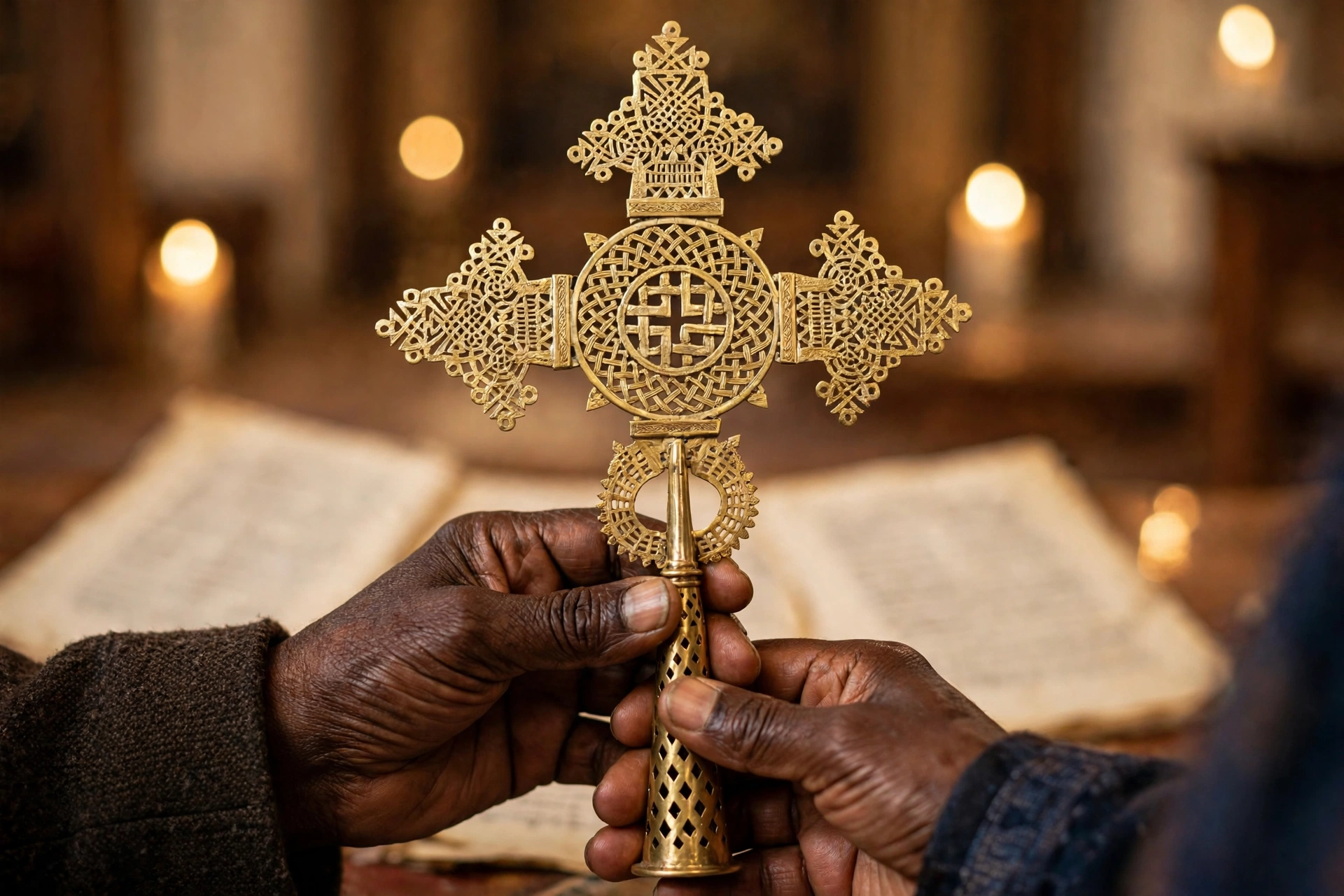
Hands holding an ornate gold Ethiopian processional cross with interlaced pattern above an open manuscript

Diagram listing four meanings of gold in Rastafari: royalty, wealth, divinity and hope

How Gold Differs from the Garvey Colours

Gold is where Rastafari and Garveyism meet, agree, and then part company, and confusing the two is the second great misunderstanding about this colour. Marcus Garvey’s Universal Negro Improvement Association adopted its flag at its New York convention in 1920, with horizontal bands of red, black, and green. The report by NPR Illinois, drawing on historian Robert Hill, explains that Garvey treated the absence of a Black flag as a mark of political powerlessness and the creation of one as proof that the race had come of age politically, with red for blood shed and shared, black for Black people, and green for growth and the fertility of Africa. It is a magnificent flag with a magnificent rationale, and Rastafari honours Garvey as a prophet. But its three colours contain no gold, and no yellow. Anyone who attributes gold to Garvey’s design has merged two different flags into one.

Rastafari’s gold comes from the other source: Ethiopia. Where Garvey’s flag centres black, for the people, the Ethiopian flag centres gold, for hope and royalty, and Rastafari, which centres Ethiopia as Zion and home, was never going to surrender that centre. The movement’s practical solution, visible on streets and stages for generations, was to wear both inheritances at once. That is why the four-colour set, red, gold, green, and black, is so common, and why summaries of livity in the Britannica Rastafari account list dressing in red, green, gold, and black together, glossed as blood, herbs, royalty, and Africanness. Four colours, two flags, one people with two homelands to honour: the African continent in general, figured by Garvey’s black, and Ethiopia in particular, figured by gold. Once you see the four-colour set as a merger rather than a muddle, a great deal of Rasta design suddenly becomes readable.

For the reader trying to keep the families straight, a simple test helps. If black is in the set and gold is not, you are looking at the Garveyite family. If gold is in the set and black is not, you are looking at the Ethiopian family. If both are present, you are almost certainly looking at Rastafari usage, or at later Pan-African design influenced by it. Our main guide to Rasta colors returns to this test with visual examples, and it is worth bookmarking if you buy, sell, teach, or write about these colours, because the two families are confused in print constantly, including by well-meaning shops and textbooks. Accuracy here is not pedantry. Each family honours a different history, and the people who fly them notice whether you know the difference.

Wearing Gold with Understanding

Wearing gold well is mostly a matter of proportion, placement, and respect. Proportion first. Because gold carries so much meaning, a little of it, well placed, says more than a flood of it. A gold medallion of the lion on a plain ground, a gold stripe at the centre of a tam, gold embroidery at the cuff or hem of a white garment, or a single gold accessory against green and red, all read as deliberate. Head-to-toe metallic gold reads as costume, and costume is the one thing a sacred colour should never become. The church rule applies to the wardrobe: reserve gold for the point of honour. In practice, that usually means one gold focal point per outfit, supported by green and red, with black grounding the whole when you want the fuller four-colour statement.

Placement second. As the flag teaches, gold sits naturally in the middle: between green above and red below on horizontal designs, at the centre of a chest emblem, at the heart in a pendant, or as the middle band of a wrist or head wrap. Our guides to traditional Rasta outfits show that central placement recurring across generations of dress, from formal white-and-gold ceremonial wear to everyday tams and scarves. For women, the companion guide to how to dress like a Rastafarian woman shows gold working through headwrap bands, jewellery, and trim that frame the face with light. For men, our survey of what Rasta men wear finds gold most often in the tam stripe, a chain and pendant, or a single embroidered emblem, each time as the outfit’s point of dignity rather than its loudest element.

Respect third, and it governs the first two. Gold in this tradition points to Ethiopia, to a living faith, and to a history of loss and endurance. That does not mean only adherents may wear it; Rasta colours have been welcomed worldwide as signs of solidarity, peace, and African pride, and the movement’s music carried them to every continent as an invitation. It does mean the thoughtful wearer learns the meanings before wearing the colours, avoids sacred emblems as jokes or novelties, and buys, where possible, from makers who understand and honour the tradition, including the long West and East African textile heritage traced in our history of ancient West African clothing, where gold thread and gold dust were prestige materials centuries before they were fashion. Knowledge does not make the colours heavier to wear. It makes them lighter, because the wearer no longer fears getting them wrong, and can enjoy them as what they are: a wearable history lesson in hope, royalty, and return.

Our View

Gold is the conscience of the Rasta colours. Green can be enjoyed as nature and red admired as courage without much thought, but gold refuses to be casual. It asks the wearer to remember a queen who arrived bearing treasure, an empire that minted its own coins, a church that saved its gold leaf for the face of the divine, and a people whose wealth was taken and whose dignity was not. We hold that gold should be taught, worn, and designed with that memory intact, centred on the garment as it is centred on the flag, and rendered with the care its history deserves. Get gold right, and the rest of the colours fall into place around it, because you have understood that these are not decorations at all. They are a history you can wear.

— The Rastafarian Clothing Team

Frequently Asked Questions

Is the middle Rasta colour gold or yellow?

It is the same stripe under two names. Official flag descriptions usually call it yellow, because they are specifying a reproducible shade. Rastafari usage calls it gold, because gold carries the meanings the colour holds: royalty, African wealth, divine light, and hope. When you are discussing meaning, gold is the better and more respectful word. When you are matching a printer’s specification, you may need the word yellow to get the right ink.

What does gold mean in Rastafari, in one sentence?

Gold means the royalty, wealth, divine light, and hopeful future of Africa and Ethiopia, including wealth that was stolen and will, in the movement’s hope, be restored. If you need it shorter still, remember the museum gloss attached to a handmade Rasta hat: gold is Africa’s wealth. Everything else in this post is an expansion of those three words.

Did Marcus Garvey choose the colour gold?

No. Garvey’s UNIA flag, adopted in 1920, is red, black, and green, with no gold band. Gold entered Rastafari dress from the Ethiopian flag, whose centre has always been gold or yellow. Rastafari honours Garvey as a prophet and often wears his black alongside Ethiopian gold, which is why the four colours red, gold, green, and black so often appear together, but the two flags and their colour sets have different origins and should not be merged.

Why is gold linked to the Lion of Judah?

Because gold marks sovereignty. The Lion of Judah was the title and emblem of Ethiopia’s emperors, who claimed Solomonic descent, and gold crowns, thrones, and regalia were the visual language of that sovereignty. A well-known museum example is a silver lion statuette wearing a gold crown, presented by Haile Selassie himself. In Rasta art the lion is therefore often crowned, maned, or set in gold, to identify it unmistakably as the royal element of the design.

Can anyone wear gold in Rasta colours, or is it only for Rastafari?

Anyone may wear these colours, and they are worn worldwide as signs of African pride, peace, and solidarity. The tradition asks only for understanding and respect: learn what gold and its companion colours mean, treat sacred emblems such as the Lion of Judah and the Ethiopian cross as emblems rather than novelties, and support makers who honour the tradition. Worn with that knowledge, gold is an invitation the movement’s music has extended to the whole world.

Questions about colours, symbols, or sizing?

We are glad to help you choose with understanding. Contact us and we will reply as soon as we can.

Sources

Recommended

Flag of Ethiopia in the correct order, with the green band on top, the yellow-gold band in the middle, and the red band at the bottom, and the blue national emblem disc at the centre

Red, Gold and Green: Where the Rasta Colors Actually Come From

Red, gold and green may be the most recognised colour combination in reggae culture, yet almost everything about where the colours actually come from gets tangled in the telling. They are often credited to a single flag, a single man or a single moment, when in truth they travelled: from Ethiopian church pennants and an imperial battlefield, through a Harlem convention hall that deliberately chose different colours of its own, and across the Atlantic in photographs, newspapers and song until they settled on Jamaica and became the everyday dress code of a faith. This is that journey, traced in order — where each colour set began, how the two sets differ, and how they ended up woven together in the clothes people wear today.

Key Takeaways

  • The Rasta colours descend from the Ethiopian tricolour: green, gold (yellow) and red pennants flown in Ethiopia long before a rectangular national flag existed.
  • Emperor Menelik II combined the pennants into a single tricolour in 1897, a year after Ethiopia’s victory at Adwa preserved its independence while most of Africa was colonised.
  • The imperial banner placed the Conquering Lion of Judah at its centre, tying the colours to Ethiopia’s Solomonic royal line.
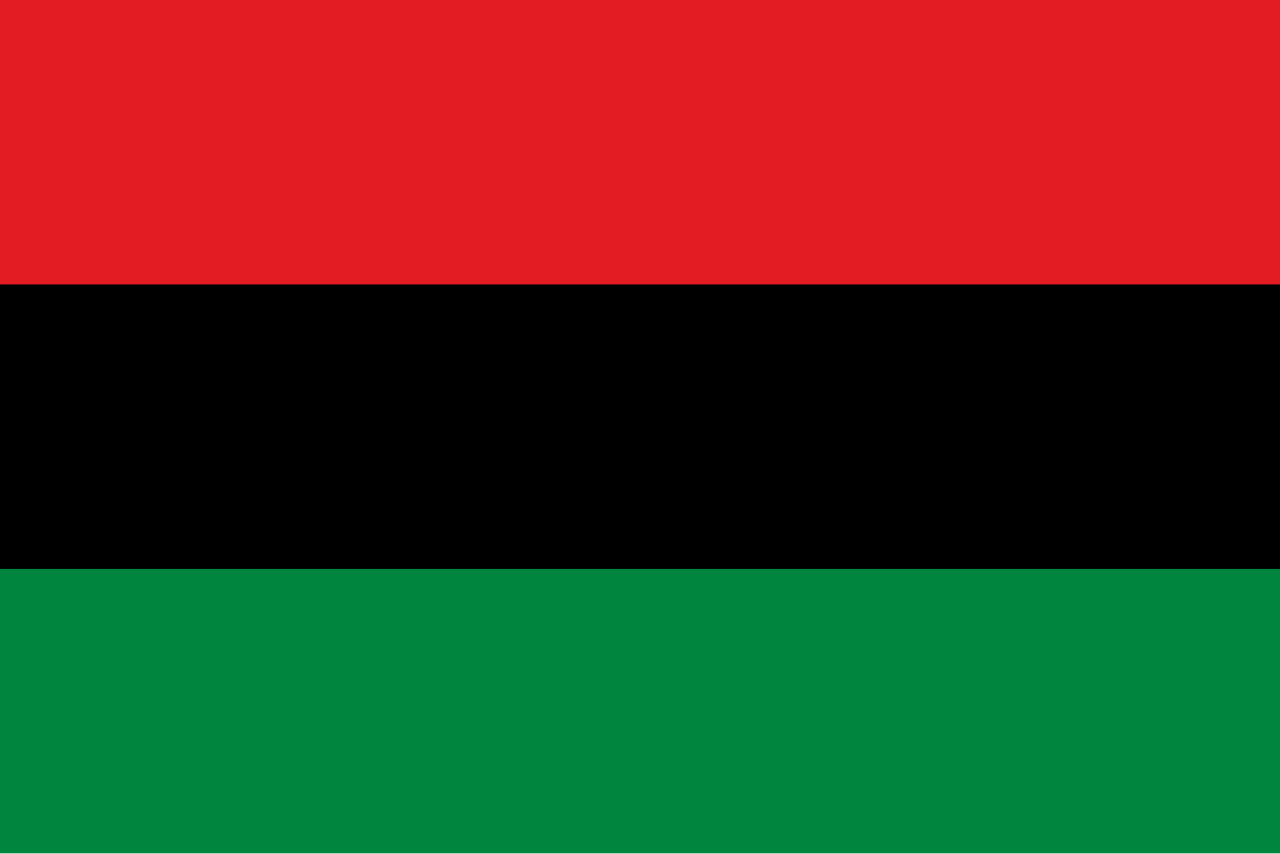
  • Marcus Garvey’s UNIA adopted a different flag in 1920 — red, black and green — with black, not gold, in the middle. The two flags are cousins, not twins.
  • The 1930 coronation of Haile Selassie I carried Ethiopian imagery into Jamaican religious life, and reggae later carried the colours to the world.

Table of Contents

Ethiopia Before the Flag

Long before red, gold and green appeared on a knitted tam or a festival flag, the three colours were already flying in Ethiopia — not as a rectangular national flag, but as separate pennants carried in procession and war. Ethiopia’s own tradition, recorded in the rainbow tradition described by Encyclopaedia Britannica, identifies the green-yellow-red banner with the rainbow God set in the heavens after the Flood in the book of Genesis. That is a striking place for a flag to begin: not in a herald’s office or a design competition, but in scripture, in a country where church and crown had been intertwined for centuries and where coloured pennants were part of religious and military life well before any European-style flag code existed.

The detail matters because it corrects the most common misunderstanding about the Rasta colours. They were not invented for the Rastafari movement, and they were not invented in Jamaica. They were not even, at first, a flag in the modern sense. They were three colours with a settled place in Ethiopian public life, displayed as pennants before the first official flag was established. When later generations in Jamaica reached for a visual language of African dignity, they did not have to create one from nothing. Ethiopia had been speaking it for generations, in cloth, in church processions and on campaign.

Ethiopia could play that role for one simple reason: it had survived. While the map of Africa was being redrawn by European empires, Ethiopia remained an independent African state ruled by its own emperors, with its own ancient Christian church, its own written language and its own court rituals. For people of African descent in the Americas, whose histories had been deliberately severed, an unconquered African kingdom with a crowned king and a recognisable banner was more than a country. It was proof — visible, flag-shaped proof — that African sovereignty was real and had endured. The colours drew their power from that survival long before anyone outside Ethiopia wore them.

Adwa and the Tricolour of 1897

The pennants became a flag because of a war. In the 1890s Italy, established in neighbouring Eritrea, pressed a disputed treaty reading that would have made Ethiopia an Italian protectorate. Emperor Menelik II rejected the claim, mobilised an army drawn from across his empire, and met the Italian invasion in the northern highlands. The resulting Battle of Adwa, fought on March 1, 1896, ended in a decisive Ethiopian victory that Britannica describes as the first crushing defeat of a European power by African forces during the colonial era. The Treaty of Addis Ababa that followed recognised Ethiopia’s full sovereignty, and Menelik’s standing at home and abroad rose accordingly.

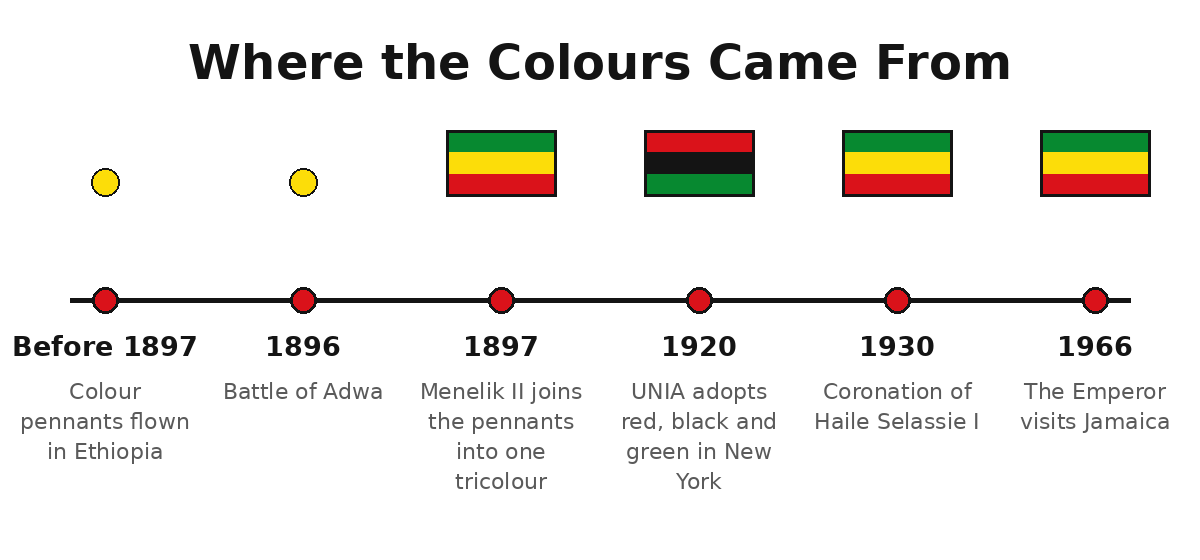
Timeline running from Ethiopian colour pennants and the Battle of Adwa through the 1897 tricolour, the 1920 UNIA flag and the 1930 coronation, ending with the colours established in Jamaica
From pennants to a national tricolour, and from Addis Ababa to Harlem and Kingston: the main stops on the colours’ journey.

A year after Adwa, the colours took their modern form. Britannica’s flag history records that pennants of the three colours had been displayed before Emperor Menelik II established the first official flag on October 6, 1897, bearing the first letter of his name in Amharic script on the yellow stripe. Other flag references date the combined rectangular tricolour to October 11, 1897; the small difference in the recorded day matters far less than the sequence, which is not in dispute — victory first, then a single rectangular banner joining what the pennants had carried separately. The order of the stripes also settled over time: red originally rode on top, and the arrangement later flipped to the green-over-gold-over-red order recognised today.

Because Ethiopia kept its flag while other African nations were still colonies, its colours became a template far beyond its borders. The CIA World Factbook notes that Ethiopia’s three main colours were so often adopted by other African countries on independence that they became known as the Pan-African colours. Ghana, Cameroon, Senegal, Mali and many others would eventually raise green, gold and red in some order, each time nodding, consciously or not, toward the one African state that had never had to ask permission to fly them. Every one of those later flags is part of this story’s family tree, and the Rastafari use of the colours sits on the same branch: an Ethiopian inheritance, adopted in admiration.

The Lion of Judah Banner

A plain tricolour, however, was only half of the imperial image. For official purposes the Ethiopian banner carried a device at its centre: the Conquering Lion of Judah, a crowned lion holding a staff topped by a cross, with ribbons in the three national colours. Britannica explains that the lion asserted a specific claim — that Menelik I, the legendary first emperor, had been the son of the Queen of Sheba and the biblical King Solomon — and with it the claim that Ethiopia’s emperors ruled in an unbroken Solomonic line. The first legal definition of the lion flag followed in November 1932, shortly after Haile Selassie’s coronation, and the banner remained in use until the empire fell in 1974, apart from the years of Italian occupation.

This is why the lion, and not just the stripes, saturates Rastafari imagery. The colours say Ethiopia; the lion says which Ethiopia — the Solomonic kingdom, the throne of David’s line transplanted to Africa. Our companion history of the Lion of Judah in Rastafari culture follows that symbol in full, and the related guide to the Ethiopian coat of arms shows how the imperial emblems fit together. For the origins of the colours themselves, the point to hold onto is the pairing: in imperial use, tricolour and lion were one statement, cloth and crown together, and it was that combined image — flag, lion, emperor — that the outside world received.

It was also the image attached to a person. When Ras Tafari Makonnen was crowned emperor on November 2, 1930, taking the throne name Haile Selassie I, he inherited the banner, the lion title and the Solomonic story in a single ceremony staged for maximum international attention, with foreign delegations and press in attendance. Britannica notes that he was afterwards regarded by the Rastafari movement as the messiah of the African race. The colours now had a living face, a coronation date and newspaper photographs that could cross an ocean — which is exactly what they did, though not before another flag entered the story from an entirely different direction.

Garvey and the Red, Black and Green

Marcus Garvey was born in St Ann’s Bay, Jamaica, in 1887, and on August 1, 1914, in Kingston, he founded the UNIA — the Universal Negro Improvement Association — dedicated to racial pride, economic self-sufficiency and an independent Black nation in Africa. The organisation found only a modest following in Jamaica, so Garvey carried it to Harlem in 1916, where it caught fire. The UCLA Marcus Garvey and UNIA Papers Project records that by 1920 the UNIA had hundreds of chapters worldwide, hosted elaborate international conventions and published the Negro World, a weekly so influential it was soon banned in many parts of Africa and the Caribbean. Garvey understood earlier than almost anyone that a scattered people needed shared symbols — a shipping line, an anthem, uniforms, titles — and above all, a flag.

Red, black and green horizontal tricolour flag adopted by the Universal Negro Improvement Association in 1920
The UNIA tricolour: red over black over green, adopted at Madison Square Garden in August 1920.

On August 13, 1920, during its month-long convention at Madison Square Garden in New York, the UNIA formally adopted its flag in Article 39 of the Declaration of Rights of the Negro Peoples of the World. The association’s own history records the meanings it assigned: red for the blood that unites all people of Black African ancestry and was shed for liberation; black for Black people themselves, a nation affirmed by the flag’s existence; and green for the abundant natural wealth of Africa. The flag was, in part, a direct rebuttal — created in response to a popular racist song of the era built on the taunt that every race had a flag except one. Garvey’s answer was to give his movement a banner and dare anyone to repeat the taunt.

Notice what Garvey did not do. He did not copy Ethiopia’s flag. His middle stripe is black, not gold, and the difference was deliberate: where Ethiopia’s banner spoke of a kingdom, Garvey’s spoke of a people — their blood, their skin, their land. As Smithsonian Magazine’s account of the National Museum of African American History and Culture explains, the Black Liberation Flag created in 1920 by Garvey and UNIA members was meant to mobilise and unite the whole African diaspora, and its colours proved so durable that artist David Hammons could rebuild the American flag itself in red, black and green seventy years later and be instantly understood. Two colour systems were now in circulation — Ethiopia’s green, gold and red, and Garvey’s red, black and green — both pointing at Africa, both carried by Black pride, and destined to be braided together in Jamaica.

Two Flags, One Persistent Confusion

Because the two flags share red and green and differ only in the middle stripe, they are constantly mistaken for each other, and the mistake flattens the history. Set them side by side and the distinction is clean. Ethiopia’s is a national flag: green over gold over red, born from pennants, formalised in 1897, centred for decades by the Lion of Judah and centred today by a blue disc and gold star, which the Factbook records was added in 1996. Garvey’s is a movement flag: red over black over green, adopted in 1920 by a diaspora organisation that held no territory and ruled no state, which was precisely its point — a nation without a country could still have colours.

Side-by-side comparison diagram of the Ethiopian green, gold and red tricolour with the Lion of Judah and the UNIA red, black and green flag, showing the shared colours and the different middle stripe
Same family, different flags: Ethiopia’s green, gold and red beside the UNIA’s red, black and green.

Rastafari dress draws on both, which is why the combination so often appears as four colours rather than three. Britannica’s survey of Rastafari livity describes adherents dressing in red, green, gold, and black, a four-colour palette that only makes sense once you see the two flags behind it: gold from Ethiopia’s imperial banner, black from Garvey’s liberation flag, red and green common to both. Neither flag cancelled the other out. In Jamaica they layered — the kingdom’s colours and the movement’s colours worn together, each correcting the other’s story. If you want the colour-by-colour symbolism of that combined palette, our earner guide to what the Rasta colors mean is the place to go; this history simply insists that the palette has two birth certificates, one Ethiopian and one Garveyite, and honesty about the colours starts with keeping both.

There is a practical payoff to getting this right. A tam in green, gold and red honours Ethiopia and its emperor. A design in red, black and green quotes Garvey and the liberation movement. A garment carrying all four colours — the most common Rastafari arrangement of all — is making the full statement: kingdom and people, Addis Ababa and Harlem, crown and diaspora. Wearers have always known the difference instinctively, even when outside commentators lumped every combination together as a generic reggae rainbow. The colours were never generic. Each stripe was argued over, adopted by vote or by decree, and carried at real cost by the people who first raised it.

The 1930 Coronation and Jamaica

The braid tightened on November 2, 1930. Ethiopia’s regent, Ras Tafari Makonnen, was crowned Emperor Haile Selassie I in Addis Ababa in a ceremony reported around the world. In Jamaica, the news landed in soil Garvey had already tilled. As Smithsonian Magazine’s history of the movement recounts, Garvey had frequently cited Psalm 68:31 — the prophecy that princes would come out of Egypt and Ethiopia would stretch out her hands to God — and had taught his followers to watch for a saviour crowned in Africa. When the coronation came, Jamaican preachers such as Leonard Howell read it as that prophecy fulfilled: the crowned king was African, his banner was the lion tricolour, and his precoronation name, Ras Tafari, gave the new faith its name.

What formed in Jamaica in the 1930s was therefore never just an Ethiopian fan club, and never just a Garveyite study circle. It was a new religious movement that fused the two inheritances: Garvey’s pan-African pride and organisational example, Ethiopia’s living king, flag and church, and the King James Bible read through the experience of slavery and colonial Jamaica. The colours fused with them. To wear green, gold and red in 1930s Kingston was to declare allegiance to an African king most Jamaicans would never see, in defiance of a colonial order that treated the wearers as outcasts. To add Garvey’s black was to declare the other half of the creed — that the people wearing the colours were themselves the nation the flags described.

None of this arrived from nowhere. The reading of Ethiopia as a promised land — sometimes called Ethiopianism — had circulated among enslaved and free Black Christians in the Americas for well over a century before Garvey, anchored in that same psalm and in the sheer fact of an African Christian kingdom still standing. Garvey gave the longing an organisation, a newspaper and a flag. The coronation gave it a date, a face and a photograph. Jamaica, where both currents ran strong and where colonial hardship gave them urgent local meaning, is simply where the two rivers met — and the colours show the confluence to this day.

The decades that followed tested that declaration hard. Early Rastafari were beaten, shaved, jailed and driven from place to place, and the movement’s own memory keeps those years close; our collection of Haile Selassie quotes gathers the words Jamaican believers carried through them. Italy’s invasion of Ethiopia in 1935 and the emperor’s exile and return bound Jamaican sympathies tighter still, because the flag under attack in Africa was now, in a real sense, their flag too. By the time Jamaica approached its own independence in 1962, the colours had completed the hardest part of their journey: they no longer needed Ethiopia’s permission or Garvey’s organisation to survive. They lived on Jamaican heads, shoulders and banners, as ordinary — and as charged — as clothing gets.

Kingston and the World

Street scene in downtown Kingston, Jamaica, with shoppers, traffic and storefronts along a busy commercial road
Kingston, Jamaica: the city where Ethiopian and Garveyite colours fused into a single everyday palette.

On April 21, 1966, the journey came full circle in a single afternoon. Haile Selassie arrived in Jamaica on a state visit, and the Jamaica Information Service records that 100,000 Rastafari descended on Palisadoes Airport in Kingston with drums and chalices to meet him — a crowd so vast the day is still kept as Groundation Day, which our guide to Groundation Day covers in depth. The emperor whose flag they had worn for three decades stood on Jamaican soil and treated the outcasts of Jamaican society with respect, and the Service notes the visit gave Rastafari a measure of respectability for the first time — and that the reggae music carrying the movement, colours and all, then became commercially viable and spread worldwide.

Reggae was the colours’ second ship, after Garvey’s newspapers and the coronation photographs. Britannica’s biography of Bob Marley describes how the Wailers’ Rastafari faith shaped their music and how, after signing to Island Records and releasing Catch a Fire, their reggae gained a global audience — an audience that met the music wearing its colours, on album sleeves, stage clothes and Marley’s own crocheted caps. The companion history of Jamaica’s impact on the spread of Rastafarian culture traces that export in full, and our look at reggae colors follows the palette onto stage and vinyl. Sayings travelled with the cloth, too — the blessing explored in Who Jah Bless, No Man Curse moved from scripture to lyric to everyday speech on the same route.

By the end of the twentieth century the circuit was complete. Colours that began as Ethiopian pennants could be bought on a market stall in London, worn at a festival in California or painted on a wall in Kingston, and at every stop someone could still tell you the whole chain: Adwa, Menelik, the lion, Garvey, the coronation, Kingston, Marley. Few design palettes in the world carry a documented itinerary like that. The colours did not drift into global culture by accident or by fashion. They were carried, deliberately, by an empire defending itself, a movement organising itself and a faith refusing to disappear — and each carrier left the palette slightly richer than they found it.

Wearing the History Today

All of which raises a fair question for anyone who wears the colours now: what, exactly, are you putting on? The honest answer is a layered statement, and the layers are the point. Green, gold and red alone salute Ethiopia — its land, its crown, its unconquered history. Red, black and green alone quote Garvey’s liberation flag. The full four-colour arrangement, the one knitted into tams, woven into belts and printed across traditional Rasta outfits that still hold their shape today, states the whole Jamaican synthesis at once. None of these is a costume. Each is a citation, whether the wearer spells it out or not.

How the citation gets worn has its own grammar, and it differs by wearer and occasion. Our styling guides walk through it piece by piece — how to dress like a Rastafarian woman and what Rasta men wear both start from the colours and build outward to fabric, fit and setting — while the deeper roots of the cloth itself reach back through the traditions surveyed in ancient West African clothing. The through-line across all of it is intention. In a culture where a middle stripe — gold or black — can change a flag’s entire meaning, choosing what to wear is a small act of history-keeping.

So wear the history accurately. Know that the gold is Ethiopia’s and the black is Garvey’s, that red ran on top of the first tricolour and green rides there now, that a lion once stood at the centre of the banner and a star stands there today. Know that the colours survived Adwa’s guns, Harlem’s printing presses, Kingston’s police raids and a century of being dismissed as mere decoration. Red, gold and green were never just a colour scheme. They are the visible residue of an argument — that African people had a past worth honouring and a future worth organising for — and the argument, stripe by stripe, is still being worn.

Our View

Most colour stories in fashion are marketing. This one is not. Red, gold and green earned their meaning the slow way — defended in battle, voted on in convention, preached in the street and sung to the world — and that is why they still stop people in a way a seasonal palette never will. Our view is simple: the colours deserve to be worn with their history attached. Gold for Ethiopia, black for Garvey’s people, red and green for the ground both flags share. Get the middle stripe right, and you have understood more real history than most textbooks manage.

— Rastafarian Clothing

Frequently Asked Questions

Did the Rasta colours come from Ethiopia or from Marcus Garvey?

From both, in sequence. Green, gold and red are Ethiopia’s colours, formalised as a tricolour in 1897. Marcus Garvey’s UNIA adopted its own flag — red, black and green — in 1920. Rastafari in Jamaica layered the two inheritances together, which is why the palette is so often worn as four colours: red, green, gold and black.

What is the difference between red, gold and green and red, black and green?

The middle stripe. Red, gold and green is the Ethiopian order, from the national tricolour that carried the Lion of Judah. Red, black and green is the UNIA liberation flag, where black stands for Black people themselves. They share red and green, point at the same continent, and mean different things.

When did Ethiopia adopt its tricolour?

The combined rectangular tricolour dates to 1897, under Emperor Menelik II, a year after the victory at Adwa. Britannica dates the first official flag to October 6, 1897; other flag references give October 11, 1897. The three colours had been flown as pennants long before either date.

Why is there a lion on so many Rasta flags?

The Conquering Lion of Judah stood at the centre of Ethiopia’s imperial banner and asserted the emperors’ claimed descent from Solomon and the Queen of Sheba. Because Rastafari honour Haile Selassie I, the last emperor to reign under that banner, the lion travelled with the colours into Jamaican religious art and dress.

Why do the colours appear in so many other African flags?

Because Ethiopia was the African state that stayed independent. The CIA World Factbook notes its three colours were adopted by so many countries on independence that they became known as the Pan-African colours — a deliberate nod to the one flag that had never been lowered to a colonial power.

Questions about the colours, the history or a piece in the shop?

We are glad to help you choose well and wear it accurately.

Contact Us

Sources

  1. Encyclopaedia Britannica, “Flag of Ethiopia” — Flag of Ethiopia
  2. CIA World Factbook, “Ethiopia” (Gov Archive) — CIA World Factbook: Ethiopia
  3. Encyclopaedia Britannica, “Battle of Adwa” — Battle of Adwa
  4. Encyclopaedia Britannica, “Haile Selassie I” — Haile Selassie I
  5. Encyclopaedia Britannica, “Marcus Garvey” — Marcus Garvey
  6. UCLA Marcus Garvey and UNIA Papers Project, “Marcus Garvey: An Overview” — Garvey Papers overview
  7. Universal Negro Improvement Association and African Communities League, “History of the Flag” — History of the Flag
  8. Smithsonian Magazine, “Smithsonian’s NMAAHC Acquires David Hammons’ ‘African American Flag'” — Smithsonian Magazine
  9. Encyclopaedia Britannica, “Rastafari” — Rastafari
  10. Smithsonian Magazine, “Rasta Revealed” — Rasta Revealed
  11. Jamaica Information Service, “Minister Grange Celebrates Rastafari Groundation Day” — Jamaica Information Service
  12. Encyclopaedia Britannica, “Bob Marley” — Bob Marley
Ethiopian flag waving against a twilight sky, green band on top, gold in the middle, red at the bottom, with the blue national emblem disc at the centre

Rasta Colors in Order: The Sequence and What Each Color Stands For

The Rasta colors in order are green, gold, and red — green at the top, gold in the middle, and red at the bottom. That is the sequence on the Ethiopian tricolour that Rastafari adopted as its own banner, and it is the sequence that matters when you read a flag, choose a garment, or check whether a design was put together with care. Yet it is one of the most commonly muddled facts in the whole subject: people list the colors in speech order, borrow the order from a different flag, or repeat a lyric as if it were a flag specification, and soon red is sitting on top and the meaning is lost. This guide settles the question directly — the order plainly, what each color stands for in its position, where the sequence comes from, the one famous historical exception, and how this banner differs from the flags it is confused with.

Start here: Rasta Colors — our main guide to the colors and their meanings

Shop Rastafarian Clothing — garments and pieces in green, gold, and red

Contact Us — questions about the colors, the culture, or an order

Key Takeaways

  • The Rasta colors in order, top to bottom, are green, gold, and red.
  • Green stands for the land, hope, and fertility; gold stands for royalty, wealth, peace, and justice; red stands for blood, sacrifice, and strength.
  • The sequence comes from the flag of Ethiopia, the African nation at the heart of Rastafari faith and identity.
  • The very first combined Ethiopian tricolour placed red on top; the order was later flipped to the green-first sequence used today.
  • Garvey’s Pan-African banner is a different flag — red, black, and green, with no gold — and black in Rasta dress carries its own separate meaning.

Table of Contents

The Order, Stated Plainly: Green, Gold, Red

Read the banner the way you would read a page: from the top down. The first color is green. The second, the band across the middle, is gold — the rich yellow-gold that flag descriptions usually record simply as yellow. The third, the band along the bottom, is red. Green, gold, red: that is the whole answer, and everything else here is the meaning, the history, and the proof behind those three words in that arrangement. The current national flag of Ethiopia, from which the Rasta banner descends, is described by World Atlas as three equal horizontal bands of green at the top, yellow in the middle, and red at the bottom, with a blue disc and gold star at the centre in its modern state form. When Rastafari use the plain tricolour, or the older imperial version with the Lion of Judah at its centre, the bands underneath stay in exactly the same order. The emblem changes with the era. The sequence does not.

Why does the order deserve a page of its own? Because a flag is not a bag of colors; it is a statement arranged in a deliberate sequence, and scrambling the sequence scrambles the statement. Green first declares what comes before everything else — the land and life itself. Gold in the middle is the treasure held at the centre of the story. Red last, at the foundation, is the price paid to hold the other two. For the fuller treatment of each color’s symbolism across Rasta life, our main guide to the rasta colors goes deeper, and our companion piece on reggae colors follows the same palette through the music that carried it around the world.

Flag of Ethiopia in the correct order, with the green band on top, the yellow-gold band in the middle, and the red band at the bottom, and the blue national emblem disc at the centre
The Ethiopian tricolour in its correct order: green, gold, red, top to bottom.

Green on Top: The Land, Hope, and Life

Green leads the sequence because the land comes first. In the Ethiopian reading, green is the earth itself — the fertile highlands and valleys of the homeland, the crops that feed the people, and the hope that life renews itself season after season. Britannica’s flag entry records the modern official reading, in which green is equated with labour, development, and fertility, and notes the older tradition identifying the flag with the rainbow set in the heavens after the Flood in Genesis — a sign of promise after judgement, and one reason the color of new growth sits at the head of the banner. Green is not decoration here: it is the ground of the whole message, placed where a reader meets it first — before royalty, before sacrifice, there is the living land and the people who work it.

Diagram of the Rasta color sequence as three horizontal bands in order, green first at the top, gold second in the middle, and red third at the bottom, with the meaning of each color written beside its band
The sequence at a glance: green, gold, red — and what each band stands for.

In Rastafari life, green extends that meaning: the herb, the ital garden, the hills of Jamaica and the fields of Africa held in a single thought — the natural world as Jah made it. Set at the head of the three bands, it becomes a signature, the opening word of a sentence the other two colors complete. Readers who want to follow the land thread further back will find background in our piece on ancient West African clothing, where cloth, color, and status were woven together long before any modern flag existed. And there is a practical point: because green is the first band, it is the color your eye should meet first in any striped design. A striped piece that opens with red at the top is showing you the historical arrangement covered later in this guide, or a mistake.

Gold in the Middle: Royalty, Wealth, and Peace

Gold holds the centre of the banner, and the centre is the place of honour. In the Rasta reading, gold is royalty — the crown, the throne, and the kingly line that Rastafari see running from Solomon through the Ethiopian emperors to Haile Selassie I. Encyclopaedia Britannica describes Rasta livity as including dress in the colors of red, green, gold, and black, symbolising the life force of blood, herbs, royalty, and Africanness — gold, in that mapping, is royalty itself. Gold is also the wealth of the homeland, the riches of Africa calmly reclaimed as African by right; and in the Ethiopian state reading, the same band — recorded as yellow in flag descriptions — carries hope, justice, and equality, with peace never far from it. Together, the middle band says this: at the centre of the story sits a crowned people, a rich homeland, and a just peace.

The position matters as much as the meaning. Gold is not first, because royalty is not the foundation; the land is. Gold is not last, because royalty is not the price; the blood is. It sits between the land that sustains the people and the sacrifice that defended them, exactly where a crown belongs — and it should read as a rich, warm gold, the color of a crown, not a caution sign. The emperor’s own words, in our collection of Haile Selassie quotes, carry the same order of values. And when you check any piece that claims the Rasta colors, find the gold and confirm it sits in the middle: a design that puts gold on top has promoted royalty above the land, and whatever it is selling, it is not this flag.

Red at the Bottom: Blood, Sacrifice, and Strength

Red closes the sequence at the bottom, and its position is the most eloquent of the three. Red is blood — the blood of the ancestors, the blood shed in slavery and in the defence of African freedom, and the life force running through the living community today. Set at the bottom of the banner, it works the way a foundation works: everything above it stands on it. The land is green and living because people bled to keep it; the crown is gold because people bled to defend it. In the Ethiopian state reading, red represents sacrifice for freedom and equality; in older imperial readings it carried power and faith as well.

That history is not abstract. The emperor whose reign gave Rastafari its name led his country’s resistance when Italy invaded, went into exile rather than surrender, and addressed the League of Nations in Geneva in an appeal that became one of the famous speeches of the century — Britannica’s biography recounts Haile Selassie I, crowned on 2 November 1930, exiled from 1936 to 1941, restored, and finally deposed in 1974, regarded by Rastas as the messiah of the African race. Red at the bottom holds that story of invasion, resistance, exile, and return in a single band. It is also why the familiar Rasta confidence in blessing and protection carries such weight in this culture; our page on who Jah bless, no man curse explores the saying and the assurance behind it. So wear red low and last — the bottom stripe, the band at the hem. The ancestors are the foundation, and foundations go at the bottom: that is the meaning of the flag, expressed in the only language a flag has, which is position.

Where the Sequence Comes From: Ethiopia’s Flag

The Rasta colors are Ethiopia’s colors, and the sequence is Ethiopia’s sequence. Green, yellow, and red pennants flew in Ethiopia for centuries before they were combined into a single rectangular flag, a combination traditionally dated to the reign of Emperor Menelik II, in the years after Ethiopia’s victory over Italy at the Battle of Adwa on 1 March 1896 — the victory that preserved Ethiopian independence while the rest of the continent was being carved into colonies, as FlagDB records. A free African empire, undefeated in the age of colonisation, flying green, gold, and red: that is the image that travelled. When Haile Selassie was crowned in 1930, the news reached Black communities from Harlem to Kingston within days, and Ethiopia — with Liberia one of only two African countries not under European colonisation at the time, as Smithsonian Folkways Magazine notes — became living proof that African sovereignty had survived. The movement that became Rastafari took the emperor’s name, his titles, and his flag’s colors as its own.

Traditional handwoven Ethiopian dress from Addis Ababa in white shemma cotton with woven coloured borders along the hem, sleeves, and neckline
Handwoven Ethiopian dressmaking, where woven border colors have carried meaning for generations.

Under Haile Selassie, the imperial flag carried the Lion of Judah at the centre of the three bands — the crowned lion holding a cross-topped staff, asserting the Solomonic line that Ethiopian tradition traces to Solomon and the Queen of Sheba. That lion version, flown until the empire fell in 1974, is the banner Rastafari kept long after Ethiopia moved on to other emblems. Our page on the meaning behind the Lion of Judah in Rastafari culture tells the lion’s story in full, and our guide to the Ethiopian coat of arms follows the emblem that replaced it — the blue disc and radiant gold star now set over the same three bands, in the same order. From Ethiopia the colors travelled twice: across Africa, where nation after nation adopted them on independence until they became known as the Pan-African colors, and across the Atlantic with reggae.

The Great Flip: When Red Sat on Top

Here is the honest complication, and the reason so many people get the order wrong with complete sincerity. The first combined Ethiopian tricolour did not put green on top. When Menelik II had the three pennants joined into one rectangular flag in 1897, the arrangement ran red at the top, yellow in the middle, and green at the bottom. Flags of the World records that the green-yellow-red flag appeared on 6 October 1897, that the colours were at first used as three separate strips with red at the top, and that at some point the order was changed — flipped, so green rose to the top and red settled to the bottom, where both have remained ever since. The same source records the older readings of the bands — red for power and faith, yellow for church, peace, natural wealth, and love, green for land and hope — alongside the later government reading of green for fertility, yellow for religious freedom, and red for the lives sacrificed in protecting national integrity.

Comparison diagram of three banners side by side: the Ethiopian tricolour in green, gold, and red order, the imperial Ethiopian flag with the Lion of Judah at its centre, and the red, black, and green Pan-African banner
Three banners, three arrangements: the modern tricolour, the imperial lion flag, and Garvey’s banner.

So if you meet someone who insists the colors run red, gold, and green from the top, they are not inventing it — they are remembering the 1897 arrangement, repeating the spoken list, or reading Garvey’s banner, which does begin with red. What they are not describing is the flag as it settled: the flag of Ethiopia today, and the flag whose image Rastafari carried into the world. That carrying had a defining moment in Jamaica — the emperor’s state visit of 21 April 1966, when vast crowds of Rastafari gathered at Palisadoes Airport to greet him, is still kept as Groundation Day, and the Jamaica Information Service records how that visit gave the movement a new measure of respect and helped carry its music, and its colors, to the world.

Not Garvey’s Flag: Where Black Fits In

The second great confusion is with a flag that shares two of the three colors and none of the order. In 1920 the Universal Negro Improvement Association of Marcus Garvey adopted a banner of red on top, black in the middle, and green at the bottom — the Pan-African or Black Liberation flag. The Smithsonian Institution describes how David Hammons later merged Garvey’s red, black, and green with the stars and stripes in his African-American Flag, held by the National Museum of African American History and Culture. But Garvey’s banner has no gold band, and its order runs red first. It is a great flag with its own meanings — red for the blood shed for liberation, black for the people, green for the land — and it is not the Rasta flag. Lay the two side by side and the difference is instant: gold in the middle and green on top means Ethiopia and Rastafari; black in the middle and red on top means Garvey and the UNIA.

Garvey’s place in the Rasta story is foundational even so. Jake Homiak, curator of the Discovering Rastafari! exhibition at the National Museum of Natural History, told Smithsonian Magazine how Ethiopianism and Garvey’s preaching in the idioms of Ethiopia — above all the biblical promise that Ethiopia shall stretch out her hands unto God — prepared Jamaica to hear of a Black king crowned in Africa in November 1930 as the fulfilment of prophecy. Garvey pointed toward Ethiopia; Ethiopia’s flag supplied the colors. That is why black still belongs in Rasta dress even though it is not a band of the tricolour: black stands for Africanness itself, the people whose land is green, whose crown is gold, and whose blood is red, and it frames the three colors the way a frame belongs to a painting without being one of its stripes. It was reggae that carried all of these colors worldwide — the music UNESCO inscribed on the Representative List of the Intangible Cultural Heritage of Humanity, born among marginalised communities in western Kingston and recognised as a voice for all on injustice, resistance, love, and humanity. One more confusion deserves a sentence: Jamaica’s national flag is a separate black, green, and gold emblem with no red and no three-band sequence — Jamaica gave the movement its birthplace, language, and music, but the flag came from Africa, and its order is Africa’s order.

Reading the Order on Clothing

Everything above becomes practical the moment you get dressed or go shopping. On clothing, the sequence reads the same way it reads on a flag: top to bottom. On a striped shirt, green sits highest on the chest and red lowest, toward the hem. On a tam, green leads and red finishes. On dresses and skirts, where designers run the bands down the body, the same rule applies. traditional rasta outfits that still look fly shows the palette across complete looks, our breakdown of how to dress like a Rastafarian woman and our answer to what do Rasta men wear apply it by wardrobe, and our notes on how to style rasta clothing pull the principles together.

This is not pedantry about stripes. Dress in Rastafari is part of livity, the principled, balanced way of life that scholars study as seriously as any other element of the movement; the University of the West Indies at Mona built its Rastafari Studies Conference around the theme of Rastafari livity and scholarship, marking fifty years since the university’s landmark Report on the Rastafari Movement in Kingston first treated the community’s way of life as worthy of respect. Wearing the colors in their order is a small act of accuracy inside that larger discipline, and it separates considered Rasta clothing from costume: a costume copies the colors, while a considered garment keeps the sequence. So run the check. Find the green — is it first? Find the gold — is it held in the middle, where the crown belongs? Find the red — is it last and lowest, the foundation? If the piece carries the Lion of Judah, the lion belongs at the centre, over the gold band, as he sat on the imperial flag.

A Simple Way to Check Any Flag or Outfit

Hold on to one short sentence and you will never get the order wrong again: the land first, the crown in the middle, the blood beneath. Land is green, and green goes on top. The crown is gold, and gold holds the centre. The blood is red, and red forms the foundation at the bottom. The sentence works because it is the flag’s own argument, in the flag’s own order — if you remember why each color sits where it sits, the order rebuilds itself every time.

Our View

Three colors, one order, and no shortcuts. Green for the land that feeds us, gold for the crown that dignifies us, red for the blood that bought us — in that sequence, the banner preaches before a word is spoken. The order is worth defending precisely because it is so easy to lose: one flipped stripe and a memorial becomes a decoration. Learn the sequence, wear the sequence, and pass it on correctly. That is how a flag stays a flag.

— The Editors, Rastafarian Clothing

Frequently Asked Questions

What is the correct order of the Rasta colors?

Top to bottom: green, gold, red. Green is the highest band, gold — recorded as yellow in flag descriptions — is the middle band, and red is the bottom band: the order of the Ethiopian tricolour that Rastafari adopted, and of the flag of Ethiopia today.

Why do so many people say red, gold, and green?

Because that is the order the colors are often listed in speech and song, and because the first combined Ethiopian tricolour of 1897 genuinely placed red at the top before the order was flipped to green first. A spoken list is not a flag order — and Garvey’s separate Pan-African banner, which really does run red first, adds to the mix-up.

Are the Rasta colors the same as the Ethiopian flag colors?

Yes. The Rasta tricolour is Ethiopia’s green, gold, and red, adopted because Ethiopia is the spiritual homeland at the centre of Rastafari faith. The differences are in the emblem, not the bands: the modern state flag adds a blue disc with a gold star, while the version Rastafari kept carries the Lion of Judah from the imperial flag.

Is black one of the Rasta colors?

Black belongs to the wider Rasta palette but is not a band of the tricolour. In Rasta dress it stands for Africanness — the people themselves — and frames and grounds the green, gold, and red. It is also the middle band of Garvey’s red, black, and green Pan-African flag, a different banner with a different order and no gold.

What do the Rasta colors mean, in order?

In order: green means the land, hope, fertility, and life; gold means royalty, the wealth of the homeland, peace, and justice; red means the blood of the ancestors, sacrifice for freedom, and strength. Remembered as a sentence — the land first, the crown in the middle, the blood beneath — the meanings and the order hold together.

Questions about the colors, the culture, or an order?

Reach us through our contact page — we read everything and reply to everyone we can.

Sources

Back to Top
Product has been added to your cart