
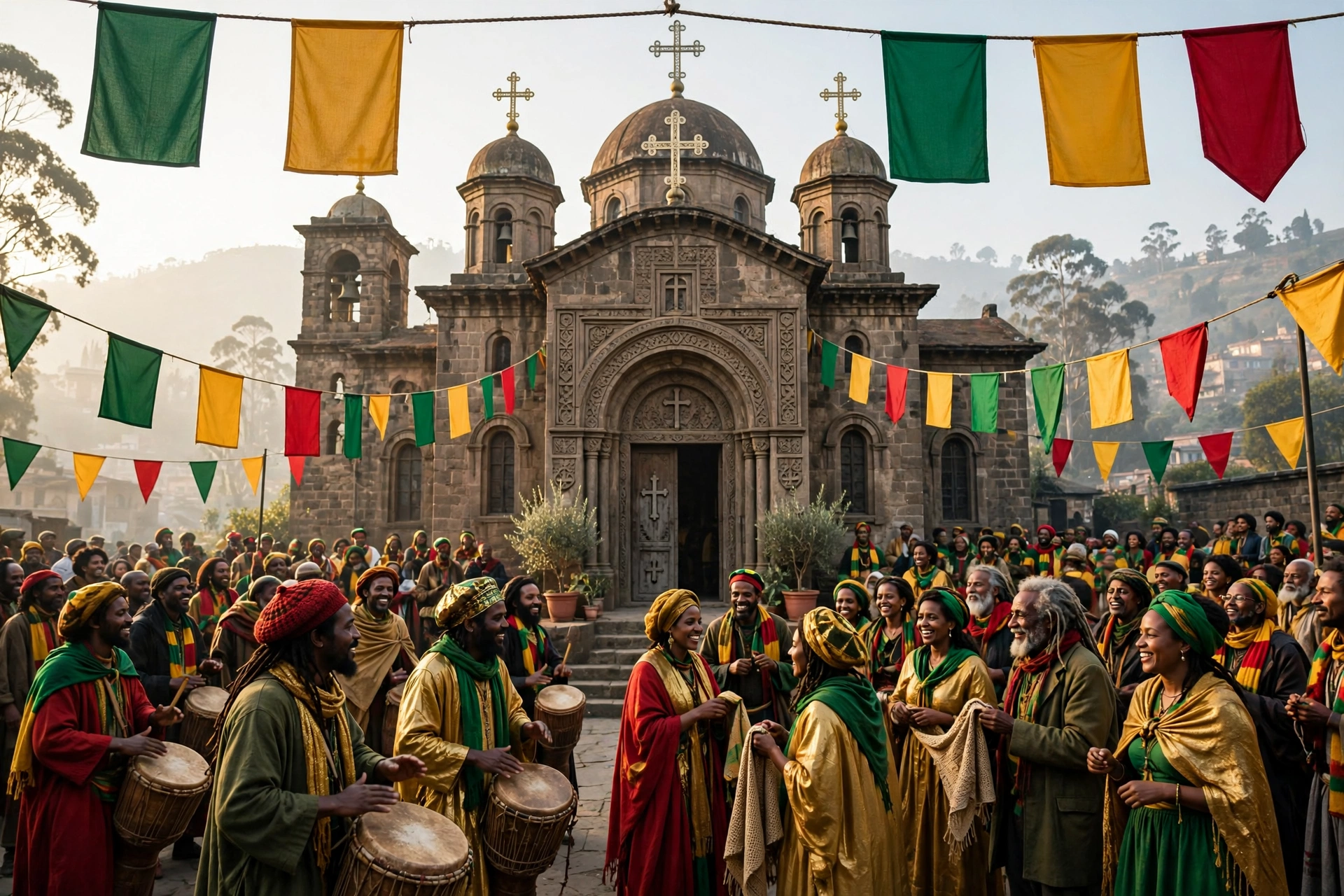
Every year on November 2, Rastafari across the world pause for the date that gave their faith its name. Coronation Day marks the morning in 1930 when Ras Tafari Makonnen was crowned Emperor of Ethiopia at St George’s Cathedral in Addis Ababa and took the throne name Haile Selassie I. For many readers the day is easy to confuse with Groundation Day in April, and easy to underestimate altogether, as if it were simply an anniversary on a calendar. It is neither. Groundation Day remembers a visit; Coronation Day remembers a crowning, and that crowning is the founding event of the movement itself. This guide separates the two days clearly, walks through what actually happened in Addis Ababa, explains why the titles proclaimed that morning mattered so much in Jamaica, and shows how the day is observed today, so that when November 2 comes around you know exactly what is being honoured and why it still carries such weight.
Keep reading the holy-days story
Start with Groundation Day: Haile Selassie’s Visit to Jamaica, the April holy day this one is most often confused with, and then explore Why Haile Selassie Still Reigns in Rasta Culture for the longer legacy.
Key Takeaways
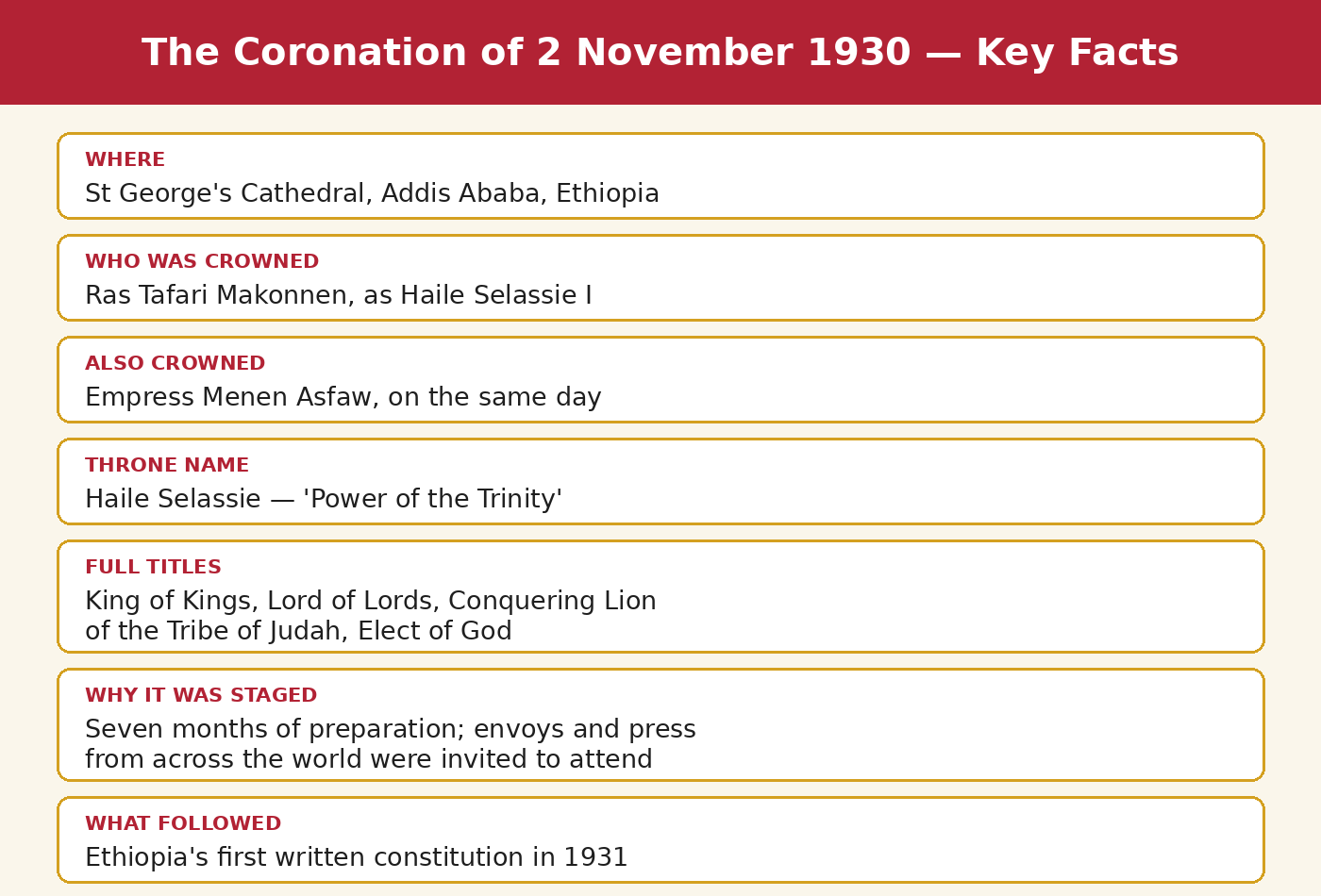
- Coronation Day falls on November 2 and marks the crowning of Ras Tafari Makonnen as Emperor Haile Selassie I of Ethiopia in 1930.
- The ceremony took place at St George’s Cathedral in Addis Ababa, and Empress Menen Asfaw was crowned beside the Emperor on the same day.
- The titles proclaimed that morning, including King of Kings and Conquering Lion of the Tribe of Judah, were read in Jamaica as the fulfilment of biblical prophecy.
- The movement’s very name comes from the Emperor’s pre-coronation name and title: Ras Tafari.
- Coronation Day is a different holy day from Groundation Day, which falls on April 21 and marks Selassie’s visit to Jamaica in 1966.
- Today the day is observed with Nyabinghi drumming, chanting, psalm reading, reasoning and gatherings in red, gold and green.
Table of Contents
- What Actually Happened on 2 November 1930
- The Titles, and Why Jamaica Heard Prophecy in Them
- The Day That Named a Movement
- Coronation Day Is Not Groundation Day
- How Coronation Day Is Observed Today
- Coronation Day in the Wider Holy-Days Calendar
- Wearing the Day: Colours, Symbols and Respect
- Our View
- Frequently Asked Questions
- Sources
- Recommended
What Actually Happened on 2 November 1930
A regent became an emperor in a ceremony the whole world was invited to watch. To understand the morning, you first have to understand how long the man at its centre had already been governing. Born Tafari Makonnen in 1892, he had served as regent and heir apparent under Empress Zauditu from 1916, steadily centralising power, building a salaried civil service and representing the progressive wing of Ethiopian politics. As the Britannica biography records, he assumed the title of negus, meaning king, in 1928, and when Zauditu died in the spring of 1930 the path to the imperial throne was open. He did not rush the crowning. The formal coronation was held months later, on November 2, 1930, and the delay was deliberate statecraft rather than hesitation.
The seven-month gap between accession and coronation was part of the message. Ethiopia was, at that moment, the only independent African state in a continent carved up by European empires, and its survival was watched closely and not always kindly by the powers that surrounded it. A detailed EBSCO coronation account explains that the ceremony was postponed for seven months after Zauditu’s death precisely so that the largest possible number of foreign representatives could attend, and that meticulous preparations were made to impress the dignitaries and the hundreds of journalists who travelled to Addis Ababa. The pageantry told two audiences the same story in different languages. To Ethiopians, it announced that the old feudal order, in which great regional lords shared power and kept their own armies, had been replaced by a centralised state under one strong monarch. To the world, it announced that Ethiopia was a sovereign equal, an ancient Christian empire receiving the envoys of kings and presidents on its own ground.
The setting carried its own history before a single word of the liturgy was spoken. St George’s Cathedral was no neutral venue. The Crown Council account describes how, on the day before the coronation, the assembled guests gathered outside the cathedral to witness the unveiling of the equestrian statue of Emperor Menelik II, the hero of Adwa, whose victory had preserved Ethiopian independence a generation earlier. The cathedral itself was too small for the crowd of guests, so a vast tent was attached to its western side, doubling its size, with two canopied thrones set up inside. A week earlier the imperial regalia, the crowns of the Emperor and Empress, the sceptre and orb, the diamond rings, the sword and spears of state and the robes, had been carried in procession to the cathedral and placed in its Holy of Holies, where clergy prayed over them day and night. Forty-nine senior clergy recited the Psalms over the regalia in shifts, and on the final night the Emperor, the Empress, their children and the nobility joined the vigil at midnight.
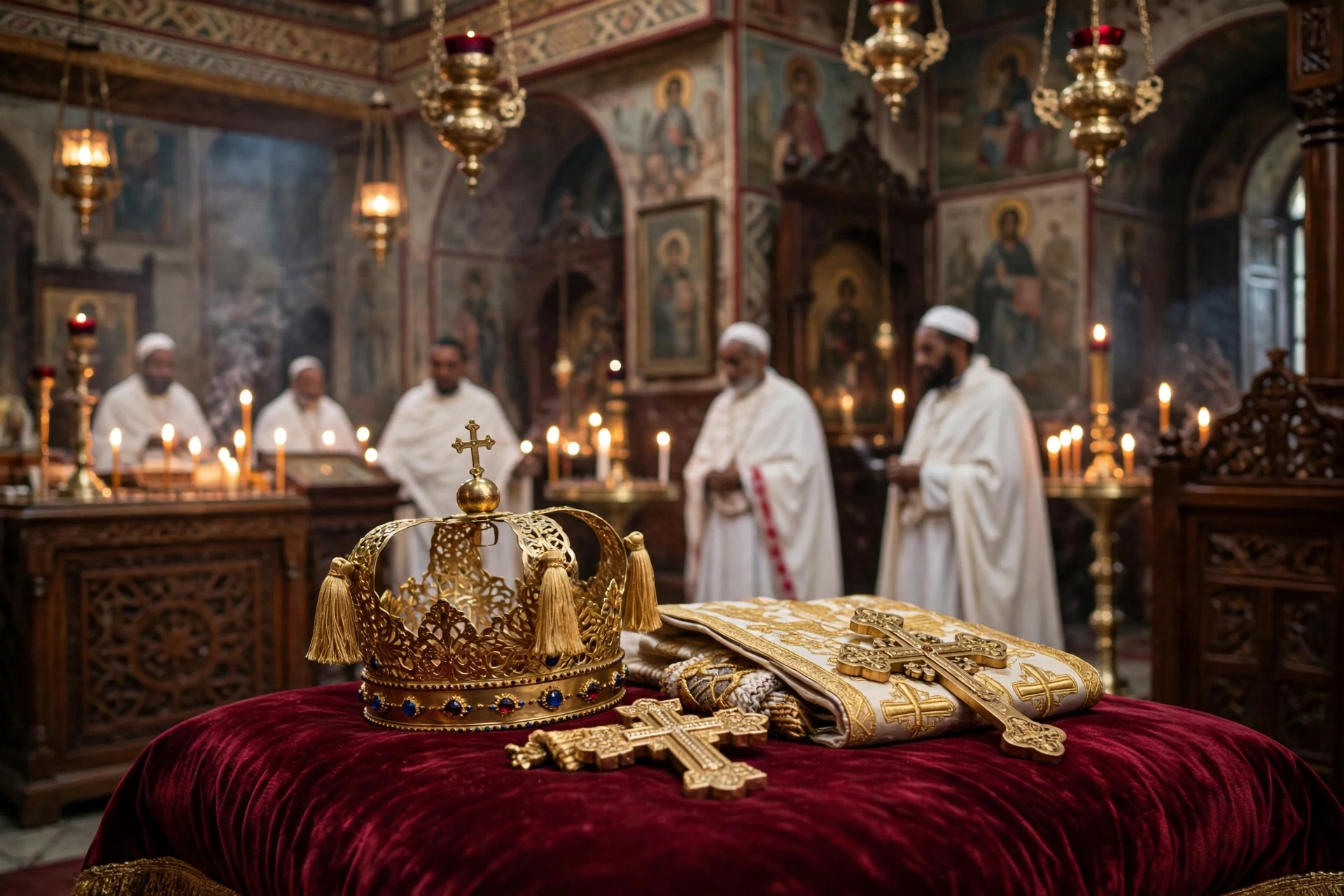
On the morning itself, the ancient rite unfolded step by step. The foreign guests arrived at seven and were seated interspersed with Ethiopian aristocrats, who could guide them on when to stand and when to sit. The Emperor and Empress entered in white cloaks embroidered with silver, took the coronation oath with a hand on a gold-bound Bible, and were then robed in red and gold. Item by item, abbots and bishops brought out the regalia: the robes of state, the diamond-studded sword, the sceptre placed in the Emperor’s right hand, the coronation ring, and the two golden spears. Then came the anointing. The Archbishop prayed over the holy oil and anointed the Emperor in the form of a cross on his forehead and chest, in the manner of the anointing of David and Solomon, before placing the imperial crown on his head. Empress Menen was then crowned in the same ceremony, in the same place, on the same day, which the Crown Council account notes was a first: empresses had traditionally been crowned by the Emperor at the palace, in a much smaller ceremony, on the third day.
The guest list explains why the news travelled so far, so fast. Britain sent Prince Henry, Duke of Gloucester, son of King George V. Italy sent the Prince of Udine, France sent one of its most senior marshals, and Japan, Egypt, the United States, Germany and a long list of other states sent senior representatives. A Pankhurst history of the period confirms the same roll call and adds a detail that mattered enormously for what followed: the celebrations attracted considerable international media coverage, for both the monarch and the country. Among those present was the novelist Evelyn Waugh, who wrote a journalistic account of the event. The coronation was filmed, photographed and reported on every continent. It was, in effect, the first Ethiopian coronation the whole world could see, and that visibility is the hinge on which the rest of this story turns. Within a year, that ceremonial authority had become written law: the Country Studies history records that in July 1931 the Emperor granted Ethiopia’s first written constitution, reserving succession to his own line and providing a legal basis for replacing traditional provincial rulers with loyal appointees. For the words the Emperor himself went on to speak across his reign, our collection of Haile Selassie quotes is the natural next read.
The Titles, and Why Jamaica Heard Prophecy in Them
Read the titles proclaimed that morning and you are reading the text Jamaica opened its Bibles to check. The new Emperor took the throne name Haile Selassie, meaning Power of the Trinity, his own baptismal name restored as a regnal name. Around it stood the full traditional style of the Ethiopian throne: King of Kings of Ethiopia, Lord of Lords, Elect of God, and Conquering Lion of the Tribe of Judah. RE Online’s Coronation Day entry lists the same titles and states plainly why the date endures: it is one of the holiest days of the Rastafari year, celebrating Selassie’s accession and cementing the role Ethiopia plays at the heart of the tradition. None of those titles was invented for the occasion. They were the inherited language of a dynasty that traced itself back, by tradition, to Solomon and the Queen of Sheba, and that inheritance is explored in depth in our guide to the Lion of Judah and what the symbol means.
In Jamaica, those inherited titles landed on ground that had been prepared for decades. Ethiopianism, the reading of the Bible through the lens of African dignity, had taught generations of Black Christians to watch Ethiopia closely. Psalm 68 speaks of princes coming out of Egypt and Ethiopia stretching out her hands to God. Revelation speaks of the Lion of the Tribe of Judah who has prevailed, and of a King of Kings and Lord of Lords. When newspaper reports and photographs of the Addis Ababa coronation reached Kingston, readers compared the reports with the verses they already knew by heart, and the correspondence seemed exact: a Black king, crowned in Africa’s one unconquered Christian empire, bearing in public the very titles their scriptures named. Our walk through Rastafarian scriptures sets out how those passages are read within the tradition, and the famous blessing explored in Who Jah Bless, No Man Curse shows the same habit of reading at work in everyday speech.
Marcus Garvey’s voice was the other half of the preparation. The Jamaican-born founder of the Universal Negro Improvement Association had spent the 1920s teaching Black pride, self-reliance and a return of attention to Africa, and a saying widely attributed to him urged his followers to look to Africa for the crowning of a Black king as a sign that deliverance was near. Historians are careful about the exact wording and dating of that saying, and honest writing should be careful too. What is not in dispute is the effect. When the crowning actually happened, in full view of the world’s press, Garvey’s audiences were ready to receive it as fulfilment. The Encyclopedia.com history of the movement describes how, following the 1930 crowning, street-corner preachers in Jamaica, among them Joseph Hibbert, Leonard Howell, Robert Hinds and Archibald Dunkley, began asserting that Selassie was a divine personage, and how for those Jamaicans he embodied Garvey’s vision of Black pride and repatriation while fulfilling the Bible’s prophecies of a messianic deliverer.
It is worth pausing on how the coronation was documented, because documentation is what carried it across an ocean. The Smithsonian Libraries hold the record of Addison Southard’s 1931 National Geographic account, published under a title that called Haile Selassie the successor to the world’s oldest continuously sovereign throne. That June 1931 coverage, with its photographs of a transformed Addis Ababa, its asphalted streets and electric lights and triumphal arches, is the kind of contemporary reporting through which the wider world, including the Caribbean, pictured the event. Time magazine put the Emperor on its cover at the start of November 1930. Film crews shot the processions. For a people in Jamaica who had been told in a hundred ways that Africa had no history worth honouring, here was Africa on the front pages, crowned, robed and receiving the bows of European princes. The medium was not incidental to the message. The message travelled because the medium did.
The Day That Named a Movement
Most faiths are named for a founder, a place or a book; this one is named for a man’s name before his crowning. Rastafari joins two words: Ras, the Ethiopian title of rank the future Emperor held, roughly prince or duke, and Tafari, his given name. The EBSCO Rastafari research overview spells the derivation out directly: the name is a compound of ras, meaning chief or head, and Tafari, the given name of Haile Selassie before he became Emperor. That etymology is the simplest proof of how central November 2 is. The movement does not merely commemorate the coronation as an important date in someone else’s history. It carries the coronation in its own name, every time the name is spoken. To say Rastafari is to say: the faith of Ras Tafari, the man crowned on that morning.
The preaching that followed turned a news event into a theology. In the years immediately after 1930, Leonard Howell and his fellow early preachers taught in Kingston’s streets and yards that the crowned Emperor was the returned Messiah, that Ethiopia was Zion, and that the system of colonial rule and racial humiliation under which Jamaicans lived, named Babylon in the movement’s language, would not have the final word. The New World Encyclopedia entry summarises the belief that unites the movement’s many mansions: that Ras Tafari Makonnen, crowned Haile Selassie I on November 2, 1930, is the living God incarnate, called Jah, who will lead the peoples of African origin into a promised land of full emancipation and divine justice, while noting honestly that some groups within the movement do not take that belief literally. Diversity of interpretation has been there from the start, and Coronation Day is one of the few observances that crosses all of it.
The Smithsonian’s landmark exhibition treated those origins with the seriousness they deserve. When the National Museum of Natural History mounted Discovering Rastafari, its curator explained that Ethiopianism, Garveyism and biblical literacy came together to form the basis of the belief in Selassie’s divinity that began to be preached in the early 1930s, and that the crowning in November 1930 received enormous media coverage and was interpreted by some in Jamaica as the second coming. The Smithsonian Magazine interview with the curator is valuable precisely because it refuses the lazy stereotype: this is a story about people reading their way, with the only book most of them owned, toward dignity. Coronation Day sits at the exact point where those three streams met. Remove the crowning, and Ethiopianism remains a hope, Garveyism remains a politics and the verses remain verses. With the crowning, all three became a faith.
There is a tension at the centre of the story, and a good account should not hide it. Haile Selassie himself was a devout member of the Ethiopian Orthodox Church throughout his life. He did not claim divinity, and on recorded occasions he directed his followers’ worship away from himself. The movement heard those words and, in the main, held its conviction anyway, reading his humility itself as a sign. Scholars of the movement have long noted this paradox without treating it as a punchline, and ordinary believers navigate it in different ways: some hold the full doctrine of his divinity, some honour him as a divinely appointed king and prophet-like figure, and some keep Coronation Day chiefly as a celebration of African sovereignty and Black dignity. The day is capacious enough for all of those observances, which is one reason it has outlasted every prediction that the movement would fade. Our longer reflection on why Haile Selassie still reigns in the culture takes that tension up in full.
Coronation Day Is Not Groundation Day
The confusion is understandable, and it is worth clearing up once and for all, because the two days honour opposite ends of the same story. Coronation Day, November 2, looks back to 1930, to Addis Ababa, to a crowning that happened before the movement existed and, in the movement’s own understanding, called it into being. Groundation Day, April 21, looks back to 1966, when the Emperor, by then an elderly statesman, came to Jamaica in person and stepped off an aircraft into a sea of believers at Kingston airport. One day is about a crown placed on a head in Ethiopia. The other is about that same man, thirty-six years later, standing on Jamaican soil in the rain while drummers played and crowds pressed in simply to see him. Our full account of Groundation Day tells the 1966 story properly; the short version is that the site’s own Groundation Day guide describes April 21 as one of the holiest days in the culture, second only to November 2, the anniversary of the coronation. Even in the ranking, the coronation comes first.
Keeping the two days distinct actually deepens both of them. If Coronation Day is the promise, Groundation Day is the meeting. In 1930 Jamaica heard about the Emperor through newspapers, photographs and film; almost nobody who believed had ever seen him, and faith had to travel on testimony alone. In 1966 testimony became presence. Elders who had preached for three decades about a king across the ocean stood in the same air as him, and the famous counsel associated with that visit, liberation before repatriation, redirected the movement’s energy toward building justice where its people actually lived. Rita Marley’s conversion after seeing the Emperor’s motorcade belongs to that day, not this one. Bob Marley’s whole career belongs downstream of both. When you celebrate November 2, you are honouring the root; when you celebrate April 21, you are honouring the encounter. A calendar that mixes them up loses the shape of the story, and the shape of the story is the teaching.
How Coronation Day Is Observed Today
There is no single headquarters issuing instructions for November 2, and that is by design. Rastafari is organised in mansions and houses, including the Nyabinghi Order, the Bobo Ashanti and the Twelve Tribes of Israel, and observance varies in detail from community to community and country to country. What unites the day across those differences is its register: where some holy days are reflective, Coronation Day is ceremonial. Drumming, chanting and psalm reading carry a deliberate note of majesty and praise, because the thing being remembered is a crowning. Gatherings may begin the night before with a vigil, echoing, consciously or not, the all-night prayer that preceded the original ceremony in Addis Ababa, and continue through the day with readings, reasonings and shared Ital food.
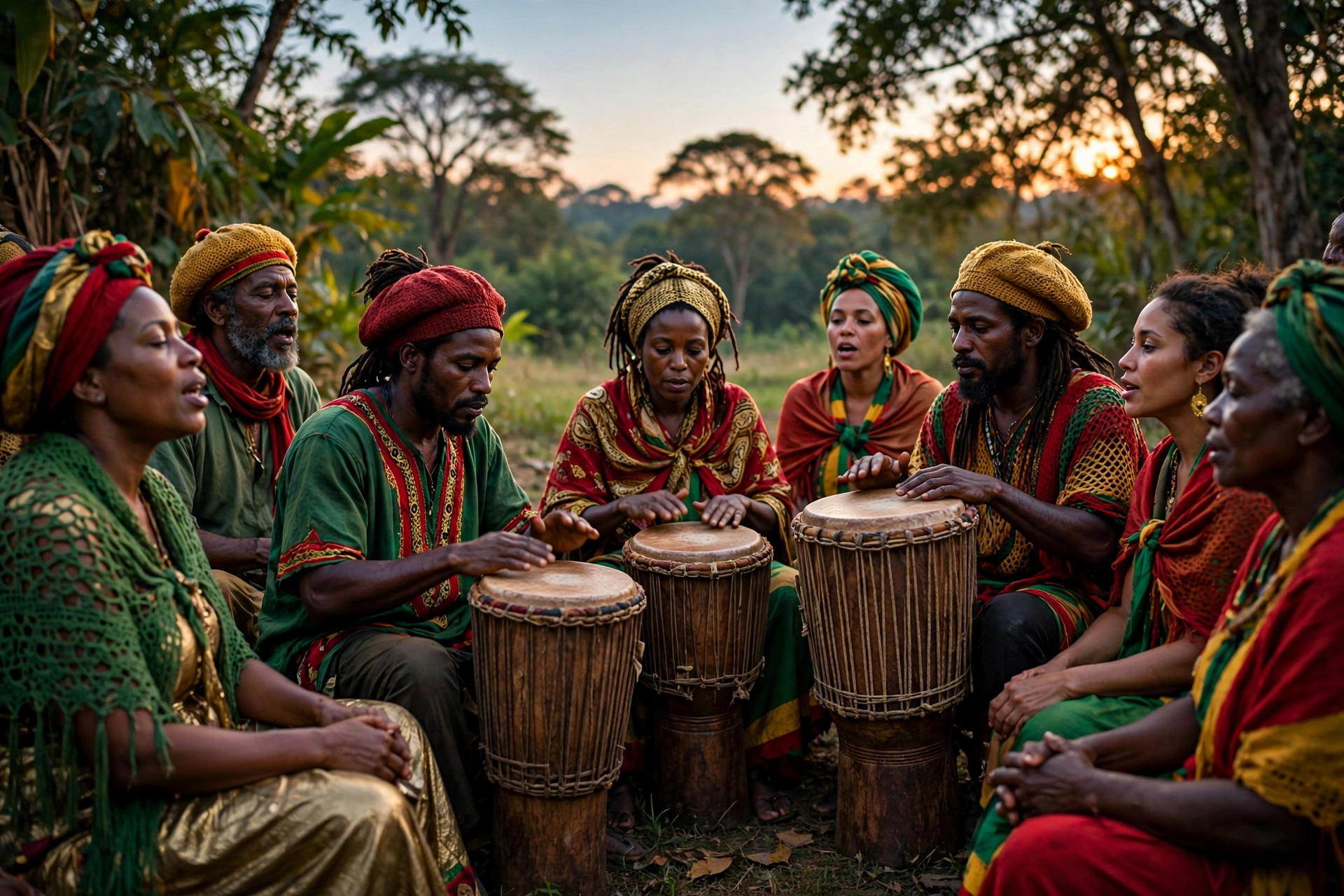
The Nyabinghi drums are the sound of the day. The bass, funde and repeater drums, played in the heartbeat rhythm that underpins the order’s worship, turn a gathering into a groundation in the older sense: a grounding, a collective settling into roots. Around the drums, elders and youth chant psalms and hymns, many of them addressed directly to the King whose crowning is being marked. Reasoning sessions, the movement’s characteristic form of communal discussion, take up the themes the day raises: sovereignty, dignity, the meaning of Zion and Babylon, and what liberation requires in the present rather than the past. For newcomers attending respectfully, the practical guidance is simple. Ask before joining a reasoning, dress modestly and in keeping with the occasion, expect the gathering to run on spiritual rather than clock time, and understand that you are a guest at someone’s act of worship, not an audience at a performance.
At home, observance can be quieter without being lesser. Many families mark the day with a morning reading, often from the Psalms or from Revelation, a shared meal prepared Ital style, music that honours the tradition, and time set aside to teach children the story properly: who Ras Tafari was, where Addis Ababa is, what happened at St George’s Cathedral and why people who had never met him wept at the news. That teaching function matters more with each passing generation. The coronation is now beyond living memory; nobody alive today stood in that cathedral tent. The day survives because it is taught, and every November 2 on which a child learns to separate it from Groundation Day, and to say what the titles mean, is a year the chain holds. Our guide to traditional Rasta outfits can help with dressing for a gathering in a way that honours rather than costumes the occasion.
Coronation Day in the Wider Holy-Days Calendar
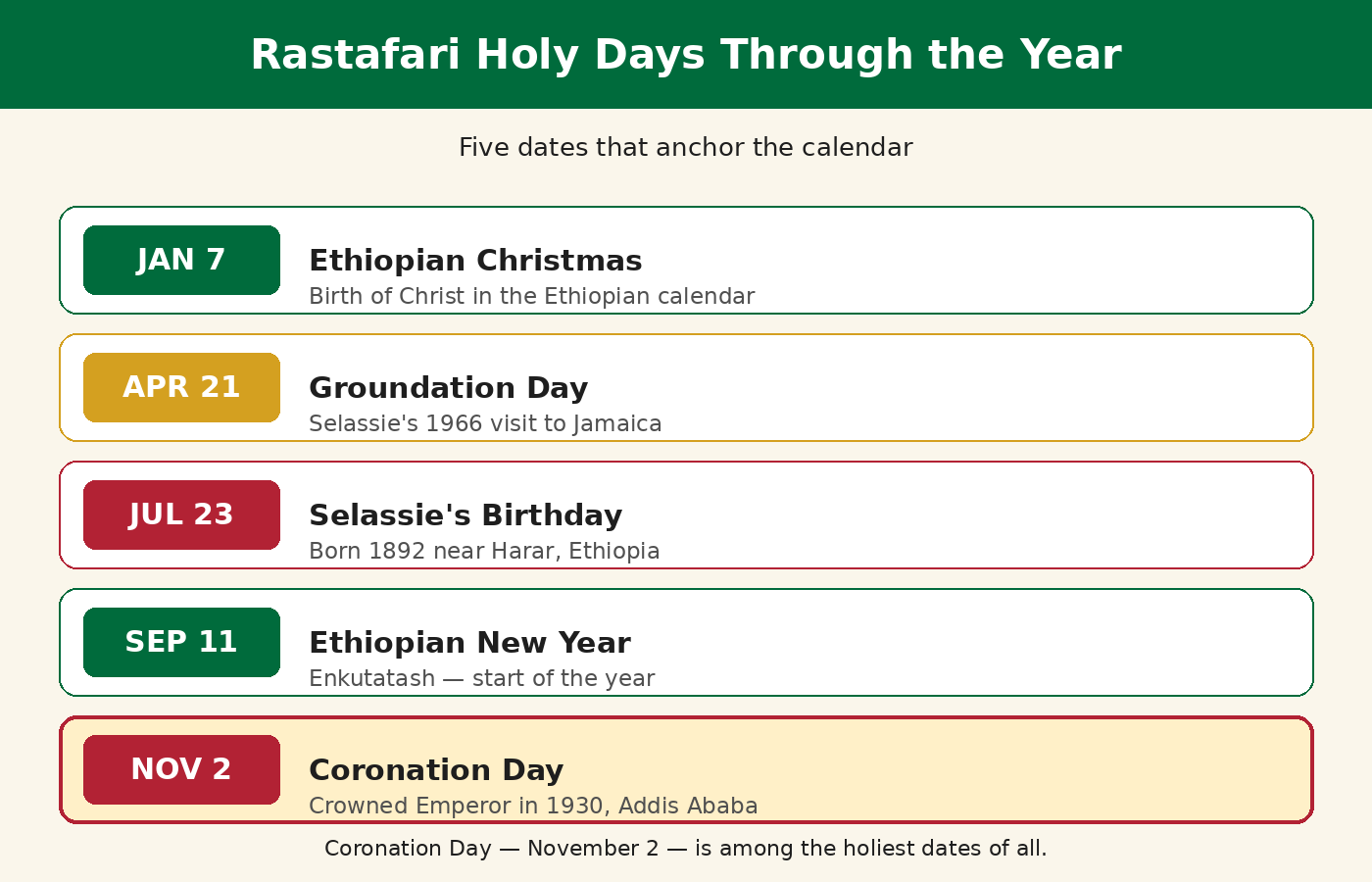
November 2 does not stand alone; it anchors a year shaped by Ethiopian time. The Rastafari calendar braids together dates from Selassie’s life, dates from Ethiopian tradition and dates from the movement’s own history. Ethiopian Christmas falls on January 7, following the Ethiopian Orthodox calendar rather than the December date most of the world uses. Groundation Day follows on April 21. The Emperor’s birthday is kept on July 23, the day he was born near Harar in 1892, a date the Britannica record confirms. Emancipation Day on August 1 marks the abolition of slavery in the British Caribbean, and Ethiopian New Year, Enkutatash, opens the Ethiopian year on September 11. Marcus Garvey’s birthday on August 17 is also widely honoured. Read as a whole, the calendar tells the movement’s autobiography in dates: birth, crowning, visit, emancipation, renewal. Coronation Day is the hinge in the middle of it, the date without which none of the Selassie-centred dates would exist at all.
Wearing the Day: Colours, Symbols and Respect
What people wear on November 2 is a language, and it helps to be able to read it. The dominant colours are green, gold and red, the colours of the Ethiopian flag of the imperial era, carried through the movement as a declaration of loyalty to Ethiopia and to the Emperor. Green speaks of the land and its fertility, gold of its wealth and royalty, and red of the blood of martyrs who suffered for the faith and the people. Our foundational guide to Rasta colours explains the full system, and the companion piece on the order of the colours settles the sequence questions that come up whenever flags and garments are made. On Coronation Day you will also see the Lion of Judah worked into garments, banners and jewellery, the imperial lion with its crown and banner, the single most recognisable emblem of the day.
The honest rule for dressing is the same as the rule for attending: honour, do not costume. Wearing the colours to a gathering you have been welcomed into, or to mark the day in your own community, is a gesture of respect that is generally received as one. Treating sacred symbols as fancy dress is not. If you are building a wardrobe that carries this heritage with understanding rather than as decoration, browse the Rastafarian Clothing shop with the story in mind: a Lion of Judah piece worn by someone who can say what the lion means, and when the King who bore that title was crowned, is a different garment from the same piece worn as a pattern. Coronation Day, at bottom, is an invitation to become the first kind of wearer. The knowledge is the difference, and the knowledge is freely given, which is rather the point of days like this one.
Our View
Coronation Day is the root date of Rastafari, and it deserves to be kept accurately. A regent was crowned in Addis Ababa on 2 November 1930, the world was invited to watch, and people in Jamaica who had been waiting on a promise recognised the titles when they heard them. Everything the movement became flows from that morning, including its name. Keep the day distinct from Groundation Day, teach it plainly, and honour it in the colours with the story attached. That is how a date stays alive for another century. — Rastafarian Clothing
Frequently Asked Questions
When is Coronation Day in Rastafari?
Coronation Day is observed every year on November 2. It marks the anniversary of the coronation of Ras Tafari Makonnen as Emperor Haile Selassie I of Ethiopia, which took place on 2 November 1930 at St George’s Cathedral in Addis Ababa.
What is the difference between Coronation Day and Groundation Day?
Coronation Day, on November 2, marks the crowning of Haile Selassie I in Ethiopia in 1930. Groundation Day, on April 21, marks his state visit to Jamaica in 1966, when he arrived in Kingston and met the Rastafari community in person. The first is a crowning in Addis Ababa; the second is a visit to Jamaica, thirty-six years later.
Why is November 2 so important to Rastafari?
Because the coronation is the movement’s founding event. The titles proclaimed that day, including King of Kings and Conquering Lion of the Tribe of Judah, were read in Jamaica as the fulfilment of biblical prophecy and of the hope associated with Marcus Garvey’s teaching. The movement’s name itself comes from Ras Tafari, the Emperor’s name and title before the crowning.
Who else was crowned on 2 November 1930?
Empress Menen Asfaw, the Emperor’s wife, was crowned in the same ceremony, in the same cathedral, on the same day. That was a departure from tradition: empresses had previously been crowned separately, at the palace, days after the Emperor’s coronation.
How is Coronation Day celebrated?
Observance varies by community, but commonly includes Nyabinghi drumming, chanting, psalm reading, reasoning sessions and communal gatherings, often with Ital food and the wearing of green, gold and red. Many families also mark the day at home with readings and by teaching the story of the coronation to their children.
Questions about Rastafari culture or our clothing?
Contact Rastafarian Clothing and we will be glad to help.
Sources
- Encyclopaedia Britannica, Haile Selassie I — biography confirming the regency, the 2 November 1930 crowning and the meaning of the throne name.
- EBSCO, Haile Selassie Is Crowned — account of the coronation’s staging, its seven-month delay and its political purposes.
- Crown Council of Ethiopia — detailed description of the vigil, regalia, oath, anointing and the crowning of Empress Menen.
- Pankhurst, Coronation and Reforms — Richard Pankhurst’s history of the ceremony, its foreign guests and its press coverage.
- Library of Congress, Country Studies — the prewar period, including the July 1931 constitution that followed the coronation.
- Smithsonian Libraries record — catalogue record for the 1931 National Geographic account of the succession.
- Smithsonian Magazine, Discovering Rastafari — curator interview on Ethiopianism, Garveyism and the interpretation of the 1930 crowning.
- RE Online, Crowning Anniversary — Coronation Day as one of the holiest days of the Rastafari year, with the Emperor’s titles.
- Encyclopedia.com, Rastafari — scholarly history of the early preachers and the movement’s emergence after the crowning.
- EBSCO, Rastafari Movement — overview covering the name’s derivation from Ras Tafari and the movement’s beliefs and practices.
- New World Encyclopedia, Rastafari — account of the unifying belief concerning the 2 November 1930 coronation and its scriptural reading.
Recommended
- Groundation Day: Celebrating Haile Selassie’s Historic Visit to Jamaica on April 21, 1966
- Haile Selassie Quotes: Words of Wisdom from the Lion of Judah
- Exploring Rastafarian Scriptures and Their Profound Connection to the Bible




Leave a comment
Your email address will not be published. Required fields are marked *