

You hear it in a chorus, in a greeting at a market stall, in a friend signing off a message with warmth, and the word stops you, because it clearly means more than the dictionary shortcut of good or all right: irie is the feeling that everything is aligned, at peace, and held, and the phrases that travel with it, from Jah and Babylon to ital, Zion, and one love, form a whole way of seeing the world compressed into everyday speech. The problem for most listeners outside Jamaica is that reggae carried these words around the planet faster than it carried their meanings, so the vocabulary is famous while the thought behind it stays half heard. This guide solves that problem directly, starting with irie itself, then opening the full set of Rasta words and phrases around it, where each one comes from, and how to hear and use them with understanding rather than imitation.
Start here: Who Jah Bless No Man Curse — the sister phrases guide to Rastafari’s declaration of blessing and protection
Rasta Colors — our main guide to red, gold, and green and what each color stands for
Key Takeaways
- Irie means good, all right, pleasing, and at peace, and in Rastafari use it also names a spiritual condition of harmony with Jah and creation.
- Rasta speech, called Iyaric, Dread Talk, or Rasta Talk, deliberately rebuilds words so their sound matches their meaning, most famously in I-words such as ital, irie, and I and I.
- Jah is God, Babylon is the oppressive system, and Zion is Africa, above all Ethiopia, as the promised home: together they map the whole Rasta story of exile and return.
- Ital, dread, livity, seen, respect, and one love are not slang decorations; each one carries a practice, a value, or a relationship.
- Reggae carried this vocabulary worldwide, which is why the words are familiar even where their meanings are not.
Table of Contents
- What Irie Means: Good, All Right, and At Peace
- Where Irie Comes From: An Honest Answer
- Iyaric: The Language That Rebuilt English
- Jah, Babylon, and Zion: The Map in Three Words
- Ital, Dread, and Livity: Words You Live, Not Just Say
- Seen, Respect, and One Love: Words Between People
- Hearing the Phrases in Music, and Using Them Well
- Our View
- Frequently Asked Questions
- Sources
- Recommended
What Irie Means: Good, All Right, and At Peace
Irie is the headline word, so start with its full range. At its simplest, irie means good, all right, cool, great, merry, or nice, and it works as an adjective, an adverb, and an interjection, which is why a single short word can do so much work in a conversation. A person can feel irie, a gathering can be irie, a meal, a song, and a whole afternoon can be irie. The most careful recent explainer of the word, DancehallMag on irie, reports that the Oxford English Dictionary files it as Jamaican English and records an older gloss that pushes the meaning higher still, toward powerful and pleasing, excellent, highest, the state of feeling great. That height matters, because irie was never only a casual thumbs up. Underneath approval sits peace, contentment, and harmony, the settled feeling that nothing in this moment needs fixing.
The phrases travel as a set, so learn them as a set. Irie rarely arrives alone in real speech. It sits inside a family of words that name God, the world as it is, the world as it should be, the food on the table, the hair on the head, and the bond between the people speaking. The table below gives the working glossary for this whole guide, covering irie alongside Jah, Babylon, Zion, ital, dread, seen, respect, one love, and livity, and every section that follows takes a group of these words and opens it properly, with its history and its weight, rather than leaving it as a one-line translation.
| Word or Phrase | What It Means | How It Is Used |
|---|---|---|
| Irie | Good, all right, pleasing, at peace | Greeting, answer, approval, blessing |
| Jah | God | Prayer, praise, everyday reference to God |
| Babylon | The oppressive, corrupt system | Naming injustice, authority, and materialism |
| Zion | Africa, above all Ethiopia, the promised home | Hope, repatriation, redemption |
| Ital | Natural, vital, pure, from vital with the I raised | Food and living free of additives and artifice |
| Dread | Awe of Jah; a Rastafari person; the locks themselves | Reverence, identity, and address |
| Seen | Understood, agreed, it is so | Confirming that a point has landed |
| Respect | Honour given and received | Greeting, thanks, and farewell |
| One love | Unity and shared humanity | Blessing, sign-off, and call to unity |
| Livity | A righteous, balanced way of life | The whole practice of living the faith |
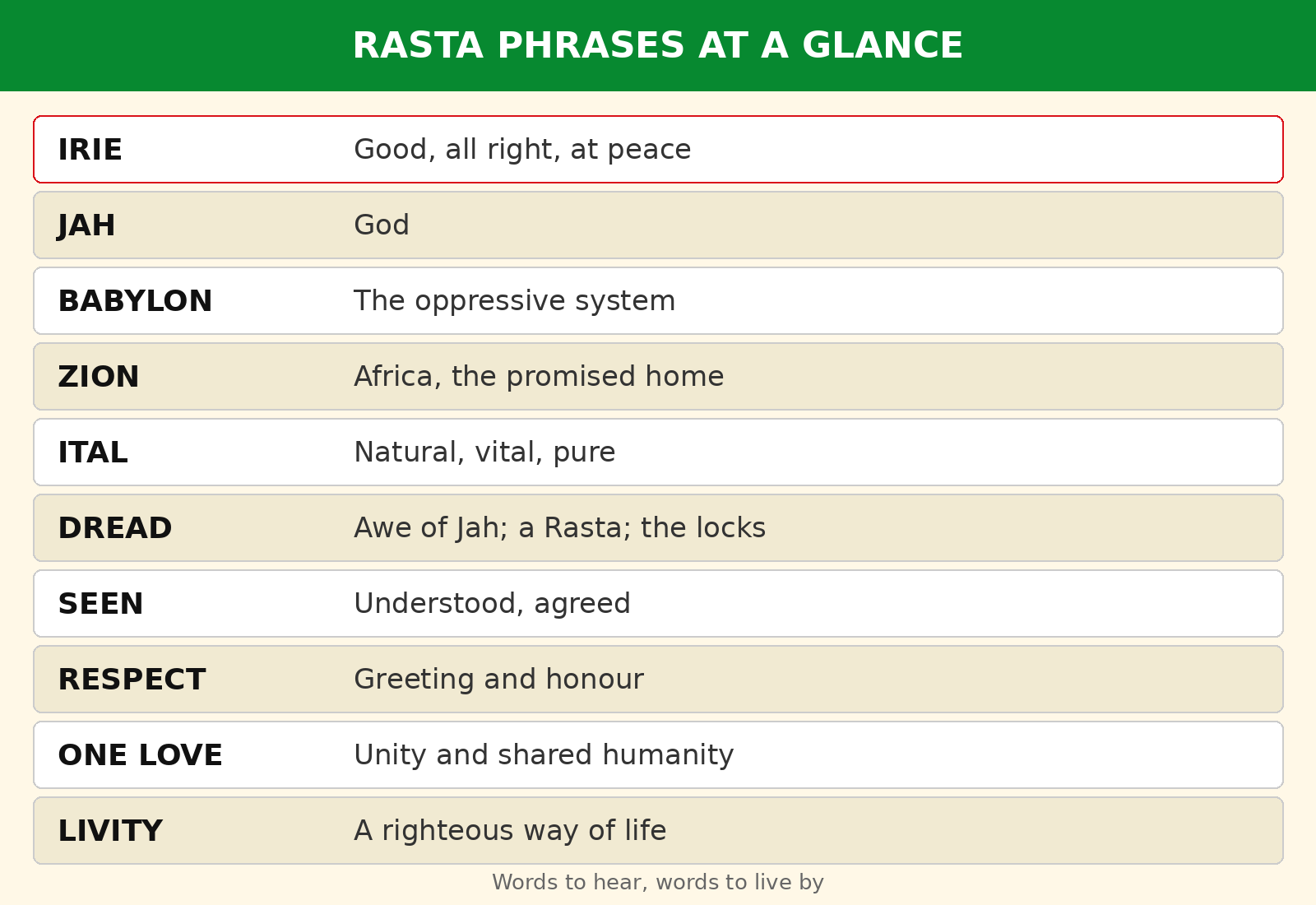
Context decides which shade of irie you are hearing. Asked how you are, irie answers that you are well in body and in spirit, not merely unharmed. Said of a place, it praises the energy of the place, the feeling that the people, the music, and the moment agree with each other. Said as an exclamation, it blesses what has just happened. English separates feeling good, things going well, and being at peace into different phrases, while irie holds all three in one breath. Our sister guide to who Jah bless, no man curse shows the same compression in a longer phrase, where an entire theology of protection fits inside six words.
Where Irie Comes From: An Honest Answer
The honest answer about the origin of irie is that nobody knows for certain, and any guide that pretends otherwise is guessing. The Oxford English Dictionary, as reported by DancehallMag, calls the origin uncertain, and its earliest recorded evidence of the word in print comes from a Kingston newspaper in the middle of the roots reggae years, when Rasta language was pouring out of studios and sound systems into everyday Jamaican speech. Several theories circulate, and none is settled. One holds that irie is an alteration of an older word for hearty. Another sees it as a creation of Iyaric, blending the raised I with free or merry. A third links it to the English phrase all right, which would make irie a compressed blessing, the whole of all right gathered into a single joyful sound. What is beyond dispute is the use: Jamaicans made the word their own, reggae carried it, and its meaning in living speech is clear even where its origin is not.
Irie lives inside Jamaican Creole, and that language has its own dignity and its own scholarship. Jamaican Creole, called Patois or Patwa by its speakers, is not broken English but a full language with its own grammar, sound system, and literature. The reference entry on Jamaican Creole describes it as the English-based creole vernacular of Jamaica with the most extensive literature and the widest artistic use of any Caribbean English creole, spread worldwide by Jamaican music, dub poetry, and the Rastafari faith itself. The work of treating that language with institutional seriousness has a home: the Jamaican Language Unit at the University of the West Indies, Mona, was established to support speakers of Jamaican, widely referred to as Patwa, including a standard writing system for the language. You are not picking up slang in the dismissive sense, then. You are touching a language a university unit exists to document, teach, and defend.
The deepest layer of irie is spiritual, and it is the layer reggae listeners feel before they can name it. In Rastafari use, feeling irie means being in tune: right with Jah, right with other people, and right with creation, living inside livity rather than merely enjoying a good mood. That is why the true opposite of irie in Rasta thought is not sadness but Babylon, the oppressive order that pulls a life out of tune. A person can be poor, tired, and opposed and still be irie, because irie names alignment rather than comfort. Hold that distinction and the word becomes what it has always been for the people who shaped it: a small daily report on the state of the soul. The colors that carry the same report visually are set out in our guide to the rasta colors, where green, gold, and red do in cloth what irie does in speech.
Iyaric: The Language That Rebuilt English
To understand any of these words properly, you have to understand Iyaric, the deliberate rebuilding of English from inside Rastafari. Iyaric, also called Dread Talk or Rasta Talk, grew as a conscious response to what Rastas experience as a negative colonial framework built into everyday English. Words were examined for the sounds they carry, and where a sound contradicted the meaning, the word was rebuilt. The greeting hello is avoided because it contains hell and low. Understand becomes overstand, because real understanding lifts a person up. Oppression becomes downpression, because the thing presses down. Encyclopaedia Britannica describes Iyaric, or Dread-talk, as the linguistic style of many Rastas, who substitute the sound of I for certain syllables, pointing at the most famous pattern of all: the I-words.
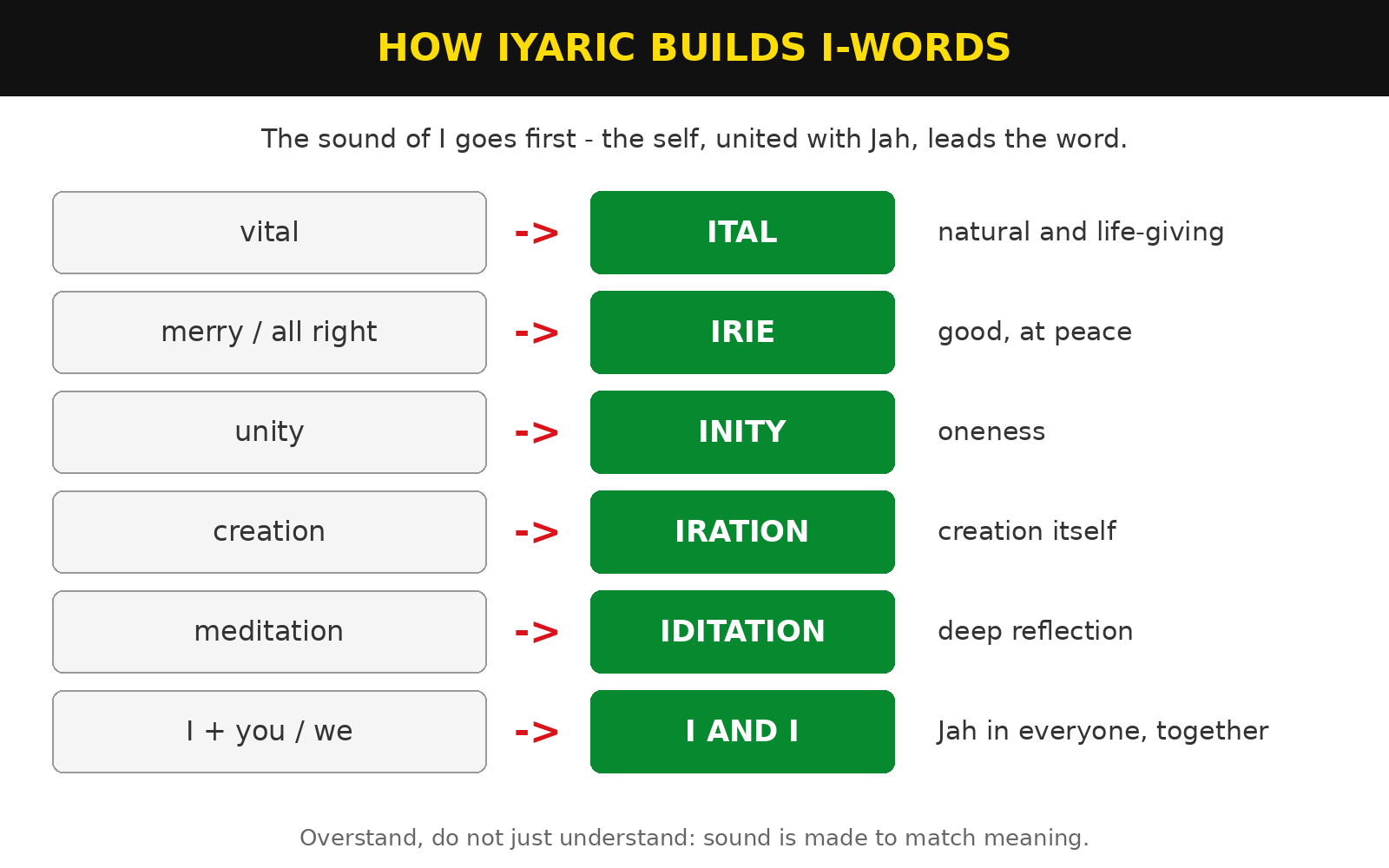
The I-words are a system, not a game, and linguists have studied them as one. Benjamin Slade’s formal study of Rasta Talk morphology shows that forms such as ital, from vital, and irie, if from merry, belong to a larger pattern in which the initial syllable of a word is reshaped around the sound of I, a process he analyses as a special kind of blending rather than simple replacement. The same study catalogues the companion pattern of overstandings, including overstand for understand, downpress for oppress, and livicate for dedicate, where a part of a word whose connotation clashes with its meaning is replaced by its opposite until sound and sense agree. Behind the pattern stands a theology of the pronoun: I and I replaces me and you, and even we, because Jah dwells in every person and no speaker stands outside that unity. When irie is read inside this system, its opening I stops looking accidental. Whether or not the word was historically built this way, Rasta ears hear it this way, and hearing is part of meaning.
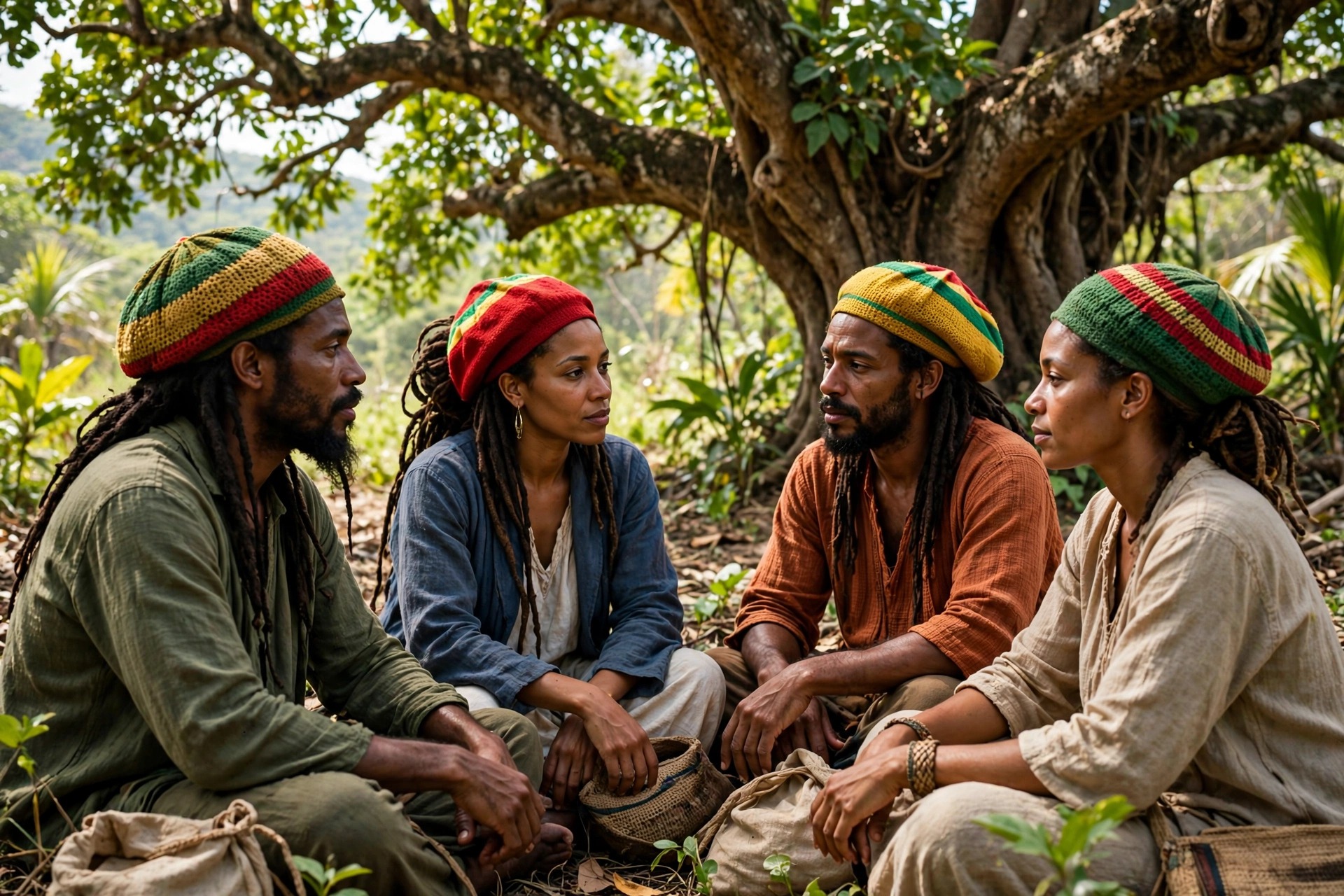
This language travelled, literally, all the way back to Africa. The University of the West Indies lecture record on Ethiopia speaking Jamaican Creole describes the communities in the Shashamane valley, where Jamaican Rastafari repatriated to Ethiopia over decades, and where Jamaican Creole, particularly the Rastafari version of it, became a language of everyday communication alongside Tigrinya, Oromo, and Amharic. A language forged in Jamaica out of exile was carried home to Zion and became one of Ethiopia’s living tongues. The words in this guide are therefore not museum pieces, and the gatherings where the language is weighed and refined, the reasonings marked on holy days such as Groundation Day, remain its living classrooms.
Jah, Babylon, and Zion: The Map in Three Words
Jah, Babylon, and Zion are the three coordinates of the Rasta map, and every other phrase in this guide is located by them. Jah is God, the name drawn from the Hebrew of the Psalms. EBSCO’s Rastafari overview explains that Rastas believe God, whom they call Jah, is particularly identified with the Holy Spirit incarnate within every human being, which is exactly why the speech form I and I exists: if Jah dwells in each person, no encounter between people is merely human. Babylon is the opposite pole, the world of corruption and materialism, named for the empire that held God’s people captive in the Old Testament story. Britannica’s Rastafari entry sets the pair in their biblical frame, describing how Rastas overstand people of African descent in the Americas to be exiles in Babylon, tested by Jah through slavery, economic injustice, and racial downpression, and awaiting deliverance.
Zion is where the map points home. In that same Britannica account, Zion is the name for Ethiopia, drawn from the biblical tradition of Zion as the place of repatriation and redemption, and Ethiopia is described as the ultimate home of all Africans and the seat of Jah. The EBSCO overview tells the same story from the other side, describing how Rastas believe a new and perfect world of Zion will be created, with its capital in Ethiopia, through the separation of the righteous from Babylon. This is why the emperor at the centre of the faith matters to the vocabulary: many Rastas regard Haile Selassie I as the messiah, and the movement takes its very name from his pre-coronation name, Ras Tafari. Our collection of Haile Selassie quotes lets the emperor speak in his own words, our account of why Haile Selassie still reigns in Rasta culture follows his place in the faith, and our guide to the meaning behind the Lion of Judah in Rastafari culture explains the lion on his banner in full.
Heard together, the three words turn ordinary sentences into theology. When a lyric praises Jah, it names the God who dwells in the singer and the listener alike. When a lyric chants down Babylon, it indicts a system, the police at the gate, the price of food, the history of slavery and colony, in a single word with a Bible behind it. When a lyric longs for Zion, it voices the hope of return, to Africa, to Ethiopia, and to a world set right. This is also why the declaration that who Jah bless no man curse cannot be undone by human hostility lands with such force: the Jah in that sentence is this Jah, indwelling and sovereign. Learn these three words properly and half of every roots reggae catalogue opens at once.
Ital, Dread, and Livity: Words You Live, Not Just Say
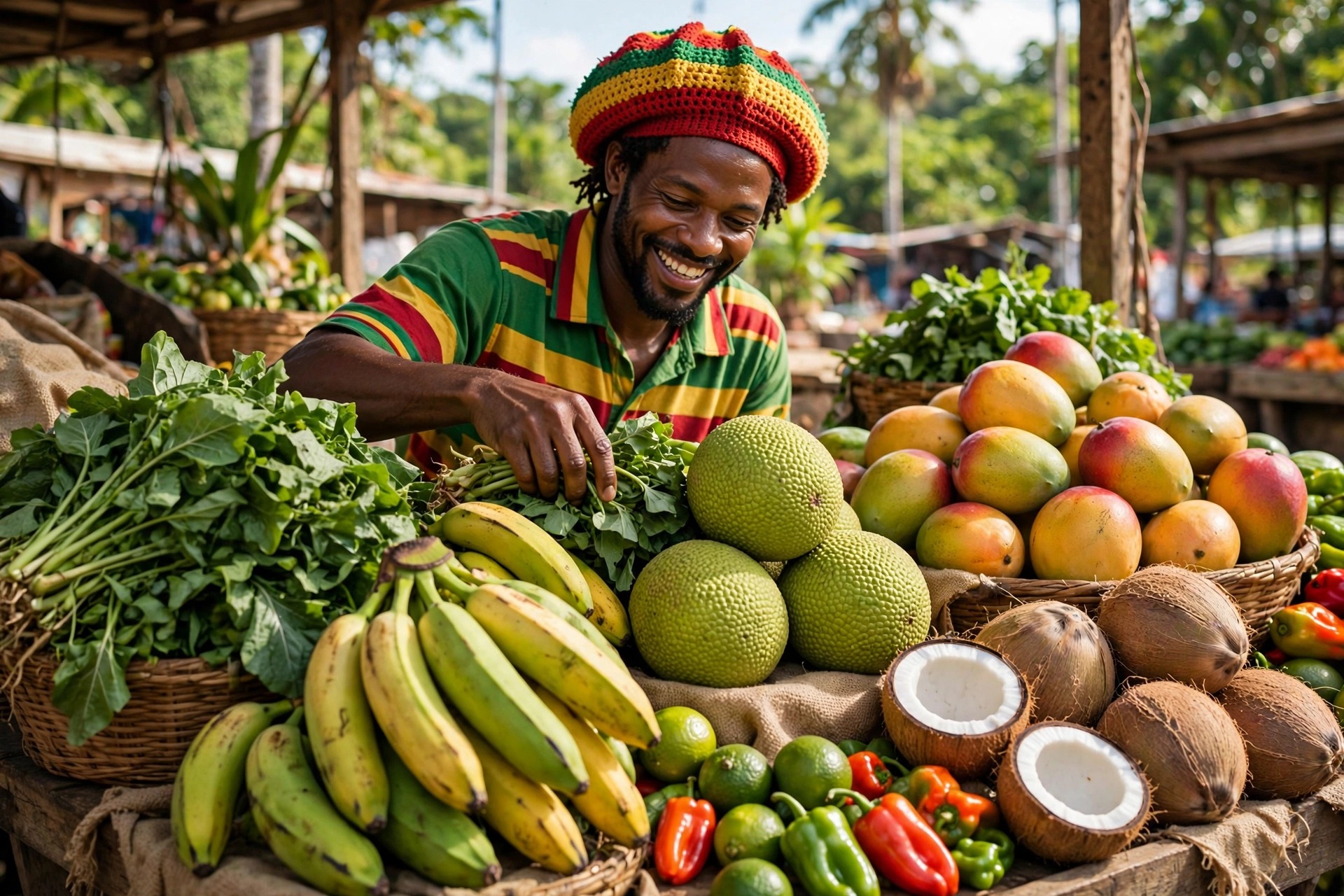
Ital, dread, and livity move the vocabulary off the tongue and into the kitchen, the mirror, and the whole conduct of a life. Ital, built from vital by raising the I, names food and living that are natural, pure, and life-giving: fresh food from the earth, free of additives and chemical interference, in most expressions vegetarian and in strict expressions vegan. Smithsonian Magazine on ital explains that ital, rhyming with and derived from vital, is employed throughout Rastafari speech to emphasize the oneness and unity of life, and that ital food promotes a healthy mind, body, spirit, and environment. National Geographic on ital eating reports the same principle from the farm itself, describing how Rastas eat a natural diet free from additives, chemicals, and most meat to stay spiritually connected to the earth, repeating the saying that sums the word up: ital is vital.
Dread is the word outsiders most often flatten, and it deserves its full weight back. In Rasta speech, dread names first a holy awe, the serious reverence due to Jah, and from there it names the person who lives in that awe and the locks that announce it. The dreadlocks are read through scripture, above all the Nazarite vow against the razor, and through the mane of the Lion of Judah, and they stand as a public refusal of Babylon’s grooming standards and vanity. The EBSCO history notes that dreadlocks became characteristic of Rastafari life in a reforming generation that took them up as a defiant rejection of a society that had rejected them, which is why dread carries pride rather than fear for those who wear it. Livity then gathers ital, dread, dress, speech, and conduct into one word: a balanced, righteous lifestyle, lived consciously every day rather than performed on a holy day. The University of the West Indies built a scholarly gathering around that word, as its record of the Rastafari Studies Conference shows, taking Rastafari livity and scholarship as its theme. Dress belongs inside livity too, which is why our guides to traditional rasta outfits that still look fly and how to dress like a Rastafarian woman treat clothing as expression rather than costume, and why the sequence in rasta colors in order is worth getting right.
Seen, Respect, and One Love: Words Between People
Seen, respect, and one love are the social words of the set, the ones that manage the space between one person and another. Seen is the smallest and the most efficient: it confirms that a point has been heard, understood, and accepted, and it carries a quiet claim about sight itself, that the listener has perceived the truth inside the words, not merely heard them. Respect works in both directions at once. Offered as a greeting or a farewell, it gives honour to the person addressed and states the speaker’s own standard in the same breath. Neither word is filler. In a speech community built on I and I, where every person carries Jah within, small words of acknowledgement are load-bearing, because they enact the equality the theology teaches.
One love is the phrase the whole world borrowed, and its history is older and more political than its greeting-card afterlife suggests. Dictionary.com on one love defines it as an expression of unity and inclusion, often used by Rastafarians, Jamaicans, and reggae musicians, and traces it to Marcus Garvey, who sometimes concluded his speeches with the phrase and whose movement’s motto of one God, one aim, one destiny Rastafari adapted into one love, one heart, one destiny. The Wailers recorded the song in the ska years and Bob Marley later re-released it, and where the phrase had centred Black solidarity for Garvey, Marley’s vision is generally read as a call to harmony among people of different races. Either way, the phrase in living use is a blessing with a programme inside it: unity is not a mood but a destiny, something to be built. It pairs naturally with irie itself: irie reports the inner state, one love directs it outward, and together they describe a person at peace with Jah and at peace with their neighbour.
Hearing the Phrases in Music, and Using Them Well
Reggae is the reason these words are in your ears at all, and the music’s own standing confirms that this vocabulary is heritage, not slang. UNESCO on reggae inscribed the reggae music of Jamaica on the Representative List of the Intangible Cultural Heritage of Humanity, describing a music that originated among marginalized groups in western Kingston and whose contribution to discourse on injustice, resistance, love, and humanity makes it at once cerebral, socio-political, sensual, and spiritual, a voice for all that still serves as social commentary, catharsis, and praise of God. Every one of those functions runs on the words in this guide: the praise on Jah, the resistance on Babylon, the love on irie and one love. When an institution of that standing treats the culture this seriously, the least a listener can do is learn its words properly.
Using the phrases well is mostly a matter of understanding plus restraint. Greet with irie where warmth is genuine and the setting is Jamaican or reggae-shaped. Answer seen when you have genuinely understood, not as punctuation. Offer respect and one love as the blessings they are, rather than as decoration on every sentence. Avoid forcing a borrowed accent, avoid stacking every phrase in this glossary into a single greeting, and avoid using Babylon, Zion, or Jah as jokes, because for the people who built this language those words carry scripture, history, and hope. If you want to go further, the door is reading rather than mimicry: follow the phrases into the posts linked throughout this guide, browse the shop to see how the words and colors live on clothing made for this culture, and let the vocabulary settle until the next lyric that puzzled you opens on its own.
Our View
Irie is a small word doing the work of a whole philosophy: it reports that a life is in tune, with Jah, with people, and with creation, and it refuses to separate feeling good from living right. That is why it has outlasted every fashion that carried it. Learn the word properly, learn the family it travels with, and you will never hear reggae, or greet a Jamaican friend, in quite the same way again. The language was built with care by people who believed words shape worlds. Treating it with care is how the rest of us honour that belief.
— The Editors, Rastafarian Clothing
Frequently Asked Questions
What does irie mean, in simple terms?
Irie means good, all right, pleasing, and at peace. It can describe how a person feels, how a place or gathering feels, or stand alone as a greeting, an answer, or an exclamation of approval. In Rastafari use it goes deeper, naming a spiritual condition of harmony with Jah, with other people, and with creation, which is why it means more than simply being in a good mood.
How do you pronounce irie, and how is it used in a sentence?
Irie is pronounced eye-ree, with the stress on the first syllable. Everyday uses include answering a greeting with a plain irie, saying everyting irie to report that everything is good, and describing a person, a song, a meal, or an evening as irie. It works as a greeting, a reply, and a judgement of quality, all in the same two syllables.
What is Iyaric, and how is it different from Jamaican Patois?
Jamaican Patois, or Jamaican Creole, is the everyday language of Jamaica, a full English-based creole language with West African influences. Iyaric, also called Dread Talk or Rasta Talk, is the deliberate Rastafari reshaping of that speech, built to make words carry righteous meanings: I-words such as ital, irie, and I and I, and rebuilt forms such as overstand for understand and downpression for oppression. Patois is the river; Iyaric is a channel the Rasta community dug through it on purpose.
What do Babylon and Zion mean in Rasta speech?
Babylon is the oppressive system: corrupt authority, materialism, and injustice, named for the empire that held God’s people captive in the Old Testament. Zion is its opposite, Africa and above all Ethiopia as the promised home. Together with Jah, the name for God, the two words map the Rasta story of exile in Babylon and return to Zion.
Is it respectful for visitors to say irie and one love?
Yes, when it is done warmly and sparingly. Irie and one love are welcoming words, and Jamaicans generally receive them gladly from visitors who use them as a genuine greeting and a genuine blessing. What gives offence is caricature: a forced accent, every phrase stacked into one sentence, or sacred words used as jokes. Understanding first, imitation last, is the respectful order.
Questions about the words, the culture, or an order?
Reach us through our contact page — we read everything and reply to everyone we can.
Sources
- DancehallMag — Irie Meaning: irie as good, all right, cool, or great, its Oxford English Dictionary treatment as Jamaican English, its uncertain origin, and its spiritual sense in Rastafari and Iyaric.
- Encyclopaedia Britannica — Rastafari: the movement begun in Jamaica in the 1930s, exiles in Babylon tested by Jah, Zion as Ethiopia, I-and-I, Iyaric or Dread-talk, livity, dreadlocks, and the ital diet.
- Slade — Rasta Talk Morphology: formal analysis of I-words such as ital and irie as blending, and of overstandings such as overstand, downpress, and livicate in Rasta Talk.
- Jamaican Language Unit: the University of the West Indies unit supporting speakers of Jamaican, widely referred to as Patwa, including a standard writing system for the language.
- UWI — Ethiopia Speaks Jamaican Creole: Jamaican Creole, particularly the Rastafari version, as an everyday language of the repatriated communities in the Shashamane valley of Ethiopia.
- UWI — Rastafari Studies Conference: the Mona conference on Rastafari livity and scholarship, marking the landmark Report on the Rastafari Movement in Kingston.
- Encyclopedia.com — Jamaican Creole: Jamaican Creole as the English-based creole vernacular of Jamaica, spread worldwide by Jamaican music, dub poetry, and the Rastafarian religion.
- UNESCO — Reggae Music of Jamaica: reggae inscribed on the Representative List of the Intangible Cultural Heritage of Humanity, originating among marginalized groups in western Kingston and acting as a voice for all.
- Dictionary.com — One Love: one love as an expression of unity and inclusion, from Marcus Garvey’s speeches and motto through Rastafari adaptation to the Wailers and Bob Marley.
- Smithsonian Magazine — Ital: ital, derived from vital, as natural food free from additives and chemicals that emphasizes the oneness and unity of life in Rastafari values.
- National Geographic — Ital Eating: ital cooking as a natural diet free from additives, chemicals, and most meat, eaten to stay healthy and spiritually connected to the earth.
- EBSCO — Rastafari Movement: Jah identified with the Holy Spirit incarnate in every person, I and I speech, Zion with its capital in Ethiopia, Babylon as corruption and materialism, and the history of dreadlocks.
Recommended
- Who Jah Bless No Man Curse — The Meaning Behind One of Rastafari’s Most Powerful Declarations
- Rasta Colors Meaning & Order: Red, Gold and Green Explained
- Groundation Day: Celebrating Haile Selassie’s Historic Visit to Jamaica



Leave a comment
Your email address will not be published. Required fields are marked *