
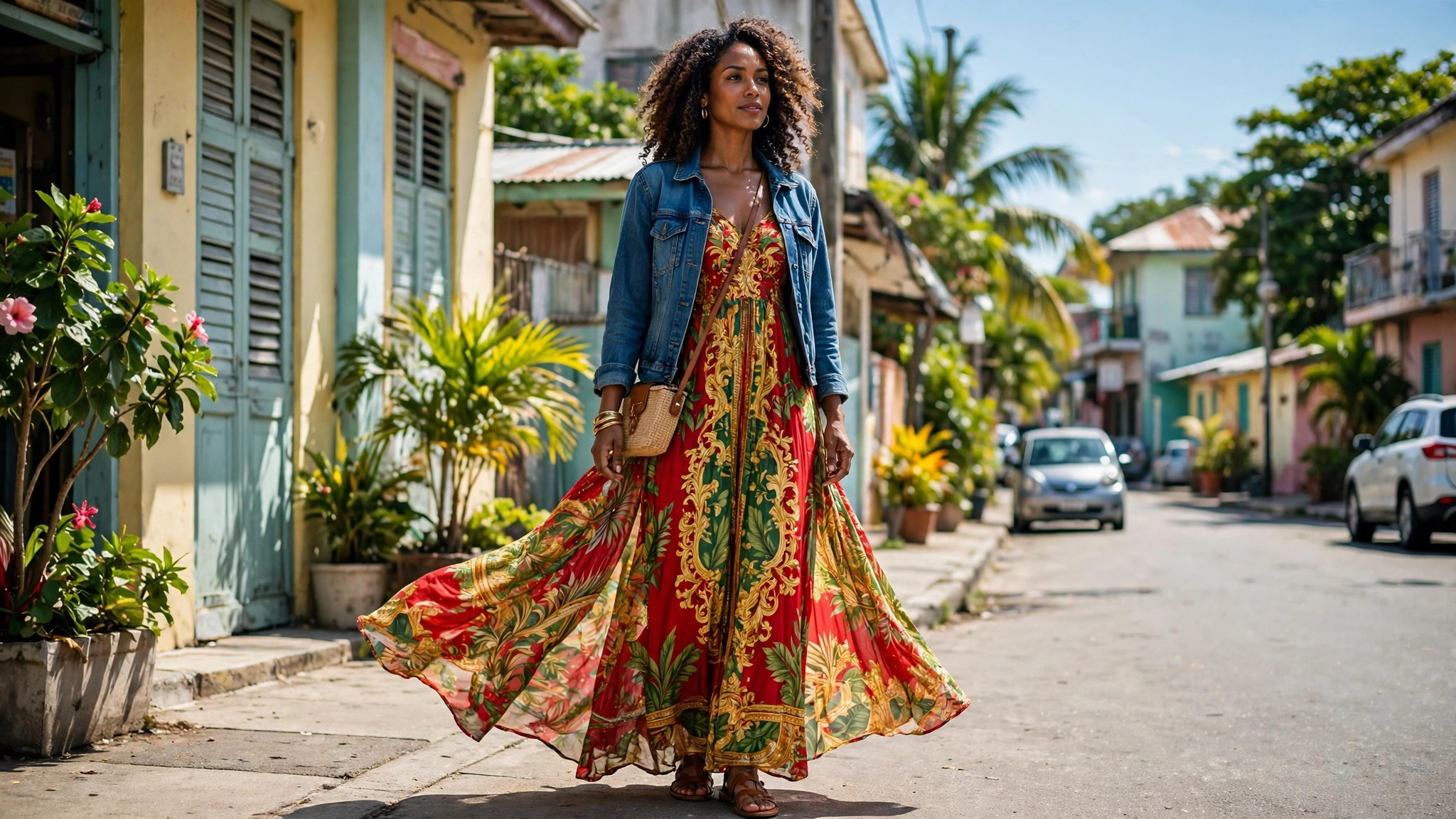
Red, gold and green are easy to love and surprisingly easy to get wrong. Worn with a plan, they look royal: the colors of Ethiopia, the colors of the Lion of Judah, the colors of a movement that has dressed with meaning for nearly a century. Worn without one, they can look like a costume, a flag wrapped around a body, or three loud colors arguing with each other. This guide is the plan. It explains what the colors mean, how much of each one to wear, which pieces do the work, and how to put together outfits that are comfortable, modest where they need to be, and unmistakably Rasta — for work, for worship, for the market, and for the evening.
Start with the meaning, then choose the clothes. Our guide to Rasta Colors explains the red, gold and green in full, and our guide to Dreadlocks in Rastafari: The Meaning and the Vow Behind Them explains the locks so many of these outfits are worn with.
Key Takeaways
- One color leads, the others support. Let a single color dominate each outfit — usually green or red — and let gold act as the accent that warms it up.
- The colors mean something. Red, gold and green carry the history of Ethiopia and the faith of Rastafari; wearing them well starts with knowing what they stand for.
- Five pieces do the work. A dress, a skirt, a tee, leggings, and a tam can make a week’s worth of outfits without a single new idea.
- Fit beats flash. Clothes that fit your body and your day will always look better than a louder outfit that fights you by noon.
- Details finish the look. A striped tam, a beaded bracelet, and a plain canvas tote do more than any extra print.
- Comfort is not optional. Breathable fabric, shoes you can walk in, and layers you can add or shed are what make an outfit wearable from morning to night.
Table of Contents
- The Problem: Colors With No Plan
- What Red, Gold and Green Actually Mean
- The Capsule: Five Pieces That Do the Work
- Proportions: How Much of Each Color
- Dressing for the Day: Work, Church, Market, Evening
- Fit and Fabric: Comfort That Lasts All Day
- The Details: Tam, Jewelry, Bag, Shoes
- What Not to Do: The Mistakes That Cheapen the Look
- Wear the Colors: Two Dresses That Do It Right
- Our View
- FAQ
The Problem: Colors With No Plan
Most outfits that fail in red, gold and green fail the same way. All three colors arrive at full strength, at the same time, in the same size, and the eye does not know where to rest. A red dress, a gold bag, a green tam, green shoes, and a red lip: each piece is fine on its own, and together they shout. The other common failure is the opposite — a timid outfit in which the colors appear only as a thin stripe on a black dress, so faint that the meaning disappears. Both mistakes come from the same place: treating the colors as decoration instead of as a language. The colors are not sprinkles. They are a sentence, and like any sentence they need a subject, a verb, and a full stop.
The fix is not to buy more clothes. It is to decide, before you dress, which color is leading today and what the outfit is for. A market morning needs different clothes from a church service, and a workday needs different clothes from an evening with friends. The women who wear these colors best are not the ones with the biggest wardrobes. They are the ones with a small set of pieces that fit, in fabrics that breathe, arranged so that one color speaks and the others answer. This guide gives you that arrangement — five pieces, a simple proportion, and a set of rules for the day that will carry you from the first coffee to the last song.
What Red, Gold and Green Actually Mean
The colors come from the flag of Ethiopia, and they carry the history of the land Rastafari call Zion. Red stands for the blood of the martyrs and the struggle of the people. Gold stands for the wealth of the land and the richness of African heritage. Green stands for the land itself and the life that grows on it. Together they are a statement about who you are and where you come from — which is why they deserve more care than a random print. Our guide to Rasta Colors tells the full story of the colors, their order, and the difference between the Rasta colors and the Ethiopian flag, and our guide to Rasta Flag Colors vs Ethiopian Flag Colors: The Real Difference sorts out the confusion between the two.
The colors also carry the movement. New World Encyclopedia’s Rastafari overview explains how the faith, the history, and the symbols of Rastafari grew together, and EBSCO’s Rastafari movement overview describes the beliefs and practices that give the colors their weight. When you wear them, you are not only choosing a palette. You are joining a story that runs from the coronation of Haile Selassie I in 1930 — the event our guide to Coronation Day in Rastafari explains — through the music that carried the movement around the world. UNESCO’s page on the reggae music of Jamaica records how reggae, inscribed on the Representative List of the Intangible Cultural Heritage of Humanity in 2018, grew out of the same marginalized Kingston communities that gave the movement its voice. The colors, the King, and the music are one story, and your outfit is a sentence in it.
The Capsule: Five Pieces That Do the Work
A capsule is a small set of pieces that all work with each other, and for red, gold and green, five pieces are enough. Start with a dress in a solid color or a simple stripe — a maxi for cooler days, a skater dress for warmer ones. Add a skirt in a second color, cut to move: a pleated skirt in gold or a flowing skirt in green. Add a tee in the third color, plain and well-fitted, the piece that turns a skirt into an outfit and a dress into a layered look. Add leggings in black or in a deep green, the piece that makes every dress warmer, more modest, and more comfortable. And add a tam in the striped colors, the piece that ties the whole outfit together and covers the locks with pride. Five pieces, three colors, and a week of outfits without a single new idea — because the ideas are already in the pieces.
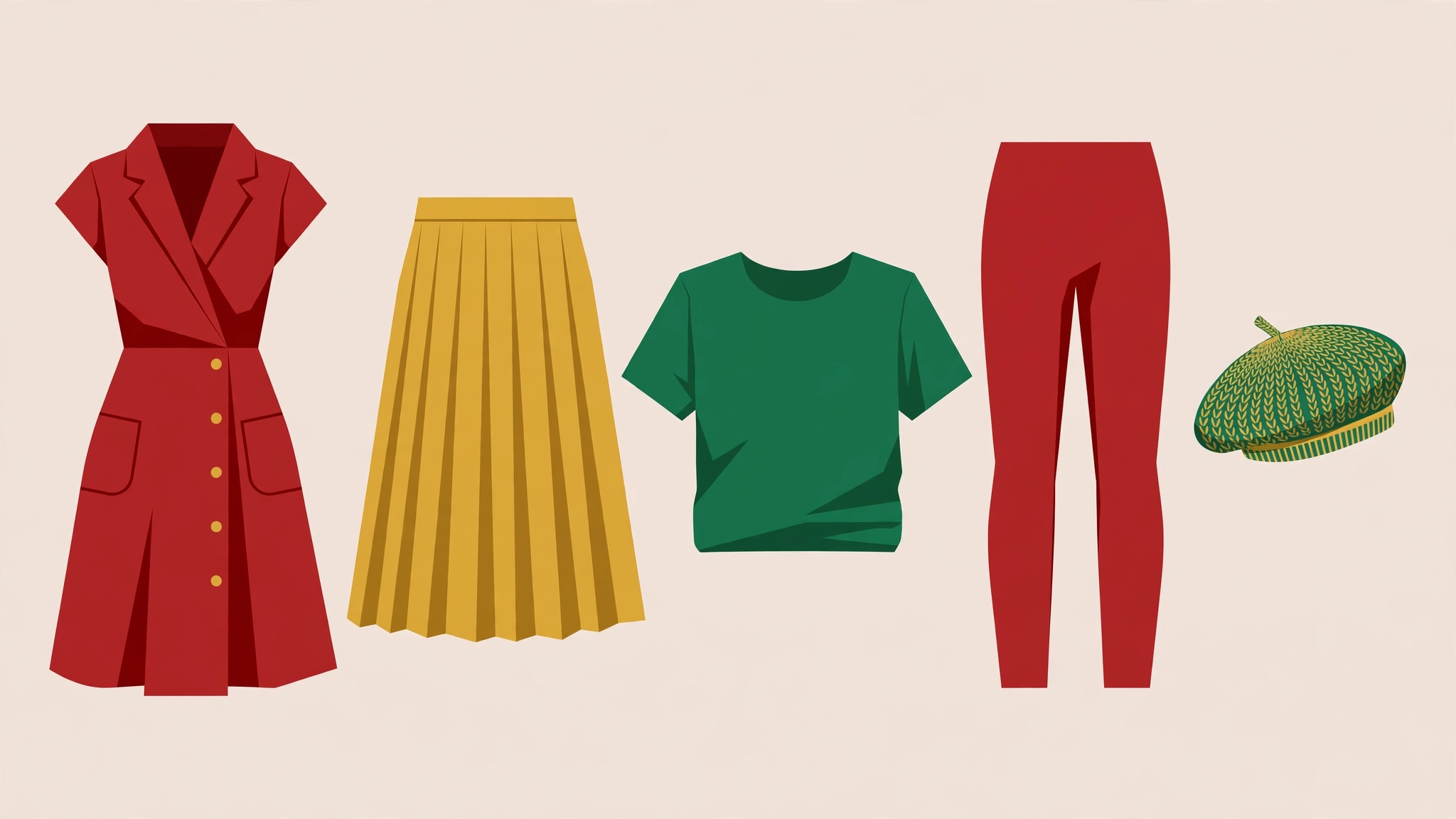
Build the capsule in solid colors first. Prints are lovely, but a print commits you: a striped dress is already a whole statement, and it will fight with a striped tam. Solids, by contrast, are team players — a green dress takes a gold skirt, a red tee takes green leggings, and the tam can be the one striped piece in the outfit. Buy the best fabric you can afford in the pieces you will wear most: the dress and the leggings earn their money every week, while a cheap tee will lose its shape by the third wash. And buy for your real life, not your imagined one. If you walk to work, you need shoes and a hem that survive the walk. If you sit all day, you need a waist that does not dig in by noon. The capsule is not a fantasy. It is a toolkit, and it should fit the hands that use it.
Proportions: How Much of Each Color
The simplest rule for three strong colors is the one designers have used for a century: most of one, some of another, and a little of the third. In practice that means about sixty percent of your outfit in the leading color, about thirty percent in the supporting color, and about ten percent in the accent. A green dress with a gold skirt peeking beneath it and a red tam is sixty-thirty-ten. A red top with green leggings and a gold bracelet is sixty-thirty-ten. The numbers are not a law, they are a habit — and the habit keeps any one color from shouting over the other two. Gold is the natural accent: it is warm, it is bright, and a little of it goes a long way. Red is the natural leader: it holds attention, so it should hold the biggest piece. Green is the natural supporter: it is calm, it grounds the outfit, and it lets the other two shine.

Neutrals are your friends, not your enemies. Black leggings under a red dress do not dilute the meaning — they give the red somewhere to rest. A denim jacket over a green and gold dress does not hide the colors — it frames them, the way a frame holds a picture. White, cream, and brown work the same way: they are the quiet ground against which the three colors can speak. The mistake is to think every piece must be red, gold or green. An outfit that is entirely in the three colors is a flag, and a flag is not an outfit. Let the neutrals do the quiet work, and let the colors do the talking.
Dressing for the Day: Work, Church, Market, Evening
One outfit cannot do every job, but one capsule can. For work, lead with the calmest color: a green dress or a green skirt with a plain tee, leggings underneath, closed shoes, and the tam tied back neatly. The colors are present, the outfit is professional, and nothing about it fights the room. For church or gathering, lead with red: a red dress or a red top with a gold skirt, the tam worn with pride, and jewelry that catches the light. Red is the color of the blood and the struggle, and a gathering is where that meaning belongs. For the market, lead with comfort: a skater dress in the stripes, sandals you can walk in, a canvas tote for the shopping, and a hat or tam against the sun. The market is where the outfit is tested — by heat, by walking, by carrying — and the right outfit passes the test without a thought.

For the evening, add one layer and one light. A denim jacket over the day’s dress, or a light cardigan in gold over a green top, changes the outfit without changing it. Swap the sandals for a closed shoe, add a beaded bracelet, and let the tam sit a little higher. The evening outfit is the day outfit with the volume turned up one notch — not a new outfit, but the same outfit dressed for the dark. That is the whole secret of dressing for the day: you are not changing clothes four times. You are changing one or two pieces, and the capsule does the rest. Our guide to Rasta outfits for reggae lovers and our guide to reggae themed outfits for women show the same idea at a concert and a festival, where the day runs even longer and the layers matter even more.
Fit and Fabric: Comfort That Lasts All Day
An outfit that looks right at 8 in the morning and wrong by noon was never right. Fit is the difference. A dress should skim, not cling; a waist should sit where your waist is, not where the pattern thinks it is; a hem should move when you walk and settle when you stop. Try the sitting test before you buy: sit down in the dress, and if it rides up, pulls, or gaps, it is the wrong size or the wrong cut — no matter how beautiful it is on the hanger. Try the walking test too: walk the length of the shop, and if you are tugging at anything by the third step, you will be tugging at it all day. Clothes should be worn, not managed.
Fabric is the other half of comfort. In warm weather, cotton, rayon, and linen breathe; polyester traps heat and shows sweat. A dress with a little stretch moves with you and keeps its shape; a dress with no give at all will fight you at every step. For leggings, look for a thick, opaque fabric that does not go see-through when you bend — hold them up to the light before you buy. For tams, a soft knit that holds its shape without squeezing is worth more than a stiff one that looks perfect and feels like a band. And for the heat, remember the oldest rule of dressing in the tropics: loose beats tight, light beats dark on the skin, and a layer you can remove beats a layer you cannot. Our guide to how to style Rasta clothing goes deeper into fit and fabric, and our guide to traditional Rasta outfits that still look fly today shows how the older styles solved the same problems with the same fabrics.
The Details: Tam, Jewelry, Bag, Shoes
Details are where an outfit becomes yours. The tam comes first: a knitted crown in the striped colors that covers the locks, keeps the sun off, and carries the palette up to the top of the outfit. Wear it pulled down over the hair for work and errands, or pushed back for the evening — either way, it should fit without squeezing, and it should be the one striped piece if the dress is already striped. Jewelry comes second, and less is more: a beaded bracelet in red, gold and green, a simple wooden bead, or a thin gold chain. The colors are already loud; the jewelry should be the quiet note that lets them sing. A bag comes third: a plain canvas tote in natural cotton carries the shopping, the book, and the water bottle, and it does not compete with the outfit the way a printed or glittering bag would. And shoes come last, because they decide whether the day is a pleasure or a punishment.
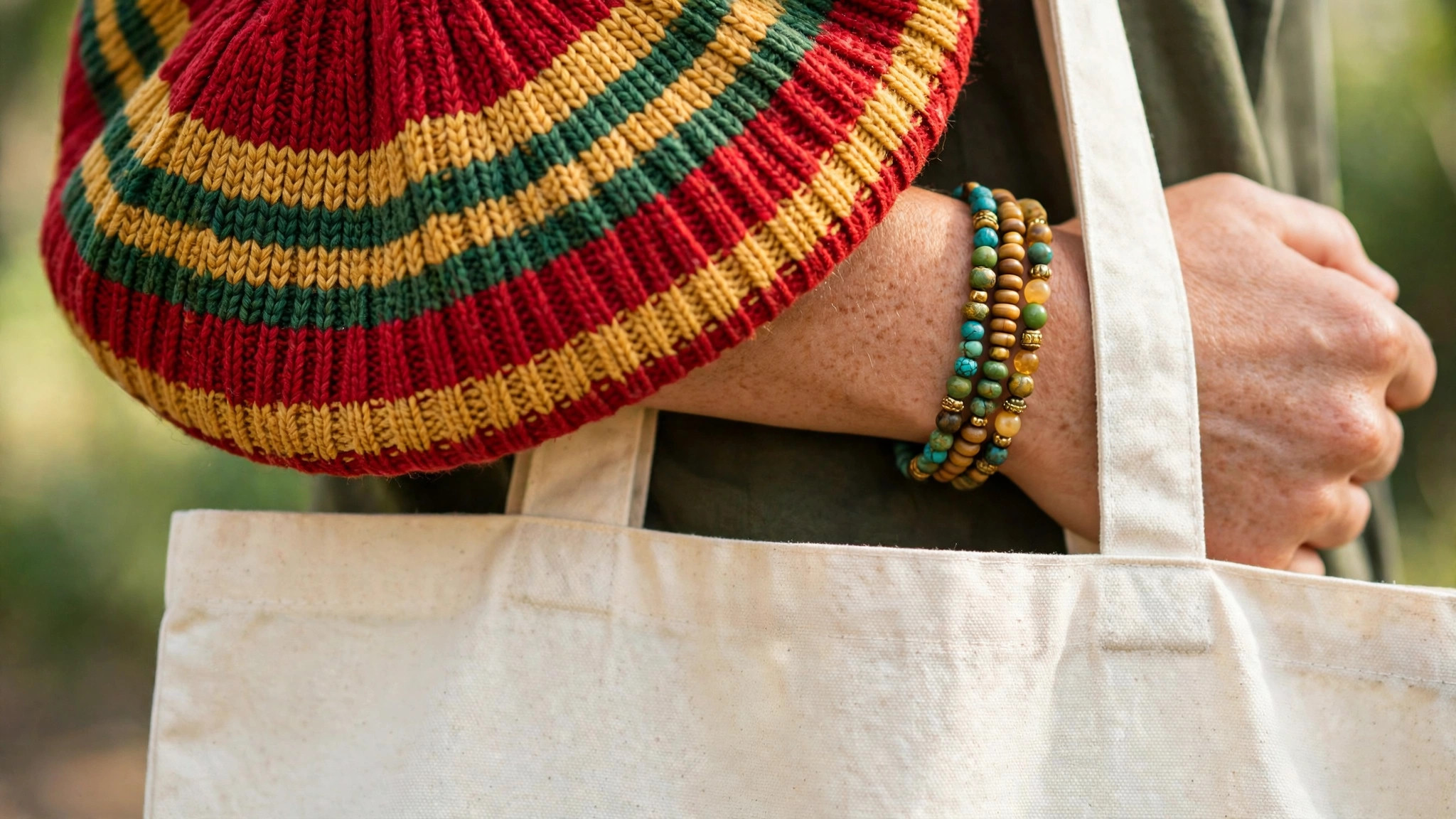
For shoes, choose for the day you actually have. Sandals with a proper sole carry you through a market morning. Closed shoes with a low heel carry you through a workday. Trainers in a plain color carry you through a long day on your feet, and no one will fault you for them — comfort is part of the look, not a betrayal of it. What to avoid: heels so high you cannot walk the distance, shoes so new they have not been broken in, and anything that makes you think about your feet instead of your day. The best shoe is the one you forget you are wearing. Our guide to Rastafarian clothing styles with meaning shows how the same details — tam, beads, and bag — have been worn for decades, and our guide to what to wear to a reggae festival shows how they hold up when the day runs long and the ground is grass.
What Not to Do: The Mistakes That Cheapen the Look
Five mistakes cheapen a red, gold and green outfit faster than anything else. The first is the flag outfit: every piece in the three colors at full strength, with nothing neutral to rest the eye. The second is the costume: a Halloween version of Rasta dress — a fake beard, a plastic crown, a wig of locks — worn for a laugh. The colors deserve better, and so do the people who live them. The third is the clash: a busy print on top of a busy print, stripes fighting checks, so that the outfit looks like an argument. The fourth is the wrong size: a dress that pulls, a tam that squeezes, leggings that go see-through when you bend. And the fifth is the neglected finish: wrinkled fabric, scuffed shoes, and a bag that has seen better days. None of these is about money. All of them are about attention. Iron the dress. Polish the shoes. Choose one print. Let a neutral in. And never wear the colors as a joke — they are a promise, and promises are not punchlines.
The deeper mistake is to wear the colors without knowing them. The palette is not a trend that arrived with a festival season; it is the flag of Ethiopia and the emblem of a faith, and the people who wear it have paid for it with their comfort and sometimes with their freedom. Wearing the colors well means wearing them with that knowledge. Read the meaning — our guides to Rasta Colors and to the meaning behind the Lion of Judah are the place to start — and let the knowledge show in the care you take with the outfit. The women who wear these colors best are not the loudest in the room. They are the ones whose clothes fit, whose colors rest in proportion, and whose meaning is clear before they say a word.
Wear the Colors: Two Dresses That Do It Right
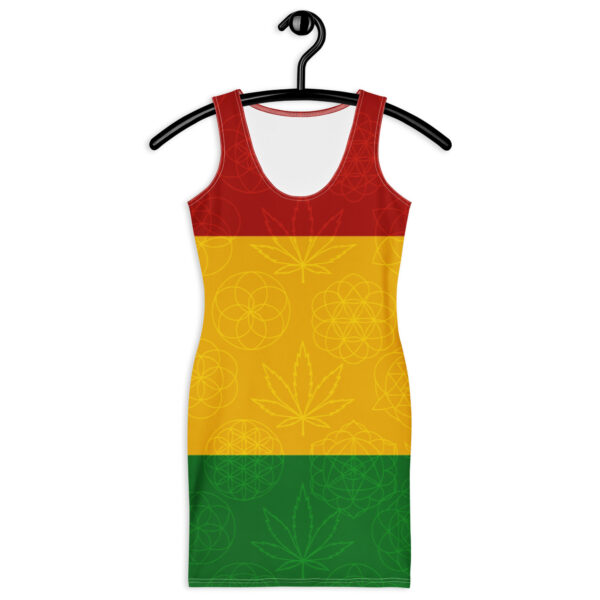
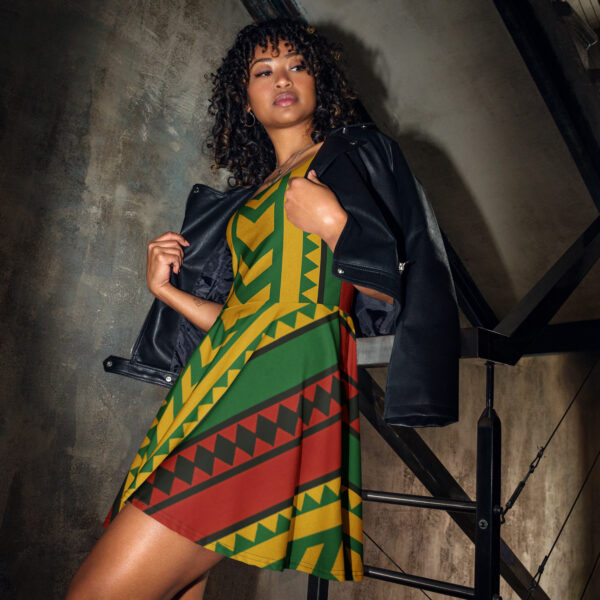
The two dresses below are the ones this guide keeps coming back to: a bodycon dress that carries the full palette in a sacred geometry print, and a skater dress in green, gold and red stripes that moves the way a market morning needs it to. Both are from our own Fifth Degree™ shop, both are in the colors, and both are built for the day — not just for the photograph.
Our View
We make these colors for the women who wear them every day, not only for the festival photograph. That is why our dresses are cut to move, our fabrics are chosen to breathe, and our prints carry the meaning plainly instead of shouting it. The best compliment our clothes ever get is the quiet one: a woman who puts one on in the morning and forgets about it until someone asks where it came from. Wear the colors with the meaning first and the mirror second, and they will never let you down.
FAQ
Can I wear all three Rasta colors in one outfit?
Yes — in proportion. Let one color lead (about sixty percent), a second support (about thirty percent), and the third act as an accent (about ten percent). Gold works best as the accent. An outfit that is all three colors at full strength, with nothing neutral to rest the eye, reads as a flag rather than an outfit.
What is the best dress style for wearing red, gold and green?
A skater dress in the stripes is the most forgiving and the easiest to wear: it fits at the waist, flares over the hips, and moves well in heat. A bodycon dress in the full palette works when the print does the talking and the accessories stay quiet. Both are in our shop, and both are built for a full day, not just a photograph.
Are Rasta colors appropriate for work?
Yes, when the outfit is built for work: lead with the calmest color, keep the fit professional, wear closed shoes, and let the colors appear in the dress or the tam rather than in every piece at once. The colors are a statement of identity, and identity belongs at work as much as anywhere else.
What should I wear under a Rasta dress?
Leggings in black or deep green, in a thick opaque fabric. They add warmth, modesty, and comfort, and they let a shorter dress work for a longer day. Hold any legging up to the light before you buy it — if you can see through it, it is not doing its job.
How do I keep red, gold and green clothes from fading?
Wash them in cold water, inside out, with a gentle detergent, and dry them out of direct sun. Red fades fastest, so it deserves the coldest water and the shortest time in the dryer. Treat the colors like the meaning they carry: with care, and they will stay bright.
Do I need a tam to wear a Rasta outfit?
No, but a tam completes the outfit: it covers the locks, carries the colors to the top of the look, and ties the pieces together. If you do not wear a tam, a simple headwrap or a hat in one of the colors does the same work. Our guide to Dreadlocks in Rastafari explains the locks the tam is so often worn with.
Questions about what we make or why we make it?
We are a small shop with a big respect for the culture we serve. If you want help choosing a piece, or you want to talk about the meaning behind it, contact us and a real person will answer.
Sources
- New World Encyclopedia — Rastafari
- Smithsonian Magazine — One Love: Discovering Rastafari
- EBSCO Research Starters — Rastafari movement
- Britannica — Haile Selassie I
- Library of Congress, Country Studies — Ethiopia
- Smithsonian Libraries — Collection record
- Crown Council of Ethiopia — Statements
- Bible Gateway — Numbers 6 (NIV), The Nazirite vow
- Bible Gateway — Judges 13 (NIV), The Birth of Samson
- UNESCO — Reggae music of Jamaica
Recommended
- Rasta Colors — Red Gold and Green Meaning and How to Wear Them
- Rasta Outfits for Reggae Lovers — Shine With Roots and Rhythm
- Traditional Rasta Outfits That Still Look Fly Today




Leave a comment
Your email address will not be published. Required fields are marked *