Search
A woman in a red, gold and green festival outfit dancing at an outdoor reggae concert at sunset, with stage lights and a crowd behind her

Reggae Festival Outfits for Women: All-Day Looks That Hold Up

A woman in a red, gold and green festival outfit dancing at an outdoor reggae concert at sunset, with stage lights and a crowd behind her

A reggae festival is a long day wearing a short outfit’s clothes. You arrive in the sun, you dance through the afternoon, the temperature drops after dark, it may rain, and the ground turns to mud under your feet — and the outfit that looked perfect in the mirror at home has to survive all of it. This guide is about building a festival outfit that holds up: a dress that breathes and moves, shoes that carry you across grass, layers that handle the evening chill, and a kit that fits in a small bag. The goal is simple. At midnight, when the last song ends, you should still feel like yourself — comfortable, dry enough, and ready to dance one more.

Start with the everyday version of the look. Our guide to Rasta Outfits for Women: Wearing Red, Gold and Green Well explains the colors and the proportions, and our guide to Rasta Colors explains what red, gold and green mean.

Key Takeaways

  • All-day means tested, not just pretty. An outfit that only works in a photograph is not a festival outfit. Test it walking, sitting, dancing, and carrying a bag.
  • Breathable fabric is the foundation. Cotton, rayon, and linen keep you cool in the sun and dry faster when the rain comes.
  • One layer handles the night. A light jacket or a denim layer, packed in the morning and worn after dark, is the difference between leaving early and staying for the last song.
  • Shoes decide the day. Flat, closed, broken-in shoes on grass beat new heels on every measure that matters.
  • The kit is small and fixed. Hat, sunscreen, water, a light jacket, and a small bag — packed the same way every time, so nothing is forgotten.
  • The colors still mean something. Red, gold and green are the colors of Ethiopia and the faith of Rastafari, and they belong at a reggae festival as much as anywhere.

Table of Contents

  1. The Problem: An Outfit That Quits by Noon
  2. What “All-Day” Actually Means
  3. The Foundation: Dress, Shoes, and Skin
  4. Layering: Day to Night Without a Second Outfit
  5. The Kit: What to Pack and How to Carry It
  6. Heat, Sun, and Rain: Dressing for the Weather
  7. Colors That Last: Red, Gold and Green in the Crowd
  8. Comfort Rules: The Small Choices That Save the Day
  9. Wear the Look: Three Dresses Built for the Whole Day
  10. Our View
  11. FAQ

The Problem: An Outfit That Quits by Noon

Every festival has the same casualties, and they are all wearing beautiful outfits that were never meant to last the day. The heels that were fine on the driveway and impossible on the grass. The white dress that met the mud by one o’clock. The strapless top that needed adjusting every three minutes. The jacket that was left in the car because it was warm at noon and missed by nine at night. None of these outfits were ugly. They were simply built for a photograph, not for a day — and a reggae festival is a day, twelve hours of sun and dancing and standing and walking, with weather that changes its mind and ground that changes under your feet.

The fix is to design for the day, not for the mirror. That means choosing the outfit by what it has to survive, in the order it has to survive it: the heat of the afternoon, the miles of walking, the evening chill, the rain that may or may not come, and the dancing that goes on through all of it. An outfit that holds up is not a boring outfit. It is a well-built one — a dress that breathes, shoes that carry you, a layer that waits in the bag, and colors that still mean something at midnight. This guide builds it, piece by piece, and it starts with the plainest question: what does all-day actually mean?

What “All-Day” Actually Means

All-day means three things, and they are not the same. It means duration: gates open in the late morning, the headliner plays after dark, and the walk back to the car takes an hour. It means activity: you will stand, walk, dance, sit on the grass, stand up again, and carry a bag through all of it. And it means weather: sun in the afternoon, a cool wind after sunset, and rain that arrives without asking. An outfit that only handles one of the three is an outfit that quits. The dress must breathe in the heat and still be warm enough with a layer at night. The shoes must grip the grass and survive the mud. The bag must hold the jacket, the water, and the sunscreen without weighing you down. Reggae itself is an all-day music — it grew, as UNESCO’s page on the reggae music of Jamaica records, out of the communities of Western Kingston and into festivals and concerts around the world — and the outfit should be built for the same long haul the music is.

Test the outfit the way the day will test it. Walk in it for twenty minutes, on grass if you can. Sit on the ground in it and stand up again. Dance in it for one song, in the shoes you will wear. Carry the bag you will carry, with the jacket and the water inside it. If anything pulls, slips, rubs, or needs holding up, fix it now — at home, with a mirror and a needle — because at the festival there will be no mirror, no needle, and no patience left. The best festival outfits are the ones that disappear: you stop thinking about them by the second song, and you do not think about them again until you are changing out of them at midnight, glad they held up.

The Foundation: Dress, Shoes, and Skin

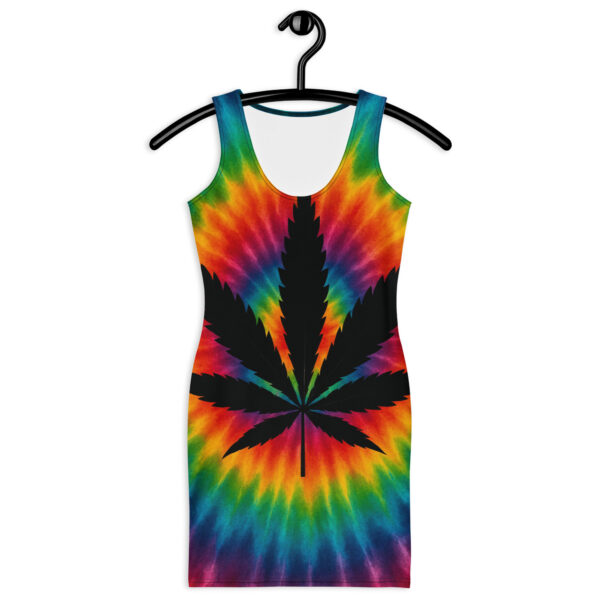
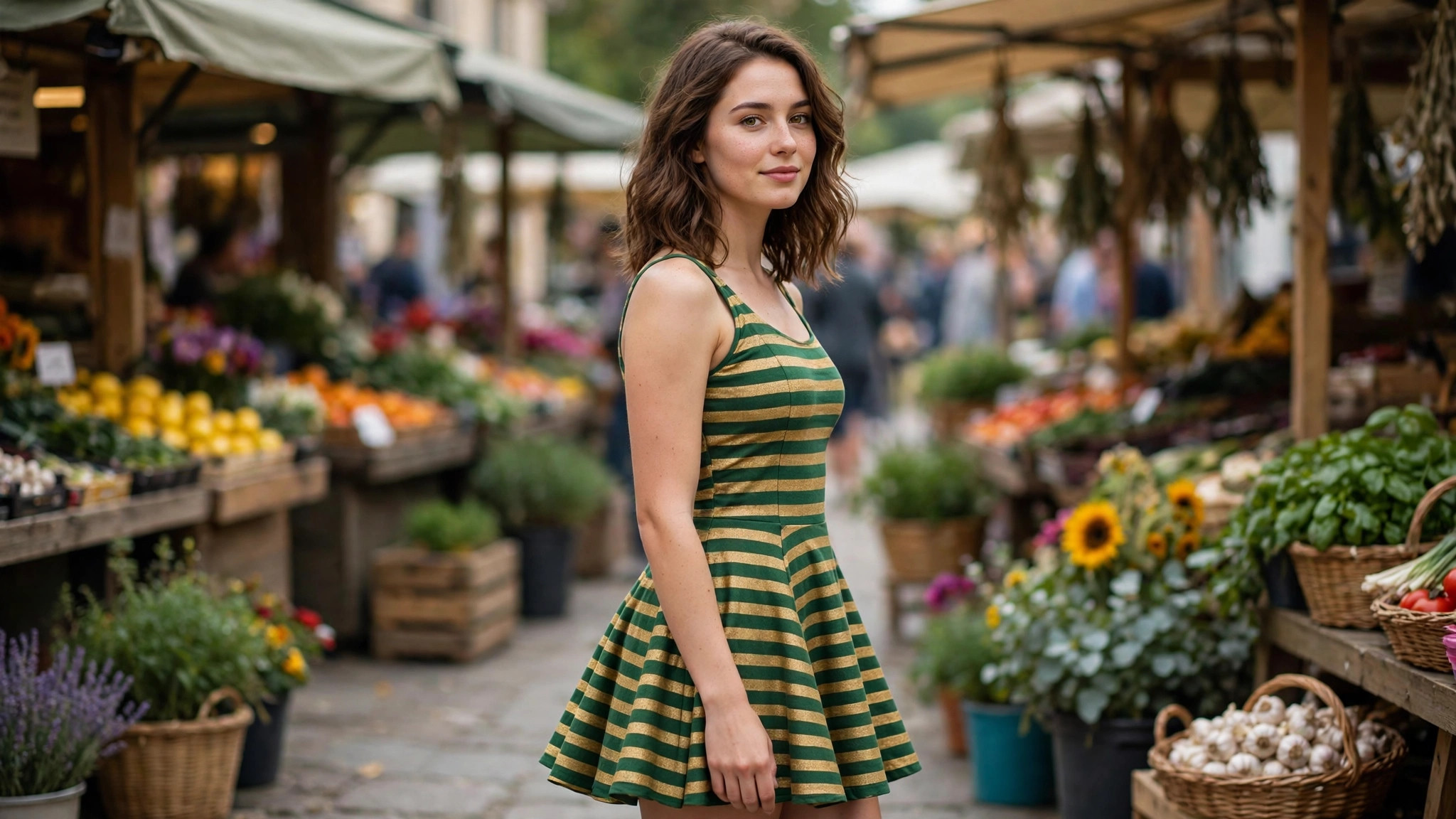
Start with the dress, because everything else hangs off it. A lightweight dress in a breathable fabric — cotton, rayon, or a cotton blend — is the foundation of an all-day festival look. A skater dress in the green, gold and red stripes moves when you dance and dries quickly when it rains. A bodycon dress in a festival print holds its shape through the day. A mini dress in tie-dye is the coolest choice for the hottest afternoon, as long as it is long enough to sit on the grass in. Whichever you choose, the tests are the same: can you walk in it, sit in it, dance in it, and carry a bag in it without thinking about it? If the answer is yes to all four, the dress is the right one.
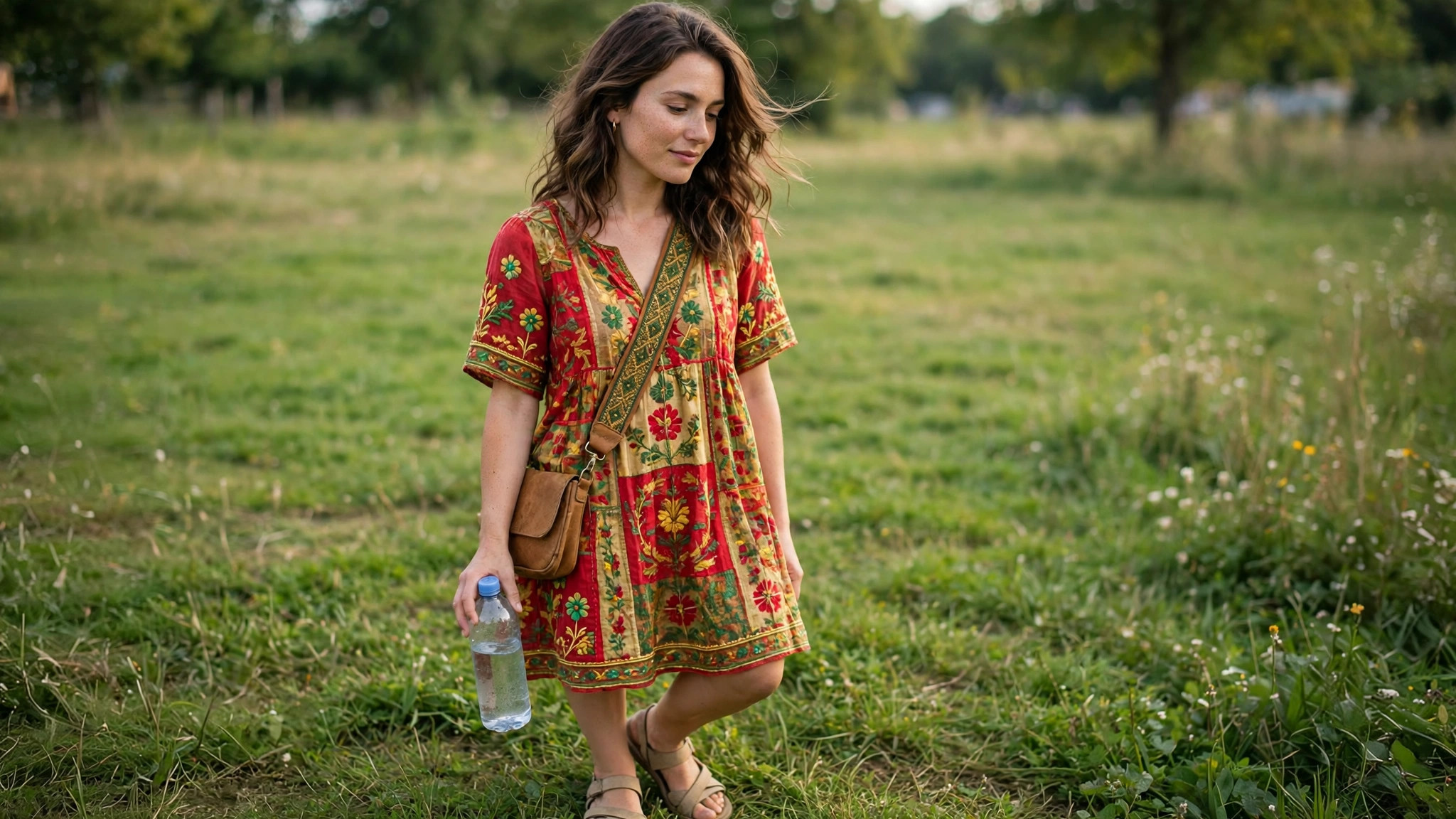
A woman in a lightweight red, gold and green festival dress and comfortable sandals standing on grass with a water bottle and a small crossbody bag
The foundation, worn the way the day will wear it: a light dress, sandals that grip the grass, water in hand, and a small bag across the body.

Shoes come next, and they matter more than the dress. On grass, heels sink; on mud, they stick; on a long walk, they punish. The right festival shoe is flat, closed or strapped, broken in before the day, and grippy enough for wet grass. Sandals with a proper sole work when the ground is dry. Trainers in a plain color work when it is not. Closed shoes protect your toes in the crowd, which is a kindness you will appreciate by the third hour. Whatever you choose, wear them in for a week first — a new shoe at a festival is a blister with a schedule. And your skin comes third: sunscreen on every exposed part before you leave, reapplied at midday, and a hat or a tam for the hours when the sun is straight overhead. Sunburn is the festival injury that lasts longest, and it is the easiest to prevent.

Layering: Day to Night Without a Second Outfit

The temperature at a festival can drop ten degrees between the afternoon and the headliner, and the outfit that was perfect at three in the afternoon can leave you shivering by nine. The answer is not a second outfit. It is one layer, chosen in the morning and carried all day. A light denim jacket is the classic: it goes over any dress, it takes the edge off the evening wind, and it looks right with the colors. A thin cardigan in gold or green does the same work more softly. A light rain jacket, if the forecast threatens, does it while keeping you dry. The layer should be light enough to tie around your waist or fold into the bag when the sun is high, and warm enough to matter when the sun is gone.
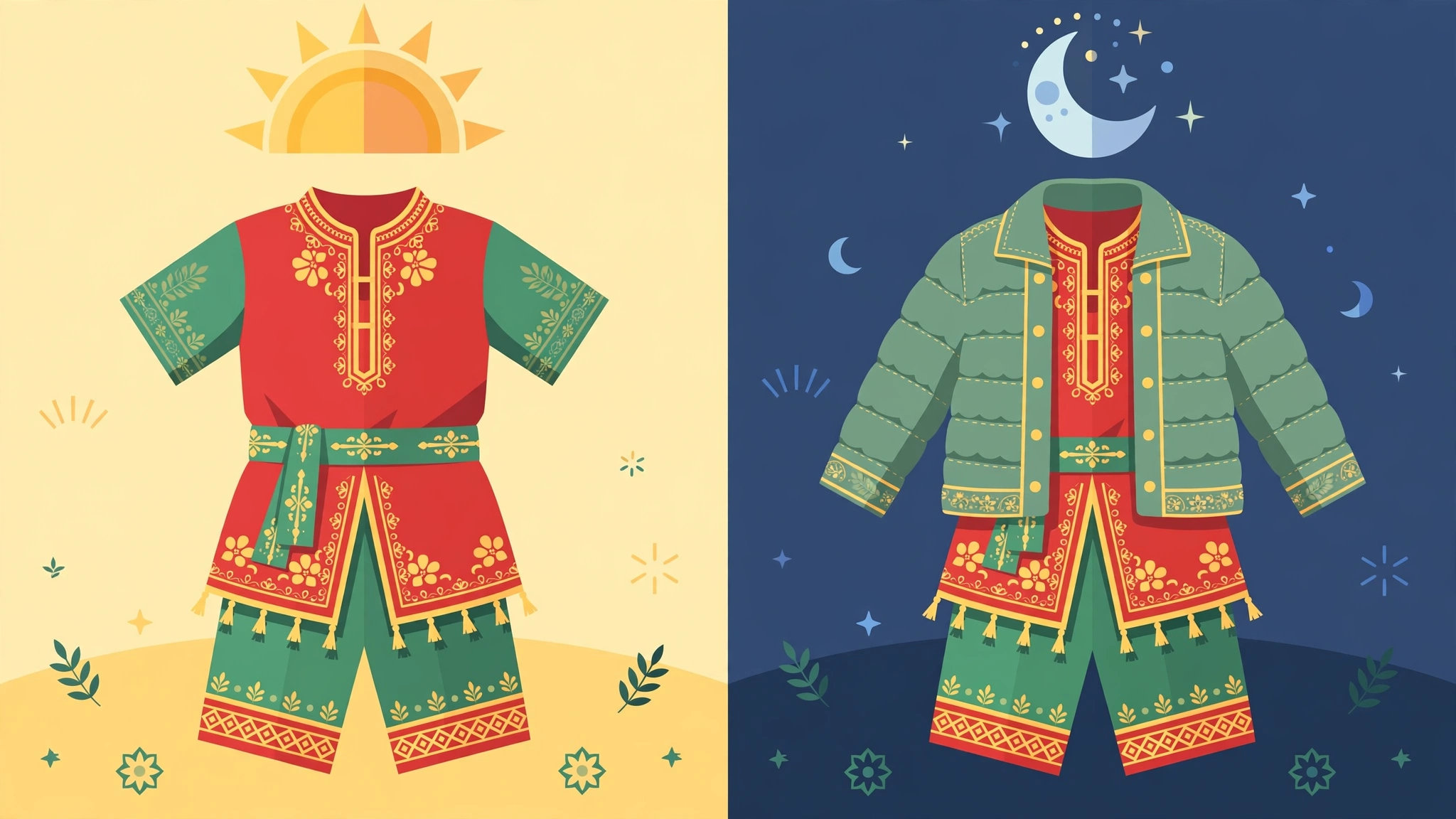
Two panels showing day-to-night festival layering: a dress under the sun, and the same dress with a green jacket under the moon
Day to night with one layer: the same dress under the sun, and the same dress with a jacket under the moon.

Layer in the right order. The dress is the base. The layer goes over it, never under it — a jacket under a dress bunches and pulls, while a jacket over a dress drapes and protects. The tam can stay on all day; it keeps the sun off at noon and the warmth in at night. And when the layer comes off in the heat, it should go somewhere it will not be lost: tied at the waist, folded into the bag, or worn over the shoulders. A jacket left on a fence is a jacket that belongs to someone else by morning. The rule for layering is the rule for the whole day: one layer, chosen in advance, carried with you, and worn when the air changes — not a wardrobe, but a plan.

The Kit: What to Pack and How to Carry It

Everything you need for a festival day fits in a small bag, and it fits the same way every time. The kit is fixed: a hat or tam for the sun, sunscreen, a water bottle, a light jacket, and a small crossbody bag to hold them all. Add a phone, a little cash, and a snack if you like — but the core five never change, and packing them the same way every time means nothing is forgotten. Lay the kit out on a blanket the night before, the way you would lay out the outfit, and check it against the list. The morning of the festival is the worst time to discover that the sunscreen is empty or the jacket is still in the wash.


Festival essentials laid out on a blanket: a straw hat, a plain sunscreen bottle, a blue water bottle, and a folded light jacket
The kit, laid out the night before: hat, sunscreen, water, and a light jacket — the four things that decide whether the day is comfortable.
A flat illustration of a red backpack with a hat, a water bottle, sunglasses, sandals, and a folded jacket arranged around it
One small backpack, everything around it: hat, bottle, sunglasses, sandals, and the jacket — packed the same way every time.

Carry the kit across your body, not in your hands. A small crossbody bag or a compact backpack keeps your hands free for dancing, for holding a drink, and for holding the people you came with. It also keeps the bag where you can feel it, which matters in a crowd. Pack the heaviest thing — the water — at the bottom and closest to your back, the jacket rolled on top, and the sunscreen and phone where you can reach them without unpacking. And leave room: the day will add things — a flyer, a friend’s jacket, a souvenir — and a bag that is full at noon is a bag that bursts by nine. Our guide to what to pack for a 420 festival covers the same kit in more detail, and our guide to the best music festivals in the US will help you choose the next day worth packing for.

Heat, Sun, and Rain: Dressing for the Weather

Festival weather is a rumor until it happens, so dress for all three forecasts at once. For heat, choose light colors and loose cuts: a light dress in a pale color reflects the sun, while a dark, tight dress absorbs it. Cotton and rayon breathe; synthetics trap sweat against the skin. For sun, the tam or hat is not optional, and neither is the sunscreen — apply it before you leave, reapply at midday, and do not forget the ears, the back of the neck, and the tops of the feet. For rain, a light jacket with a hood beats an umbrella in a crowd, and a dress that dries quickly beats a dress that holds water. If the ground turns to mud, closed shoes and a steady step beat clean shoes and a hurry.

Drink water before you feel thirsty, and keep drinking through the day. Dancing in the sun is exercise, and the body does not send a polite invitation before it runs dry. Eat something real at midday — not only snacks — and keep a little food in the bag for the evening, when the queues are long and the headliner is about to start. And know the signs that the day is asking too much: dizziness, a headache that will not quit, and skin that has stopped sweating in the heat. If any of those appear, find shade, drink water, and rest. The music will still be there in an hour. The day is long, and the outfit that holds up is the one worn by a person who is still standing at the end of it.

Colors That Last: Red, Gold and Green in the Crowd

At a reggae festival, the colors are not a costume — they are the crowd. Red, gold and green have been the colors of the movement since the flag of Ethiopia gave them to it, and they belong at the festival as much as anywhere. Our guide to Rasta Colors explains what each one stands for — red for the blood of the martyrs, gold for the wealth of the land, green for the life that grows on it — and our guide to Rasta Outfits for Women: Wearing Red, Gold and Green Well explains how to wear them in proportion: one color leading, one supporting, one as the accent. The festival is where that proportion proves itself, because the crowd is the test: an outfit that is all three colors at full strength, with nothing neutral to rest the eye, disappears into the noise. An outfit with one color leading and the others answering stands out — and it still reads as Rasta from the back of the field.

The colors also do practical work at a festival. They make you findable: in a crowd of thousands, a friend in a green and gold striped dress is a landmark. They photograph well in golden hour, when the low sun warms the red and the gold and turns the green deep. And they connect you to the music: reggae’s colors are the movement’s colors, and wearing them at a reggae festival is wearing the uniform of the occasion — not a uniform imposed on you, but one you chose. The history behind the colors runs deep: New World Encyclopedia’s Rastafari overview traces the faith and its symbols, and EBSCO’s Rastafari movement overview describes the beliefs that give them weight. Wear them with that knowledge, and they will never look like a trend.

Comfort Rules: The Small Choices That Save the Day

The difference between a good festival day and a miserable one is rarely the headline act. It is the small choices. Break the shoes in for a week — a new shoe at a festival is a blister with a schedule. Wear the outfit once at home, for a whole day, and fix whatever pulls or slips before the festival fixes it for you. Pack the bag the night before, and put the sunscreen where you can reach it without unpacking. Eat a real breakfast, because dancing on an empty stomach is a short road to a headache. Bring a little cash as well as a card, because the signal dies exactly when you need it. And make a meeting point with your friends before you go in — in a crowd with no signal, a meeting point is worth more than a phone.

Look after each other, too. If a friend is flagging, find shade and water together. If a stranger is struggling in the heat, offer the water before you offer the advice. A festival is a community for a day, and the same spirit that built the music — the voice of the marginalized, as UNESCO’s reggae listing puts it — is the spirit that looks after the people in the crowd. And when the day is done, change out of the outfit before the drive home: clean clothes, dry shoes, and a long drink of water. The outfit did its job. Let it rest, wash it cold and inside out, and it will be ready for the next festival — and so will you.

Wear the Look: Three Dresses Built for the Whole Day

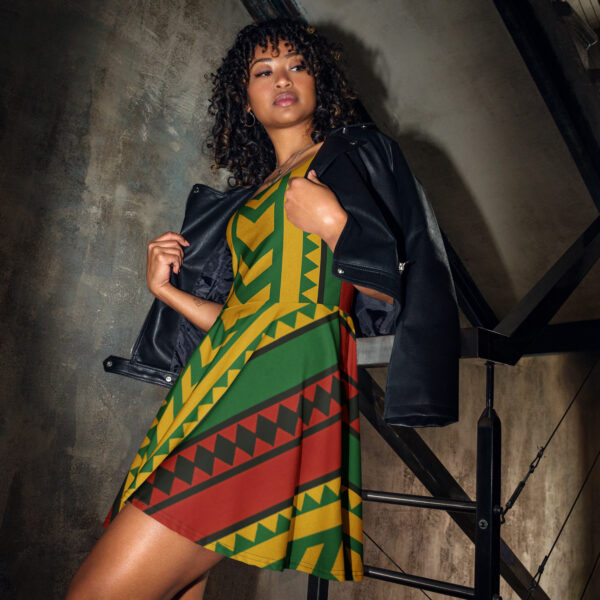
The three dresses below are the ones this guide is built around: a skater dress in green, gold and red stripes that moves the way a festival needs it to, a festival dress in the full red, gold and green leaf print, and a tie-dye mini for the hottest part of the afternoon. All three are from our own Fifth Degree™ shop, all three are breathable, and all three are priced for a day out — not for a photograph.
Our View

We make festival clothes for people who actually go to festivals — who dance in the sun, stand in the rain, and stay for the last song. That is why our dresses are cut to move, our fabrics are chosen to breathe, and our prices are set for a day out rather than a photograph. The best festival outfit is the one you forget you are wearing until someone asks where it came from. Build it for the whole day, wear the colors with the meaning first, and let the music do the rest.

FAQ

What should a woman wear to a reggae festival?

A lightweight, breathable dress in red, gold and green — a skater dress, a festival dress, or a mini dress — with flat, broken-in shoes, a tam or hat, and a light jacket for the evening. Add sunscreen, water, and a small crossbody bag. Our guide to what to wear to a reggae festival covers the same ground for the whole crowd.

What shoes are best for a reggae festival?

Flat, closed or strapped shoes with grip, broken in for a week before the day. Sandals with a proper sole work when the ground is dry; trainers work when it is wet. Heels sink into grass and stick in mud, and new shoes are a blister with a schedule.

What should I pack for an all-day festival?

The fixed kit: a hat or tam, sunscreen, a water bottle, a light jacket, and a small crossbody bag — plus your phone, a little cash, and a snack. Pack it the same way every time, the night before, so nothing is forgotten. Our guide to what to pack for a 420 festival covers the kit in more detail.

How do I stay cool at an outdoor festival?

Choose light colors and loose, breathable fabrics; wear a hat or tam; drink water before you feel thirsty; and rest in the shade when the sun is highest. Cotton and rayon breathe, synthetics trap heat. A light dress that moves air around you is worth more than any amount of shade.

What if it rains at the festival?

A light jacket with a hood beats an umbrella in a crowd, and a dress that dries quickly beats one that holds water. Closed shoes keep your feet safe in the mud, and a steady step beats a hurry. Keep the phone and cash in a sealed pocket or a small dry bag inside your crossbody.

Can I wear red, gold and green to any reggae festival?

Yes — the colors are the movement’s colors, and a reggae festival is where they belong. Wear them in proportion, with one color leading, and with the meaning behind them. Our guide to Rasta Colors explains what each color stands for.

Questions about what we make or why we make it?

We are a small shop with a big respect for the culture we serve. If you want help choosing a piece, or you want to talk about the meaning behind it, contact us and a real person will answer.

Sources

Author

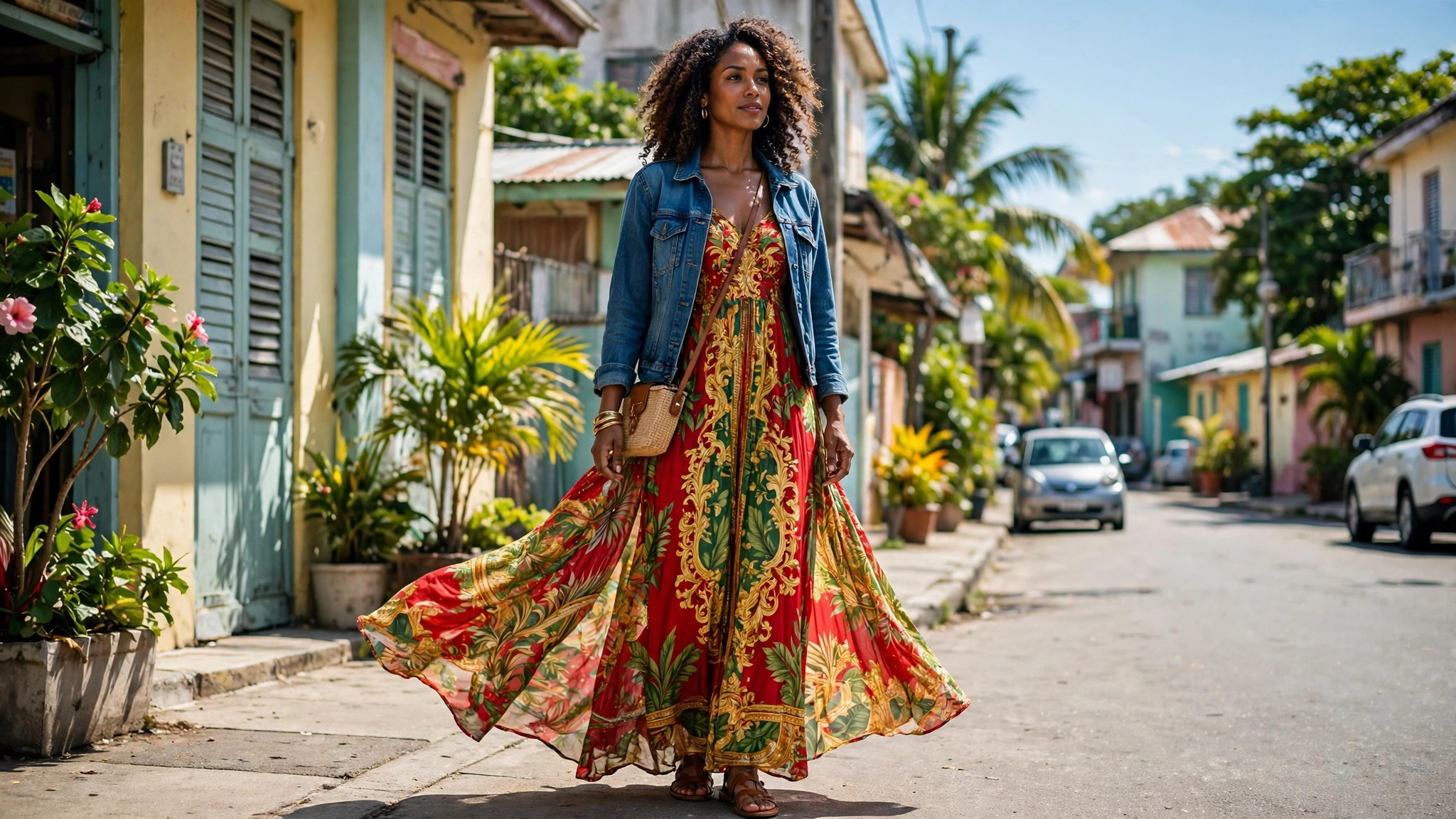
A woman in a flowing red, gold and green maxi dress with a denim jacket standing on a sunny Caribbean street

Rasta Outfits for Women: Wearing Red, Gold and Green Well

A woman in a flowing red, gold and green maxi dress with a denim jacket standing on a sunny Caribbean street

Red, gold and green are easy to love and surprisingly easy to get wrong. Worn with a plan, they look royal: the colors of Ethiopia, the colors of the Lion of Judah, the colors of a movement that has dressed with meaning for nearly a century. Worn without one, they can look like a costume, a flag wrapped around a body, or three loud colors arguing with each other. This guide is the plan. It explains what the colors mean, how much of each one to wear, which pieces do the work, and how to put together outfits that are comfortable, modest where they need to be, and unmistakably Rasta — for work, for worship, for the market, and for the evening.

Start with the meaning, then choose the clothes. Our guide to Rasta Colors explains the red, gold and green in full, and our guide to Dreadlocks in Rastafari: The Meaning and the Vow Behind Them explains the locks so many of these outfits are worn with.

Key Takeaways

  • One color leads, the others support. Let a single color dominate each outfit — usually green or red — and let gold act as the accent that warms it up.
  • The colors mean something. Red, gold and green carry the history of Ethiopia and the faith of Rastafari; wearing them well starts with knowing what they stand for.
  • Five pieces do the work. A dress, a skirt, a tee, leggings, and a tam can make a week’s worth of outfits without a single new idea.
  • Fit beats flash. Clothes that fit your body and your day will always look better than a louder outfit that fights you by noon.
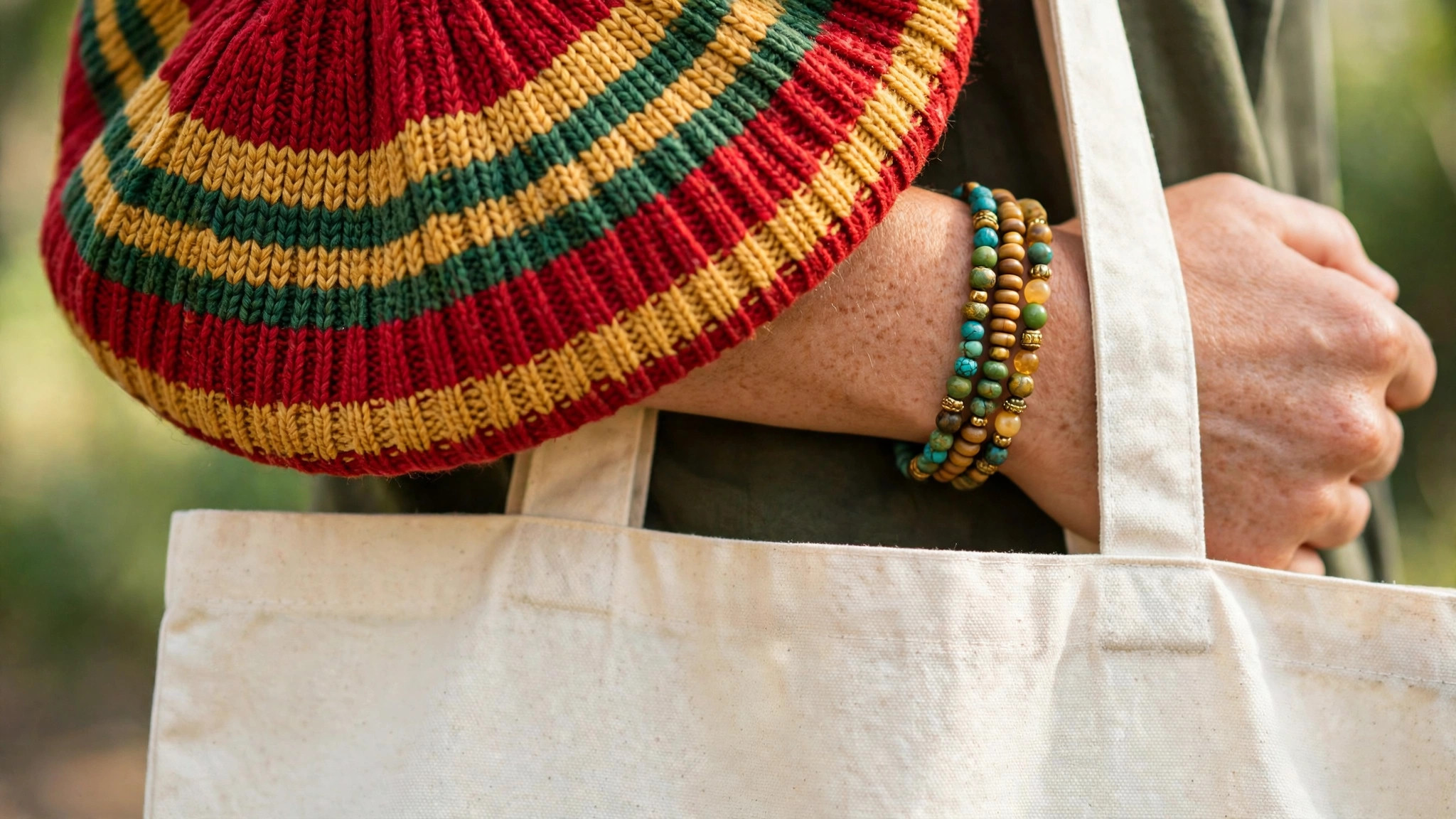
  • Details finish the look. A striped tam, a beaded bracelet, and a plain canvas tote do more than any extra print.
  • Comfort is not optional. Breathable fabric, shoes you can walk in, and layers you can add or shed are what make an outfit wearable from morning to night.

Table of Contents

  1. The Problem: Colors With No Plan
  2. What Red, Gold and Green Actually Mean
  3. The Capsule: Five Pieces That Do the Work
  4. Proportions: How Much of Each Color
  5. Dressing for the Day: Work, Church, Market, Evening
  6. Fit and Fabric: Comfort That Lasts All Day
  7. The Details: Tam, Jewelry, Bag, Shoes
  8. What Not to Do: The Mistakes That Cheapen the Look
  9. Wear the Colors: Two Dresses That Do It Right
  10. Our View
  11. FAQ

The Problem: Colors With No Plan

Most outfits that fail in red, gold and green fail the same way. All three colors arrive at full strength, at the same time, in the same size, and the eye does not know where to rest. A red dress, a gold bag, a green tam, green shoes, and a red lip: each piece is fine on its own, and together they shout. The other common failure is the opposite — a timid outfit in which the colors appear only as a thin stripe on a black dress, so faint that the meaning disappears. Both mistakes come from the same place: treating the colors as decoration instead of as a language. The colors are not sprinkles. They are a sentence, and like any sentence they need a subject, a verb, and a full stop.

The fix is not to buy more clothes. It is to decide, before you dress, which color is leading today and what the outfit is for. A market morning needs different clothes from a church service, and a workday needs different clothes from an evening with friends. The women who wear these colors best are not the ones with the biggest wardrobes. They are the ones with a small set of pieces that fit, in fabrics that breathe, arranged so that one color speaks and the others answer. This guide gives you that arrangement — five pieces, a simple proportion, and a set of rules for the day that will carry you from the first coffee to the last song.

What Red, Gold and Green Actually Mean

The colors come from the flag of Ethiopia, and they carry the history of the land Rastafari call Zion. Red stands for the blood of the martyrs and the struggle of the people. Gold stands for the wealth of the land and the richness of African heritage. Green stands for the land itself and the life that grows on it. Together they are a statement about who you are and where you come from — which is why they deserve more care than a random print. Our guide to Rasta Colors tells the full story of the colors, their order, and the difference between the Rasta colors and the Ethiopian flag, and our guide to Rasta Flag Colors vs Ethiopian Flag Colors: The Real Difference sorts out the confusion between the two.

The colors also carry the movement. New World Encyclopedia’s Rastafari overview explains how the faith, the history, and the symbols of Rastafari grew together, and EBSCO’s Rastafari movement overview describes the beliefs and practices that give the colors their weight. When you wear them, you are not only choosing a palette. You are joining a story that runs from the coronation of Haile Selassie I in 1930 — the event our guide to Coronation Day in Rastafari explains — through the music that carried the movement around the world. UNESCO’s page on the reggae music of Jamaica records how reggae, inscribed on the Representative List of the Intangible Cultural Heritage of Humanity in 2018, grew out of the same marginalized Kingston communities that gave the movement its voice. The colors, the King, and the music are one story, and your outfit is a sentence in it.

The Capsule: Five Pieces That Do the Work

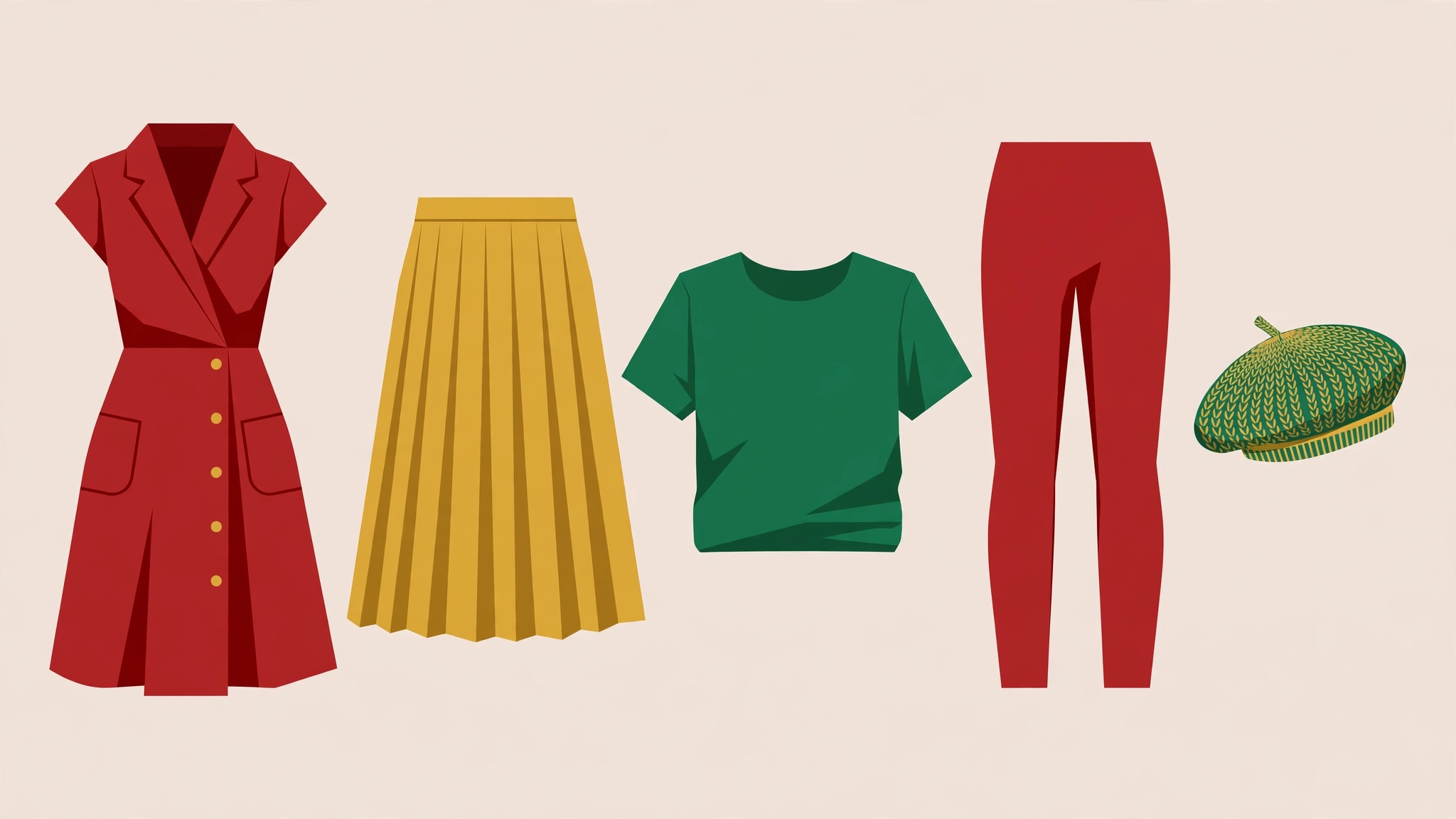
A capsule is a small set of pieces that all work with each other, and for red, gold and green, five pieces are enough. Start with a dress in a solid color or a simple stripe — a maxi for cooler days, a skater dress for warmer ones. Add a skirt in a second color, cut to move: a pleated skirt in gold or a flowing skirt in green. Add a tee in the third color, plain and well-fitted, the piece that turns a skirt into an outfit and a dress into a layered look. Add leggings in black or in a deep green, the piece that makes every dress warmer, more modest, and more comfortable. And add a tam in the striped colors, the piece that ties the whole outfit together and covers the locks with pride. Five pieces, three colors, and a week of outfits without a single new idea — because the ideas are already in the pieces.

A flat lay of a capsule wardrobe: a red dress, a gold pleated skirt, a green tee, red leggings, and a green and gold knit tam
Five pieces, three colors: a dress, a skirt, a tee, leggings, and a tam — enough for a week of outfits.

Build the capsule in solid colors first. Prints are lovely, but a print commits you: a striped dress is already a whole statement, and it will fight with a striped tam. Solids, by contrast, are team players — a green dress takes a gold skirt, a red tee takes green leggings, and the tam can be the one striped piece in the outfit. Buy the best fabric you can afford in the pieces you will wear most: the dress and the leggings earn their money every week, while a cheap tee will lose its shape by the third wash. And buy for your real life, not your imagined one. If you walk to work, you need shoes and a hem that survive the walk. If you sit all day, you need a waist that does not dig in by noon. The capsule is not a fantasy. It is a toolkit, and it should fit the hands that use it.

Proportions: How Much of Each Color

The simplest rule for three strong colors is the one designers have used for a century: most of one, some of another, and a little of the third. In practice that means about sixty percent of your outfit in the leading color, about thirty percent in the supporting color, and about ten percent in the accent. A green dress with a gold skirt peeking beneath it and a red tam is sixty-thirty-ten. A red top with green leggings and a gold bracelet is sixty-thirty-ten. The numbers are not a law, they are a habit — and the habit keeps any one color from shouting over the other two. Gold is the natural accent: it is warm, it is bright, and a little of it goes a long way. Red is the natural leader: it holds attention, so it should hold the biggest piece. Green is the natural supporter: it is calm, it grounds the outfit, and it lets the other two shine.

Three horizontal color blocks in red, gold and green showing the proportion of each color to wear in an outfit
Most of one color, some of a second, and a little of the third — the proportion that keeps three strong colors from arguing.

Neutrals are your friends, not your enemies. Black leggings under a red dress do not dilute the meaning — they give the red somewhere to rest. A denim jacket over a green and gold dress does not hide the colors — it frames them, the way a frame holds a picture. White, cream, and brown work the same way: they are the quiet ground against which the three colors can speak. The mistake is to think every piece must be red, gold or green. An outfit that is entirely in the three colors is a flag, and a flag is not an outfit. Let the neutrals do the quiet work, and let the colors do the talking.

Dressing for the Day: Work, Church, Market, Evening

One outfit cannot do every job, but one capsule can. For work, lead with the calmest color: a green dress or a green skirt with a plain tee, leggings underneath, closed shoes, and the tam tied back neatly. The colors are present, the outfit is professional, and nothing about it fights the room. For church or gathering, lead with red: a red dress or a red top with a gold skirt, the tam worn with pride, and jewelry that catches the light. Red is the color of the blood and the struggle, and a gathering is where that meaning belongs. For the market, lead with comfort: a skater dress in the stripes, sandals you can walk in, a canvas tote for the shopping, and a hat or tam against the sun. The market is where the outfit is tested — by heat, by walking, by carrying — and the right outfit passes the test without a thought.

A woman in a green and gold striped skater dress standing at a colorful outdoor market stall
Market morning in a striped skater dress: comfortable, easy to move in, and unmistakably Rasta.

For the evening, add one layer and one light. A denim jacket over the day’s dress, or a light cardigan in gold over a green top, changes the outfit without changing it. Swap the sandals for a closed shoe, add a beaded bracelet, and let the tam sit a little higher. The evening outfit is the day outfit with the volume turned up one notch — not a new outfit, but the same outfit dressed for the dark. That is the whole secret of dressing for the day: you are not changing clothes four times. You are changing one or two pieces, and the capsule does the rest. Our guide to Rasta outfits for reggae lovers and our guide to reggae themed outfits for women show the same idea at a concert and a festival, where the day runs even longer and the layers matter even more.

Fit and Fabric: Comfort That Lasts All Day

An outfit that looks right at 8 in the morning and wrong by noon was never right. Fit is the difference. A dress should skim, not cling; a waist should sit where your waist is, not where the pattern thinks it is; a hem should move when you walk and settle when you stop. Try the sitting test before you buy: sit down in the dress, and if it rides up, pulls, or gaps, it is the wrong size or the wrong cut — no matter how beautiful it is on the hanger. Try the walking test too: walk the length of the shop, and if you are tugging at anything by the third step, you will be tugging at it all day. Clothes should be worn, not managed.

Fabric is the other half of comfort. In warm weather, cotton, rayon, and linen breathe; polyester traps heat and shows sweat. A dress with a little stretch moves with you and keeps its shape; a dress with no give at all will fight you at every step. For leggings, look for a thick, opaque fabric that does not go see-through when you bend — hold them up to the light before you buy. For tams, a soft knit that holds its shape without squeezing is worth more than a stiff one that looks perfect and feels like a band. And for the heat, remember the oldest rule of dressing in the tropics: loose beats tight, light beats dark on the skin, and a layer you can remove beats a layer you cannot. Our guide to how to style Rasta clothing goes deeper into fit and fabric, and our guide to traditional Rasta outfits that still look fly today shows how the older styles solved the same problems with the same fabrics.

The Details: Tam, Jewelry, Bag, Shoes

Details are where an outfit becomes yours. The tam comes first: a knitted crown in the striped colors that covers the locks, keeps the sun off, and carries the palette up to the top of the outfit. Wear it pulled down over the hair for work and errands, or pushed back for the evening — either way, it should fit without squeezing, and it should be the one striped piece if the dress is already striped. Jewelry comes second, and less is more: a beaded bracelet in red, gold and green, a simple wooden bead, or a thin gold chain. The colors are already loud; the jewelry should be the quiet note that lets them sing. A bag comes third: a plain canvas tote in natural cotton carries the shopping, the book, and the water bottle, and it does not compete with the outfit the way a printed or glittering bag would. And shoes come last, because they decide whether the day is a pleasure or a punishment.

A close-up of outfit details: a red gold and green striped knit tam, beaded bracelets, and a blank canvas tote
The details that finish the look: a striped tam, beaded bracelets, and a plain canvas tote that lets the colors speak.

For shoes, choose for the day you actually have. Sandals with a proper sole carry you through a market morning. Closed shoes with a low heel carry you through a workday. Trainers in a plain color carry you through a long day on your feet, and no one will fault you for them — comfort is part of the look, not a betrayal of it. What to avoid: heels so high you cannot walk the distance, shoes so new they have not been broken in, and anything that makes you think about your feet instead of your day. The best shoe is the one you forget you are wearing. Our guide to Rastafarian clothing styles with meaning shows how the same details — tam, beads, and bag — have been worn for decades, and our guide to what to wear to a reggae festival shows how they hold up when the day runs long and the ground is grass.

What Not to Do: The Mistakes That Cheapen the Look

Five mistakes cheapen a red, gold and green outfit faster than anything else. The first is the flag outfit: every piece in the three colors at full strength, with nothing neutral to rest the eye. The second is the costume: a Halloween version of Rasta dress — a fake beard, a plastic crown, a wig of locks — worn for a laugh. The colors deserve better, and so do the people who live them. The third is the clash: a busy print on top of a busy print, stripes fighting checks, so that the outfit looks like an argument. The fourth is the wrong size: a dress that pulls, a tam that squeezes, leggings that go see-through when you bend. And the fifth is the neglected finish: wrinkled fabric, scuffed shoes, and a bag that has seen better days. None of these is about money. All of them are about attention. Iron the dress. Polish the shoes. Choose one print. Let a neutral in. And never wear the colors as a joke — they are a promise, and promises are not punchlines.

The deeper mistake is to wear the colors without knowing them. The palette is not a trend that arrived with a festival season; it is the flag of Ethiopia and the emblem of a faith, and the people who wear it have paid for it with their comfort and sometimes with their freedom. Wearing the colors well means wearing them with that knowledge. Read the meaning — our guides to Rasta Colors and to the meaning behind the Lion of Judah are the place to start — and let the knowledge show in the care you take with the outfit. The women who wear these colors best are not the loudest in the room. They are the ones whose clothes fit, whose colors rest in proportion, and whose meaning is clear before they say a word.

Wear the Colors: Two Dresses That Do It Right

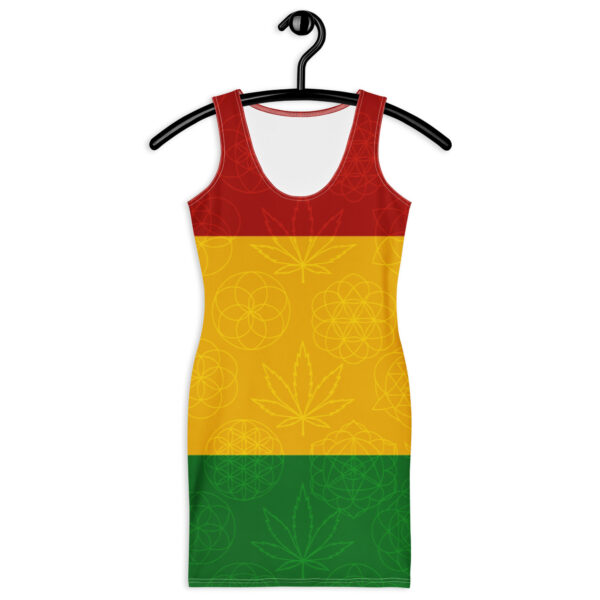
The two dresses below are the ones this guide keeps coming back to: a bodycon dress that carries the full palette in a sacred geometry print, and a skater dress in green, gold and red stripes that moves the way a market morning needs it to. Both are from our own Fifth Degree™ shop, both are in the colors, and both are built for the day — not just for the photograph.

Our View

We make these colors for the women who wear them every day, not only for the festival photograph. That is why our dresses are cut to move, our fabrics are chosen to breathe, and our prints carry the meaning plainly instead of shouting it. The best compliment our clothes ever get is the quiet one: a woman who puts one on in the morning and forgets about it until someone asks where it came from. Wear the colors with the meaning first and the mirror second, and they will never let you down.

FAQ

Can I wear all three Rasta colors in one outfit?

Yes — in proportion. Let one color lead (about sixty percent), a second support (about thirty percent), and the third act as an accent (about ten percent). Gold works best as the accent. An outfit that is all three colors at full strength, with nothing neutral to rest the eye, reads as a flag rather than an outfit.
What is the best dress style for wearing red, gold and green?

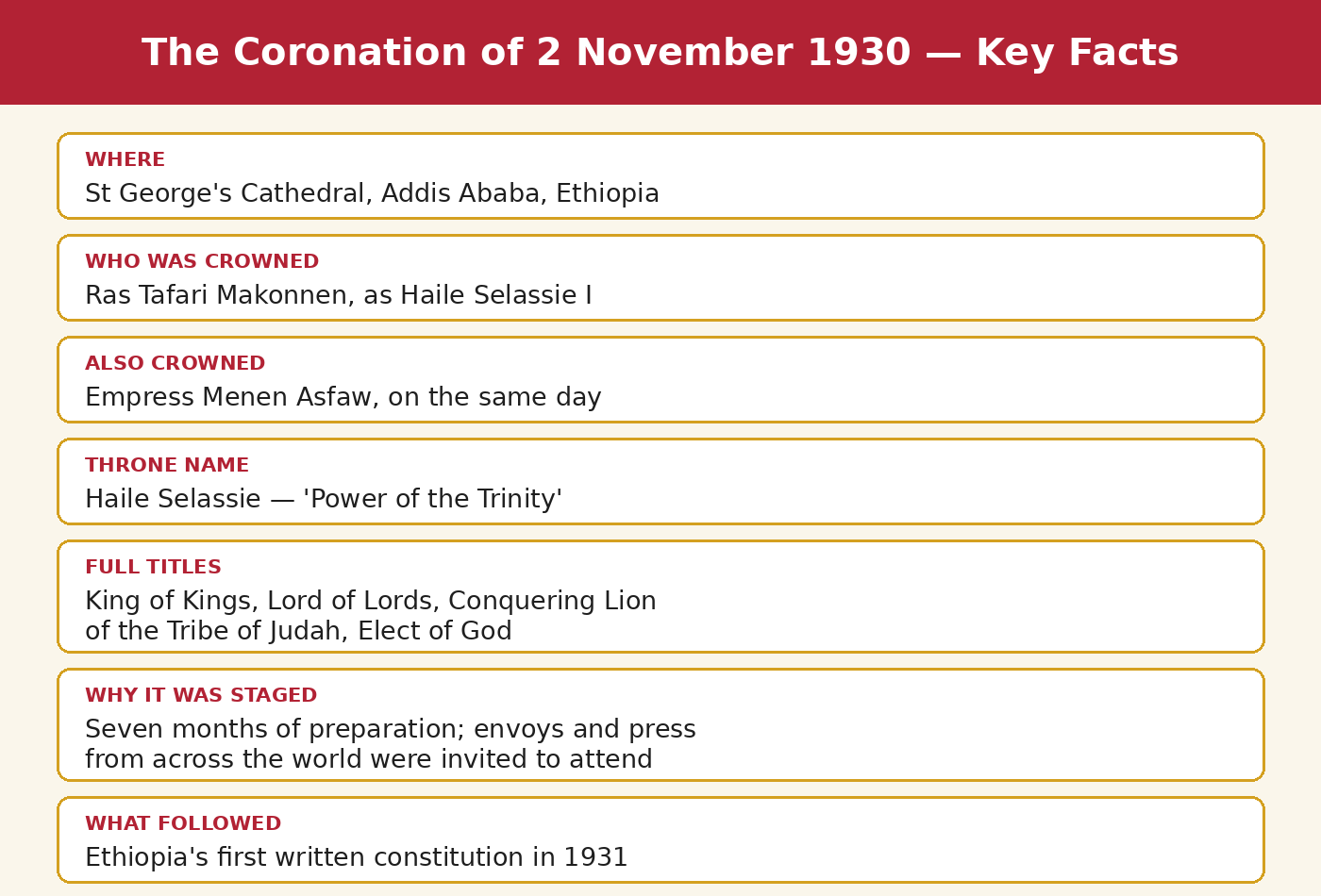
A skater dress in the stripes is the most forgiving and the easiest to wear: it fits at the waist, flares over the hips, and moves well in heat. A bodycon dress in the full palette works when the print does the talking and the accessories stay quiet. Both are in our shop, and both are built for a full day, not just a photograph.

Are Rasta colors appropriate for work?

Yes, when the outfit is built for work: lead with the calmest color, keep the fit professional, wear closed shoes, and let the colors appear in the dress or the tam rather than in every piece at once. The colors are a statement of identity, and identity belongs at work as much as anywhere else.

What should I wear under a Rasta dress?

Leggings in black or deep green, in a thick opaque fabric. They add warmth, modesty, and comfort, and they let a shorter dress work for a longer day. Hold any legging up to the light before you buy it — if you can see through it, it is not doing its job.

How do I keep red, gold and green clothes from fading?

Wash them in cold water, inside out, with a gentle detergent, and dry them out of direct sun. Red fades fastest, so it deserves the coldest water and the shortest time in the dryer. Treat the colors like the meaning they carry: with care, and they will stay bright.

Do I need a tam to wear a Rasta outfit?

No, but a tam completes the outfit: it covers the locks, carries the colors to the top of the look, and ties the pieces together. If you do not wear a tam, a simple headwrap or a hat in one of the colors does the same work. Our guide to Dreadlocks in Rastafari explains the locks the tam is so often worn with.

Questions about what we make or why we make it?

We are a small shop with a big respect for the culture we serve. If you want help choosing a piece, or you want to talk about the meaning behind it, contact us and a real person will answer.

Sources

Author

man wearing football freedom clothing flag print joggers outside a stadium on match day

Football Freedom Clothing: Joggers, Jerseys and Match-Day Style

Football freedom clothing brings the energy of the match into everyday dress. It is a wardrobe built from joggers, jerseys, graphic tees, scarves and caps, each piece carrying colour, a flag or a word that means something to the person wearing it. The look works because it is comfortable first and expressive second, so it suits the walk to the ground, a long afternoon with friends, a street outfit and a festival crowd with equal ease. This guide explains what each piece does, how to choose it well, how to put the pieces together and how to wear the colours with care and confidence.

Looking for the real thing? The Fifth Degree Etsy shop carries rasta and freedom clothing made for everyday wear.

Shop Fifth Degree

Key Takeaways

  • Start with joggers, then add one statement piece at a time.
  • Choose comfort and fit before colour, print or branding.
  • Let one flag, word or emblem lead and keep the rest plain.
  • Match the outfit to the setting: ground, street or festival.
  • Check fabric, seams and print quality before you pay.

Table of Contents

What Football Freedom Clothing Is

Football freedom clothing is a loose family of garments that borrows its language from the game and its meaning from the people who wear it. The game itself is simple to recognise: two teams, a ball and a shared set of rules that turn a field into a stage. Association football is played and watched in almost every country, and its kit has become a kind of shorthand that travels well beyond the touchline. When a shirt, a scarf or a pair of joggers carries a flag or a place name, it stops being only sportswear and starts to speak for identity, memory and belonging. That is the heart of this wardrobe. It is not a uniform and it is not a costume. It is a set of comfortable, well-chosen pieces that let a person show where they stand without saying a word.

The pieces work together because each one has a clear job. Joggers give the outfit its ease and its movement. A jersey gives it the colour and the crest of the game. A graphic tee gives it a message in plain language. A scarf gives it warmth and a block of colour that can be seen across a crowd. A cap finishes the look and keeps the sun out of the eyes. None of these pieces needs to shout on its own. Together they build a look that feels deliberate rather than accidental, and that is the difference between an outfit and a pile of clothes. The history of football helps explain why the clothing feels so familiar: the game grew up in public, in streets and in stadiums, and its clothing was made to be worn hard, washed often and recognised at a distance.

Freedom clothing in this sense is not a single design. It is a way of choosing. A person might wear the colours of a place they come from, a team they follow, a cause they care about or a culture they belong to. The Flag of Palestine, for example, uses black, white, green and red in a design that is recognised far beyond the field, and those colours appear on joggers, tees and scarves in many wardrobes. In a rasta wardrobe the same idea shows up in green, gold and red, the colours that run through Rastafari clothing and through the women’s rasta clothing guide on this site. The point is not to collect every colour. The point is to choose the colours that mean something to you and to wear them well.

It helps to think of the wardrobe as a small system rather than a single outfit. A good system has a base, a statement and a finish. The base is usually joggers and a plain tee, because those pieces carry the comfort. The statement is usually a jersey or a printed tee, because that piece carries the message. The finish is a scarf or a cap, because those pieces add colour and shape without adding weight. When you build in that order, the outfit stays balanced. When you start with the loudest piece and add more loud pieces on top, the look becomes crowded and the message gets lost. A quiet base also makes the statement piece easier to read, which matters in a crowd where a shirt may be seen for only a moment.

The table below compares the five key pieces at a glance. Use it to decide where to spend your attention and your money. Joggers and a good tee repay the most wear, so they deserve the most care in choosing. A scarf and a cap cost less and change the look more quickly, so they are a good place to try a new colour. A jersey sits in the middle: it is the most recognisable piece, so it should be chosen with the most thought about fit and print.

Piece Best use Comfort Statement level
Joggers Match day, travel, everyday wear High Medium
Jersey Match day, gatherings, support Medium High
Graphic tee Everyday wear, warm weather High High
Scarf Cold match days, layering Medium Medium
Cap Sun, travel, finishing an outfit High Low to medium
football freedom clothing key pieces joggers jersey graphic tee scarf cap
Joggers, a jersey, a graphic tee, a scarf and a cap: the five pieces that make up a football freedom wardrobe.

A wardrobe like this also has a practical side. The pieces are meant to be worn often, so they should be easy to wash, easy to pack and easy to repair. A jersey that only survives one wash is not a bargain, however low its price. A pair of joggers with a weak drawstring will spend more time being adjusted than being worn. That is why the later sections of this guide spend time on fabric, seams and print. The kit worn in association football was made for movement and for washing, and the best freedom clothing follows the same idea: simple construction, honest materials and a print that stays put. When you shop with that standard in mind, you buy fewer pieces and wear each one more, which is better for your wardrobe and for your wallet.

There is also a social side to wearing these clothes. A football shirt is a conversation starter. It tells a stranger something about you before you speak, and it can open a door to a shared interest. That is a strength, and it is also a reason to wear the clothes with respect. A flag is not a decoration. A crest is not a random shape. If you wear a design that belongs to a place or a people, take a moment to learn what it means and to wear it in a way that honours it. The Palestine football T-shirt post on this site looks at that idea from the side of support and awareness, while this guide looks at it from the side of the wardrobe. Both point in the same direction: wear the piece because you mean it, not because it is loud.

How the pieces fit together

The easiest way to build an outfit is to start at the bottom and work up. Choose joggers that fit well and feel good, then choose a tee that sits cleanly over them, then add a jersey or a jacket only if the weather or the occasion calls for it. A scarf can be draped rather than wrapped on a mild day, and a cap can be worn or carried. Each step should make the outfit feel more finished, not more crowded. If a piece makes you tug at it, adjust it or think about it, it is probably the wrong piece for that day. Comfort is not a luxury in this wardrobe. It is the test that tells you whether the outfit works.

Colour is the other test. A football freedom outfit usually has one leading colour and one or two supporting colours. The leading colour might be the green of a flag, the red of a crest or the gold of a rasta palette. The supporting colours should be quieter: black, white, navy or a soft grey. When the leading colour appears in two places, for example on the joggers and on the cap, the outfit feels planned. When it appears in five places at once, the outfit feels noisy. The how to style rasta clothing guide makes the same point with green, gold and red, and it is worth reading alongside this one if you lean toward rasta colours. A plain tee is your friend here. It gives the eye somewhere to rest and it lets the statement piece do its work.

Joggers: The Piece That Leads the Wardrobe

Joggers lead this wardrobe because they do the most work with the least fuss. A good pair moves with the body, sits comfortably through a long day and still looks put together when you walk into a gathering. The shape is familiar: a tapered leg, a ribbed cuff, an elastic waist with a drawstring and pockets that actually hold something. Sweatpants began as athletic wear, and joggers keep that athletic ease while adding a cleaner line that works away from the track. The difference is in the cut. A jogger tapers toward the ankle instead of hanging straight, so it shows the shoe and keeps the leg looking neat. That small change is what lets joggers move from the gym to the street without looking like sleepwear.

When you try joggers, start with the waist and the cuff. The waist should sit flat without digging in, and the drawstring should adjust easily and stay tied. The cuff should rest at the ankle without riding up when you walk and without squeezing the leg. The seat should have room to sit and to climb steps without pulling. If any of those points fails, the pair will spend the day reminding you of itself, and no print can fix that. Check the pockets too. A pocket that gaps open will lose a phone, and a pocket that is too shallow will not hold a key. These are small tests, and they take less than a minute in front of a mirror. They save far more time than they cost.

Print placement matters more on joggers than on almost any other piece, because the leg is long and the eye follows it. A word that runs down the leg should be readable when you stand and when you walk. A flag stripe should run straight and stay straight, not twist around the leg. A crest or emblem should sit where it can be seen without being hidden by a fold. The best prints use the leg as a canvas and keep the design simple: one word, one stripe, one emblem. A design that tries to do everything at once becomes hard to read and hard to wear. Look at the back of the leg as well as the front, because the back is what people see when you walk away.

Fabric is the other half of the choice. Cotton gives joggers a soft hand and a natural feel, and cotton remains the fibre most people reach for in everyday clothing. A cotton blend with a small share of a stretch fibre will hold its shape better through a long day and through washing, while a fleece lining adds warmth for cold weather. A lighter, unlined jogger suits warm days and travel, because it packs small and dries quickly. Feel the fabric before you judge it. It should feel smooth, not scratchy, and it should spring back when you stretch it gently. If it stays stretched out of shape, it will do the same after a day of wear.

The joggers to look for first

One pair of joggers in this wardrobe shows how the idea works in practice. It is black, with green and red stripes down the leg, the word Palestine running down one leg and a small crest near the waist. The design is bold, but it is also simple: two stripes, one word, one emblem. That simplicity is why it works with a plain tee, a black jacket or a white shirt. It is the kind of piece that can lead an outfit without needing anything else to be loud.

Palestine Football Men's Joggers - black all-over print joggers with green and red stripes and Palestine lettering down the leg

Palestine Football Men’s Joggers — $89.99

Black all-over print joggers with green and red stripes and Palestine lettering down the leg.

See the Joggers on Etsy

When you look at a pair like that, check the same points you would check on any joggers: the waist, the cuff, the print and the fabric. A strong design deserves strong construction, and the two should be judged separately. A print you love on a pair that fits badly will stay in the drawer. A pair that fits well with a print you only half like will be worn, but it will not feel like yours. Wait for the pair that passes both tests. The Palestine football shirts on this site show the same colours in a different form, and comparing the two helps you see whether you want the statement on your legs, on your chest or on both. Most people do best with one strong statement at a time, so let the joggers lead and keep the top plain.

How to wear joggers well

Joggers pair best with a top that is simple and a shoe that is clean. A plain tee in black, white or a deep green lets the joggers carry the colour. A fitted jacket adds shape on a cool evening, while a loose shirt over the top can soften the athletic look for a gathering. Shoes matter more than most people expect. A clean trainer keeps the outfit sporty, a simple boot makes it tougher, and a sandal changes the mood entirely. Try the outfit with the shoes you actually wear most often, not with the shoes you wish you wore. If the cuff sits well over the shoe and the leg does not bunch, the pairing works. If the joggers hide the shoe or fight with it, try a different shoe before you blame the joggers.

Jerseys and Graphic Tees

A jersey is the most recognisable piece in football clothing, and that is both its strength and its risk. The shape is simple: a short-sleeved shirt with a crest, a number or a sponsor mark, made to be seen from a distance. In the game, the jersey tells you who is who. Away from the game, it tells you what the wearer cares about. A guide to rasta jerseys on this site looks at the same idea through rasta colours, and the lesson is the same: a jersey should fit cleanly, the print should be crisp and the colours should be true. A jersey that is too tight will pull across the chest, and a jersey that is too loose will look like a borrowed shirt. The shoulder seam should sit at the edge of the shoulder, the hem should sit at the hip, and the sleeves should end above the elbow without flaring.

Graphic tees are the quieter cousin of the jersey, and they are often the more useful piece. A T-shirt is the simplest garment most of us own, and a printed tee uses that simplicity to carry a word, a flag or an image. The best graphic tees say one thing clearly. A single word in a strong typeface, a flag in its true colours or a simple emblem will be read in a glance. A tee that tries to say three things at once will be read by no one. Check the print by holding the shirt up to the light and by stretching it gently. A good print stays solid and does not crack. A weak print will show fine lines after a few washes, and those lines are the first sign that the shirt will not last.

Choosing between a jersey and a tee is mostly a question of setting. A jersey suits match day, a gathering of supporters and any occasion where the team or the place is the point. A tee suits everyday wear, warm weather and days when you want the message without the full kit. You can wear both in one outfit, but only if one of them is plain. A printed jersey over a printed tee is too much. A jersey over a plain tee, with the tee peeking at the collar and the hem, is a classic layer that adds warmth without adding noise. In cold weather, a long-sleeved tee under a jersey works in the same way. The rasta basketball jerseys post shows how a jersey can carry culture and court style at once, and the same balance applies here: the jersey should feel like clothing, not like a banner.

Fit is where most jerseys fail. Football jerseys are often cut for an athletic body, so they can be narrow in the chest and long in the body. If you are between sizes, try the larger size and check the shoulders. A jersey that is a little loose can be worn with joggers and a cap and still look right. A jersey that is too tight will never look right, however much you like the design. Women should look for a cut that follows the body without clinging, and men should look for a cut that leaves room to move without swimming in fabric. The Palestinian football jersey and the Palestine soccer jersey posts on this site describe jerseys in this wardrobe, and reading them alongside this guide will help you compare designs before you choose. Both posts treat the jersey as a piece of support clothing, and that is a useful reminder: the jersey is a way of standing with something, so choose one you would be glad to stand beside.

Colour and print on jerseys and tees

Colour on a jersey should be true to the flag or the team it refers to. A green that is too pale or a red that is too orange will look wrong to anyone who knows the colours, and it will fade badly in the wash. Ask yourself whether the colours look right in daylight, not only under shop lights. Print quality matters just as much. A crest should have clean edges, lettering should be spelled correctly and the print should sit flat on the fabric. If the print feels thick and plasticky, it may crack. If it feels like part of the fabric, it is more likely to last. These checks take a moment, and they are the difference between a jersey you wear for a long time and a jersey you wear once.

Scarves, Caps and Finishing Pieces

A scarf is the simplest way to add colour and warmth to a football outfit. A scarf is a long strip of cloth worn around the neck, and in football culture it is often printed with a team name, a place or a set of colours. On a cold day it keeps you warm. On a mild day it can be draped loosely over a jacket. On a warm day it can be carried or tied to a bag. The key is to let the scarf be the colour. If the scarf is striped in green and red, keep the rest of the outfit plain. If the scarf is plain, you can let the jersey or the joggers carry the colour instead. Check the fabric before you buy. A soft knit will sit well and will not itch. A stiff, shiny scarf will slip, bunch and look cheap, however good its colours are.

Rastafarian man wearing a green red gold and yellow crochet cap
A crochet cap in green, gold and red finishes an outfit and keeps the sun off on a warm day.

A cap finishes the outfit in a different way. A baseball cap shades the eyes, keeps hair out of the face and adds a small block of colour above the shoulders. A crochet cap does the same job with a softer, handmade feel, and in a rasta wardrobe it often carries the green, gold and red palette. The Lion of Judah appears on many caps and tees in this wardrobe, and it is worth knowing what it means before you wear it. Whichever style you choose, the cap should fit without squeezing and without slipping. Try it on, walk around and shake your head gently. If it moves, it is the wrong size. A cap that fits well disappears from your thoughts, which is exactly what a finishing piece should do.

Other finishing touches

Socks, a belt and a bag are small pieces, but they can tie an outfit together or pull it apart. Socks should match the outfit, not fight it: plain black or white socks work with almost every football outfit, while striped socks work only when they echo a colour already in the outfit. A belt should be simple and should sit flat. A bag should be big enough for a scarf, a bottle and a layer, because match days are long and the weather changes. The reggae festival looks on this site show how a simple bag and a cap can carry a festival outfit, and the same idea works at the ground. Keep the finishing pieces quiet and let the main pieces speak.

Styling for Match Day, the Street and the Festival

Match day is the most straightforward setting. Start with joggers and a plain tee, add a jersey or a jacket, and finish with a scarf and a cap. The outfit should be comfortable for standing, walking and sitting, and it should keep you warm if the weather turns. Layers are your friend: a tee under a jersey under a jacket gives you three settings in one outfit. Keep a spare layer in your bag rather than wearing everything at once. The where to buy rasta clothing online guide is useful here, because it helps you find pieces that are made to be worn hard and washed often, which is what match day demands.

three ways to style football joggers match day street festival
Three ways to style football joggers: match day, street and festival.

Street styling is a little quieter. Here the joggers lead, the tee is plain and the jersey stays at home. A clean jacket, a simple cap and clean shoes make the outfit feel deliberate rather than athletic. The colours can be bolder on the street, because there is no crowd to blend into, but the rule of one leading colour still applies. A pair of black joggers with a green stripe, a white tee and a black jacket is a good example: the stripe is the only colour, so it is easy to read. The dress like a Rastafarian woman guide shows how colour can be worn with confidence in everyday settings, and the same confidence works here. If you feel comfortable, you look comfortable, and that is most of the work.

Rastafarian man wearing a green shirt and a red gold green striped cap on a beach in Jamaica
A striped cap and a plain shirt keep a warm-weather outfit simple, so the colours can do the work.

Festival styling is the most playful of the three, and it is also the easiest to overdo. A festival is loud, colourful and crowded, so your outfit does not need to compete with it. Start with the same base, joggers and a plain tee, then add one festival piece: a brighter cap, a lighter scarf or a tee with a stronger print. Comfort matters more at a festival than anywhere else, because you will be on your feet for hours. Choose shoes you can walk in, a cap that shades you and a layer you can tie around your waist when the sun comes out. Reggae music grew up in outdoor gatherings, and its clothing follows the same idea: colour, comfort and ease. A festival outfit that lets you dance, sit and walk without thinking about it is a good festival outfit.

One outfit, three settings

The same joggers can work in all three settings if you change only the top and the finishing pieces. For match day, add a jersey and a scarf. For the street, add a plain tee and a jacket. For a festival, add a brighter tee and a cap. That is the test of a good wardrobe: the pieces should mix and match, not sit in separate piles for separate days. When you shop, ask yourself whether a new piece works with at least three pieces you already own. If it does, it earns its place. If it only works with one outfit, it will spend most of its life in a drawer.

Fit, Fabric and Care

Fit, fabric and care are where a good wardrobe is made. Try every piece on and move in it. Sit down, reach up and walk. A piece that feels good in the shop and bad at home will not be worn. Haile Selassie is a central figure in Rastafari, and the colours and symbols linked to that history deserve the same care in choosing as the fit does. A reggae hoodies layer can add warmth over a tee, and a hoodie is a useful layer on a cold morning, but it should not hide the piece you meant to show. Keep the layer simple and let the statement piece stay visible.

Care is simple: wash cold, turn printed pieces inside out and hang them to dry. Heat is the enemy of print and of elastic, so a hot dryer will shorten the life of both. Check seams after washing. A loose thread caught early can be trimmed. A loose thread ignored will become a hole. The best reggae shirts for festival season guide makes the same point about print and wash, and it is worth reading before a festival, when a shirt will be washed often. Store joggers folded, not hung, so the waist keeps its shape.

What to check before you pay

Before you pay, run through a short check. Does it fit at the waist, the shoulders and the cuff? Is the print straight, clean and spelled correctly? Are the seams straight and the stitching even? Does the fabric feel good against the skin? Does the piece work with at least three pieces you already own? If the answer to any of those is no, put it back. A piece that passes all five will be worn often, and that is the best value you can get from clothing.

Choosing Well and Avoiding Common Mistakes

The most common mistake is buying too many statement pieces at once. One strong piece is a statement. Three strong pieces are noise. Start with joggers and a plain tee, add a jersey or a printed tee, and stop there. The second mistake is buying the wrong size because the design is good. A good design in the wrong size is still the wrong size. The third mistake is ignoring the weather. A heavy scarf on a warm day and a thin tee on a cold day will both make you uncomfortable, and discomfort shows. The rasta colored basketball jersey and the Palestine jersey football posts show how one strong jersey can carry an outfit, and both are useful comparisons when you are choosing between designs.

Buy slowly. A wardrobe built over time, piece by piece, will fit better and last longer than a wardrobe bought in one afternoon. Try pieces together at home before you wear them out. Look in a mirror in daylight. Ask a friend whose taste you trust. If you are unsure, wear the plainer option. Plain is never wrong, and it lets the one piece you love do its work.

Our View

Football freedom clothing works best when it is comfortable, honest and worn with meaning. Start with joggers that fit, add one piece that says something, and let the rest stay quiet. Wear the colours you understand, care for the pieces you love, and the outfit will take care of itself.

— Brian Ka

FAQ

What is football freedom clothing?

It is a wardrobe of joggers, jerseys, graphic tees, scarves and caps that borrows its language from football and its meaning from flags, places and cultures. The pieces are comfortable, the colours carry meaning and the look works for match day, the street and festivals.

What should I buy first?

Start with joggers and a plain tee. They are the pieces you will wear most, and they set the fit and the comfort of every outfit that follows. Add a jersey or a printed tee next, then a scarf or a cap.

How do I style football joggers?

Pair them with a plain tee and clean shoes, and add a jacket or a jersey when the weather calls for it. Keep one colour leading and let the joggers carry the print. Change only the top and the finishing pieces to move the same joggers from match day to the street to a festival.

Can I wear a jersey and a graphic tee together?

Yes, if one of them is plain. A jersey over a plain tee is a classic layer. Two printed pieces together will fight each other, so choose one statement and keep the other quiet.

How do I care for printed joggers and jerseys?

Wash cold, turn printed pieces inside out and hang them to dry. Avoid a hot dryer, which harms print and elastic. Check seams after washing and trim loose threads early.

Questions about sizing, fabric or an order? Get in touch with the Fifth Degree team.

Contact Fifth Degree

Sources

Author

  • Brian Ka

    Brian Ka is the creative force behind Fifth Degree, a brand that fuses bold sportswear aesthetics with festival energy and deep Rasta cultural roots. His designs embody the spirit of self-expression, from statement-making brands like In Vein to k-pop blog that celebrate a free-spirited cultural lifestyle. Whether it's high-performance fabrics for all-day wear or styles that embrace Rasta heritage, Fifth Degree exists at the crossroads of fashion and culture. With a keen eye for detail and a passion for innovation, Brian ensures every piece reflects individuality, comfort, and the vibrant energy of those who wear them.


    View all posts


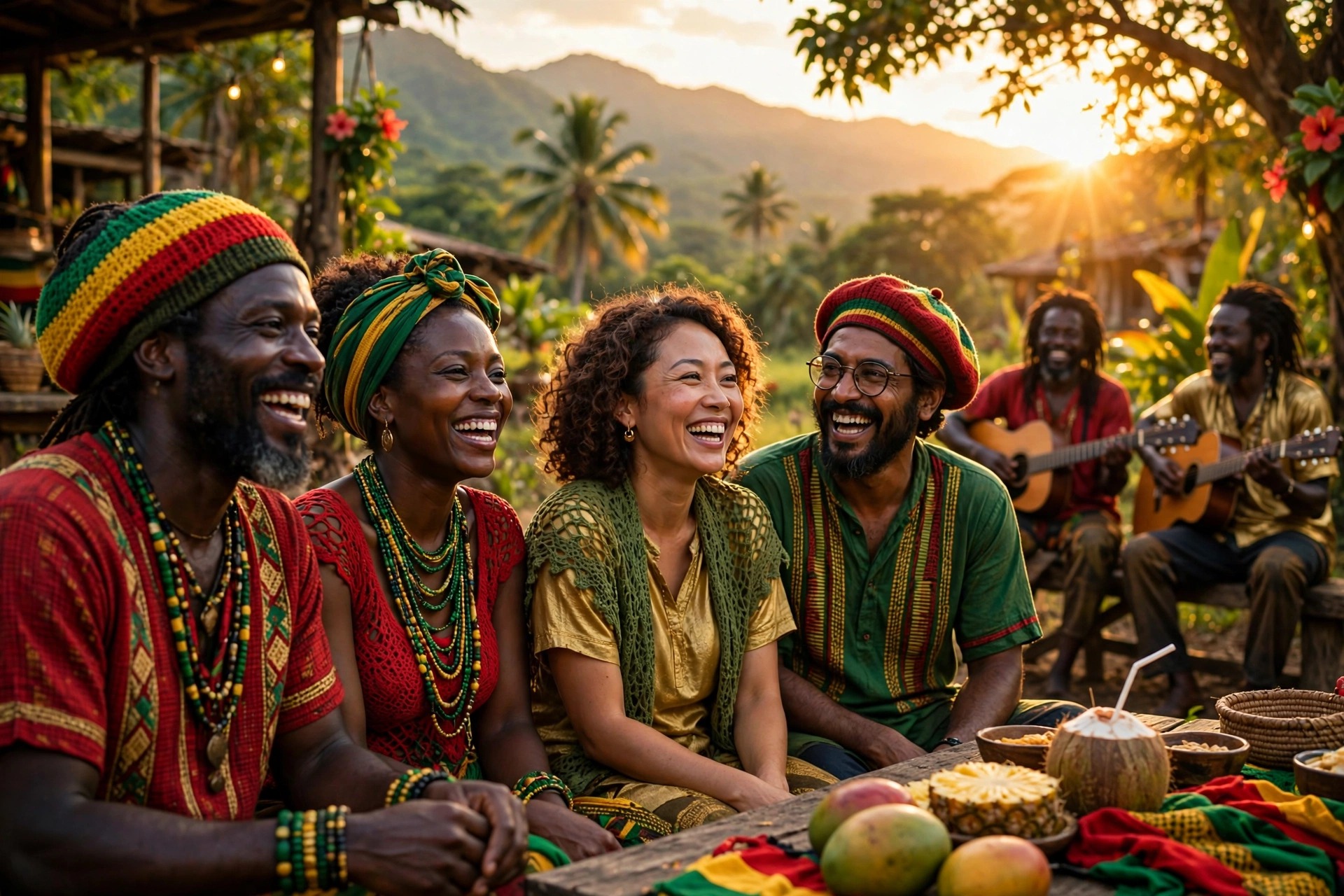
Joyful Rastafari gathering at sunset in Jamaica, with friends in red, gold, and green laughing together around a table of fruit while two musicians play guitars behind them

What Does “Irie” Mean? Rasta Words and Phrases, Explained

You hear it in a chorus, in a greeting at a market stall, in a friend signing off a message with warmth, and the word stops you, because it clearly means more than the dictionary shortcut of good or all right: irie is the feeling that everything is aligned, at peace, and held, and the phrases that travel with it, from Jah and Babylon to ital, Zion, and one love, form a whole way of seeing the world compressed into everyday speech. The problem for most listeners outside Jamaica is that reggae carried these words around the planet faster than it carried their meanings, so the vocabulary is famous while the thought behind it stays half heard. This guide solves that problem directly, starting with irie itself, then opening the full set of Rasta words and phrases around it, where each one comes from, and how to hear and use them with understanding rather than imitation.

Start here: Who Jah Bless No Man Curse — the sister phrases guide to Rastafari’s declaration of blessing and protection

Rasta Colors — our main guide to red, gold, and green and what each color stands for

Key Takeaways

  • Irie means good, all right, pleasing, and at peace, and in Rastafari use it also names a spiritual condition of harmony with Jah and creation.
  • Rasta speech, called Iyaric, Dread Talk, or Rasta Talk, deliberately rebuilds words so their sound matches their meaning, most famously in I-words such as ital, irie, and I and I.
  • Jah is God, Babylon is the oppressive system, and Zion is Africa, above all Ethiopia, as the promised home: together they map the whole Rasta story of exile and return.
  • Ital, dread, livity, seen, respect, and one love are not slang decorations; each one carries a practice, a value, or a relationship.
  • Reggae carried this vocabulary worldwide, which is why the words are familiar even where their meanings are not.

Table of Contents

What Irie Means: Good, All Right, and At Peace

Irie is the headline word, so start with its full range. At its simplest, irie means good, all right, cool, great, merry, or nice, and it works as an adjective, an adverb, and an interjection, which is why a single short word can do so much work in a conversation. A person can feel irie, a gathering can be irie, a meal, a song, and a whole afternoon can be irie. The most careful recent explainer of the word, DancehallMag on irie, reports that the Oxford English Dictionary files it as Jamaican English and records an older gloss that pushes the meaning higher still, toward powerful and pleasing, excellent, highest, the state of feeling great. That height matters, because irie was never only a casual thumbs up. Underneath approval sits peace, contentment, and harmony, the settled feeling that nothing in this moment needs fixing.

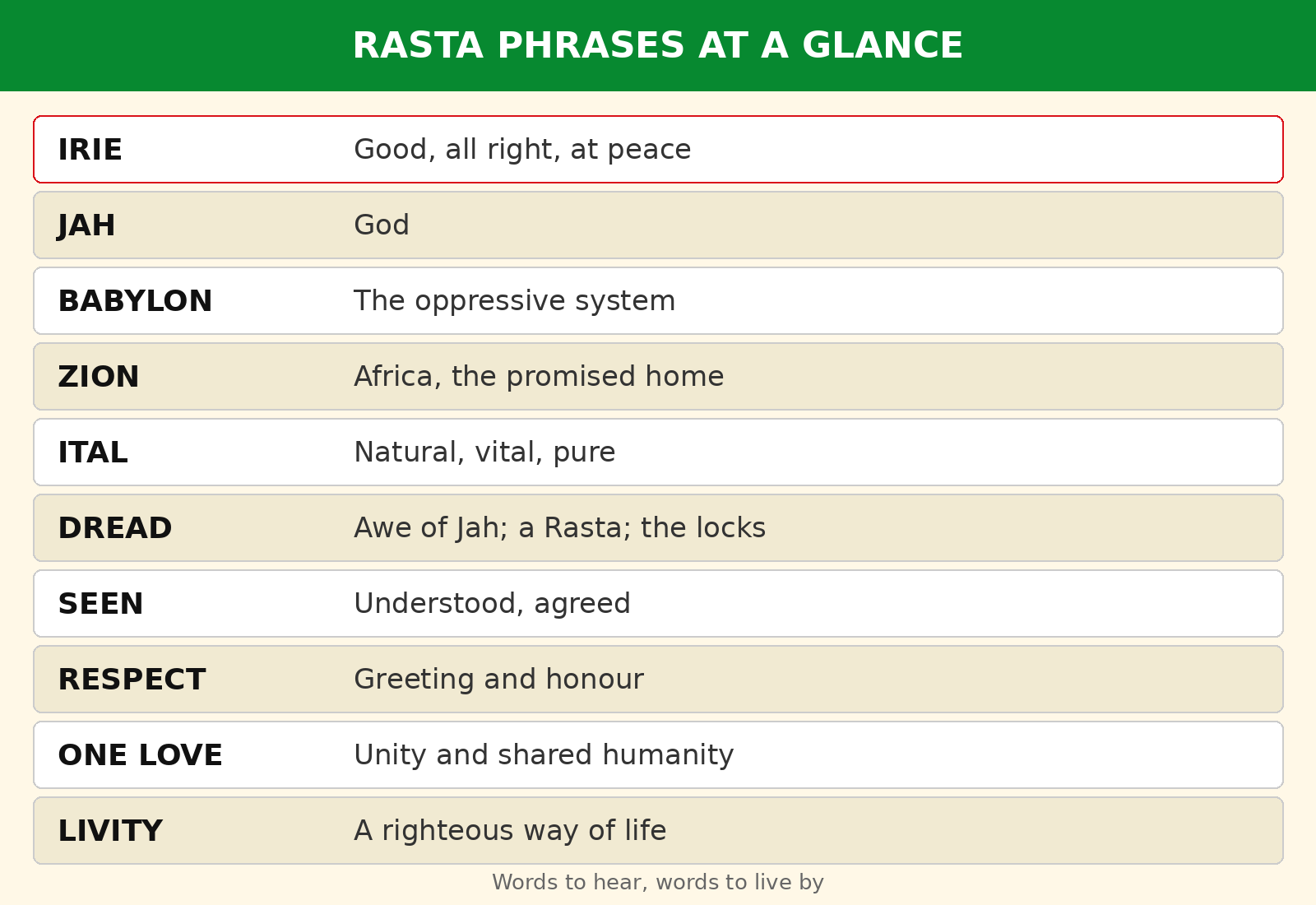
The phrases travel as a set, so learn them as a set. Irie rarely arrives alone in real speech. It sits inside a family of words that name God, the world as it is, the world as it should be, the food on the table, the hair on the head, and the bond between the people speaking. The table below gives the working glossary for this whole guide, covering irie alongside Jah, Babylon, Zion, ital, dread, seen, respect, one love, and livity, and every section that follows takes a group of these words and opens it properly, with its history and its weight, rather than leaving it as a one-line translation.

Word or Phrase What It Means How It Is Used
Irie Good, all right, pleasing, at peace Greeting, answer, approval, blessing
Jah God Prayer, praise, everyday reference to God
Babylon The oppressive, corrupt system Naming injustice, authority, and materialism
Zion Africa, above all Ethiopia, the promised home Hope, repatriation, redemption
Ital Natural, vital, pure, from vital with the I raised Food and living free of additives and artifice
Dread Awe of Jah; a Rastafari person; the locks themselves Reverence, identity, and address
Seen Understood, agreed, it is so Confirming that a point has landed
Respect Honour given and received Greeting, thanks, and farewell
One love Unity and shared humanity Blessing, sign-off, and call to unity
Livity A righteous, balanced way of life The whole practice of living the faith
Chart listing ten Rasta words and phrases with short meanings: irie, Jah, Babylon, Zion, ital, dread, seen, respect, one love, and livity
Ten words that carry a worldview: the core Rasta phrases at a glance.

Context decides which shade of irie you are hearing. Asked how you are, irie answers that you are well in body and in spirit, not merely unharmed. Said of a place, it praises the energy of the place, the feeling that the people, the music, and the moment agree with each other. Said as an exclamation, it blesses what has just happened. English separates feeling good, things going well, and being at peace into different phrases, while irie holds all three in one breath. Our sister guide to who Jah bless, no man curse shows the same compression in a longer phrase, where an entire theology of protection fits inside six words.

Where Irie Comes From: An Honest Answer

The honest answer about the origin of irie is that nobody knows for certain, and any guide that pretends otherwise is guessing. The Oxford English Dictionary, as reported by DancehallMag, calls the origin uncertain, and its earliest recorded evidence of the word in print comes from a Kingston newspaper in the middle of the roots reggae years, when Rasta language was pouring out of studios and sound systems into everyday Jamaican speech. Several theories circulate, and none is settled. One holds that irie is an alteration of an older word for hearty. Another sees it as a creation of Iyaric, blending the raised I with free or merry. A third links it to the English phrase all right, which would make irie a compressed blessing, the whole of all right gathered into a single joyful sound. What is beyond dispute is the use: Jamaicans made the word their own, reggae carried it, and its meaning in living speech is clear even where its origin is not.

Irie lives inside Jamaican Creole, and that language has its own dignity and its own scholarship. Jamaican Creole, called Patois or Patwa by its speakers, is not broken English but a full language with its own grammar, sound system, and literature. The reference entry on Jamaican Creole describes it as the English-based creole vernacular of Jamaica with the most extensive literature and the widest artistic use of any Caribbean English creole, spread worldwide by Jamaican music, dub poetry, and the Rastafari faith itself. The work of treating that language with institutional seriousness has a home: the Jamaican Language Unit at the University of the West Indies, Mona, was established to support speakers of Jamaican, widely referred to as Patwa, including a standard writing system for the language. You are not picking up slang in the dismissive sense, then. You are touching a language a university unit exists to document, teach, and defend.

The deepest layer of irie is spiritual, and it is the layer reggae listeners feel before they can name it. In Rastafari use, feeling irie means being in tune: right with Jah, right with other people, and right with creation, living inside livity rather than merely enjoying a good mood. That is why the true opposite of irie in Rasta thought is not sadness but Babylon, the oppressive order that pulls a life out of tune. A person can be poor, tired, and opposed and still be irie, because irie names alignment rather than comfort. Hold that distinction and the word becomes what it has always been for the people who shaped it: a small daily report on the state of the soul. The colors that carry the same report visually are set out in our guide to the rasta colors, where green, gold, and red do in cloth what irie does in speech.

Iyaric: The Language That Rebuilt English

To understand any of these words properly, you have to understand Iyaric, the deliberate rebuilding of English from inside Rastafari. Iyaric, also called Dread Talk or Rasta Talk, grew as a conscious response to what Rastas experience as a negative colonial framework built into everyday English. Words were examined for the sounds they carry, and where a sound contradicted the meaning, the word was rebuilt. The greeting hello is avoided because it contains hell and low. Understand becomes overstand, because real understanding lifts a person up. Oppression becomes downpression, because the thing presses down. Encyclopaedia Britannica describes Iyaric, or Dread-talk, as the linguistic style of many Rastas, who substitute the sound of I for certain syllables, pointing at the most famous pattern of all: the I-words.

Diagram showing how Iyaric builds I-words, with vital becoming ital, unity becoming inity, creation becoming iration, meditation becoming iditation, and the pronoun form I and I
How I-words are built: the raised I goes first, and the word follows it.

The I-words are a system, not a game, and linguists have studied them as one. Benjamin Slade’s formal study of Rasta Talk morphology shows that forms such as ital, from vital, and irie, if from merry, belong to a larger pattern in which the initial syllable of a word is reshaped around the sound of I, a process he analyses as a special kind of blending rather than simple replacement. The same study catalogues the companion pattern of overstandings, including overstand for understand, downpress for oppress, and livicate for dedicate, where a part of a word whose connotation clashes with its meaning is replaced by its opposite until sound and sense agree. Behind the pattern stands a theology of the pronoun: I and I replaces me and you, and even we, because Jah dwells in every person and no speaker stands outside that unity. When irie is read inside this system, its opening I stops looking accidental. Whether or not the word was historically built this way, Rasta ears hear it this way, and hearing is part of meaning.

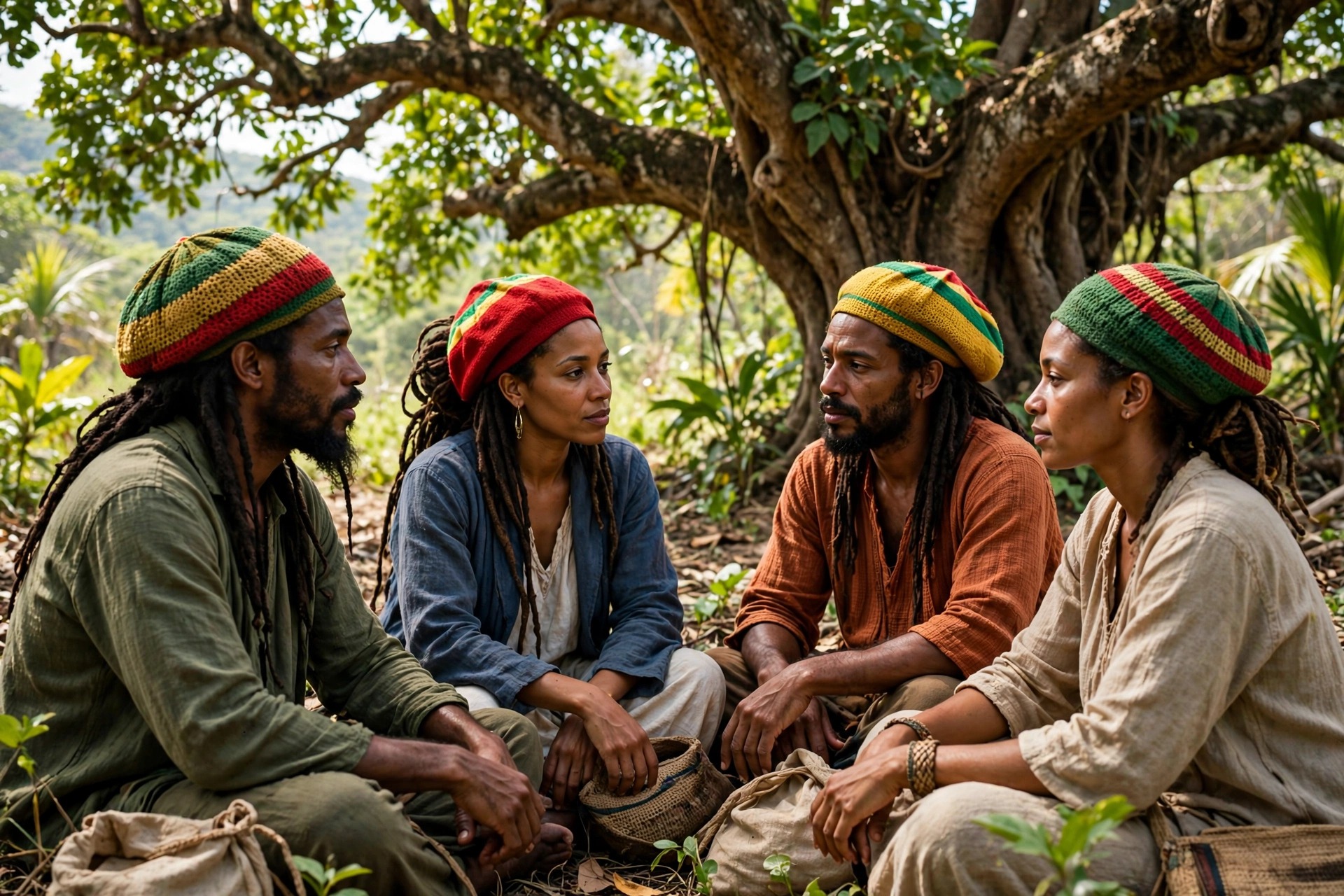
Four Rastafari friends with dreadlocks and green, gold, and red knit caps seated in a circle under a large tree in conversation
A reasoning: the setting where Rasta speech is sharpened, tested, and passed on.

This language travelled, literally, all the way back to Africa. The University of the West Indies lecture record on Ethiopia speaking Jamaican Creole describes the communities in the Shashamane valley, where Jamaican Rastafari repatriated to Ethiopia over decades, and where Jamaican Creole, particularly the Rastafari version of it, became a language of everyday communication alongside Tigrinya, Oromo, and Amharic. A language forged in Jamaica out of exile was carried home to Zion and became one of Ethiopia’s living tongues. The words in this guide are therefore not museum pieces, and the gatherings where the language is weighed and refined, the reasonings marked on holy days such as Groundation Day, remain its living classrooms.

Jah, Babylon, and Zion: The Map in Three Words

Jah, Babylon, and Zion are the three coordinates of the Rasta map, and every other phrase in this guide is located by them. Jah is God, the name drawn from the Hebrew of the Psalms. EBSCO’s Rastafari overview explains that Rastas believe God, whom they call Jah, is particularly identified with the Holy Spirit incarnate within every human being, which is exactly why the speech form I and I exists: if Jah dwells in each person, no encounter between people is merely human. Babylon is the opposite pole, the world of corruption and materialism, named for the empire that held God’s people captive in the Old Testament story. Britannica’s Rastafari entry sets the pair in their biblical frame, describing how Rastas overstand people of African descent in the Americas to be exiles in Babylon, tested by Jah through slavery, economic injustice, and racial downpression, and awaiting deliverance.

Zion is where the map points home. In that same Britannica account, Zion is the name for Ethiopia, drawn from the biblical tradition of Zion as the place of repatriation and redemption, and Ethiopia is described as the ultimate home of all Africans and the seat of Jah. The EBSCO overview tells the same story from the other side, describing how Rastas believe a new and perfect world of Zion will be created, with its capital in Ethiopia, through the separation of the righteous from Babylon. This is why the emperor at the centre of the faith matters to the vocabulary: many Rastas regard Haile Selassie I as the messiah, and the movement takes its very name from his pre-coronation name, Ras Tafari. Our collection of Haile Selassie quotes lets the emperor speak in his own words, our account of why Haile Selassie still reigns in Rasta culture follows his place in the faith, and our guide to the meaning behind the Lion of Judah in Rastafari culture explains the lion on his banner in full.

Heard together, the three words turn ordinary sentences into theology. When a lyric praises Jah, it names the God who dwells in the singer and the listener alike. When a lyric chants down Babylon, it indicts a system, the police at the gate, the price of food, the history of slavery and colony, in a single word with a Bible behind it. When a lyric longs for Zion, it voices the hope of return, to Africa, to Ethiopia, and to a world set right. This is also why the declaration that who Jah bless no man curse cannot be undone by human hostility lands with such force: the Jah in that sentence is this Jah, indwelling and sovereign. Learn these three words properly and half of every roots reggae catalogue opens at once.

Ital, Dread, and Livity: Words You Live, Not Just Say

Ital, dread, and livity move the vocabulary off the tongue and into the kitchen, the mirror, and the whole conduct of a life. Ital, built from vital by raising the I, names food and living that are natural, pure, and life-giving: fresh food from the earth, free of additives and chemical interference, in most expressions vegetarian and in strict expressions vegan. Smithsonian Magazine on ital explains that ital, rhyming with and derived from vital, is employed throughout Rastafari speech to emphasize the oneness and unity of life, and that ital food promotes a healthy mind, body, spirit, and environment. National Geographic on ital eating reports the same principle from the farm itself, describing how Rastas eat a natural diet free from additives, chemicals, and most meat to stay spiritually connected to the earth, repeating the saying that sums the word up: ital is vital.

Smiling market vendor in a green, gold, and red striped shirt and knit cap arranging leafy greens beside plantains, breadfruit, mangoes, and halved coconuts
Ital begins at the stall: fresh, natural food, straight from the earth.

Dread is the word outsiders most often flatten, and it deserves its full weight back. In Rasta speech, dread names first a holy awe, the serious reverence due to Jah, and from there it names the person who lives in that awe and the locks that announce it. The dreadlocks are read through scripture, above all the Nazarite vow against the razor, and through the mane of the Lion of Judah, and they stand as a public refusal of Babylon’s grooming standards and vanity. The EBSCO history notes that dreadlocks became characteristic of Rastafari life in a reforming generation that took them up as a defiant rejection of a society that had rejected them, which is why dread carries pride rather than fear for those who wear it. Livity then gathers ital, dread, dress, speech, and conduct into one word: a balanced, righteous lifestyle, lived consciously every day rather than performed on a holy day. The University of the West Indies built a scholarly gathering around that word, as its record of the Rastafari Studies Conference shows, taking Rastafari livity and scholarship as its theme. Dress belongs inside livity too, which is why our guides to traditional rasta outfits that still look fly and how to dress like a Rastafarian woman treat clothing as expression rather than costume, and why the sequence in rasta colors in order is worth getting right.

Seen, Respect, and One Love: Words Between People

Seen, respect, and one love are the social words of the set, the ones that manage the space between one person and another. Seen is the smallest and the most efficient: it confirms that a point has been heard, understood, and accepted, and it carries a quiet claim about sight itself, that the listener has perceived the truth inside the words, not merely heard them. Respect works in both directions at once. Offered as a greeting or a farewell, it gives honour to the person addressed and states the speaker’s own standard in the same breath. Neither word is filler. In a speech community built on I and I, where every person carries Jah within, small words of acknowledgement are load-bearing, because they enact the equality the theology teaches.

One love is the phrase the whole world borrowed, and its history is older and more political than its greeting-card afterlife suggests. Dictionary.com on one love defines it as an expression of unity and inclusion, often used by Rastafarians, Jamaicans, and reggae musicians, and traces it to Marcus Garvey, who sometimes concluded his speeches with the phrase and whose movement’s motto of one God, one aim, one destiny Rastafari adapted into one love, one heart, one destiny. The Wailers recorded the song in the ska years and Bob Marley later re-released it, and where the phrase had centred Black solidarity for Garvey, Marley’s vision is generally read as a call to harmony among people of different races. Either way, the phrase in living use is a blessing with a programme inside it: unity is not a mood but a destiny, something to be built. It pairs naturally with irie itself: irie reports the inner state, one love directs it outward, and together they describe a person at peace with Jah and at peace with their neighbour.

Hearing the Phrases in Music, and Using Them Well

Reggae is the reason these words are in your ears at all, and the music’s own standing confirms that this vocabulary is heritage, not slang. UNESCO on reggae inscribed the reggae music of Jamaica on the Representative List of the Intangible Cultural Heritage of Humanity, describing a music that originated among marginalized groups in western Kingston and whose contribution to discourse on injustice, resistance, love, and humanity makes it at once cerebral, socio-political, sensual, and spiritual, a voice for all that still serves as social commentary, catharsis, and praise of God. Every one of those functions runs on the words in this guide: the praise on Jah, the resistance on Babylon, the love on irie and one love. When an institution of that standing treats the culture this seriously, the least a listener can do is learn its words properly.

Using the phrases well is mostly a matter of understanding plus restraint. Greet with irie where warmth is genuine and the setting is Jamaican or reggae-shaped. Answer seen when you have genuinely understood, not as punctuation. Offer respect and one love as the blessings they are, rather than as decoration on every sentence. Avoid forcing a borrowed accent, avoid stacking every phrase in this glossary into a single greeting, and avoid using Babylon, Zion, or Jah as jokes, because for the people who built this language those words carry scripture, history, and hope. If you want to go further, the door is reading rather than mimicry: follow the phrases into the posts linked throughout this guide, browse the shop to see how the words and colors live on clothing made for this culture, and let the vocabulary settle until the next lyric that puzzled you opens on its own.

Our View

Irie is a small word doing the work of a whole philosophy: it reports that a life is in tune, with Jah, with people, and with creation, and it refuses to separate feeling good from living right. That is why it has outlasted every fashion that carried it. Learn the word properly, learn the family it travels with, and you will never hear reggae, or greet a Jamaican friend, in quite the same way again. The language was built with care by people who believed words shape worlds. Treating it with care is how the rest of us honour that belief.

— The Editors, Rastafarian Clothing

Frequently Asked Questions

What does irie mean, in simple terms?

Irie means good, all right, pleasing, and at peace. It can describe how a person feels, how a place or gathering feels, or stand alone as a greeting, an answer, or an exclamation of approval. In Rastafari use it goes deeper, naming a spiritual condition of harmony with Jah, with other people, and with creation, which is why it means more than simply being in a good mood.

How do you pronounce irie, and how is it used in a sentence?

Irie is pronounced eye-ree, with the stress on the first syllable. Everyday uses include answering a greeting with a plain irie, saying everyting irie to report that everything is good, and describing a person, a song, a meal, or an evening as irie. It works as a greeting, a reply, and a judgement of quality, all in the same two syllables.

What is Iyaric, and how is it different from Jamaican Patois?

Jamaican Patois, or Jamaican Creole, is the everyday language of Jamaica, a full English-based creole language with West African influences. Iyaric, also called Dread Talk or Rasta Talk, is the deliberate Rastafari reshaping of that speech, built to make words carry righteous meanings: I-words such as ital, irie, and I and I, and rebuilt forms such as overstand for understand and downpression for oppression. Patois is the river; Iyaric is a channel the Rasta community dug through it on purpose.

What do Babylon and Zion mean in Rasta speech?

Babylon is the oppressive system: corrupt authority, materialism, and injustice, named for the empire that held God’s people captive in the Old Testament. Zion is its opposite, Africa and above all Ethiopia as the promised home. Together with Jah, the name for God, the two words map the Rasta story of exile in Babylon and return to Zion.

Is it respectful for visitors to say irie and one love?

Yes, when it is done warmly and sparingly. Irie and one love are welcoming words, and Jamaicans generally receive them gladly from visitors who use them as a genuine greeting and a genuine blessing. What gives offence is caricature: a forced accent, every phrase stacked into one sentence, or sacred words used as jokes. Understanding first, imitation last, is the respectful order.

Questions about the words, the culture, or an order?

Reach us through our contact page — we read everything and reply to everyone we can.

Sources

  • DancehallMag — Irie Meaning: irie as good, all right, cool, or great, its Oxford English Dictionary treatment as Jamaican English, its uncertain origin, and its spiritual sense in Rastafari and Iyaric.
  • Encyclopaedia Britannica — Rastafari: the movement begun in Jamaica in the 1930s, exiles in Babylon tested by Jah, Zion as Ethiopia, I-and-I, Iyaric or Dread-talk, livity, dreadlocks, and the ital diet.
  • Slade — Rasta Talk Morphology: formal analysis of I-words such as ital and irie as blending, and of overstandings such as overstand, downpress, and livicate in Rasta Talk.
  • Jamaican Language Unit: the University of the West Indies unit supporting speakers of Jamaican, widely referred to as Patwa, including a standard writing system for the language.
  • UWI — Ethiopia Speaks Jamaican Creole: Jamaican Creole, particularly the Rastafari version, as an everyday language of the repatriated communities in the Shashamane valley of Ethiopia.
  • UWI — Rastafari Studies Conference: the Mona conference on Rastafari livity and scholarship, marking the landmark Report on the Rastafari Movement in Kingston.
  • Encyclopedia.com — Jamaican Creole: Jamaican Creole as the English-based creole vernacular of Jamaica, spread worldwide by Jamaican music, dub poetry, and the Rastafarian religion.
  • UNESCO — Reggae Music of Jamaica: reggae inscribed on the Representative List of the Intangible Cultural Heritage of Humanity, originating among marginalized groups in western Kingston and acting as a voice for all.
  • Dictionary.com — One Love: one love as an expression of unity and inclusion, from Marcus Garvey’s speeches and motto through Rastafari adaptation to the Wailers and Bob Marley.
  • Smithsonian Magazine — Ital: ital, derived from vital, as natural food free from additives and chemicals that emphasizes the oneness and unity of life in Rastafari values.
  • National Geographic — Ital Eating: ital cooking as a natural diet free from additives, chemicals, and most meat, eaten to stay healthy and spiritually connected to the earth.
  • EBSCO — Rastafari Movement: Jah identified with the Holy Spirit incarnate in every person, I and I speech, Zion with its capital in Ethiopia, Babylon as corruption and materialism, and the history of dreadlocks.

Author

Rastafarian man wearing a green shirt and a red gold green striped cap on a beach in Jamaica

Where to Buy Rasta Clothing Online

Knowing where to buy rasta clothing online makes the difference between a garment that lasts and a garment that disappoints. The colors, the symbols, and the fit all matter, and so does the shop behind them. This guide explains the main places to buy rasta clothing online, from Etsy shops and independent makers to larger marketplaces, thrift finds, and vintage sellers, and it shows how to judge quality, fit, and trust before you order.

Looking for rasta clothing made to be worn, not just looked at?

Fifth Degree makes rasta-inspired clothing in the colors and symbols described in this guide.

Shop Fifth Degree

Key Takeaways

  • Start with shops that explain their colors, symbols, and fabrics.
  • Compare Etsy shops, independent makers, marketplaces, and thrift sellers before you buy.
  • Check close-up photos, print quality, size guides, and reviews.
  • Confirm shipping, returns, and delivery times before you order.
  • Buy one good piece first, and wear it often before you buy more.

Table of Contents

Where to Start

The best place to start buying rasta clothing online is with a clear idea of what you want. A striped tee, a lion-print jersey, a long dress, or a crocheted tam are all good first pieces, and each one is sold in many places. Knowing the piece, the color, and the fit you want will help you judge a shop, and it will also help you avoid buying a garment that looks good in a photo and disappoints in person. Our guide to Rasta Colors explains the palette, and our guide to how to style rasta clothing shows how the pieces are put together, and both are useful reading before you shop.

Rasta clothing is clothing in the colors and symbols of Rastafari, and it is rooted in a faith and way of life that grew in Jamaica. Rastafari looks to Ethiopia and to the figure of Haile Selassie, and it places a high value on dignity, self-reliance, and community. Those values show up in the clothing, and they also show up in the way good shops work. A good shop will explain its designs, name its symbols, and show care in the way a garment is made. A shop that uses the colors as a random pattern, with no explanation and no care, is less likely to be selling clothing that respects the tradition. Clothing in this tradition is meant to be lived in, and the shop you buy from should understand that.

E-commerce has made rasta clothing easier to find, and it has also made it harder to judge. A shop can look professional in a photo and still sell a thin, poorly printed garment, and a small maker with a simple shop can sell a beautiful, well-made piece. The difference is in the details. Close-up photos, fabric descriptions, size guides, and honest reviews are the signs of a shop that cares, and their absence is a warning. Online shopping rewards a careful buyer, and this guide is written for that buyer.

The sections below compare the main places to buy, and they give practical advice for each one. No single place is right for every buyer, and the best choice depends on the piece, the budget, and the time available. A person who wants a specific jersey may do best with an independent maker, and a person who wants a bargain may do best with a thrift seller. The table below gives a quick comparison, and the rest of the guide goes into each option in detail.

Where to buy What you will find Price range Best for
Etsy shops Handmade and small-batch tees, jerseys, dresses, and tams Mid-range Unique designs and makers who explain their work
Independent makers Own-brand clothing, often with a clear story and process Mid to higher Quality, fit, and a direct link to the maker
Larger marketplaces Wide choice, many sellers, fast shipping on some items Low to mid Comparing prices and finding a basic piece quickly
Thrift and vintage Second-hand and older pieces, often one of a kind Low Bargains and pieces with a history
Local and festival sellers Clothing sold in person, often made locally Mid-range Trying before you buy and meeting the maker

The table above is a starting point, not a final answer. A shop in any of these groups can be good or bad, and the only way to know is to look at the garment, the description, and the reviews. The rest of this guide shows how to do that, and it also shows how to avoid the most common mistakes.

Rastafarian man wearing a green red gold and yellow crochet cap
A crocheted cap in green, red, gold, and yellow is one of the most recognizable pieces of rasta clothing, and it is sold by many of the shops in this guide.

What to know before you shop

Before you shop, learn what the colors mean. Green stands for the land and for life, gold stands for the wealth and richness of African heritage, red stands for sacrifice and struggle, and black stands for the African people. The flag of Ethiopia shows green, gold, and red in horizontal bands, and the Lion of Judah is a symbol of strength and kingship. A shop that knows those meanings will usually show it in the way it describes its clothing, and a shop that does not will usually show that too. Our guide to Red, Gold and Green traces the history of the colors in detail.

Etsy Shops and Independent Makers

Etsy shops are one of the best places to buy rasta clothing online, because they bring together many small makers in one place, and they make it easy to compare designs, prices, and reviews. A good Etsy shop will show close-up photos of the print, explain the fabric and the fit, and answer questions about sizing and care. It will also have reviews from buyers who have worn the garment, and those reviews are often the best guide to quality. When you find a shop you like, look at its other listings, read its shop story, and check how long it has been selling. A shop with a clear story and a history of good reviews is more likely to be a good place to buy.

Where to buy rasta clothing compared: Etsy for handmade and custom pieces, marketplaces for wide choice, thrift for vintage finds, local shops to try before you buy
The four main places to buy rasta clothing, compared.

One Etsy shop that shows the idea well is the Fifth Degree shop on Etsy, which sells rasta-inspired clothing in the colors and symbols described in this guide. That shop is the natural subject of this guide, and it is the only shop named in the body of this guide as a place to buy. It is here because the shop makes the kind of clothing this guide describes, and because it explains its designs in the way a good shop should. When you look at any Etsy shop, use the same test. Does it explain the colors? Does it show the print clearly? Does it give measurements? If the answer is yes, it is a shop worth considering.

Independent makers who sell through their own websites are another good option, and they often offer the highest quality. A maker who sells direct can control the fabric, the print, and the fit, and can explain the process in detail. The trade-off is choice. An independent maker may sell only a few designs, and may not have the range of an Etsy shop or a marketplace. That is not a weakness. It is a sign that the maker has focused on a small number of pieces and made them well. Our Rasta Store guide and our Rasta Shop of Your Dreams guide both discuss how to judge a shop, and they are good reading before a first purchase.

When buying from a small maker, check the practical details. How long does the maker take to make and ship the garment? What is the return policy? Does the maker answer messages? A small maker who answers quickly and clearly is more likely to be a good seller than a large shop that never answers. Also check the shipping cost and the delivery time, especially if the maker is in another country. A garment that is made to order can take longer to arrive, and that is normal, but the maker should say so in the listing.

Larger Marketplaces

Larger marketplaces offer a wide choice and often lower prices, and they can be a good place to find a basic piece quickly. The trade-off is quality and meaning. A marketplace listing for a rasta tee may be made by a seller who has no connection with the culture, and who uses the colors as a random pattern. The garment may be cheap, and it may also be thin, poorly printed, and badly fitted. That does not mean that every marketplace seller is bad. It means that the buyer needs to be more careful, and to check the photos, the description, and the reviews with extra care.

When shopping on a larger marketplace, look for sellers who give the same signs as a good Etsy shop. Close-up photos, a fabric description, a size guide with measurements, and reviews that mention washing and wear are all good signs. A listing that uses only a stock photo, that gives no measurements, and that has no reviews is a warning sign. Also check the seller’s other listings. A seller who sells many kinds of clothing, with no focus on rasta or reggae culture, is less likely to understand the style than a seller who focuses on it. The music of Bob Marley and the history of reggae are part of the cultural background, and a seller who knows that background will usually show it.

Price is a useful signal, but it is not a perfect one. A very cheap garment is often cheap for a reason, and a very expensive garment is not always better. The best approach is to compare similar pieces across sellers, and to look for a price that matches the fabric, the print, and the construction. A cotton tee with a clear print and a good fit is worth more than a thin tee with a blurry print, and the price should reflect that. Our guide to Rasta Apparel and our guide to rasta jerseys explain what to look for in a tee and a jersey, and they are useful when comparing marketplace listings.

Thrift and Vintage Finds

A thrift store can be a good place to find rasta clothing, both online and in person, and it has two advantages. The first is price. A second-hand garment is often much cheaper than a new one, and it can be a good way to try the style without spending a lot. The second is character. A thrift find is often one of a kind, and it may have a history that a new garment does not have. A vintage tee or a well-worn hoodie can be a beautiful piece, and it can also be a sustainable choice, because it keeps clothing in use for longer.

Vintage clothing needs a careful eye. The fabric, the print, and the seams should be checked, and the measurements should be read, because vintage sizes are often different from modern sizes. A garment that looks good in a photo may have a faded print, a stretched collar, or a stain that is not shown clearly. When buying vintage online, ask the seller for more photos, for the measurements, and for a description of any wear. A good vintage seller will answer those questions honestly, and will show the garment from several angles. A seller who will not do that is a warning sign.

Thrift and vintage sellers also sell through online marketplaces and through their own shops, and the same rules apply. Look for clear photos, honest descriptions, and reviews from buyers who have bought second-hand clothing before. Also think about the meaning of the piece. A vintage rasta garment may have been made by a maker who understood the culture, and it may carry that understanding in its design. That is a good reason to buy it, and it is also a good reason to care for it well once it arrives.

Local Shops and Festival Sellers

Local shops and festival sellers are the oldest way to buy rasta clothing, and they are still a good option, even for an online buyer. Many local shops now sell online as well, and they often list the same garments they sell in person. Buying from a local shop has a clear advantage. You can try the garment on, feel the fabric, and talk with the seller, and you can also support a maker in your own community. A festival seller is similar. At a reggae festival, a market, or a community gathering, sellers often have a stall with a range of clothing, and they can explain the designs in person.

When you find a local or festival seller online, check whether the shop has a website or a social page, and whether it lists its address and its hours. A shop that is open to visitors is more likely to be a real business than a shop that exists only online. Also check whether the seller makes the clothing or buys it from elsewhere. A seller who makes the clothing can often adjust the fit, explain the fabric, and repair a garment, and that is a valuable service. Our guide to Jamaican Clothing Brands shows how local makers have shaped the style, and our guide to what to wear to a reggae festival shows how festival clothing is chosen and worn.

Rastafarian man in Barbados wearing a red gold green and black crochet cap
In Barbados and across the Caribbean, a crocheted cap in the four rasta colors is a familiar piece of dress, and it is sold by local shops and festival sellers as well as online.

How to find a local seller online

Search for the seller by name, and look for a website, a shop page, or a social profile that shows the clothing, the maker, and the place. A seller who shows their workshop, their market stall, or their community is more likely to be a real maker than a seller who shows only a stock photo. Also look for reviews from local buyers, and for photos of the clothing being worn in the community. Those signs are harder to fake than a simple listing, and they are a good guide to trust.

Judging Quality, Fit, and Trust

Quality in rasta clothing starts with fabric. Cotton is the most common choice, and it is valued for its breathability, its softness, and its ability to hold color. A good cotton tee will feel soft, will not be too thin, and will keep its shape after washing. A cheap cotton tee will often be thin, will lose its shape, and will fade quickly. Blends with a small amount of synthetic fiber can add stretch and durability, and they are common in leggings, joggers, and dresses. The key is to read the fabric description, to feel the garment when possible, and to avoid pieces that feel rough, stiff, or unusually light for their type.

Print quality is the next test. A good print is clear, well placed, and made with ink that stays on the fabric. A poor print is blurry, off-center, or made with ink that cracks and peels. When shopping online, look for close-up photos of the print, read the description of the printing method, and check the reviews for comments about washing and wear. A maker who shows the print clearly and who explains how it is made is more likely to be selling a garment that will last. Our guide to Fifth Degree rasta jerseys shows how a good print looks on a jersey, and our guide to Marijuana Clothing discusses a related part of the wardrobe.

Fit and trust go together. Check the seams, the hems, and the collar, and check the size guide for measurements. A well-made garment will have straight seams, a collar that lies flat, and hems that do not curl. A seller who gives measurements for chest, length, and sleeve, and who explains how the garment fits, is more likely to have thought about the wearer. Trust is built in the same way. A shop that names its makers, that shows its workshop, or that explains its designs is showing respect for the buyer and for the culture. The Rasta Gear guide discusses how to judge a shop, and it is good reading for anyone who is choosing where to buy.

Ordering Safely Online

Ordering safely online starts with the basics. Use a secure payment method, buy from a shop that uses a known payment system, and keep a record of the order, the price, and the delivery date. Avoid shops that ask for payment by a method you do not recognize, or that ask for personal details that are not needed for the order. A good shop will have a clear privacy policy, a clear return policy, and a way to contact the seller. If those things are missing, it is a warning sign, and it is better to buy elsewhere.

Before you order rasta clothing online checklist: fabric, sizing chart, seller reviews, shipping time and returns policy
Five checks to make before ordering rasta clothing online.

Shipping and returns are part of safety too. Before you order, check the shipping cost, the delivery time, and the return policy. A garment that is made to order can take longer to arrive, and that is normal, but the seller should say so in the listing. A shop that offers a clear return policy, with a time limit and a way to return a garment that does not fit, is more likely to be a good seller than a shop that offers no returns. Also check the size guide before you order, and measure a garment that already fits you well. Jamaica, where the movement grew, is a warm place, and the clothing reflects that, but the size guide is the same wherever the shop is based. UNESCO has recognized reggae music of Jamaica as intangible cultural heritage, and the Rock and Roll Hall of Fame has honored Bob Marley for his place in music history, and those honors are a reminder that the clothing is connected to a culture that deserves care.

Our guide to Where to Buy Marijuana Print Clothing Online covers a related buying question, and our guide to Struggling to Find Authentic Women’s Rasta Clothing discusses how to find pieces that are authentic and well made. Our piece on Women’s 420 Apparel with Rasta Vibes shows how the style is worn with meaning in a related part of the wardrobe. The life of Haile Selassie is central to the story behind the colors, and it is worth knowing before you buy a garment that carries his name or image.

Our View — Brian Ka

Where you buy rasta clothing matters as much as what you buy. Choose a shop that explains its colors, shows its prints clearly, and gives real measurements, and buy one good piece first. The right shop will make the clothing better, and the right piece will make the shop worth returning to.

Frequently Asked Questions

Where is the best place to buy rasta clothing online?

Etsy shops and independent makers are often the best place to start, because they explain their designs, show close-up photos, and have reviews from buyers who have worn the garments. Larger marketplaces offer a wider choice and lower prices, and thrift sellers offer bargains and one-of-a-kind pieces. The best place depends on the piece, the budget, and the time available, and the best shop is the one that explains its colors, shows its prints, and gives real measurements.

How can I tell if rasta clothing online is good quality?

Look for soft, breathable cotton, a clear and well-placed print, straight seams, a collar that lies flat, and a size guide with measurements. Read the reviews for comments about washing and wear, and look for close-up photos of the print. A maker who shows the print clearly and explains how it is made is more likely to be selling a garment that will last.

What should I check before I order rasta clothing online?

Check the size guide, the fabric, the print, the shipping cost, the delivery time, and the return policy. Measure a garment that already fits you well, and compare it with the measurements in the listing. Use a secure payment method, and keep a record of the order. If the shop does not give measurements or a return policy, it is better to buy elsewhere.

Can I buy authentic rasta clothing from a large marketplace?

It is possible, but it needs more care. A large marketplace can have good sellers and poor sellers side by side, and the buyer needs to check the photos, the description, and the reviews with extra care. Look for a seller who focuses on rasta or reggae clothing, who explains the colors and symbols, and who has reviews that mention quality and fit. A seller who uses the colors as a random pattern, with no explanation, is a warning sign.

Is thrift and vintage rasta clothing a good choice?

Thrift and vintage clothing can be a good choice, because it is often cheaper, one of a kind, and more sustainable. It needs a careful eye, because vintage sizes are often different from modern sizes, and a garment may have wear that is not shown clearly in a photo. Ask the seller for more photos, for measurements, and for a description of any wear, and buy from a seller who answers honestly.

Questions about where to buy rasta clothing, sizing, or an order?

Reach out to Fifth Degree and we will help you find the right piece.

Contact Fifth Degree

Sources

Recommended

Author

  • Brian Ka

    Brian Ka is the creative force behind Fifth Degree, a brand that fuses bold sportswear aesthetics with festival energy and deep Rasta cultural roots. His designs embody the spirit of self-expression, from statement-making brands like In Vein to k-pop blog that celebrate a free-spirited cultural lifestyle. Whether it's high-performance fabrics for all-day wear or styles that embrace Rasta heritage, Fifth Degree exists at the crossroads of fashion and culture. With a keen eye for detail and a passion for innovation, Brian ensures every piece reflects individuality, comfort, and the vibrant energy of those who wear them.


    View all posts


Back view of a person with long dreadlocks and a red, gold and green knitted tam looking over golden Jamaican hills at sunset

Dreadlocks in Rastafari: The Meaning and the Vow Behind Them

Back view of a person with long dreadlocks and a red, gold and green knitted tam looking over golden Jamaican hills at sunset

Dreadlocks are the most recognizable sign of Rastafari, and also the most misunderstood. To some they look like a hairstyle. To Rastafari they are a vow made visible: hair left uncut as a sign of a promise to God, a mark of separation from Babylon, and a crown a person grows rather than buys. This guide explains what dreadlocks mean in Rastafari, where the practice comes from in the Bible, how it traveled to Jamaica, and how it is lived and kept today — so that you can understand the locks before you admire them, and respect them whether or not you ever wear them.

Keep reading the story of the King the locks honor. Our guide to Coronation Day in Rastafari: November 2 and Why It Matters explains the crowning of Haile Selassie I, and our guide to Rasta Colors explains the red, gold and green that so often go with the locks.

Key Takeaways

  • Dreadlocks are a vow, not a hairstyle. In Rastafari they point to the Nazirite vow of the Bible, in which the hair is left uncut as a sign of dedication to God.
  • The Bible is the root. Numbers 6 forbids the razor during the vow, and Samson’s story in Judges 13 ties uncut hair to strength and calling.
  • The locks came to Jamaica with a movement, not a fashion. They grew out of the early Rastafari community’s reading of Scripture, its reverence for Haile Selassie I, and its refusal of Babylon’s standards.
  • They mean identity, resistance, and covenant. The locks say who a person belongs to, what they refuse, and what they promised.
  • They take years and steady care. Locks mature in stages, and keeping them healthy is simple, regular work: washing, drying fully, palm-rolling new growth, and protecting them at night.
  • Respect is the first rule. Never touch another person’s locks without asking, and never treat them as a costume.

Table of Contents

  1. What Dreadlocks Actually Are
  2. The Nazirite Vow: The Biblical Root
  3. From the Bible to Jamaica: How the Vow Reached Rastafari
  4. Haile Selassie, the Lion of Judah, and the Crown
  5. What Dreadlocks Mean: Identity, Resistance, and Covenant
  6. How Dreadlocks Grow and How They Are Kept
  7. Dreadlocks, School, Work, and the Law
  8. Wearing Dreadlocks Well: Respect, Care, and Style
  9. Myths Worth Letting Go
  10. Wear the Vow: Haile Selassie Pieces
  11. Our View
  12. FAQ

What Dreadlocks Actually Are

A dreadlock is a section of hair that has been allowed to mat and lock together into a rope-like strand. Unlike a braid, which is woven and can be undone, or a twist, which is coiled and temporary, a lock forms when the hair’s own texture binds it into a permanent shape. The process takes months, and the result can last a lifetime. Locks can be thin or thick, short or floor-length, worn loose, tied back, or covered with a tam. The word itself carries the old sense of dread — not fear of the hair, but awe: the dread of the Lord, and the dreadful power of a person who has set themselves apart. New World Encyclopedia’s Rastafari overview places the locks among the movement’s most visible signs of identity, alongside the colors and the lion.

That visibility is the point, and it is also the problem. Because locks are so easy to see, they are the first thing strangers judge, and the first thing people copy without understanding. A lock is not a costume piece, and it is not a shortcut to looking like a Rasta. It is a slow-grown sign that says its wearer has made a decision about how to live. When you see locks worn with a red, gold and green tam, the colors and the hair are saying the same thing together: roots, royalty, and resistance. Our guide to what Rasta men wear shows how the locks fit into the wider picture of dress, from the tam on the head to the colors on the chest.

It helps to be clear about what locks are not. They are not dirty hair. Clean locks are washed regularly, and neglect is not a spiritual practice — it is neglect. They are not a single style, either: the locks of an elder who has worn them for forty years look nothing like the starter locs of someone six months in, and both are real. And they are not exclusive to Rastafari. Locked hair appears in many cultures and faiths, from the sadhus of India to the Maasai of East Africa. What makes the locks Rastafari is not the technique but the meaning the wearer gives them — the vow behind them. That is where the story starts, and it starts in the Bible.

The Nazirite Vow: The Biblical Root

The root of the Rastafari lock is the Nazirite vow, set out in Numbers 6. A Nazirite was a person who set themselves apart for God for a time, and the vow had three marks: no wine or strong drink, no contact with the dead, and no razor on the head. The verse is plain: during the entire period of the vow, no razor may be used on the head, and the person must let the hair grow long. The uncut hair was the visible sign of the promise — the part of the vow everyone could see, and the part the wearer could not hide. To cut it was to break the sign.

The same rule reaches back further, to the priests. Leviticus 21:5 tells priests not to shave their heads, and the reason is the same: the body of a person set apart for God is not to be treated like any other body. Hair, in this reading, is not decoration. It is a boundary. It marks the line between the holy and the common, between the person who has promised and the world that has not. When Rastafari leave the razor alone, they are standing in that same line.

The most famous Nazirite in the Bible is Samson, whose story is told in Judges 13. Before he was born, an angel told his mother that the boy would be a Nazirite from the womb, and that no razor was ever to touch his head. His strength was tied to his hair, and when his hair was cut, his strength left him. Rastafari read that story as more than a tale about a strong man. They read it as proof that the vow is real, that the hair carries the promise, and that cutting it has a cost. Not every Rasta is a lifelong Nazirite in the strict biblical sense — the vow in Numbers was often for a set time — but the principle is the same: the hair is left alone because God asked for it to be left alone.

That is why the first thing to understand about dreadlocks is that they are not about fashion at all. They are about obedience. A person who grows locks in Rastafari is saying, in the most public way possible, that they have heard a command and intend to keep it. The locks are the receipt for that promise. They grow a little every day, and every inch is a day the vow was kept.

From the Bible to Jamaica: How the Vow Reached Rastafari

Rastafari began in Jamaica in the 1930s, in a community that read the Bible as its own history. The coronation of Ras Tafari as Haile Selassie I, Emperor of Ethiopia, in 1930 was the spark: here was a Black king crowned in Africa, and the community read his crowning as the fulfillment of prophecy. The movement’s early teachers, Leonard Howell among them, preached that Black people were the true Israelites, that Ethiopia was Zion, and that the Bible — read from the standpoint of the oppressed — was a book about them. In that reading, the Nazirite vow was not ancient history. It was an instruction, and it was waiting to be obeyed. New World Encyclopedia’s Rastafari overview traces how the movement’s beliefs, including its reading of the Bible and its reverence for Haile Selassie I, came together in those early years.

The locks themselves became common among Rastafari in the 1940s and 1950s, carried by the movement’s most committed members — the brethren who lived apart, ate Ital, and refused the ways of Babylon. For them, growing locks was a rejection of the colonial order: the straightened hair, the European dress, and the respectability that the plantation and the church demanded. To let the hair lock was to refuse to be groomed into someone else’s image. It was also a practical break. A person who will not cut their hair cannot be made presentable on Babylon’s terms, and that was the point. The locks made the refusal visible every day, in every room, to every policeman and employer. Smithsonian Magazine’s One Love describes how the movement’s symbols, including the locks, carried that refusal into the wider world.

The cost was real. In Jamaica in the 1950s and 1960s, Rastas were harassed, beaten, and jailed, and their locks were sometimes cut off by force — a punishment that struck at the vow itself. The community answered by holding tighter to the practice, and by the 1970s the locks had become the movement’s unmistakable signature, carried around the world by reggae and by the image of Bob Marley. What began as a small community’s act of obedience had become a global sign. The vow had traveled from the desert of Numbers to the hills of Jamaica to the stages of the world — and the hair had carried it the whole way. Our guide to Coronation Day in Rastafari tells the story of the crowning that set the movement in motion, and the Library of Congress country study of Ethiopia gives the history of the land the movement calls Zion.

Haile Selassie, the Lion of Judah, and the Crown

No account of the locks is complete without the King they honor. Haile Selassie I was crowned Emperor of Ethiopia on November 2, 1930, and Rastafari received his crowning as the fulfillment of prophecy — the King of Kings and Lord of Lords, the Lion of the Tribe of Judah, come in the flesh. Britannica’s Haile Selassie I biography records his life from his birth as Ras Tafari Makonnen in 1892 to his long reign and his place in Ethiopian history, and the Library of Congress country study of Ethiopia sets his reign in the wider story of the country he ruled. Our guide to the meaning behind the Lion of Judah in Rastafari culture explains why the lion became the movement’s emblem, and our collection of Haile Selassie quotes gathers his own words on peace, unity, and the dignity of Africa.

The lion matters to the locks because the locks, like the lion, are a royal sign. The Lion of Judah is the emblem of the tribe from which the kings of Ethiopia claimed descent, and the locks are worn as the mane of that lion — a crown that grows from the head instead of sitting on it. That is why the locks and the image of the lion so often appear together, on flags, on album covers, and on the chest of a shirt: the hair says the wearer belongs to the Lion, and the Lion says the wearer is royalty. The Smithsonian Libraries record preserves materials from the coronation era, and the Crown Council of Ethiopia continues to publish statements on the imperial tradition the movement honors. To learn why the King still matters so deeply, read why Haile Selassie still reigns in Rasta culture, what Haile Selassie taught us about spiritual leadership, and why Haile Selassie is still the King of Reggae.

A flat illustration of an open Bible, a golden lion, a jeweled crown, and a green drum in a row on a cream background
The four symbols that stand behind the locks: the Bible that commands the vow, the Lion of Judah, the crown of Haile Selassie I, and the drum that carries the praise.

What Dreadlocks Mean: Identity, Resistance, and Covenant

Ask ten Rastas what their locks mean and you will get ten answers that rhyme. Identity comes first. The locks say who a person is before they say a word: a child of Africa, a member of the house of Israel, a follower of the King. In a world that spent centuries telling Black people their hair was a problem to be fixed, the locks answer that the hair was never the problem. The problem was the standard. Growing locks is a way of taking the standard back into your own hands — or rather, of taking your hands off your hair and letting it be what God made it to be. EBSCO’s Rastafari movement overview describes the movement’s beliefs and practices, including the place of the locks among them.

An elder with grey dreadlocks and a white headwrap standing in a garden of hibiscus flowers
An elder’s locks are a living record: decades of keeping a vow, worn in the open.

Resistance comes second, and it follows from the first. The locks refuse Babylon — the system of empire, exploitation, and empty respectability that Rastafari name as the enemy. A person in locks cannot pass as respectable in Babylon’s offices and courts, and that is precisely the point: the locks make the refusal permanent and public. They are a picket sign you wear to work, to school, and to the shop. And covenant comes third. The locks are a promise, and a promise is a relationship. Every morning the wearer wakes up with the vow on their head, and every day they choose to keep it. That daily choosing is what makes the locks more than a style: they are a discipline, renewed each morning without a word being spoken. For the wider story of how faith is worn, see our guide to Rastafarian clothing styles with meaning and our guide to Rasta outfits for reggae lovers, where the locks meet the colors and the music.

How Dreadlocks Grow and How They Are Kept

Locks do not appear overnight. They grow in stages, and each stage asks for something different. In the beginning there are starter locs — twists, coils, or two-strand twists that hold the hair in sections while it begins to mat. This is the awkward stage: the hair looks unfinished, it frizzes, it unravels in the wash, and the temptation to give up is strongest. Then comes budding, when the sections begin to swell and tangle at the roots and the locks start to hold their shape. After a year or two, the locks mature: they tighten, they hang, they gain weight and length, and they need less fussing and more simple care. Patience is the whole method. The hair knows what to do; the wearer’s job is mostly to stay out of its way and keep it clean.

Three panels showing hair at three stages: loose curls, budding locs, and mature long dreadlocks
From loose curls to budding locs to mature locks: the same head, three stages, and a lot of patience in between.

Keeping locks healthy is simple, regular work. Wash them — with a residue-free shampoo, so nothing builds up inside the lock. Dry them fully, because damp locks held against the scalp will smell and can grow mildew; a full day in the sun or a careful session with a dryer is not vanity, it is hygiene. Palm-roll the new growth, rolling each lock between the palms to help it tighten, and do it gently: hard pulling breaks hair and thins roots. Protect the locks at night with a silk or satin wrap or a durag, which keeps lint out and friction down. And keep the scalp in mind: a healthy scalp grows healthy locks, so oil it lightly, keep it clean, and leave it alone when it is not asking for help.

Hands palm-rolling a dreadlock on a wooden table beside a small glass bottle of golden oil
Palm-rolling keeps new growth tidy while the locs mature — gentle, regular, and unhurried.

What to avoid matters as much as what to do. Heavy waxes and thick butters promise to lock hair faster, but they build up inside the strands and are almost impossible to wash out; a little light oil goes further. Tight styles that pull at the roots can cause thinning and breakage, and the damage is slow to heal. Bleach and harsh color lift the hair’s strength along with its color, and on locked hair the damage is hard to cut away. And never let anyone cut your locks without your say-so — the vow is yours, and the scissors belong to no one else. If your locks ever need real repair, find a loctician who respects the vow and the hair in equal measure, and who will tell you the truth about what can and cannot be fixed.

Dreadlocks, School, Work, and the Law

For most of their history, dreadlocks have been treated by schools, employers, and police as a problem to be solved rather than a faith to be respected. Children have been sent home from school for their hair. Workers have been told to cut their locks or lose their jobs. Travelers have been searched, stopped, and singled out because of the hair on their heads. The pattern is old, and it is not an accident: when a hairstyle marks a person as a member of a movement that refuses the established order, the established order notices. Smithsonian Magazine’s One Love shows how the movement’s symbols have been read by the wider world, and how that reading has so often been a misreading.

The law has been catching up, slowly and unevenly. In the United States, a growing number of states have passed laws against hair discrimination in schools and workplaces — laws often grouped under the name of the CROWN Act — and courts in several countries have recognized that a person’s hair can be an expression of faith and identity, not a grooming failure. The protection is not the same everywhere, and it is not complete anywhere. If you wear locks and run into a rule about hair at school or work, ask for the policy in writing, ask how it is applied to other hairstyles, and ask what accommodation exists for religious practice. Keep a record of what is said. And if you are the person writing the policy, ask yourself whether the rule protects safety and hygiene, or whether it only protects a particular idea of what a respectable person looks like. The first is a rule. The second is a prejudice with a dress code.

For the rest of us, the rule is simpler: respect is not a legal argument, it is a habit. Do not touch a stranger’s locks. Do not ask a person with locks whether they wash their hair — you would not ask it of anyone else. Do not assume a person in locks smokes, or does not work, or holds any particular belief beyond the one their hair announces: that they have made a promise, and they intend to keep it. The law can punish the worst of the disrespect, but only manners can prevent most of it.

Wearing Dreadlocks Well: Respect, Care, and Style

Wearing locks well starts with the same rule as growing them: remember what they are for. The tam is the locks’ best friend — a knitted crown that keeps them out of the way, keeps the sun off, and carries the colors at the same time. A tam in red, gold and green says the same thing the locks say, and the two belong together; our guide to Rasta Colors explains what each color stands for and how to wear them without turning a sacred palette into a costume. Tie the locks back for work that needs a clear face and clear hands. Cover them in the kitchen, the workshop, and the places where loose hair is a hazard. Let them down when the day is done. The locks are not fragile, but they are not a tool either — treat them like a promise, not like a rope.

Style follows the vow, it does not lead it. A simple gold or wooden bead at the end of a lock, a wrap in the colors, a clean shirt in red, gold or green — these are enough, and they are more than enough. The mistake is to dress the locks up until the meaning disappears under the accessories. If you are not Rasta and you love the look, ask yourself what you are borrowing and why. There is a difference between appreciating a tradition and wearing it as a holiday. The first learns the vow before the hairstyle; the second takes the hairstyle and leaves the vow behind. If you want the look, learn the story first — this guide is a start — and if you want the locks themselves, grow them with the same patience and the same promise the elders grew theirs with.

Myths Worth Letting Go

Four myths about dreadlocks deserve to be retired. The first is that locks are dirty. Clean locks are washed, dried, and cared for like any other hair, and the cleanest locks belong to the people who wash them most. The second is that locks are only for Rastas. Locked hair appears in many faiths and cultures, and the technique belongs to no one — but the Rastafari meaning of the locks belongs to Rastafari, and it deserves to be named when it is borrowed. The third is that locks cannot be washed. They can, they must, and the people who tell you otherwise have never kept a set of locks. The fourth is that every Rasta has locks. Many do, and many do not: the movement has always included brethren and sistren who keep their hair short or covered, and their faith is no less for it. The locks are a sign of the vow, not a test of it, and no one should be judged by their hair — in either direction.

Wear the Vow: Haile Selassie Pieces

The locks honor a King, and the King’s image belongs on cloth as well as on the head. These pieces from our own Fifth Degree™ shop carry Haile Selassie I and the Lion of Judah — the tee and the hoodie from our own store, and the basketball jersey that has become a proven favorite. Wear them the way the locks are worn: with the meaning first and the style second.

Our View

We make clothes, not vows — and we know the difference. The locks belong to the people who grow them, and the best thing a clothing shop can do is honor the meaning without borrowing the holiness. That is why our Selassie pieces carry the Lion and the crown plainly, without irony and without costume: the King deserves to be worn the way the locks are worn, as a sign of something real. If you wear the locks, wear them with the vow. If you wear the colors, wear them with the story. And if you only admire the locks from a distance, admire them properly — as a promise kept in public, day after day, for years.

FAQ

Do all Rastafari have dreadlocks?

No. Many Rastafari wear locks, and the locks are the movement’s most visible sign, but the movement has always included brethren and sistren who keep their hair short or covered. The locks are a sign of the vow, not a test of faith, and no one should be judged by their hair in either direction.

Where do dreadlocks come from in the Bible?

From the Nazirite vow in Numbers 6, which forbids the razor while the vow is in force and requires the hair to grow long, and from the story of Samson in Judges 13, whose strength was tied to his uncut hair. The priestly rule in Leviticus 21:5 points the same way: the hair of a person set apart is not to be shaved.

How long does it take to grow dreadlocks?

Starter locs take a few months to hold their shape, the budding stage follows over the first year, and locks are generally mature after one to two years. After that they keep growing for as long as they are kept. Patience is the whole method — the hair knows what to do.

Do dreadlocks need to be washed?

Yes, regularly, with a residue-free shampoo, and they must be dried fully afterward. Clean locks are washed locks, and neglect is not a spiritual practice. Palm-rolling new growth and protecting the locks at night keep them healthy between washes.

Can I touch someone’s dreadlocks?

Only if they invite you to. The locks are personal, they are part of a vow, and they belong to the person wearing them. Admire them with your eyes and your words, not your hands.

Is it disrespectful for a non-Rasta to wear dreadlocks?

Locked hair exists in many cultures, so the style itself is not owned by one faith. What belongs to Rastafari is the meaning the locks carry in the movement — the vow, the King, and the refusal of Babylon. If you wear locks, learn that meaning first, honor it, and do not wear the look as a costume.

Questions about what we make or why we make it?

We are a small shop with a big respect for the culture we serve. If you want help choosing a piece, or you want to talk about the meaning behind it, contact us and a real person will answer.

Sources

Author

Crowd in red, gold and green celebrating outside a stone Ethiopian Orthodox cathedral hung with green, gold and red banners, drummers in the foreground

Coronation Day in Rastafari: November 2 and Why It Matters

Crowd in red, gold and green celebrating outside a stone Ethiopian Orthodox cathedral hung with green, gold and red banners, drummers in the foreground

Every year on November 2, Rastafari across the world pause for the date that gave their faith its name. Coronation Day marks the morning in 1930 when Ras Tafari Makonnen was crowned Emperor of Ethiopia at St George’s Cathedral in Addis Ababa and took the throne name Haile Selassie I. For many readers the day is easy to confuse with Groundation Day in April, and easy to underestimate altogether, as if it were simply an anniversary on a calendar. It is neither. Groundation Day remembers a visit; Coronation Day remembers a crowning, and that crowning is the founding event of the movement itself. This guide separates the two days clearly, walks through what actually happened in Addis Ababa, explains why the titles proclaimed that morning mattered so much in Jamaica, and shows how the day is observed today, so that when November 2 comes around you know exactly what is being honoured and why it still carries such weight.

Keep reading the holy-days story

Start with Groundation Day: Haile Selassie’s Visit to Jamaica, the April holy day this one is most often confused with, and then explore Why Haile Selassie Still Reigns in Rasta Culture for the longer legacy.

Key Takeaways

  • Coronation Day falls on November 2 and marks the crowning of Ras Tafari Makonnen as Emperor Haile Selassie I of Ethiopia in 1930.
  • The ceremony took place at St George’s Cathedral in Addis Ababa, and Empress Menen Asfaw was crowned beside the Emperor on the same day.
  • The titles proclaimed that morning, including King of Kings and Conquering Lion of the Tribe of Judah, were read in Jamaica as the fulfilment of biblical prophecy.
  • The movement’s very name comes from the Emperor’s pre-coronation name and title: Ras Tafari.
  • Coronation Day is a different holy day from Groundation Day, which falls on April 21 and marks Selassie’s visit to Jamaica in 1966.
  • Today the day is observed with Nyabinghi drumming, chanting, psalm reading, reasoning and gatherings in red, gold and green.

Table of Contents

What Actually Happened on 2 November 1930

A regent became an emperor in a ceremony the whole world was invited to watch. To understand the morning, you first have to understand how long the man at its centre had already been governing. Born Tafari Makonnen in 1892, he had served as regent and heir apparent under Empress Zauditu from 1916, steadily centralising power, building a salaried civil service and representing the progressive wing of Ethiopian politics. As the Britannica biography records, he assumed the title of negus, meaning king, in 1928, and when Zauditu died in the spring of 1930 the path to the imperial throne was open. He did not rush the crowning. The formal coronation was held months later, on November 2, 1930, and the delay was deliberate statecraft rather than hesitation.

The seven-month gap between accession and coronation was part of the message. Ethiopia was, at that moment, the only independent African state in a continent carved up by European empires, and its survival was watched closely and not always kindly by the powers that surrounded it. A detailed EBSCO coronation account explains that the ceremony was postponed for seven months after Zauditu’s death precisely so that the largest possible number of foreign representatives could attend, and that meticulous preparations were made to impress the dignitaries and the hundreds of journalists who travelled to Addis Ababa. The pageantry told two audiences the same story in different languages. To Ethiopians, it announced that the old feudal order, in which great regional lords shared power and kept their own armies, had been replaced by a centralised state under one strong monarch. To the world, it announced that Ethiopia was a sovereign equal, an ancient Christian empire receiving the envoys of kings and presidents on its own ground.

The setting carried its own history before a single word of the liturgy was spoken. St George’s Cathedral was no neutral venue. The Crown Council account describes how, on the day before the coronation, the assembled guests gathered outside the cathedral to witness the unveiling of the equestrian statue of Emperor Menelik II, the hero of Adwa, whose victory had preserved Ethiopian independence a generation earlier. The cathedral itself was too small for the crowd of guests, so a vast tent was attached to its western side, doubling its size, with two canopied thrones set up inside. A week earlier the imperial regalia, the crowns of the Emperor and Empress, the sceptre and orb, the diamond rings, the sword and spears of state and the robes, had been carried in procession to the cathedral and placed in its Holy of Holies, where clergy prayed over them day and night. Forty-nine senior clergy recited the Psalms over the regalia in shifts, and on the final night the Emperor, the Empress, their children and the nobility joined the vigil at midnight.

Golden crown and ornate processional crosses resting on folded ceremonial cloth on a red velvet cushion inside a candlelit Ethiopian Orthodox cathedral, clergy in white robes behind

On the morning itself, the ancient rite unfolded step by step. The foreign guests arrived at seven and were seated interspersed with Ethiopian aristocrats, who could guide them on when to stand and when to sit. The Emperor and Empress entered in white cloaks embroidered with silver, took the coronation oath with a hand on a gold-bound Bible, and were then robed in red and gold. Item by item, abbots and bishops brought out the regalia: the robes of state, the diamond-studded sword, the sceptre placed in the Emperor’s right hand, the coronation ring, and the two golden spears. Then came the anointing. The Archbishop prayed over the holy oil and anointed the Emperor in the form of a cross on his forehead and chest, in the manner of the anointing of David and Solomon, before placing the imperial crown on his head. Empress Menen was then crowned in the same ceremony, in the same place, on the same day, which the Crown Council account notes was a first: empresses had traditionally been crowned by the Emperor at the palace, in a much smaller ceremony, on the third day.

The guest list explains why the news travelled so far, so fast. Britain sent Prince Henry, Duke of Gloucester, son of King George V. Italy sent the Prince of Udine, France sent one of its most senior marshals, and Japan, Egypt, the United States, Germany and a long list of other states sent senior representatives. A Pankhurst history of the period confirms the same roll call and adds a detail that mattered enormously for what followed: the celebrations attracted considerable international media coverage, for both the monarch and the country. Among those present was the novelist Evelyn Waugh, who wrote a journalistic account of the event. The coronation was filmed, photographed and reported on every continent. It was, in effect, the first Ethiopian coronation the whole world could see, and that visibility is the hinge on which the rest of this story turns. Within a year, that ceremonial authority had become written law: the Country Studies history records that in July 1931 the Emperor granted Ethiopia’s first written constitution, reserving succession to his own line and providing a legal basis for replacing traditional provincial rulers with loyal appointees. For the words the Emperor himself went on to speak across his reign, our collection of Haile Selassie quotes is the natural next read.

The Titles, and Why Jamaica Heard Prophecy in Them

Read the titles proclaimed that morning and you are reading the text Jamaica opened its Bibles to check. The new Emperor took the throne name Haile Selassie, meaning Power of the Trinity, his own baptismal name restored as a regnal name. Around it stood the full traditional style of the Ethiopian throne: King of Kings of Ethiopia, Lord of Lords, Elect of God, and Conquering Lion of the Tribe of Judah. RE Online’s Coronation Day entry lists the same titles and states plainly why the date endures: it is one of the holiest days of the Rastafari year, celebrating Selassie’s accession and cementing the role Ethiopia plays at the heart of the tradition. None of those titles was invented for the occasion. They were the inherited language of a dynasty that traced itself back, by tradition, to Solomon and the Queen of Sheba, and that inheritance is explored in depth in our guide to the Lion of Judah and what the symbol means.

In Jamaica, those inherited titles landed on ground that had been prepared for decades. Ethiopianism, the reading of the Bible through the lens of African dignity, had taught generations of Black Christians to watch Ethiopia closely. Psalm 68 speaks of princes coming out of Egypt and Ethiopia stretching out her hands to God. Revelation speaks of the Lion of the Tribe of Judah who has prevailed, and of a King of Kings and Lord of Lords. When newspaper reports and photographs of the Addis Ababa coronation reached Kingston, readers compared the reports with the verses they already knew by heart, and the correspondence seemed exact: a Black king, crowned in Africa’s one unconquered Christian empire, bearing in public the very titles their scriptures named. Our walk through Rastafarian scriptures sets out how those passages are read within the tradition, and the famous blessing explored in Who Jah Bless, No Man Curse shows the same habit of reading at work in everyday speech.

Marcus Garvey’s voice was the other half of the preparation. The Jamaican-born founder of the Universal Negro Improvement Association had spent the 1920s teaching Black pride, self-reliance and a return of attention to Africa, and a saying widely attributed to him urged his followers to look to Africa for the crowning of a Black king as a sign that deliverance was near. Historians are careful about the exact wording and dating of that saying, and honest writing should be careful too. What is not in dispute is the effect. When the crowning actually happened, in full view of the world’s press, Garvey’s audiences were ready to receive it as fulfilment. The Encyclopedia.com history of the movement describes how, following the 1930 crowning, street-corner preachers in Jamaica, among them Joseph Hibbert, Leonard Howell, Robert Hinds and Archibald Dunkley, began asserting that Selassie was a divine personage, and how for those Jamaicans he embodied Garvey’s vision of Black pride and repatriation while fulfilling the Bible’s prophecies of a messianic deliverer.

It is worth pausing on how the coronation was documented, because documentation is what carried it across an ocean. The Smithsonian Libraries hold the record of Addison Southard’s 1931 National Geographic account, published under a title that called Haile Selassie the successor to the world’s oldest continuously sovereign throne. That June 1931 coverage, with its photographs of a transformed Addis Ababa, its asphalted streets and electric lights and triumphal arches, is the kind of contemporary reporting through which the wider world, including the Caribbean, pictured the event. Time magazine put the Emperor on its cover at the start of November 1930. Film crews shot the processions. For a people in Jamaica who had been told in a hundred ways that Africa had no history worth honouring, here was Africa on the front pages, crowned, robed and receiving the bows of European princes. The medium was not incidental to the message. The message travelled because the medium did.

The Day That Named a Movement

Most faiths are named for a founder, a place or a book; this one is named for a man’s name before his crowning. Rastafari joins two words: Ras, the Ethiopian title of rank the future Emperor held, roughly prince or duke, and Tafari, his given name. The EBSCO Rastafari research overview spells the derivation out directly: the name is a compound of ras, meaning chief or head, and Tafari, the given name of Haile Selassie before he became Emperor. That etymology is the simplest proof of how central November 2 is. The movement does not merely commemorate the coronation as an important date in someone else’s history. It carries the coronation in its own name, every time the name is spoken. To say Rastafari is to say: the faith of Ras Tafari, the man crowned on that morning.

The preaching that followed turned a news event into a theology. In the years immediately after 1930, Leonard Howell and his fellow early preachers taught in Kingston’s streets and yards that the crowned Emperor was the returned Messiah, that Ethiopia was Zion, and that the system of colonial rule and racial humiliation under which Jamaicans lived, named Babylon in the movement’s language, would not have the final word. The New World Encyclopedia entry summarises the belief that unites the movement’s many mansions: that Ras Tafari Makonnen, crowned Haile Selassie I on November 2, 1930, is the living God incarnate, called Jah, who will lead the peoples of African origin into a promised land of full emancipation and divine justice, while noting honestly that some groups within the movement do not take that belief literally. Diversity of interpretation has been there from the start, and Coronation Day is one of the few observances that crosses all of it.

The Smithsonian’s landmark exhibition treated those origins with the seriousness they deserve. When the National Museum of Natural History mounted Discovering Rastafari, its curator explained that Ethiopianism, Garveyism and biblical literacy came together to form the basis of the belief in Selassie’s divinity that began to be preached in the early 1930s, and that the crowning in November 1930 received enormous media coverage and was interpreted by some in Jamaica as the second coming. The Smithsonian Magazine interview with the curator is valuable precisely because it refuses the lazy stereotype: this is a story about people reading their way, with the only book most of them owned, toward dignity. Coronation Day sits at the exact point where those three streams met. Remove the crowning, and Ethiopianism remains a hope, Garveyism remains a politics and the verses remain verses. With the crowning, all three became a faith.

There is a tension at the centre of the story, and a good account should not hide it. Haile Selassie himself was a devout member of the Ethiopian Orthodox Church throughout his life. He did not claim divinity, and on recorded occasions he directed his followers’ worship away from himself. The movement heard those words and, in the main, held its conviction anyway, reading his humility itself as a sign. Scholars of the movement have long noted this paradox without treating it as a punchline, and ordinary believers navigate it in different ways: some hold the full doctrine of his divinity, some honour him as a divinely appointed king and prophet-like figure, and some keep Coronation Day chiefly as a celebration of African sovereignty and Black dignity. The day is capacious enough for all of those observances, which is one reason it has outlasted every prediction that the movement would fade. Our longer reflection on why Haile Selassie still reigns in the culture takes that tension up in full.

Coronation Day Is Not Groundation Day

The confusion is understandable, and it is worth clearing up once and for all, because the two days honour opposite ends of the same story. Coronation Day, November 2, looks back to 1930, to Addis Ababa, to a crowning that happened before the movement existed and, in the movement’s own understanding, called it into being. Groundation Day, April 21, looks back to 1966, when the Emperor, by then an elderly statesman, came to Jamaica in person and stepped off an aircraft into a sea of believers at Kingston airport. One day is about a crown placed on a head in Ethiopia. The other is about that same man, thirty-six years later, standing on Jamaican soil in the rain while drummers played and crowds pressed in simply to see him. Our full account of Groundation Day tells the 1966 story properly; the short version is that the site’s own Groundation Day guide describes April 21 as one of the holiest days in the culture, second only to November 2, the anniversary of the coronation. Even in the ranking, the coronation comes first.

Keeping the two days distinct actually deepens both of them. If Coronation Day is the promise, Groundation Day is the meeting. In 1930 Jamaica heard about the Emperor through newspapers, photographs and film; almost nobody who believed had ever seen him, and faith had to travel on testimony alone. In 1966 testimony became presence. Elders who had preached for three decades about a king across the ocean stood in the same air as him, and the famous counsel associated with that visit, liberation before repatriation, redirected the movement’s energy toward building justice where its people actually lived. Rita Marley’s conversion after seeing the Emperor’s motorcade belongs to that day, not this one. Bob Marley’s whole career belongs downstream of both. When you celebrate November 2, you are honouring the root; when you celebrate April 21, you are honouring the encounter. A calendar that mixes them up loses the shape of the story, and the shape of the story is the teaching.

Chart listing five Rastafari holy days through the year: January 7 Ethiopian Christmas, April 21 Groundation Day, July 23 Selassie's birthday, September 11 Ethiopian New Year and November 2 Coronation Day highlighted

How Coronation Day Is Observed Today

There is no single headquarters issuing instructions for November 2, and that is by design. Rastafari is organised in mansions and houses, including the Nyabinghi Order, the Bobo Ashanti and the Twelve Tribes of Israel, and observance varies in detail from community to community and country to country. What unites the day across those differences is its register: where some holy days are reflective, Coronation Day is ceremonial. Drumming, chanting and psalm reading carry a deliberate note of majesty and praise, because the thing being remembered is a crowning. Gatherings may begin the night before with a vigil, echoing, consciously or not, the all-night prayer that preceded the original ceremony in Addis Ababa, and continue through the day with readings, reasonings and shared Ital food.

The Nyabinghi drums are the sound of the day. The bass, funde and repeater drums, played in the heartbeat rhythm that underpins the order’s worship, turn a gathering into a groundation in the older sense: a grounding, a collective settling into roots. Around the drums, elders and youth chant psalms and hymns, many of them addressed directly to the King whose crowning is being marked. Reasoning sessions, the movement’s characteristic form of communal discussion, take up the themes the day raises: sovereignty, dignity, the meaning of Zion and Babylon, and what liberation requires in the present rather than the past. For newcomers attending respectfully, the practical guidance is simple. Ask before joining a reasoning, dress modestly and in keeping with the occasion, expect the gathering to run on spiritual rather than clock time, and understand that you are a guest at someone’s act of worship, not an audience at a performance.

Circle of Rastafari drummers and singers outdoors at dusk, hands on tall wooden drums, wearing red, gold and green garments and headwraps

At home, observance can be quieter without being lesser. Many families mark the day with a morning reading, often from the Psalms or from Revelation, a shared meal prepared Ital style, music that honours the tradition, and time set aside to teach children the story properly: who Ras Tafari was, where Addis Ababa is, what happened at St George’s Cathedral and why people who had never met him wept at the news. That teaching function matters more with each passing generation. The coronation is now beyond living memory; nobody alive today stood in that cathedral tent. The day survives because it is taught, and every November 2 on which a child learns to separate it from Groundation Day, and to say what the titles mean, is a year the chain holds. Our guide to traditional Rasta outfits can help with dressing for a gathering in a way that honours rather than costumes the occasion.

Coronation Day in the Wider Holy-Days Calendar

November 2 does not stand alone; it anchors a year shaped by Ethiopian time. The Rastafari calendar braids together dates from Selassie’s life, dates from Ethiopian tradition and dates from the movement’s own history. Ethiopian Christmas falls on January 7, following the Ethiopian Orthodox calendar rather than the December date most of the world uses. Groundation Day follows on April 21. The Emperor’s birthday is kept on July 23, the day he was born near Harar in 1892, a date the Britannica record confirms. Emancipation Day on August 1 marks the abolition of slavery in the British Caribbean, and Ethiopian New Year, Enkutatash, opens the Ethiopian year on September 11. Marcus Garvey’s birthday on August 17 is also widely honoured. Read as a whole, the calendar tells the movement’s autobiography in dates: birth, crowning, visit, emancipation, renewal. Coronation Day is the hinge in the middle of it, the date without which none of the Selassie-centred dates would exist at all.

Fact chart for the coronation of 2 November 1930 listing the cathedral in Addis Ababa, Ras Tafari Makonnen crowned as Haile Selassie I, Empress Menen crowned the same day, the throne name meaning Power of the Trinity, the full royal titles, the seven months of preparation and the 1931 constitution that followed

Wearing the Day: Colours, Symbols and Respect

What people wear on November 2 is a language, and it helps to be able to read it. The dominant colours are green, gold and red, the colours of the Ethiopian flag of the imperial era, carried through the movement as a declaration of loyalty to Ethiopia and to the Emperor. Green speaks of the land and its fertility, gold of its wealth and royalty, and red of the blood of martyrs who suffered for the faith and the people. Our foundational guide to Rasta colours explains the full system, and the companion piece on the order of the colours settles the sequence questions that come up whenever flags and garments are made. On Coronation Day you will also see the Lion of Judah worked into garments, banners and jewellery, the imperial lion with its crown and banner, the single most recognisable emblem of the day.

The honest rule for dressing is the same as the rule for attending: honour, do not costume. Wearing the colours to a gathering you have been welcomed into, or to mark the day in your own community, is a gesture of respect that is generally received as one. Treating sacred symbols as fancy dress is not. If you are building a wardrobe that carries this heritage with understanding rather than as decoration, browse the Rastafarian Clothing shop with the story in mind: a Lion of Judah piece worn by someone who can say what the lion means, and when the King who bore that title was crowned, is a different garment from the same piece worn as a pattern. Coronation Day, at bottom, is an invitation to become the first kind of wearer. The knowledge is the difference, and the knowledge is freely given, which is rather the point of days like this one.

Our View

Coronation Day is the root date of Rastafari, and it deserves to be kept accurately. A regent was crowned in Addis Ababa on 2 November 1930, the world was invited to watch, and people in Jamaica who had been waiting on a promise recognised the titles when they heard them. Everything the movement became flows from that morning, including its name. Keep the day distinct from Groundation Day, teach it plainly, and honour it in the colours with the story attached. That is how a date stays alive for another century. — Rastafarian Clothing

Frequently Asked Questions

When is Coronation Day in Rastafari?

Coronation Day is observed every year on November 2. It marks the anniversary of the coronation of Ras Tafari Makonnen as Emperor Haile Selassie I of Ethiopia, which took place on 2 November 1930 at St George’s Cathedral in Addis Ababa.

What is the difference between Coronation Day and Groundation Day?

Coronation Day, on November 2, marks the crowning of Haile Selassie I in Ethiopia in 1930. Groundation Day, on April 21, marks his state visit to Jamaica in 1966, when he arrived in Kingston and met the Rastafari community in person. The first is a crowning in Addis Ababa; the second is a visit to Jamaica, thirty-six years later.

Why is November 2 so important to Rastafari?

Because the coronation is the movement’s founding event. The titles proclaimed that day, including King of Kings and Conquering Lion of the Tribe of Judah, were read in Jamaica as the fulfilment of biblical prophecy and of the hope associated with Marcus Garvey’s teaching. The movement’s name itself comes from Ras Tafari, the Emperor’s name and title before the crowning.

Who else was crowned on 2 November 1930?

Empress Menen Asfaw, the Emperor’s wife, was crowned in the same ceremony, in the same cathedral, on the same day. That was a departure from tradition: empresses had previously been crowned separately, at the palace, days after the Emperor’s coronation.

How is Coronation Day celebrated?

Observance varies by community, but commonly includes Nyabinghi drumming, chanting, psalm reading, reasoning sessions and communal gatherings, often with Ital food and the wearing of green, gold and red. Many families also mark the day at home with readings and by teaching the story of the coronation to their children.

Questions about Rastafari culture or our clothing?

Contact Rastafarian Clothing and we will be glad to help.

Sources

Author

Woman wearing a green, gold and red rasta striped dress and a crochet tam at an outdoor reggae festival

Women’s Rasta Clothing: A Complete Guide

Women’s rasta clothing brings the colors, symbols, and spirit of Rastafari into a wardrobe made for women. It uses the red, gold, green, and black palette, lion and flag imagery, and comfortable, breathable fabrics, and it works for everyday wear, for festivals, for family gatherings, and for quiet days at home. This complete guide explains the pieces, the colors, the fits, and the fabrics, and it shows how to build a wardrobe that is comfortable, flattering, and true to the culture behind the clothes.

Looking for women’s rasta clothing made to be worn, not just looked at?

Fifth Degree makes rasta-inspired clothing for women in the colors and symbols described in this guide.

Shop Fifth Degree

Key Takeaways

  • Start with the colors, and learn what red, gold, green, and black mean.
  • Choose a fit that suits your body, and favor breathable, comfortable fabrics.
  • Build around one strong piece, such as a dress, a jersey, or a striped tee.
  • Balance bold color with neutrals, and let one piece lead the outfit.
  • Check print quality, seams, and size guides before you buy.

Table of Contents

What Is Women’s Rasta Clothing?

Women’s rasta clothing is clothing for women in the colors and symbols of Rastafari, and it covers the full range of a modern wardrobe. It includes dresses, skirts, tees, hoodies, jerseys, leggings, joggers, and headwear, and it is made to be worn in daily life, not only at festivals or gatherings. The style is rooted in the Rastafari movement, a faith and way of life that grew in Jamaica, and it carries the same values as the men’s side of the style. Dignity, self-reliance, community, and a connection with the natural world are all part of it, and the clothing shows those values in the way it is cut, colored, and worn.

The movement behind the clothing is worth knowing. Rastafari looks to Ethiopia and to the figure of Haile Selassie, and it places a high value on identity and pride. Those ideas show up in women’s clothing in practical ways. Natural fibers, comfortable cuts, and colors drawn from a shared heritage are favored over stiff formal wear or clothing that is designed only to impress. A dress in earth tones with a red, gold, and green stripe, or a tee with a lion print, can be both beautiful and meaningful, and that combination is the heart of the style.

Clothing in this tradition is not a uniform, and there is no single outfit that every woman wears. Some women favor long, modest dresses and wraps, and some favor fitted tees, leggings, and jerseys. Some wear the colors every day, and some save the boldest pieces for festivals and celebrations. All of those choices are part of the same style, and the right choice depends on the woman, the occasion, and the weather. Our guide to Rasta Colors gives a short introduction to the palette, and our guide to how to style rasta clothing shows how the pieces are put together.

Music is one of the main reasons the style traveled so far. Reggae carried Rastafari ideas, language, and imagery to listeners in many countries, and the women who made and wore the style were part of that story. The music, the dance, and the dress all grew together, and they still belong together. A reggae festival, a sound-system night, or a community gathering will show the full range of women’s rasta clothing, from subtle striped socks to head-to-toe color, and each woman will have made the look her own. Our piece on Rastafarian clothing styles for women who dress with meaning shows how those choices are made in practice.

Piece What it looks like Best for Fit note
Maxi dress Long dress in earth tones with a color stripe or lion print Gatherings and warm days Flowing, not tight
Striped tee Cotton tee in red, gold, and green stripes Daily wear Relaxed, true to size
Leggings Stretch leggings in rasta colors or black with a color print Movement, dance, and comfort Stretchy, opaque fabric
Hoodie Soft hoodie in green or black with a lion or flag print Cooler days and travel Roomy, soft interior
Jersey Basketball jersey in black with rasta trim Festivals and sport Loose, athletic cut

The table above shows the range of the wardrobe, and it also shows that no single piece defines the style. A maxi dress and a pair of leggings are both women’s rasta clothing, and the right choice depends on the day. That range is a strength. A woman can build a wardrobe that suits her body, her life, and her taste, and she can do it without giving up the colors and symbols that matter to her.

Rastafarian man in Barbados wearing a red gold green and black crochet cap
A crocheted cap in the four rasta colors is a familiar piece of dress across the Caribbean, for women and men alike.

Who wears it, and why

Women’s rasta clothing is worn by Rastafari women, by reggae fans, by members of the Jamaican diaspora, and by women who admire the culture and want to show respect for it. Some wear the colors as a statement of Pan-African pride, and some wear them because the colors are bold, warm, and beautiful. All of those reasons can live side by side, and the clothing is at its best when the woman wearing it knows something about where it comes from. That knowledge is the difference between a costume and a choice, and it is the reason this guide starts with history and meaning before it moves on to fit and shopping.

Colors and Meaning for Women

The colors of women’s rasta clothing are the same as the colors of the wider style, and they come from the Ethiopian flag and from the wider Pan-African color tradition. Green, gold, and red are the colors of the Ethiopian flag, and they were taken up by Rastafari as a sign of connection with Ethiopia, which holds a central place in the movement as a spiritual homeland and as a symbol of African independence. Black was added as a color of the people themselves, and the four colors together are now read as a single statement about identity, heritage, and pride.

Each color carries a meaning. Green stands for the land and for life, and it is the color of the hills, the fields, and the vegetation that sustains people. Gold stands for the wealth of the land and for the richness of African heritage, and it is the brightest of the four colors. Red stands for the blood of those who fought and suffered, and for sacrifice, struggle, and the cost of freedom. Black stands for the African people and for the strength and dignity of the diaspora. The flag of Ethiopia shows the first three colors in horizontal bands, and the Pan-African colours show how the palette sits within a wider tradition of African unity and pride.

Rasta color pairings for women's outfits: green with gold, red with black, gold with black, and green with red
Four rasta color pairings that work in women’s outfits.

For women, the colors can be worn in many ways. A full set in all four colors can work at a festival, and a single color piece can work for daily wear. A gold stripe on a black dress, a green scarf over a white top, or a red cap with dark jeans can all carry the meaning without overwhelming the outfit. The key is balance. One color should lead, one should support, and the others should be accents, and neutrals such as black, white, brown, and denim should give the eye a place to rest. Our guide to Red, Gold and Green traces the history of the colors in detail, and our piece on what gold means in Rastafari goes into the meaning of gold in more depth.

The symbols matter too. The Lion of Judah appears on dresses, tees, and jerseys, and it is understood as a symbol of strength, kingship, and the connection between Rastafari and Ethiopia. The Ethiopian flag appears in full, in part, or as a stripe, and it signals pride in African heritage. Dreadlocks are a central part of Rastafari identity for many wearers, and headwear that respects them, such as a crocheted tam, is part of the clothing tradition. The life of Haile Selassie is central to that story, and his role as emperor gave the colors and symbols a weight that a purely decorative palette would not have.

Dresses and Skirts

Dresses are the heart of many women’s rasta wardrobes, and they come in many cuts. A long maxi dress in earth tones with a red, gold, and green stripe is a classic choice, and it works for gatherings, for warm days, and for occasions when a flowing, modest cut is wanted. A shorter dress in a bright stripe is a good choice for a festival, and a fitted dress in black with a lion print is a good choice for an evening out. The best dresses are made from soft, breathable fabric, with a print that is clear and well placed, and with a fit that is comfortable without being shapeless.

Skirts offer the same range in a more flexible form. A long skirt in green or black can be paired with a plain tee, a striped top, or a fitted blouse, and it can be dressed up or down with shoes and accessories. A shorter skirt in the colors can be paired with leggings for comfort and coverage, and it works well for dance and movement. When choosing a skirt, look for a waistband that sits comfortably, a hem that moves well, and a fabric that does not cling. A skirt that is too tight will lose its ease, and a skirt that is too loose will lose its shape, so fit matters as much as color.

Our guide to how to dress like a Rastafarian woman gives more examples, and our piece on women’s traditional rasta clothing shows how long dresses and wraps are worn with meaning. The fashion of the style changes slowly, because its colors and symbols carry a history that does not reset with a new season, and that is part of its appeal. A dress bought with care can be worn for a long time, and it will not look dated when the next trend arrives.

Tops, Tees, and Hoodies

A T-shirt is the starting point for most women’s rasta wardrobes. A cotton tee in black, white, or green, with a lion print, a flag stripe, or a simple wordmark, is a versatile piece that can be worn alone or layered under a hoodie or jacket. The best tees are made from soft, breathable cotton, with a print that is clear and well placed, and with a fit that is comfortable without being shapeless. A tee that is too tight will pull and distort the print, and a tee that is too loose will hide the shape of the outfit, so it is worth checking the size guide and the measurements before buying.

A hoodie is the next layer, and it is often the piece that carries the boldest color. A hoodie in green with a gold lion, or a black hoodie with a red, gold, and green stripe across the chest, can be the center of an outfit, and it pairs well with jeans, joggers, leggings, or a skirt. When choosing a hoodie, look for a soft interior, a sturdy drawstring, and a print that does not crack after a few washes. Those details are the difference between a hoodie that lasts a season and one that lasts for a long time. Fifth Degree’s top rasta clothing picks for women include tops and hoodies that show how the colors are used in practice.

Basketball jerseys have become a signature piece in women’s rasta clothing too, and they show how the style can take a sport garment and make it its own. A jersey in black with red, gold, and green trim, or in green with a lion emblem, is worn on the court, at festivals, and on the street, and it is often paired with shorts, leggings, or jeans. The music of Bob Marley helped to carry the style around the world, and the jersey is a good example of how that music and that style are still worn together. Our guide to Best Female Rasta Clothing shows more of the tops and jerseys that women choose.

Leggings, Joggers, and Bottoms

Leggings are a practical and comfortable choice, and they are central to many women’s rasta wardrobes. A pair of leggings in black with a red, gold, and green print, or in a solid rasta color, can be worn for dance, for exercise, for travel, and for daily wear, and they pair well with a long tee, a tunic, a dress, or a hoodie. The best leggings are made from a stretch fabric that is opaque, breathable, and comfortable at the waist, and they keep their shape after washing. Our guide to Rasta Color Leggings for Ladies explains the fit, the fabric, and the way the colors are used on these pieces.

Joggers and sweatpants are the relaxed alternative, and they are made for comfort. A pair of joggers in black or green, with a color stripe or a small lion print, can be worn at home, on a walk, at a festival, or on a long journey, and they pair well with a tee, a hoodie, or a jersey. One pair that shows the idea well is the Weed Sweatpants Black, at 15 dollars on Poshmark, a black pair of sweatpants with a weed-leaf design that can be worn as a comfortable, casual piece in a rasta-inspired wardrobe, and that is the only product mention in the body of this guide. Our guide to Rasta Joggers covers the cut and the comfort of these pieces in more detail.

Jeans, shorts, and skirts complete the range of bottoms. Dark jeans with a striped tee, or denim shorts with a lion-print top, can be a simple and effective outfit, and they work because the denim gives the colors room to breathe. Jamaica, where the movement grew, is a warm place, and the clothing reflects that. Light, breathable bottoms that allow movement are favored, and heavy, stiff fabrics are avoided. Our piece on Cannabis Clothing for Women and our guide to 10 Best 420 Dresses show how the bottoms and dresses in the style are chosen and worn.

Rastafarian man wearing a green shirt and a red gold green striped cap on a beach in Jamaica
A green shirt and a striped cap in the rasta colors, worn on a beach in Jamaica.

Choosing bottoms that work with your tops

The simplest rule for bottoms is to let the top lead. If the top is bold, choose a plain bottom in black, denim, or a solid color. If the top is plain, choose a bottom with a stripe, a print, or a color accent. That balance keeps the outfit from becoming too busy, and it also makes the wardrobe more flexible. A plain black legging, for example, can be worn with a striped tee, a lion-print hoodie, or a jersey, and it will work with all three. A striped legging, on the other hand, needs a plainer top, or the outfit will have two pieces competing for attention.

Fit, Fabric, and Comfort

Fit is the most important part of women’s rasta clothing, and it is also the part that is most often overlooked. A garment that fits well will look better, feel better, and last longer, and it will also show the colors and prints to their best advantage. A dress should sit on the shoulders, a tee should allow the arms to move, and a pair of leggings should be comfortable at the waist and the ankle. Sizes vary between makers, so it is worth checking the size guide, reading the measurements, and, when possible, trying the garment on before buying. Our guide to Struggling to Find Authentic Women’s Rasta Clothing discusses how to find pieces that fit and feel right.

Fabric matters as much as fit. Cotton is the most common choice, and it is valued for its breathability, its softness, and its ability to hold color. A good cotton tee or dress will feel soft, will not be too thin, and will keep its shape after washing. Blends with a small amount of synthetic fiber can add stretch and durability, and they are common in leggings, joggers, and dresses. The key is to read the fabric description, to feel the garment when possible, and to avoid pieces that feel rough, stiff, or unusually light for their type. UNESCO has recognized reggae music of Jamaica as intangible cultural heritage, and the clothing, like the music, is made to be lived in, not only looked at.

Comfort is not a luxury in this style. It is part of the meaning. Rasta clothing is meant to be danced in, walked in, worked in, and worn on the street, and a garment that is uncomfortable will not be worn often, no matter how good the colors look. When trying a new piece, move in it, sit in it, and wear it for a full day if you can. If it pulls, rides up, or feels stiff, it is not the right piece, even if the print is beautiful. The best pieces in the style manage both sides at once. They look bold and they feel easy, and they do not ask the wearer to choose between meaning and comfort.

Styling for Every Occasion

Styling women’s rasta clothing starts with the occasion. A festival, a concert, or a community gathering is a place for bold color, for a full outfit, and for a statement piece. A day at work, a family visit, or a trip to the shops is a place for a quieter version, with one color piece and a neutral base. The same wardrobe can serve both occasions, and the difference is in how the pieces are combined. A striped dress that is bold at a festival can be toned down with a plain jacket and simple shoes, and a lion-print jersey that is loud on its own can be softened with a black cap and dark jeans.

Women's rasta outfit formula: start with a neutral base, add one color piece, a color accessory, and simple shoes
A simple formula for building a women’s rasta outfit.

Accessories complete the outfit. Patches, pins, scarves, socks, and bags in the colors can add a small touch of meaning to an otherwise plain outfit, and they are a good way to start wearing the style without committing to a full outfit. A scarf in the colors over a plain coat can add meaning to a winter outfit without making it loud, and a pair of striped socks can be enough to show the wearer’s connection to the culture. Our guide to Rasta Accessories shows how to choose accessories that support the outfit rather than overwhelm it. Our festival guide on what to wear to a reggae festival shows how the same principles work when the occasion is loud, warm, and crowded.

Headwear deserves its own attention, because it is both practical and symbolic. Crocheted tams, caps, and beanies in the four colors are worn to protect dreadlocks, to keep warm, and to complete an outfit. A tam in green, gold, and red, with a black band, is a classic piece, and it is worn by women and men alike. The Rock and Roll Hall of Fame has honored Bob Marley for his place in music history, and his image, with his dreadlocks and his colors, is part of why the style is recognized around the world. A well-made tam will fit comfortably, will breathe, and will hold its shape.

It is also worth thinking about respect and context. Rasta clothing is worn in a cultural and religious context, and respect for that context is part of wearing it well. Learn what the colors mean, learn who Haile Selassie was, and learn how the movement sees itself, and wear the clothing with knowledge, not only with a liking for the colors. A costume is worn for a party or a joke, and it is taken off without thought. Rasta clothing is not a costume, and wearing it as one can feel disrespectful to people for whom the colors are a matter of faith and identity. Our guide to Women’s 420 Apparel with Rasta Vibes shows how the style is worn with meaning in a related part of the wardrobe.

Our View — Brian Ka

Women’s rasta clothing works best when it is chosen for the woman wearing it, not for a trend. Learn the colors, choose one good piece that fits well, wear it often, and let the rest of the wardrobe grow from there. The colors have lasted because they mean something, and the women who wear them with knowledge are the women who keep that meaning alive.

Frequently Asked Questions

What is women’s rasta clothing?

Women’s rasta clothing is clothing for women in the colors and symbols of Rastafari, including red, gold, green, and black, lion and flag imagery, and garments such as dresses, skirts, tees, hoodies, jerseys, leggings, and joggers. It is everyday clothing with a cultural and spiritual meaning, and it is worn by Rastafari women, by reggae fans, and by women who admire the culture.

How should I choose a size in women’s rasta clothing?

Check the size guide for each maker, read the measurements for chest, waist, hips, and length, and compare them with a garment that already fits you well. Sizes vary between makers, and a dress, a tee, and a pair of leggings from the same shop can fit differently. When possible, try the garment on, and favor makers who give clear measurements and explain how the garment fits.

What colors should I wear, and how much color is too much?

Green stands for the land and for life, gold stands for the wealth and richness of African heritage, red stands for sacrifice and struggle, and black stands for the African people. One strong color piece with a neutral base is a good start, and a full set in all four colors is best saved for festivals and gatherings. Let one piece lead, and let the others support it.

Can anyone wear women’s rasta clothing?

Anyone can wear women’s rasta clothing, and many women do, but it should be worn with knowledge and respect. Learn what the colors and symbols mean, choose garments that are well made, and avoid wearing the style as a costume or a joke. Wearing the colors with care is the best way to show respect for the faith and culture behind them.

How do I care for rasta clothing?

Wash colored garments in cold water, turn them inside out, and dry them away from strong sun when possible. That care will keep the red from fading, the gold from dulling, and the green from losing its depth. A garment that is cared for will last longer, and it will also look better for longer, and it will be a better expression of the culture it comes from.

Questions about women’s rasta clothing, sizing, or an order?

Reach out to Fifth Degree and we will help you find the right piece.

Contact Fifth Degree

Sources

Recommended

Author

  • Brian Ka

    Brian Ka is the creative force behind Fifth Degree, a brand that fuses bold sportswear aesthetics with festival energy and deep Rasta cultural roots. His designs embody the spirit of self-expression, from statement-making brands like In Vein to k-pop blog that celebrate a free-spirited cultural lifestyle. Whether it's high-performance fabrics for all-day wear or styles that embrace Rasta heritage, Fifth Degree exists at the crossroads of fashion and culture. With a keen eye for detail and a passion for innovation, Brian ensures every piece reflects individuality, comfort, and the vibrant energy of those who wear them.


    View all posts


Rastafarian man wearing a green shirt and a red gold green striped cap on a beach in Jamaica

Rasta Clothing: What It Is and What the Colors Mean

Rasta clothing is clothing that carries the colors, symbols, and spirit of Rastafari into everyday life. It is recognized at once by its red, gold, green, and black palette, its lion imagery, and its relaxed, confident fit. This guide explains what rasta clothing is, where the colors come from, what each color means, how the main garments work together, and how to wear the look with respect, comfort, and personal style.

Looking for rasta clothing made to be worn, not just looked at?

Fifth Degree makes rasta-inspired clothing in the colors and symbols described in this guide.

Shop Fifth Degree

Key Takeaways

  • Learn what red, gold, green, and black stand for before you wear them.
  • Start with one strong color piece, then build the outfit around it.
  • Wear lion, flag, and crown imagery with respect for the faith behind it.
  • Choose breathable cotton and comfortable cuts for daily wear.
  • Check fit, fabric, and print quality before you buy.

Table of Contents

What Is Rasta Clothing?

Rasta clothing is a style of dress rooted in the Rastafari movement, a faith and way of life that grew in Jamaica and spread around the world through music, migration, and shared culture. It is not a uniform, and there is no single outfit that every person who follows Rastafari wears. Instead, it is a family of garments, colors, and symbols that people combine in their own way, often with a strong sense of identity, pride, and belonging.

To understand the clothing, it helps to understand the movement behind it. Rastafari is a religious and cultural movement that looks to Ethiopia and to the figure of Haile Selassie, and that places a high value on dignity, self-reliance, community, and a connection with the natural world. Those values show up in the clothes in practical ways. Natural fibers, comfortable cuts, and colors drawn from a shared heritage are favored over stiff formal wear.

Music is one of the main reasons the style traveled so far. Reggae carried Rastafari ideas, language, and imagery to listeners in many countries, and the artists who made that music wore the colors on stage, on album covers, and in public life. When people heard the music, they also saw the clothes, and the two became linked in the public mind. That link is still strong.

At its simplest, rasta clothing is everyday clothing in the Rastafari color palette, often decorated with symbols that matter to the wearer. The most common symbols are the Lion of Judah, the Ethiopian flag, and the colors themselves in stripes or blocks. The Lion of Judah appears on tees, jerseys, jackets, and patches, and it is understood as a symbol of strength, kingship, and the connection between Rastafari and Ethiopia. Our guide to Rasta Colors gives a short introduction to the palette.

Style What it looks like Best for How bold it reads
Everyday color One color piece, such as a striped tee, with plain neutrals Daily wear Subtle
Full color Red, gold, and green across top, bottom, and headwear Festivals and gatherings Bold
Symbol-led Lion, flag, or crown print as the center of the outfit Making a statement Medium to bold
Sport and street Basketball jerseys, joggers, and hoodies in rasta colors Sport and casual days Medium
Traditional Long dresses, wraps, and modest cuts with color accents Community and family occasions Quiet and grounded

The table above shows that there is no single correct level of boldness. A quiet, everyday version and a full festival version are both rasta clothing, and the right choice depends on the occasion, the weather, and the wearer. That flexibility is part of the appeal. A person can wear the colors every day without shouting, and can turn the volume up when the moment calls for it.

Rastafarian man wearing a green red gold and yellow crochet cap
A crocheted cap in green, red, gold, and yellow is one of the most recognizable pieces of rasta clothing.

Where the Colors Come From

The colors of rasta clothing come from the Ethiopian flag and from the wider Pan-African color tradition, and their story is tied to the history of Ethiopia, Jamaica, and the African diaspora. Green, gold, and red are the colors of the Ethiopian flag, and they were taken up by Rastafari as a sign of connection with Ethiopia, which holds a central place in the movement as a spiritual homeland and as a symbol of African independence. Black was added as a color of the people themselves.

The flag of Ethiopia has green, gold, and red in horizontal bands. When Rastafari began in Jamaica, Ethiopia was already a powerful symbol. It was an African nation that had kept its independence, and its emperor, Haile Selassie, was seen by early Rastafari as a figure of great spiritual importance. That reverence is rooted in Ethiopia’s own ancient faith, centered on the Ethiopian Orthodox Tewahedo Church, to which Haile Selassie himself belonged. Wearing the colors of Ethiopia was a way to show that connection in public, without words. The life of Haile Selassie is central to that story.

The colors also sit within a broader tradition. Pan-African colours are used by many movements, flags, and organizations that express African unity and pride, and red, black, and green in particular have a long history in that tradition. Marcus Garvey, whose ideas influenced Rastafari and many other movements, promoted red, black, and green as colors of the African people. The work of Marcus Garvey is worth reading for anyone who wants to understand the background of the palette.

Over time, the colors moved from flags and banners into clothing. Early wearers used simple striped shirts, knitted caps, and sashes, often made at home or bought from local makers. As reggae spread, the colors appeared on stage clothes, on posters, and on record sleeves, and makers began to print them on tees, hoodies, and dresses for a wider audience. The colors are a living tradition, not a fixed code. Our guide to Rasta Colors in Order explains the sequence and what each position can mean. Our comparison of rasta flag colors vs Ethiopian flag colors sets out the difference between the Ethiopian flag and the rasta flag in full.

What Each Color Means

Each color in rasta clothing carries a meaning, and the meanings are often explained together, as a single story told in four parts. Green is the color of the land of Ethiopia and of Africa, and it stands for growth, life, and the natural world. It is the color of the hills, the fields, and the vegetation that sustains people, and it is also a reminder of a homeland that many wearers have not lived in but still feel connected to. When green appears in clothing, it often grounds the outfit.

Gold, sometimes called yellow, is the color of the wealth of the land and of the richness of African heritage. It stands for sunshine, for harvest, and for the value of the people and the culture. In clothing, gold is often the brightest of the four colors, and it is used to lift an outfit and to draw the eye. A gold stripe, a gold cap, or a gold print can change a plain black tee into a rasta piece. Our piece on what gold means in Rastafari goes into that meaning in more depth.

Rasta color meanings chart: green for land and growth, gold for wealth and heritage, red for sacrifice and struggle, black for the people
The four rasta colors and what each one means.

Red is the color of the blood of those who fought and suffered, and it stands for sacrifice, struggle, and the cost of freedom. It is the most intense of the colors, and it is often used with care. A full red outfit can be powerful, and a red stripe or a red cap can be enough to make the meaning clear without overwhelming the rest of the clothes. People who wear red in this tradition are often aware of that weight, and they wear it as a mark of respect for those who came before.

Black is the color of the people, and it stands for the African people and for the strength and dignity of the diaspora. In clothing, black is also a practical color. It is a base that lets the other colors stand out, and it suits many occasions, from daily wear to formal gatherings. A black tee with a red, gold, and green print is one of the most common rasta garments. Taken together, the four colors tell a story about land, wealth, struggle, and people.

Rastafarian man in Barbados wearing a red gold green and black crochet cap
In Barbados and across the Caribbean, a crocheted cap in the four rasta colors is a familiar and practical piece of dress.

The Main Pieces of a Rasta Wardrobe

A rasta wardrobe is built from familiar garments, and the main pieces are easy to find and easy to wear. T-shirts are the starting point for most people. A cotton tee in black, white, or green, with a lion print, a flag stripe, or a simple wordmark, is a versatile piece that can be worn alone or layered under a hoodie or jacket. The best tees are made from soft, breathable cotton, with a print that is clear and well placed, and with a fit that is comfortable without being shapeless.

The main pieces of a rasta wardrobe: tam, t-shirt, dress, jersey, hoodie and scarf in green, gold, red and black
The main pieces of a rasta wardrobe, from the tam to the scarf.

Hoodies and sweatshirts are the next layer. They are worn in cooler weather, on travel days, and at evening gatherings, and they are often the piece that carries the boldest color. A hoodie in green with a gold lion, or a black hoodie with a red, gold, and green stripe across the chest, can be the center of an outfit, and it pairs well with jeans, joggers, or a skirt. When choosing a hoodie, look for a soft interior, a sturdy drawstring, and a print that does not crack after a few washes.

Basketball jerseys have become a signature piece in modern rasta clothing, and they show how the style can take a sport garment and make it its own. A jersey in black with red, gold, and green trim, or in green with a lion emblem, is worn on the court, at festivals, and on the street, and it is often paired with shorts, joggers, or jeans. Our guides to rasta jerseys and to Fifth Degree rasta jerseys explain the cut, the fit, and the way the colors are used on these pieces. One jersey that shows the idea well is the Ethiopia Haile Selassie I Basketball Jersey, the Rasta Lion of Zion design from Fifth Degree, at 65 dollars on Etsy, which puts the lion, the Ethiopian colors, and the name of Haile Selassie on a black basketball jersey that can be worn as a statement piece or as part of a fuller outfit.

Dresses, skirts, and leggings are central to the women’s side of the style. The women’s wardrobe includes long dresses in earth tones with color accents, striped dresses for festivals, leggings in rasta colors for comfort and movement, and skirts that pair with a plain tee or a fitted top. The same principles apply. One strong color piece, a comfortable fit, and a print that means something will always work better than a busy outfit with no clear center. Our piece on Rastafarian clothing styles for women who dress with meaning shows how those choices are made. Our guide to what Rasta men wear covers the men’s side in detail, and men’s and women’s pieces differ mainly in cut.

How to Wear Rasta Clothing Well

Wearing rasta clothing well starts with the occasion. A festival, a concert, or a community gathering is a place for bold color, for a full outfit, and for a statement piece. A day at work, a family visit, or a trip to the shops is a place for a quieter version, with one color piece and a neutral base. The same wardrobe can serve both occasions, and the difference is in how the pieces are combined. A striped tee that is bold at a festival can be toned down with dark jeans and a plain jacket.

Fit is the next consideration. Rasta clothing is meant to be comfortable, and that means a fit that allows movement without looking sloppy. A tee should sit on the shoulders, a hoodie should allow the arms to move, and a pair of joggers should be comfortable at the waist and the ankle. Sizes vary between makers, so it is worth checking the size guide, reading the measurements, and, when possible, trying the garment on before buying. A garment that fits well will look better, feel better, and last longer.

Color balance is a practical skill, and it can be learned. The simplest rule is to choose one main color, one supporting color, and one accent, and to let the rest of the outfit be neutral. A green hoodie, black joggers, and a gold cap is an example. A black tee with a red, gold, and green print, blue jeans, and plain shoes is another. White is a useful neutral, because it brightens the palette and it works in warm weather. Brown and tan are useful too, because they connect with the earth tones in the tradition.

Layering helps in cooler weather and in changing conditions. A tee under a hoodie, a hoodie under a jacket, or a scarf over a dress can add warmth and depth, and it can also add a second color without changing the whole outfit. Footwear matters too, and it is often overlooked. Comfortable shoes, sandals, or boots that suit the occasion will complete an outfit, and they should be chosen with the same care as the top. Our guide to how to style rasta clothing gives more examples, and our festival guide on what to wear to a reggae festival shows how the same principles work when the occasion is loud, warm, and crowded.

Respect, Context, and Common Mistakes

Rasta clothing is worn in a cultural and religious context, and respect for that context is part of wearing it well. The most important habit is to learn before you wear. Learn what the colors mean, learn who Haile Selassie was, learn what the Lion of Judah stands for, and learn how the movement sees itself. That learning does not need to be academic, and it does not need to take a long time. Reading a clear guide, listening to reggae with attention to the words, and talking with people who wear the style can all help. Jamaica, where the movement grew, is a good place to start that learning.

One common mistake is to treat the colors as a costume. A costume is worn for a party, for a joke, or for a single night, and it is taken off without thought. Rasta clothing is not a costume, and wearing it as one can feel disrespectful to people for whom the colors are a matter of faith and identity. That does not mean that only Rastafari can wear the colors. It means that anyone who wears them should do so with care, with knowledge, and with a willingness to be corrected.

Another mistake is to mix sacred symbols with careless or offensive designs. A lion print on a well-made tee is one thing. A lion print combined with a design that mocks the faith, or that uses the colors to sell something that has nothing to do with the culture, is another. When buying, look at the whole design, not only the colors. A maker who explains the design, who names the symbols, and who shows care in the way the garment is made is more likely to be making clothing that respects the tradition. Our Rasta Store guide and our Rasta Apparel guide both discuss how to tell the difference.

Choosing Quality Rasta Clothing

Quality in rasta clothing starts with fabric. Cotton is the most common choice, and it is valued for its breathability, its softness, and its ability to hold color. A good cotton tee will feel soft, will not be too thin, and will keep its shape after washing. A cheap cotton tee will often be thin, will lose its shape, and will fade quickly. Blends with a small amount of synthetic fiber can add stretch and durability, and they are common in leggings, joggers, and dresses. The key is to read the fabric description, to feel the garment when possible, and to avoid pieces that feel rough or stiff.

Print quality is the next test. A good print is clear, well placed, and made with ink that stays on the fabric. A poor print is blurry, off-center, or made with ink that cracks and peels. When shopping online, look for close-up photos of the print, read the description of the printing method, and check the reviews for comments about washing and wear. A maker who shows the print clearly and who explains how it is made is more likely to be selling a garment that will last.

Fit and construction matter as much as fabric and print. Check the seams, the hems, and the collar. A well-made garment will have straight seams, a collar that lies flat, and hems that do not curl. Size guides are also a sign of care. Where the clothing is made, and who makes it, is worth considering too. Small makers, independent shops, and makers who explain their process often produce clothing with more care than large, anonymous sellers. The Rasta Gear guide and the Rasta Shop of Your Dreams guide both discuss how to judge a shop. Dreadlocks themselves are a central part of Rastafari identity for many wearers, and headwear that respects them is part of the clothing tradition.

Care is the last part of quality. Rasta clothing, like any colored clothing, should be washed in cold water, turned inside out, and dried away from strong sun when possible. That care will keep the red from fading, the gold from dulling, and the green from losing its depth. A garment that is cared for will last longer, and it will also look better for longer. That is a practical point, and it is also a point about respect. Clothing that is made with care and worn with care will show that care.

Our View — Brian Ka

Rasta clothing works best when it is worn as a choice, not as a trend. Learn the colors, choose one good piece, wear it often, and let the rest of the wardrobe grow from there. The colors have lasted because they mean something, and the people who wear them with knowledge are the people who keep that meaning alive.

Frequently Asked Questions

What is rasta clothing?

Rasta clothing is clothing in the colors and symbols of Rastafari, including red, gold, green, and black, lion and flag imagery, and garments such as tees, hoodies, jerseys, dresses, and crocheted tams. It is everyday clothing with a cultural and spiritual meaning, and it is worn by Rastafari, by reggae fans, and by people who admire the culture.

What do the rasta colors mean?

Green stands for the land and for life, gold stands for the wealth and richness of African heritage, red stands for the blood and sacrifice of those who struggled for freedom, and black stands for the African people. Together, the colors tell a story about land, value, struggle, and identity, and they are drawn from the Ethiopian flag and the wider Pan-African tradition.

Can anyone wear rasta clothing?

Anyone can wear rasta clothing, and many people do, but it should be worn with knowledge and respect. Learn what the colors and symbols mean, choose garments that are well made, and avoid wearing the style as a costume or a joke. Wearing the colors with care is the best way to show respect for the faith and culture behind them.

What is the difference between rasta colors and the Ethiopian flag?

The Ethiopian flag is the national flag of Ethiopia, with green, gold, and red bands. Rasta colors draw on the same palette and add black and symbols such as the Lion of Judah, and they are used as a sign of connection with Ethiopia and with African heritage. The two are closely related, and they are not the same thing, and both deserve care in the way they are used.

How should I start wearing rasta clothing?

Start with one strong piece, such as a striped tee, a lion-print jersey, or a cap in the colors, and pair it with neutral jeans, joggers, or a skirt. Check the fit and the fabric, wear the piece often, and add new pieces only when they work with what you already own. That simple start will give you a wardrobe that is comfortable, balanced, and true to the meaning of the colors.

Questions about rasta clothing, sizing, or an order?

Reach out to Fifth Degree and we will help you find the right piece.

Contact Fifth Degree

Sources

Recommended

Author

  • Brian Ka

    Brian Ka is the creative force behind Fifth Degree, a brand that fuses bold sportswear aesthetics with festival energy and deep Rasta cultural roots. His designs embody the spirit of self-expression, from statement-making brands like In Vein to k-pop blog that celebrate a free-spirited cultural lifestyle. Whether it's high-performance fabrics for all-day wear or styles that embrace Rasta heritage, Fifth Degree exists at the crossroads of fashion and culture. With a keen eye for detail and a passion for innovation, Brian ensures every piece reflects individuality, comfort, and the vibrant energy of those who wear them.


    View all posts


Back to Top
Product has been added to your cart