
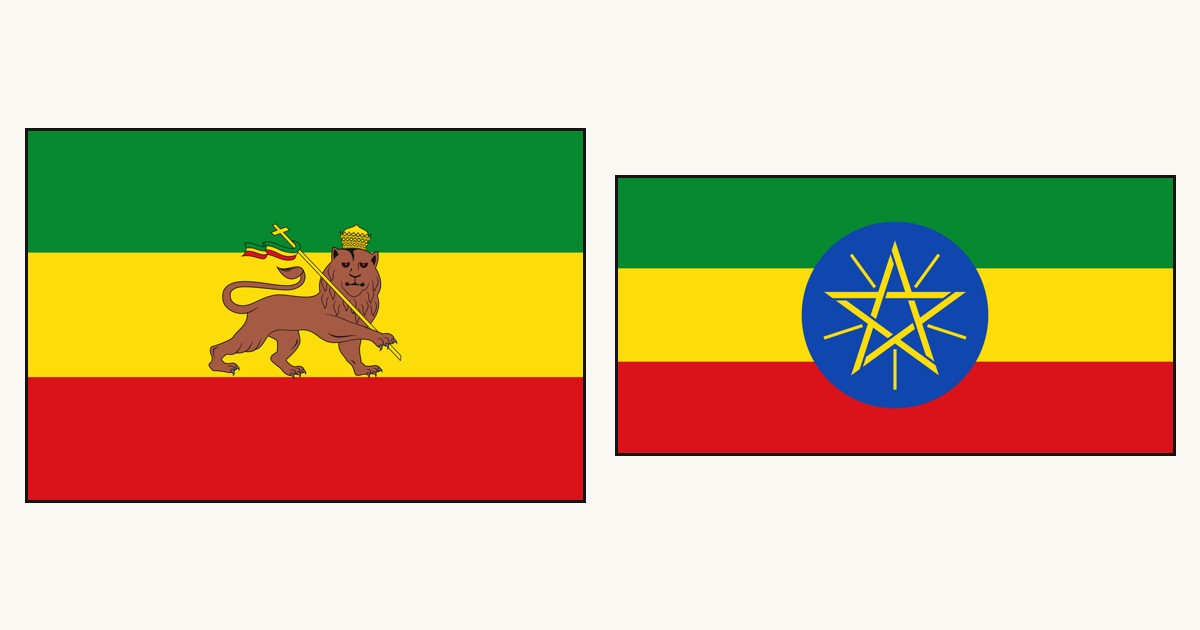
Two flags share the same three colors, the same horizontal stripes, and almost the same name in everyday conversation, yet they are not the same flag, they do not belong to the same owner, and they do not say the same thing. One is the living national flag of Ethiopia, a sovereign state whose emblem is a radiant star on a blue disc. The other is the banner most people call the Rasta flag, which is not a new design at all but the old imperial flag of Ethiopia, kept flying by the Rastafari movement long after Ethiopia itself set it aside. If you have ever looked at a green, gold and red flag and wondered whether the lion in the middle makes it Ethiopian, Rasta, or both, this guide settles the question piece by piece: stripe order, emblem, color meaning, history, and the third flag, Marcus Garvey’s red, black and green, that gets folded into the confusion.
Start with the colors themselves
Rasta Colors: The Complete Guide | Shop Rastafarian Clothing | Contact Us
Key Takeaways
- The Rasta flag and the current Ethiopian flag share the green, yellow and red tricolour, in the same top-to-bottom order. The difference is the emblem in the center.
- The Rasta flag carries the crowned Lion of Judah, the emblem of imperial Ethiopia. Ethiopia’s current national flag carries a yellow pentagram with rays on a light blue disc, adopted with the present design in 1996.
- There is no single official Rasta flag issued by a government. What people call the Rasta flag is the imperial Ethiopian banner that Rastafari kept in use because of what Haile Selassie and the Lion mean within the faith.
- Garvey’s Pan-African flag is a different flag again: red on top, black in the middle, green at the bottom, with no emblem and no gold stripe.
- The colors carry overlapping but distinct meanings. In Ethiopia’s own law, green is for labour, fertility and development, yellow for hope, justice and equality, and red for sacrifice and heroism. In Rastafari use, gold is also read as the wealth of Africa and the lion adds kingship, strength and African sovereignty.
Table of Contents
- Two Flags at a Glance
- Ethiopia’s National Flag Today: Stripes, Disc and Star
- The Rasta Flag: The Imperial Banner That Never Retired
- Stripe Order: Where Readers Get Tripped Up
- What Green, Gold and Red Mean in Each Tradition
- Lion vs Star: The Emblem Is the Whole Argument
- The Third Flag in the Room: Garvey’s Red, Black and Green
- Which Flag for What: Clothing, Festivals and Display
Two Flags at a Glance
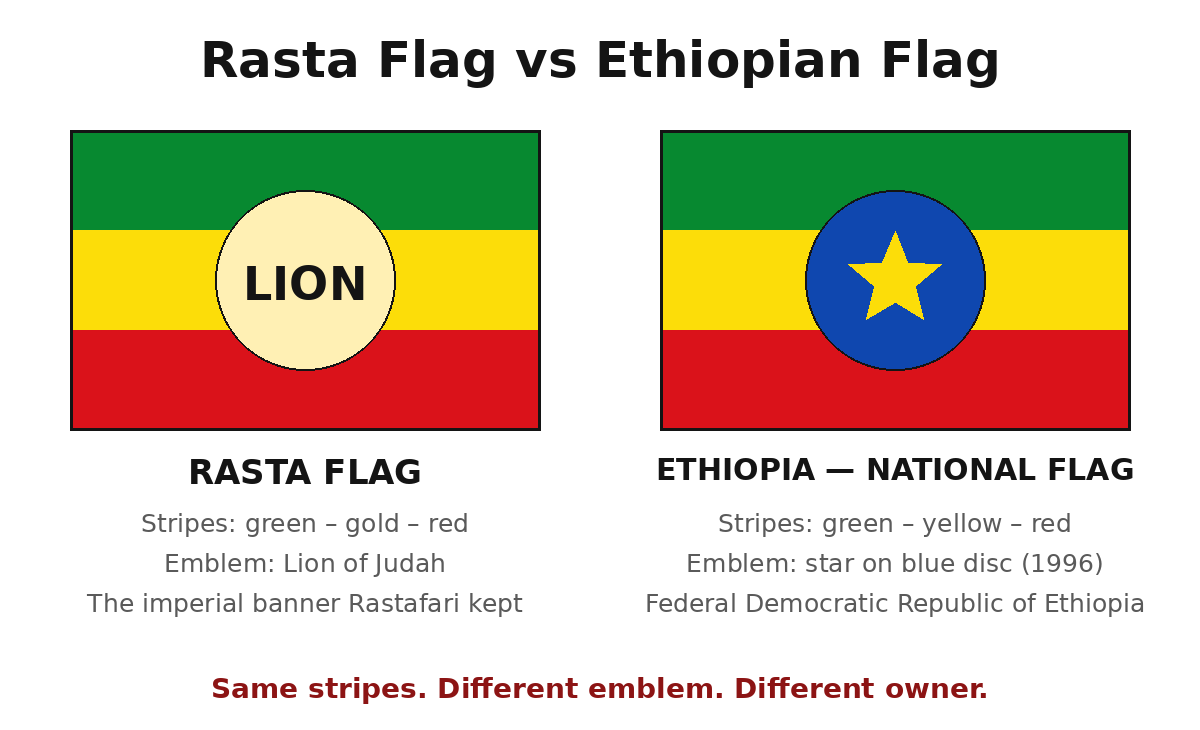
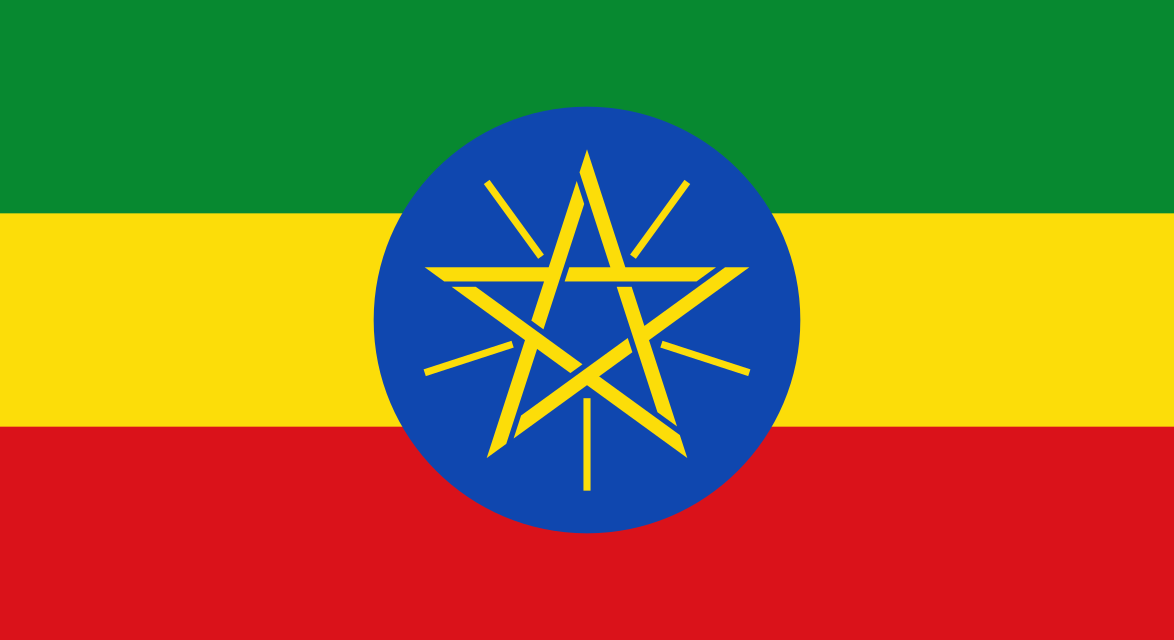
The fastest way to separate the two flags is to ignore the stripes and look at the middle. Both flags are built on the same green, yellow and red field, and that shared field is exactly why they are confused. The CIA World Factbook describes Ethiopia’s current flag as three equal horizontal bands of green, yellow and red with a yellow pentagram and rays on a light blue disc at the center, and no lion appears anywhere in that description. The flag most people call the Rasta flag keeps the same three bands but places the crowned Lion of Judah at the center instead, holding a staff topped with a cross. Same cloth, different center, different owner, different statement.
| Feature | Rasta Flag | Ethiopian National Flag (Current) |
|---|---|---|
| Whose flag is it? | A religious and cultural banner of the Rastafari movement; not issued by any state | The official national flag of the Federal Democratic Republic of Ethiopia |
| Stripes, top to bottom | Green, gold (yellow), red | Green, yellow, red |
| Center emblem | Crowned Lion of Judah holding a cross-topped staff | Yellow pentagram with radiating rays on a light blue disc |
| Design origin | The imperial Ethiopian flag, in use under the empire until 1974 and retained by Rastafari | The tricolour tradition from 1897, with the blue disc and star emblem added in 1996 |
| What the emblem declares | Kingship, the Solomonic dynasty, and Haile Selassie as Conquering Lion of Judah | Unity and equality of Ethiopia’s peoples, and a bright shared future |
| Blue in the design? | No blue field or disc | Yes, the emblem sits on a blue disc signifying peace |
| Legal status | No legal standing as a national flag anywhere; flown freely as a faith and culture symbol | Defined in Ethiopian law, including stripe order, proportions and emblem |
Read the table from the center outward and the confusion mostly dissolves. The stripes tell you which family a flag belongs to, the green, gold and red family that Ethiopia created and the wider world borrowed. The emblem tells you which member of the family you are looking at: a lion means the imperial banner and, in modern use, Rastafari; a star on blue means the present-day Ethiopian state. A plain tricolour with nothing in the middle is the shared ancestor of both, and the version many Ethiopians still fly informally, as the Flags of the World entry on Ethiopia documents. Our full breakdown of the color family itself lives in our guide to rasta colors, which this comparison builds on rather than repeats.
Ethiopia’s National Flag Today: Stripes, Disc and Star
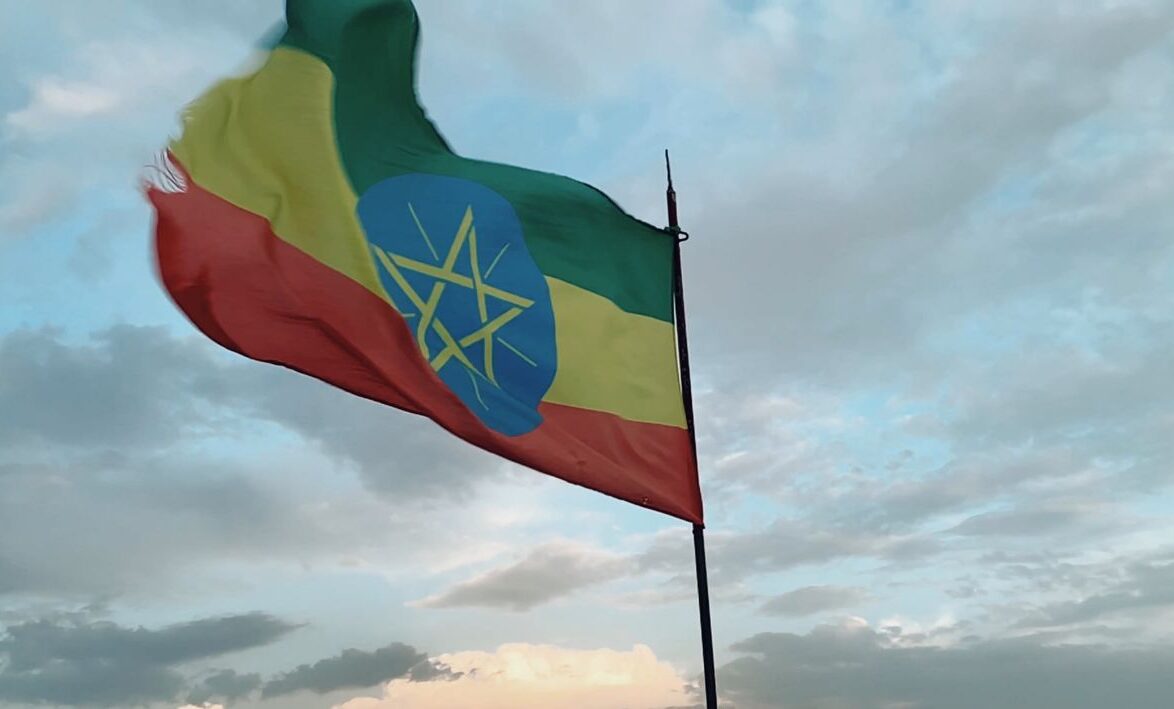
Ethiopia’s current flag is a legal object before it is a symbol, and its specification is written down in law. The country’s Flag and Emblem Proclamation states the construction plainly: green at the top, yellow in the middle and red at the bottom, the three colours bright and basic, structured horizontally in equal size, with the length of the flag twice its width. At the center sits the national emblem, a blue circle carrying a star formed by straight and equal yellow lines, with yellow rays radiating from the joints. That proclamation is the reason the modern Ethiopian flag can be described so precisely, and it is also the reason a flag with a lion in the middle, however beloved, is not the flag of Ethiopia today.
The emblem itself is younger than the stripes by almost a century. The Flags of the World record dates the current flag, emblem included, to 6 February 1996, and the Encyclopaedia Britannica account gives the same turning point, describing how the constitution for the Federal Democratic Republic added the central blue disc with its yellow outlined and rayed star. The emblem was adjusted again in 2009, when the disc took the darker blue seen today. So the honest answer on dating has two parts: the tricolour is a nineteenth-century creation, and the flag in its exact current form is a 1990s design laid over that older field.
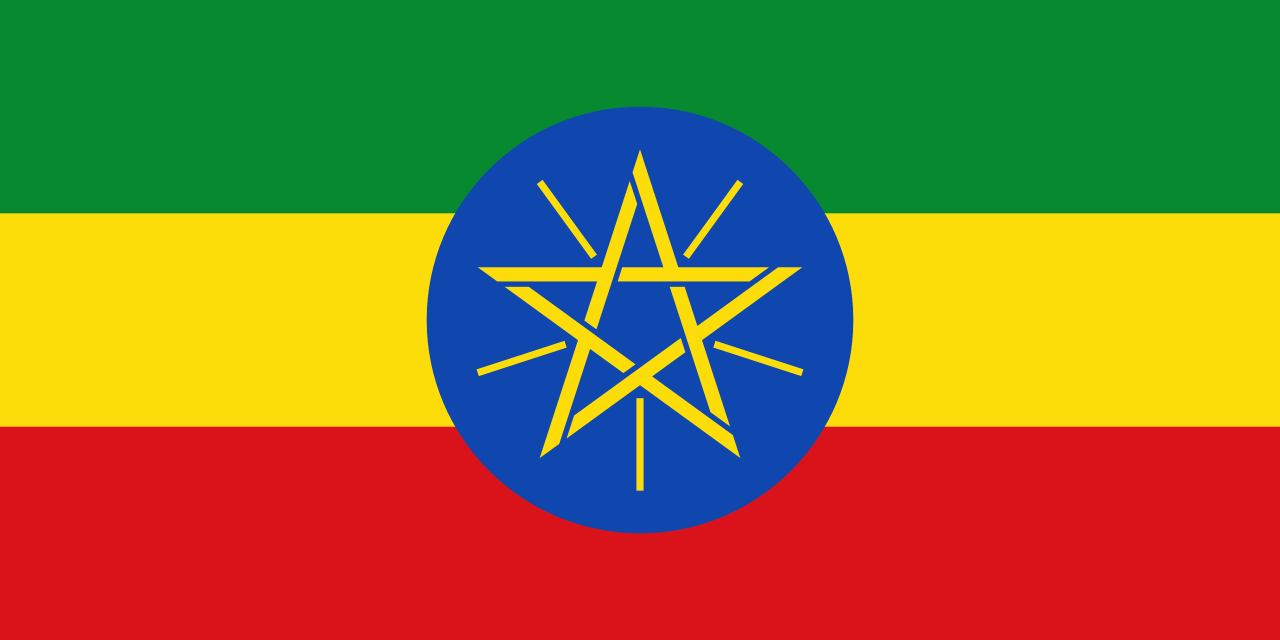
The meanings attached to the modern flag are also a matter of record rather than folklore. The same Ethiopian proclamation assigns them directly: green for labour, fertility and development, yellow for hope, justice and equality, red for sacrifice and heroism in defence of freedom and equality, and the blue background of the emblem for peace. The star formed by equal lines signifies the unity of Ethiopia’s nations, nationalities and peoples, and its rays their bright prospect. General references land in the same place; WorldAtlas summarises the flag the same way. When the emblem is explained on our site, the companion piece is our explainer on the Ethiopian coat of arms, since the device on the flag and the national emblem are the same design doing two jobs.
One more fact explains why these colors travelled so far beyond Ethiopia’s borders. Ethiopia kept its independence through the colonial partition of Africa, and its flag became a template for liberation: the Factbook notes that the three main colors were adopted so often by other African countries on independence that they became known as the Pan-African colors. That borrowing is the deep reason green, gold and red now appear on flags, clothing and artwork with no direct connection to Ethiopia at all, a theme we return to in our look at reggae colors and how the palette moved through music culture.
The Rasta Flag: The Imperial Banner That Never Retired
The Rasta flag was never designed as a Rasta flag, and that single fact clears up most of the argument around it. It is the flag of imperial Ethiopia, the banner flown under the emperors, with the Conquering Lion of Judah at its center. When the empire fell in 1974 and Ethiopia moved through socialist emblems toward the present republican design, the lion flag lost its state. It did not lose its people. In Jamaica, a religious movement had spent four decades looking to Ethiopia as Zion and to its emperor as a living sign of African sovereignty, and that movement simply kept the flag. What the world now calls the Rasta flag is an act of preservation: a deposed empire’s banner, carried on by a faith that never accepted the deposition as the end of the story.
To see why the lion flag, of all flags, became sacred in Jamaica, start with what Rastafari is. Encyclopaedia Britannica describes Rastafari as a religious and political movement begun in Jamaica in the 1930s, combining Protestant Christianity, mysticism and a pan-African political consciousness, in which Ethiopia is the ultimate home of all Africans and many adherents regard Emperor Haile Selassie I, crowned in 1930, as the messiah. The Smithsonian Magazine account of the Smithsonian’s own Rastafari exhibition traces the movement to a longing for place and dignity among peoples of African descent, and to the November 1930 coronation that Jamaican preachers read as prophecy fulfilled. A movement built on that reading was never going to adopt the emblem of the republic that replaced him. It kept his flag instead.
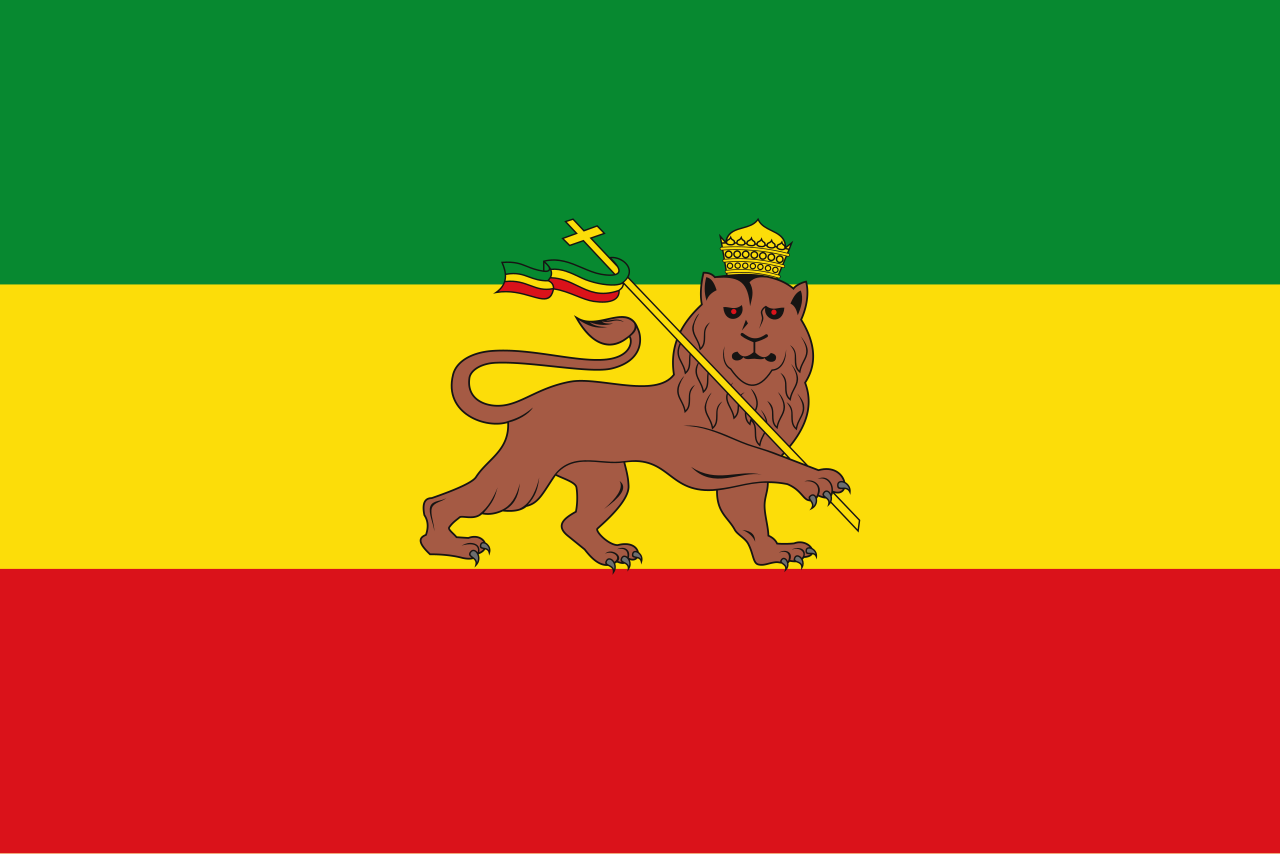
The lion itself is far older than the movement that adopted it. The imperial arms showed a crowned lion holding a staff topped by a cross, with ribbons in the three national colours, and the Swiss National Museum explains the claim behind the image: the Ethiopian emperors styled themselves Conquering Lion of the Tribe of Judah, presenting Haile Selassie as a successor in the line of Solomon and the Queen of Sheba, and the crowned lion with its sceptre appeared on the Ethiopian flag of his era. Within Rastafari, that makes the lion a portrait as much as a symbol, a point we develop fully in our piece on the Lion of Judah in Rastafari culture. On the Rasta flag, the lion is not decoration. It is the reason the flag exists.
Because the Rasta flag has no issuing government, it has no single enforced specification, and honest variations exist. Some banners show the lion larger, some smaller, some render the middle stripe as a richer gold rather than flat yellow, and black joins the palette on clothing and artwork even though it is not a stripe of the flag itself. Britannica’s summary of Rastafari livity notes that adherents dress in red, green, gold and black, colours it glosses as the life force of blood, herbs, royalty and Africanness, which is why a four-colour palette surrounds a three-stripe flag. A university study of the colours in dress, Rasta Colors and African Roots from CUNY City Tech, traces exactly this spillover, showing how the Ethiopian colours and the Lion moved from flags into Rastafari textiles, garments and jewellery as everyday markers of identity. The flag is the source; the clothing is the flag, worn.
Stripe Order: Where Readers Get Tripped Up
On stripe order, the two flags agree, and the popular belief that they are arranged differently is the most durable myth in this comparison. Both run green on top, yellow or gold in the middle, and red at the bottom. If you are holding a green-gold-red flag with red at the top, you are not holding a different flag; you are holding one of these two flags the wrong way up, and the emblem is your check. On the Ethiopian flag the star sits centered on the stripes, and on the Rasta flag the lion stands on his feet, crown up, staff upright. An upside-down lion is the giveaway that the whole banner needs turning around.
The myth has a genuine historical root, which is why it refuses to die. The tricolour was not born in its present order. The Flags of the World history of imperial Ethiopia records that the rectangular flag adopted in October 1897 carried red at the top, and that the change to green on top came later, in the period after the Italian occupation ended in 1941. Britannica’s flag history tells the earlier part of the same story, noting that pennants of the three colours preceded the first official flag established by Emperor Menelik II in 1897, and that his first flag bore the initial of his name on the yellow stripe before the imperial lion arms took that central place for official use. So a red-top Ethiopian flag is not an invention. It is a photograph of the flag’s youth, and reproductions of the early design still circulate, where they quietly teach anyone who copies them an order the flag itself abandoned generations ago.
Flag historians also record a tradition that the tricolour flown with red uppermost signalled a country at war, which gave the reversed flag a meaning of its own rather than treating it as a simple mistake. For a modern reader, the practical rule is simpler than the history. Green on top is correct for both flags in any current context, on a wall, on a garment, or on a festival banner. Red on top is either an antique reproduction, a deliberate historical reference, or an error, and on anything made for Rastafari use today it is almost always the third of those. Getting the order right is part of wearing the colours with respect, a theme that runs through our guide to traditional rasta outfits as well.
What Green, Gold and Red Mean in Each Tradition
The colours are shared, but the two traditions load them with meaning in noticeably different proportions. Ethiopia’s official reading, set out in its flag proclamation, is civic in character. Green speaks of labour, fertility and development, the working land. Yellow speaks of hope, justice and equality, the terms on which the federation’s peoples live together. Red speaks of sacrifice and heroism, the price paid for freedom. It is the vocabulary of a state describing itself to itself: land, fairness, and the cost of keeping both. Nothing in the official reading is mystical, and the emblem’s blue disc adds the state’s favourite word of all, peace.
The Rastafari reading grows from the same soil but reaches further back and further out. Green is the land again, but now it is also the vegetation of Africa and Jamaica, the herb, and the hope of return to Zion. Gold, and Rasta usage insists on the word gold rather than yellow, is the wealth of Africa: its minerals, its riches, and the royalty of a people told for centuries that they had none. Red is blood, the blood of martyrs and of ancestors who died under slavery and oppression, remembered rather than merely honoured. The New World Encyclopedia entry on Rastafari shows how tightly these readings are bound to the movement’s core, describing a faith that takes Haile Selassie, whose pre-coronation name Ras Tafari gave the movement its own name, as Jah incarnate and the promised messiah, read through biblical prophecy and the emperor’s titles, among them Conquering Lion of Judah. Colours attached to a belief that strong become a creed.
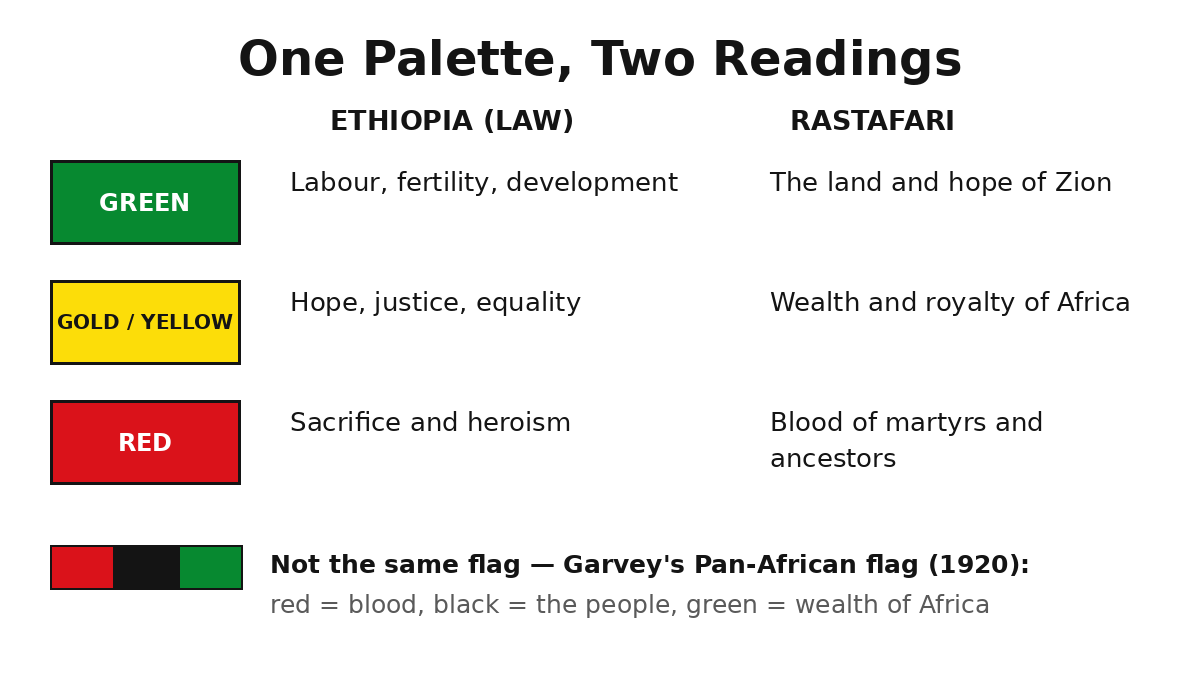
An older Ethiopian reading sits underneath both, and it explains why the colours felt sacred long before either the republic or Rastafari claimed them. Flag historians note that before the empire ended, the colours were also interpreted through the Ethiopian Orthodox Church: red for faith and power, yellow for the church, peace, natural wealth and love, and green for the land and hope, with a further association to the Holy Trinity. A colour set that a church, an empire, a republic and a religion have all found meaning in is a language, and fluency in it is most of what this site exists to teach, from the sayings collected in our Haile Selassie quotes to the blessing examined in Who Jah Bless, No Man Curse.
Lion vs Star: The Emblem Is the Whole Argument
Strip the emblems away and the two flags collapse into one; restore them and you can watch two different ideas of Ethiopia argue with each other in a single image. The lion argues for continuity with a sacred monarchy. It claims descent from Solomon and Sheba, it crowns its bearer King of Kings, and it roots the nation’s authority in a line of emperors stretching back through scripture. The star argues for a federation of equals. Its lines are straight and equal by law, its rays promise every nation, nationality and people the same bright future, and its blue field asks for peace rather than glory. Neither emblem is a logo in the modern sense. Each is a constitution, compressed into a picture small enough to sew onto cloth.
The lion’s side of the argument deserves its full weight, because outsiders routinely underestimate it. For Rastafari, Haile Selassie is not a mascot of the faith but its center, and the Smithsonian’s exhibition reporting describes adherents for whom his messages of liberation and unity remain paramount decades after his death. When a believer flies the lion flag, the claim being made is theological: the emperor the world deposed still reigns where it matters. Our coverage of the holy days that keep that calendar alive, beginning with Groundation Day, shows how the lion, the emperor and the colours are celebrated together rather than as separate symbols. To ask a Rasta to swap the lion for the star is not to ask for a design update. It is to ask for a different religion.
The star’s side deserves equal fairness, because the republic’s choice was deliberate and, on its own terms, generous. Ethiopia is home to many peoples and faiths, and an emblem drawn from one dynasty’s arms could not speak for all of them. The 1996 design reached for geometry instead of genealogy: a star anyone can stand under, on a disc the colour of peace. Ethiopians who fly the current flag are not flying a lesser version of the lion banner; they are flying a different settlement about what their country is, one in which the state belongs to its peoples collectively rather than to a throne. Two flags, one palette, and a plain tricolour flown by millions who decline to choose between them: that is the real shape of the comparison, and it is why the colours alone will never tell you which Ethiopia a given banner means.
The Third Flag in the Room: Garvey’s Red, Black and Green
Any honest comparison has to clear a third flag off the table, because a large share of what gets sold and searched as a Rasta flag is actually Marcus Garvey’s. The Pan-African flag, also called the Black Liberation flag or the UNIA flag, is a horizontal tricolour of red on top, black in the middle and green at the bottom. It has no gold stripe, no yellow stripe, and no emblem. It was formally adopted in August 1920 by the Universal Negro Improvement Association at its Madison Square Garden convention, a full decade before Haile Selassie’s coronation gave Rastafari its name. It belongs to Garvey’s movement first, and to the wider Pan-African world after it.
Its colours carry their own settled meanings, distinct from both Ethiopian readings. The Smithsonian Magazine account of the flag’s afterlife in American art records the standard gloss: red denotes the blood that was shed, black is for the people the flag represents, and green represents the abundant wealth of Africa. The UNIA’s own early catechism phrased it in the same spirit. Notice what is missing: there is no gold, because Garvey’s flag was designed for a people, not inherited from a state, and its black centre stripe, the people themselves, sits exactly where Ethiopia puts its gold.
Rastafari honours Garvey as a prophet, and the two flags fly side by side at gatherings so often that the public merges them into one blur of red, gold, green and black. The merger is understandable and, at a celebration, harmless. On a product listing, a tattoo, or a history exam, it is worth resisting. If the flag in front of you has a black middle stripe and no lion, you are looking at Garvey’s banner. If it has a gold middle stripe and a lion, you are looking at the imperial Ethiopian banner Rastafari kept. If it has a gold middle stripe and a star on blue, you are looking at the Ethiopia of today. Three flags, three owners, one shared conviction that African peoples deserved a banner of their own. The wider African roots of the palette are traced in our piece on ancient West African clothing and the colour traditions it carried.
Which Flag for What: Clothing, Festivals and Display
Knowing the difference changes what you wear, what you fly, and what you give, because each flag sends its message whether you intend it or not. Clothing printed with the lion speaks Rastafari. It is the design on the tams, tees and dresses documented in our guides to dressing like a Rastafarian woman and what rasta men wear, and it is read by everyone who knows the code as a statement of faith and identity, not a holiday souvenir. Wearing it well means wearing it accurately: green on top, lion upright and complete, crown and staff intact, because a cropped or upside-down lion reads to the people whose symbol it is the way a misspelled name reads to its owner.
The current Ethiopian flag belongs, first, to Ethiopians, and its proper homes are the official and the celebratory: national days, cultural festivals, restaurants, churches and homes where it stands for the country as it is now. Flying it at a reggae festival as a generic Rasta banner is the one genuinely common misuse in this field, since it borrows a living state’s flag, emblem and all, to decorate a different tradition that already has a banner of its own. The reverse misuse matters too: presenting the lion flag as the current flag of Ethiopia, in a classroom, a shop listing or a news graphic, teaches an error about a real country, whose actual flag has carried the star for a generation. Respect runs in both directions, and it costs nothing but attention.
Garvey’s flag, finally, is the banner of Pan-African pride in the broadest sense, at home at Black history events, Juneteenth celebrations, and anywhere the message is the unity of the African diaspora rather than one faith or one nation. A well-made display can honour all three flags together, provided each is labelled for what it is. That labelling instinct, telling the lion from the star and the gold stripe from the black one, is the whole skill this article set out to teach. Once your eye learns to go straight to the center of the flag and the middle stripe, you will never confuse them again.
Our View
The two flags are not rivals, and treating them as versions of each other sells both short. Ethiopia’s star flag is a young emblem on an old and honourable field, chosen by a republic to speak for all its peoples at once. The lion flag is that same field carrying the emblem Ethiopia set aside, kept in the air by a faith for whom the emperor it honours never stopped mattering. Learn to read the center of the flag and you learn to read the difference between a nation describing itself and a people remembering a king, and there is room in the world, and on this site, for both stories to be told accurately.
— Rastafarian Clothing
Frequently Asked Questions
Is the Rasta flag the same as the Ethiopian flag?
No. The Rasta flag is the imperial Ethiopian flag with the Lion of Judah, retained by the Rastafari movement after the empire ended in 1974. Ethiopia’s current national flag keeps the same green, yellow and red stripes but carries a yellow star with rays on a blue disc, a design adopted in 1996. Same stripes, different emblem, different owner.
What are the Rasta flag colors in order?
From top to bottom: green, gold and red, with the crowned Lion of Judah at the center. The order matches the modern Ethiopian flag. A flag with red at the top is either an early historical design, since the original 1897 tricolour ran red first before the order later changed, or a modern flag hung upside down.
Why is there a lion on the Rasta flag?
The lion is the Conquering Lion of Judah, the emblem and title of Ethiopia’s emperors, including Haile Selassie I. Rastafari regards Selassie as central to the faith, so the movement kept his imperial banner, lion included, as its own. The lion stands for kingship, strength, pride and African sovereignty.
What does the star on the Ethiopian flag mean?
Under Ethiopia’s flag law, the star formed by straight and equal lines signifies the unity of the country’s nations, nationalities and peoples, its yellow rays signify their bright future, and the blue disc behind it signifies peace. The emblem was added to the tricolour in 1996 and its blue was darkened in a 2009 adjustment.
Is the red, black and green flag a Rasta flag?
Not originally. Red, black and green is the Pan-African or Black Liberation flag created under Marcus Garvey and adopted by the UNIA in 1920, before Rastafari existed. Rastas honour Garvey as a prophet and the two flags often appear together, which is why the designs are confused, but the Garvey flag has a black middle stripe and no gold and no lion.
Questions about the colours, the symbols, or an order?
Write to us through our contact page and we will point you to the right guide, garment or answer.
Sources
- CIA World Factbook: Ethiopia — flag description, colour meanings, the 1996 emblem date and the Pan-African colours note.
- Flags of the World: Ethiopia — current flag specification, plain tricolour use and colour symbolism.
- Encyclopaedia Britannica: Flag of Ethiopia — flag history, the imperial lion arms and the 1996 disc and star.
- Encyclopaedia Britannica: Rastafari — the movement’s origins, Ethiopia as Zion, Haile Selassie and the colours of livity.
- Flag and Emblem Proclamation No. 16/1996 — Ethiopia’s own legal text on stripe order, proportions, colour meanings and the emblem.
- Smithsonian Magazine: Rasta Revealed — the Smithsonian exhibition account of Rastafari’s origins and enduring beliefs.
- Smithsonian Magazine: African American Flag — Garvey’s 1920 Black Liberation flag and the meanings of red, black and green.
- Swiss National Museum: Haile Selassie — the Conquering Lion title, the Solomonic claim and the lion on the flag.
- New World Encyclopedia: Rastafari — the movement’s history, Haile Selassie’s titles and Garvey’s influence.
- WorldAtlas: Flag of Ethiopia — plain-language summary of the current flag, its colours and its emblem.
- Rasta Colors and African Roots (CUNY) — academic study of the colours and the Lion in Rastafari dress and textiles.
- Flags of the World: Imperial Ethiopia — the imperial flag’s history, including the 1897 red-top order and the later change to green on top.
Recommended
- Rasta Colors — Red Gold and Green Meaning and How to Wear Them
- The Meaning Behind the Lion of Judah in Rastafari Culture — Complete Guide
- Traditional Rasta Outfits That Still Look Fly Today


Leave a comment
Your email address will not be published. Required fields are marked *